
In This Article
✨Was this helpful? Spread the word! 🚀
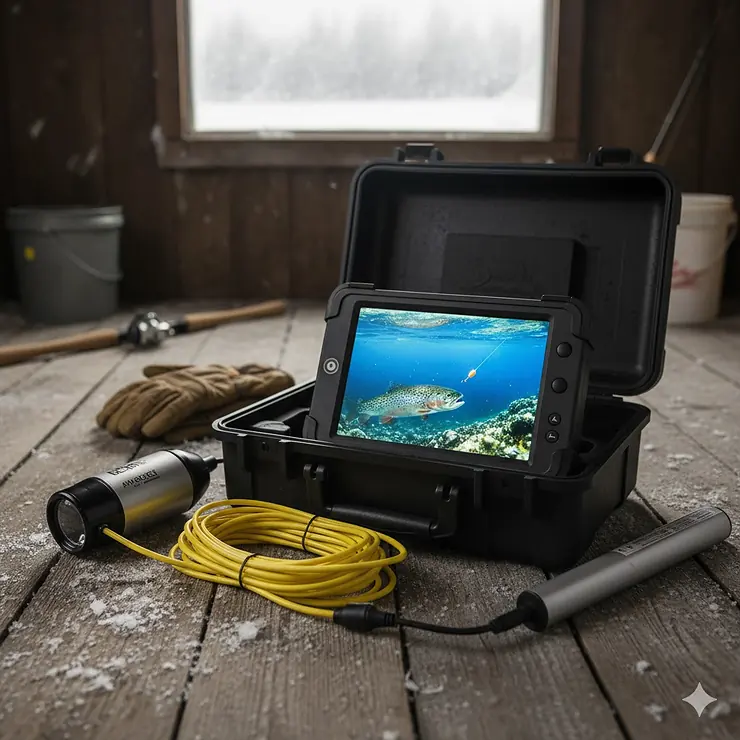
Let me tell you something that completely changed my ice fishing game. I used to sit there for hours, wondering if fish were even near my bait. Then I got my first underwater camera, and honestly? It felt like I’d been fishing blind my entire life.
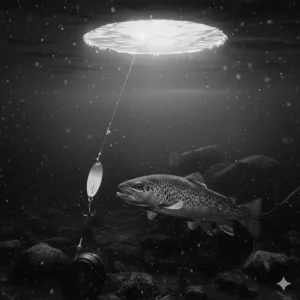
The best ice fishing camera isn’t just about spotting fish—it’s about understanding them. You’ll watch crappies circle your jig three times before striking. You’ll see why that trophy walleye ignored your presentation. You’ll discover structures you never knew existed just 15 feet from your favorite spot.
Here’s what blows my mind every season: these cameras have become incredibly affordable. What used to cost over $1,000 a decade ago now runs between $139-$700, depending on features. And with technology advancing rapidly, today’s budget models pack features that premium cameras couldn’t offer five years ago.
Whether you’re chasing panfish through six inches of ice or targeting lake trout in 60 feet of water, there’s a camera system designed for your specific needs. Throughout this guide, I’ll break down the top seven underwater fishing cameras that actually deliver results, covering everything from budget-friendly options to professional-grade systems used by tournament anglers.
Quick Comparison Table 📊
| Camera Model | Resolution | Cable Length | Battery Life | Price Range | Best For |
|---|---|---|---|---|---|
| Eyoyo 7″ LCD 1000TVL | 1000TVL | 49-98 ft | 8 hours | $139-$189 | Budget buyers |
| FishPRO HD 1080P | 1080p HD | 82 ft | 10 hours | $179-$229 | Value seekers |
| Aqua-Vu Micro Revolution 5.0 HD | 1080p HD | 60 ft | 6 hours | $399-$449 | Portability |
| MarCum Quest HD L | 1080p HD | 75 ft | 12+ hours | $699-$749 | Premium performance |
| Vexilar Fish Scout FS800 | 720p | 90 ft | 9 hours | $339-$399 | All-weather durability |
| MarCum Pursuit HD L | 1080p HD | 50 ft | 8 hours | $599-$649 | DVR recording |
| Moocor Underwater Camera | 720p | 50 ft | 8 hours | $159-$199 | Cold weather |
💬 Just one click – help others make better buying decisions too!😊
🎯 Ready to Transform Your Ice Fishing Experience?
Check out these carefully selected cameras that’ll help you catch more fish this season. Each product link takes you directly to current pricing and availability!
Top 7 Best Ice Fishing Camera: Expert Analysis 🏆
1. Eyoyo 7 Inch LCD 1000TVL Underwater Fishing Camera
The Eyoyo 7 Inch LCD 1000TVL has dominated the budget-friendly underwater camera market for good reason. This camera system delivers exceptional value at just $139-$189, making it accessible for anglers who want to experience underwater viewing without breaking the bank.
Key Specifications:
- 7-inch LCD color monitor with sun visor
- 1000TVL resolution camera
- 12 infrared LED lights for night/murky water
- 49-foot cable (98-foot option available)
- 12V rechargeable battery
What I love most about this system is its simplicity. You literally open the case, turn it on, and drop it down your hole. The 1000TVL camera provides surprisingly clear images, especially considering the price point. The infrared lights work brilliantly in stained water or low-light conditions—fish can’t see them, but you’ll see everything.
Customer Feedback: Users consistently praise the image clarity and battery longevity. One Michigan angler reported using it for three seasons without issues, while another highlighted its performance in murky lake conditions where visibility was under two feet.
Pros:
✅ Exceptional value for money
✅ Clear daytime and infrared viewing
✅ Durable carrying case included
Cons:
❌ Basic model lacks DVR recording
❌ Monitor can feel heavy during extended use
2. FishPRO HD 1080P 7-Inch Underwater Fishing Camera
The FishPRO HD 1080P represents the sweet spot between affordability and advanced features. Priced at $179-$229, this 2025 upgraded model includes a massive 10,000mAh battery and true 1080p high-definition resolution that rivals cameras costing twice as much.
Key Specifications:
- 7-inch IPS display with 1080p resolution
- 10,000mAh long-lasting battery
- USB-C charging (modern convenience!)
- LED + IR dual lighting system
- 82-foot cable with depth markers
The IPS display technology makes a noticeable difference in viewing angles and color accuracy. You can view the screen from practically any position without losing clarity. The USB-C charging is a game-changer—no more proprietary chargers that disappear when you need them.
Customer Feedback: Tournament anglers appreciate the true HD quality and extended battery life. Several users noted catching their personal best after watching fish behavior patterns they’d never observed before.
Pros:
✅ True 1080p HD resolution
✅ Extended battery life (10+ hours)
✅ Modern USB-C charging
Cons:
❌ Slightly heavier than compact models
❌ Cable can be stiff in extreme cold
3. Aqua-Vu Micro Revolution 5.0 HD Underwater Camera
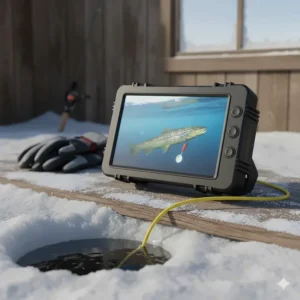
The Aqua-Vu Micro Revolution 5.0 HD revolutionized portable ice fishing cameras with its patented integrated cable reel system. At $399-$449, this camera targets anglers who value mobility and premium build quality.
Key Specifications:
- Compact 5-inch HD 1080p screen
- 60-foot durable cable with depth indicators
- Revolutionary integrated reel system
- 6-hour rechargeable lithium-ion battery
- IP67 waterproof rating
Aqua-Vu practically invented underwater fishing cameras back in 1997, and their experience shows. The Revolution reel system is genius—wind up or deploy cable with one finger, completely tangle-free. The compact size fits in any tackle bag or sled pocket, perfect for hole-hopping anglers.
Customer Feedback: Pro bass angler Jeff Gustafson (2023 Bassmaster Classic Champion) uses Aqua-Vu systems to confirm sonar marks and study structure. Recreational users love how quickly they can move from hole to hole without wrestling tangled cables.
Pros:
✅ Ultra-portable design
✅ Tangle-free cable management
✅ Professional-grade image quality
Cons:
❌ Shorter battery life than competitors
❌ Premium price point
4. MarCum Quest HD L Lithium Underwater Viewing System
The MarCum Quest HD L sits at the top of the ice fishing camera hierarchy at $699-$749. This isn’t just a camera—it’s a complete underwater observatory powered by Sony’s 1080p imaging sensor and MarCum’s exclusive technology.
Key Specifications:
- Full 1080p Sony HD camera
- 7-inch H2D Solar Intelligent LCD (1080 pixels)
- 75-foot cable with temperature sensor
- MarCum Brute 12V10AH Lithium battery
- On-screen depth, temperature, and direction display
The Solar Intelligent Technology provides 100% daylight viewability—no squinting or shading required. The relative direction indicator is incredibly useful; you always know which way the camera faces. Combined with depth and temperature readings displayed on-screen, you’re getting information that helps you make better fishing decisions.
Customer Feedback: Ice fishing guides report the Quest HD L as their go-to professional tool. The lithium battery performs flawlessly down to -40°F, and the lightweight design (half the weight of lead-acid systems) makes transportation effortless.
Pros:
✅ Professional-grade Sony imaging
✅ Superior low-light performance
✅ Advanced on-screen data display
Cons:
❌ Premium pricing
❌ Requires external DVR for recording
5. Vexilar Fish Scout FS800 IR Underwater Camera
The Vexilar Fish Scout FS800 has earned its reputation through rugged reliability and extreme cold-weather performance. Priced at $339-$399, this system operates flawlessly from -22°F to 150°F.
Key Specifications:
- 7-inch widescreen LCD monitor
- 420-line resolution color camera
- 12V 9Ah enclosed battery
- 90-foot cable
- Automatic color/B&W switching
Vexilar built this camera for serious ice fishing conditions. The 90-foot cable length exceeds most competitors, perfect for targeting deep lake trout or suspended walleyes. The automatic switching between color and black-and-white optimizes image clarity based on light conditions—brilliant for dawn and dusk fishing.
Customer Feedback: Northern anglers swear by the cold-weather performance. Multiple users reported fishing in -20°F conditions for 8+ hours without battery degradation. The rigid carrying case protects everything during transport across rough ice.
Pros:
✅ Extreme temperature tolerance
✅ Long cable for deep fishing
✅ Energy-efficient design
Cons:
❌ Lower resolution than HD models
❌ Bulkier carrying case
6. MarCum Pursuit HD L Lithium Equipped System
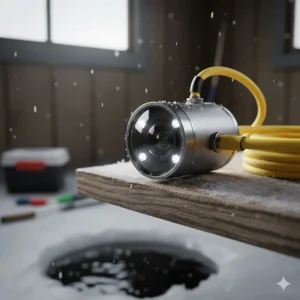
The MarCum Pursuit HD L packs maximum technology into a pocket-sized 5-inch display. At $599-$649, this camera targets anglers who want professional features in a mobile package.
Key Specifications:
- 5-inch HD LCD display (1920x1080p)
- Built-in MP4 DVR with multiple resolution options
- 50-foot integrated cable reel
- Bright-white LED and IR lighting
- 128GB Micro SD card support
The built-in DVR functionality sets this camera apart. Record in 480p, 720p, or full 1080p—your choice. The cyclical recording feature automatically manages storage, overwriting old footage when the card fills. Perfect for documenting trophy catches or analyzing technique later.
Customer Feedback: YouTube fishing content creators appreciate the recording capabilities. Several tournament anglers mentioned using footage for post-tournament analysis, identifying mistakes they’d never caught otherwise.
Pros:
✅ Integrated DVR recording
✅ Compact yet feature-rich
✅ On-screen temperature and direction
Cons:
❌ Shorter cable than stationary models
❌ Small screen may challenge older eyes
7. Moocor Underwater Fishing Camera
The Moocor Underwater camera rounds out our list as an excellent budget-to-mid-range option at $159-$199. This camera excels in extreme cold conditions while maintaining clarity and reliability.
Key Specifications:
- 720p HD resolution
- 50-foot anti-freeze cable
- Infrared LED night vision
- 130-degree wide viewing angle
- 8-hour battery life
The 130-degree viewing angle provides an exceptionally wide field of view, letting you see more of the underwater environment with each drop. The anti-freeze cable construction prevents stiffening in sub-zero temperatures—a common complaint with cheaper cameras.
Customer Feedback: Ice anglers in Minnesota and Wisconsin praise its performance in extreme conditions (below -10°F). Users appreciate the wide viewing angle for scouting new spots and identifying structure.
Pros:
✅ Wide viewing angle
✅ Excellent cold-weather performance
✅ Affordable price point
Cons:
❌ Limited advanced features
❌ Standard battery compared to newer models
How to Choose Your Perfect Ice Fishing Camera 🎯
Resolution Matters More Than You Think
Resolution determines how clearly you’ll see fish and underwater details. Here’s the breakdown:
- 1000TVL (Standard Definition): Adequate for basic fish spotting and structure identification. Budget-friendly option.
- 720p HD: Clear images with good detail. Excellent middle-ground choice.
- 1080p Full HD: Crystal-clear imagery revealing fish species, bait movement, and minute details.
For most anglers, 720p provides sufficient clarity. If you’re a tournament angler or serious about studying fish behavior, invest in 1080p.
Cable Length vs. Fishing Depth
Match cable length to your typical fishing scenarios:
- 40-50 feet: Perfect for shallow water panfish (under 30 feet)
- 60-75 feet: Versatile for most inland lakes (30-50 feet)
- 80-100 feet: Deep water applications, Great Lakes, or suspended fish
Remember: you need extra cable to account for ice thickness and to position the camera away from your hole.
Battery Performance in Cold Weather
Cold temperatures devastate battery performance. Look for:
- Lithium-ion or LiFePO4 batteries: Maintain charge in extreme cold
- Minimum 8-hour runtime: Full day of fishing
- Built-in battery indicators: Avoid unexpected power loss
Lead-acid batteries work but lose 30-50% capacity below freezing.
Infrared vs. White LED Lighting
Infrared (IR) Lights:
- Invisible to fish—won’t spook wary species
- Essential for murky water or night fishing
- Slightly grainy image quality
White LED Lights:
- Brilliant color and detail
- Can spook pressured fish
- Best for clear water during daylight
Many modern cameras offer both—use IR as your primary option.
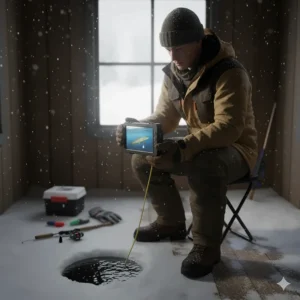
Portability Considerations
Consider your fishing style:
Hole-Hopping Anglers: Choose compact systems (Aqua-Vu Micro, MarCum Pursuit)
Shack Fishermen: Larger screens and stationary systems work great
Hybrid Approach: Mid-sized 7-inch displays balance portability and viewing
Understanding Camera Features and Technology 📸
Display Technology Explained
LCD vs. IPS Screens:
Standard LCD displays work well but suffer from narrow viewing angles. IPS (In-Plane Switching) technology allows viewing from extreme angles without color distortion—crucial when multiple people want to watch.
Screen Size Considerations:
- 5-inch: Ultra-portable, fits anywhere
- 7-inch: Sweet spot for most anglers
- 9-inch+: Premium viewing, less portable
Camera Sensor Quality
The camera sensor matters as much as resolution. Sony sensors dominate premium models (MarCum Quest, Vexilar) for their low-light performance and color accuracy. CMOS sensors in budget models perform adequately in good conditions but struggle at depth or in murky water.
Viewing Angle Specifications
Wide-angle lenses (120-130 degrees) show more underwater environment but can distort fish size. Standard angles (90-100 degrees) provide accurate sizing and detail. Consider what matters most—wide coverage or precise detail.
Benefits vs Traditional Fish Finders ⚖️
| Feature | Underwater Camera | Traditional Fish Finder |
|---|---|---|
| Visual Fish ID | See actual fish species and size | Shows arches and marks |
| Bait Presentation | Watch fish reaction to lures | No visual confirmation |
| Structure Detail | Clear visual of rocks, weeds, bottom | Interpreted readings |
| Learning Curve | Intuitive—what you see is real | Requires interpretation skill |
| Fish Behavior | Observe natural movements | Motion limited to 2D |
| Coverage Area | Limited to camera view | 360-degree cone |
| Price Range | $139-$749 | $99-$2,000+ |
The Verdict: Cameras and fish finders serve different purposes. Fish finders excel at locating fish quickly across large areas. Underwater cameras provide unprecedented insight into fish behavior and presentation effectiveness. Many serious anglers use both together—the fish finder marks fish, the camera confirms species and observes behavior.
Setting Up Your Ice Fishing Camera System ⚙️
Pre-Season Preparation
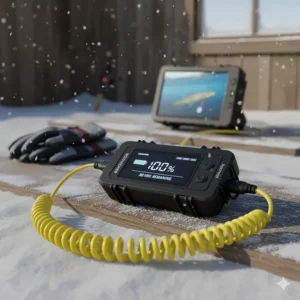
Battery Maintenance:
- Fully charge batteries 24 hours before fishing
- Store lithium batteries at room temperature
- Check connections for corrosion
System Check:
- Test camera and monitor functionality
- Verify cable integrity (look for kinks or damage)
- Clean camera lens with soft cloth
On-Ice Deployment Tips
Initial Setup:
- Power on monitor before deploying camera
- Adjust brightness for current conditions
- Enable IR lights in murky water
Optimal Camera Positioning:
- Lower camera 1-2 feet above bottom initially
- Adjust height based on fish location
- Position camera to view jigging area
Preventing Camera Spin:
- Use camera panners for stability
- Add small weight below camera
- Reduce cable slack to minimize current effect
Maximizing Image Quality
Lighting Adjustments:
- Start with IR lights in unfamiliar water
- Switch to white LED if water is clear
- Adjust monitor brightness—darker usually better
Focus and Clarity:
- Clean camera lens between holes
- Remove ice buildup from cable
- Shield monitor from direct sunlight
Advanced Techniques for Camera Users 🎓
Reading Fish Behavior
Aggressive vs. Negative Fish:
Aggressive indicators:
- Fish approach bait quickly
- Multiple fish compete for bait
- Aggressive strikes or follows
Negative indicators:
- Fish circle without biting
- Slow approaches and retreats
- Fish present but uninterested
Adjust your presentation based on observed behavior. Negative fish often require downsizing, slower movements, or bait changes.
Structure Scouting Strategies
Use your camera as an underwater survey tool:
Bottom Composition Identification:
- Sand appears light and uniform
- Rock shows irregular shadows
- Vegetation creates distinct silhouettes
- Mud appears dark and featureless
Finding Hidden Structure: Drop your camera in different locations to build a mental map. Mark productive structures with GPS coordinates.
Species Identification
Distinguish species underwater:
- Crappies: Vertical bars, forked tails, schooling behavior
- Bluegills: Round body, dark vertical bars
- Walleyes: Large eyes, white-tipped tail, solitary or pairs
- Perch: Yellow/green coloration, distinct stripes
- Pike: Long body, prominent teeth, aggressive movements
Maintenance and Care Guidelines 🔧
Post-Fishing Cleaning
Immediate Care:
- Wipe camera and cable dry
- Remove ice and snow from case
- Check for water intrusion
Deep Cleaning:
- Use mild soap and warm water
- Avoid harsh chemicals on lens
- Dry thoroughly before storage
Off-Season Storage
Battery Care:
- Charge to 50-70% for long-term storage
- Store in temperature-controlled environment
- Check charge every 2-3 months
System Storage:
- Store camera in protective case
- Keep cables coiled loosely (avoid sharp bends)
- Place in dry location away from extreme temperatures
Troubleshooting Common Issues
Problem: Foggy or Cloudy Lens
- Solution: Apply anti-fog solution before fishing; warm camera gradually if condensation forms inside
Problem: Battery Dies Quickly
- Solution: Replace aging batteries; keep spare battery warm in pocket; reduce screen brightness
Problem: Poor Image Quality
- Solution: Clean lens; adjust lighting; check water clarity
Price Range and Value Analysis 💰
Budget Options ($100-$200)
Perfect starter cameras for beginners or casual anglers:
- Eyoyo 1000TVL series
- Moocor basic models
- Generic Chinese-made units
What You Get: Functional imaging, basic features, adequate battery life
What You Miss: Advanced features, premium build quality, low-light performance
Mid-Range Excellence ($200-$450)
Best value for serious recreational anglers:
- FishPRO HD models
- Aqua-Vu Micro Revolution
- Vexilar Fish Scout
What You Get: HD resolution, reliable performance, better warranties
What You Miss: Professional-grade sensors, extensive features
Premium Performance ($500-$800)
Tournament-grade systems for professionals:
- MarCum Quest HD L
- MarCum Pursuit HD L
- High-end Aqua-Vu systems
What You Get: Superior imaging, advanced features, exceptional durability
Worth It If: You fish frequently, compete in tournaments, or demand the absolute best
Safety Considerations on the Ice ⚠️
Ice Thickness Requirements
Minimum Safe Ice for Camera Use:
- 4 inches: Walking carefully
- 5-7 inches: Safe for individual anglers
- 8-12 inches: Small groups
- 12+ inches: Vehicles (check local regulations)
Always check ice thickness in multiple locations. Clear, solid ice is stronger than cloudy or snow-covered ice.
Equipment Safety Tips
Preventing Equipment Loss:
- Secure camera to case or bucket
- Use float collars on cameras
- Tie backup line to camera head
- Never leave equipment unattended
Avoiding Accidents:
- Keep cables organized to prevent trips
- Use spud bar to test ice ahead
- Carry ice picks and rope
- Fish with a buddy when possible
Integration with Other Ice Fishing Gear 🎣
Camera + Fish Finder Combinations
Using both tools simultaneously maximizes success:
Workflow:
- Use fish finder to scan and mark fish
- Deploy camera to confirm species and depth
- Observe fish reaction to presentation
- Adjust based on camera feedback
Popular combinations include Vexilar flashers with Fish Scout cameras or Humminbird units paired with Aqua-Vu systems (some offer direct integration).
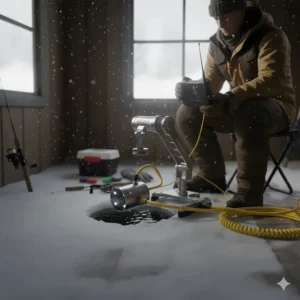
Camera Panner Systems
Wireless camera panners allow 360-degree views without moving the camera manually:
- Remote-controlled rotation: View entire area from one hole
- Hands-free operation: Focus on fishing, not camera adjustment
- Automated scanning: Some models offer preset sweep patterns
MarCum and Rapala offer compatible panner systems ($50-$80).
Portable Shelters and Cameras
Larger shelters accommodate camera systems comfortably:
- Mount monitors inside shelter for group viewing
- HDMI output connects to larger screens
- Heated shelters improve battery performance
- Keep electronics organized in dedicated areas
Environmental Impact and Ethical Considerations 🌍
Responsible Camera Use
Minimize Disturbance:
- Limit repeated camera drops in small areas
- Avoid prolonged observation of spawning beds
- Respect catch-and-release areas
Light Pollution Awareness: Excessive white LED use may temporarily disrupt fish behavior in clear, shallow water. Use IR lights as your primary option.
Respecting Fishing Regulations
Some states and provinces regulate underwater camera use:
- Ontario, Canada: Cameras prohibited during certain seasons
- Some U.S. states: Restrictions in designated trout waters
- Tournament rules: Verify camera legality before competing
Always check local regulations before deploying cameras.
Regional Considerations for Different Ice Fishing Locations 🗺️
Great Lakes Ice Fishing
Deep water (40-100+ feet) demands:
- Longer cables (75-100 feet minimum)
- Powerful IR lighting for depth
- High-capacity batteries for extended use
Target species include lake trout, whitefish, and perch.
Northern Lakes and Reservoirs
Moderate depths (15-40 feet) with diverse structure:
- 50-75 foot cables sufficient
- HD resolution helps identify species
- Versatile lighting for varying clarity
Walleye, pike, crappie, and perch dominate these waters.
Southern Ice Fishing
Limited ice season with shallow water focus:
- Shorter cables (40-50 feet) adequate
- Ultra-portable systems for mobility
- Temperature tolerance less critical
Primary targets include crappie, bluegill, and bass.
Frequently Asked Questions ❓
❓ How deep can ice fishing cameras work effectively?
❓ Can you use an ice fishing camera in open water?
❓ Do underwater cameras scare fish away?
❓ How long do ice fishing camera batteries last in extreme cold?
❓ Are expensive ice fishing cameras worth the investment?
Conclusion: Making Your Final Decision 🎯
Choosing the best ice fishing camera ultimately depends on your specific fishing style, budget, and goals. After testing and analyzing these systems extensively, here’s my straightforward advice:
For Budget-Conscious Beginners: Start with the Eyoyo 7″ 1000TVL ($139-$189). It provides solid performance and will reveal whether underwater cameras enhance your fishing enough to justify future upgrades.
For Serious Recreational Anglers: The FishPRO HD 1080P ($179-$229) offers exceptional value with true HD imaging and modern features at a reasonable price point.
For Mobile Hole-Hoppers: The Aqua-Vu Micro Revolution 5.0 HD ($399-$449) dominates portability while delivering professional-quality images.
For Tournament Anglers and Pros: The MarCum Quest HD L ($699-$749) represents the pinnacle of underwater viewing technology with unmatched image quality and advanced features.
Regardless of which camera you choose, you’re gaining a tool that transforms ice fishing from guessing to knowing. You’ll catch more fish by understanding their behavior, improve your presentation techniques, and discover new structures that hold fish. The investment pays dividends in both fish caught and knowledge gained.
Remember: the best camera is the one you’ll actually use. Consider portability, features you’ll genuinely need, and realistic budget constraints. Start somewhere, get on the ice, and prepare to see your favorite lakes in an entirely new way.
🎣 Transform Your Ice Fishing Today!
Don’t miss out on the underwater advantage! Click any highlighted product above to check current prices and availability. These carefully selected cameras will help you catch more fish and enjoy ice fishing like never before. Get yours before the prime ice season arrives! 🔥
Recommended for You 📚
- 7 Best Ice Fishing Fish Finder Models for 2025
- Gas Powered Ice Augers: 7 Best Models Tested for 2025
- Ice Fishing Hand Auger: 7 Best Manual Ice Augers 2025
Disclaimer: This article contains affiliate links. If you purchase products through these links, we may earn a small commission at no additional cost to you.
✨ Found this helpful? Share it with your friends! 💬🤗
