
In This Article
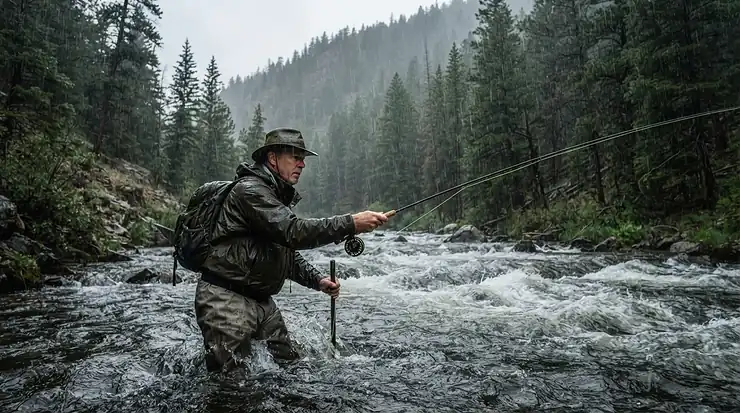
Every angler remembers the day the forecast lied. One minute you’re working a shoreline in a light drizzle. The next, a gray wall rolls across the water and the sky simply lets go. Cheap ponchos flap. Seams weep. Cold water finds the gap at your collar, and a fishing trip becomes a chore.
That’s where rain gear for fishing in heavy downpours earns its keep. It isn’t a fancier raincoat. It’s a system of a hooded jacket, bibs, sealed seams and cuffs that tolerate wet hands, built to keep you dry through wind-driven rain and boat spray. Bad weather can mean good fishing, but only if you can stand being out in it.
This guide cuts through the marketing noise. I dug into published tests from Field & Stream and Wired2Fish, plus manufacturer spec sheets and retailer listings, to compare seven real options. They run from a sub-$30 backup jacket to a premium Gore-Tex Pro kit. You’ll learn how a waterproof rating actually works and why heavy duty fishing rain gear isn’t always the right call. You’ll also see how a waterproof fishing suit stacks up against separates, and which storm fishing safety rules no jacket can replace. Finally, we’ll build a layered rain protection system you can use this season.
One honesty note: I haven’t worn any of these suits. Everything below comes from specs and published testing, with analysis on top. Prices are ranges seen at the time of research, so check current price before you buy.
Quick Comparison: 7 Options for Rain Gear for Fishing in Heavy Downpours
Here’s the lineup at a glance, sorted from premium to budget.
| Product | Tier | Standout Feature | Price Range | Best For |
|---|---|---|---|---|
| Simms ProDry | Premium | 3-layer Gore-Tex Pro | $1,200–$1,400 (jacket + bibs) | Hard-core anglers fishing the worst weather |
| HUK Pro Series | Premium | 30K/15K rating, cap-clip hood | $750–$1,000 (pair) | Boat-running, tournament-style anglers |
| FXR Vapor Pro Tri-Laminate | Premium value | Near-ProDry features for less | $1,000–$1,200 (suit) | Anglers wanting flagship features at a discount |
| Mustang Survival Taku | Upper mid-range | Marine-spec fabric, kneepads | $400–$900 (pair, varies) | Coastal and inshore boaters |
| Grundéns Neptune | Mid-range | Commercial-grade coated shell | Around $100 (jacket) | Torrential rain on a sensible budget |
| Frogg Toggs FTX Armor | Mid-range | 15,000 mm / 10,000 MVTR | $280–$360 (pair) | Weekend lake and river anglers |
| Magellan Outdoors Rain Jacket | Budget | Packable nylon shell | Under $30 | Backup for light showers |
The premium tier is where the best waterproofing lives, but Frogg Toggs FTX Armor is the more realistic buy for most weekend anglers. It costs roughly a third of the flagship suits and still publishes real numbers: 15,000 mm waterproof, 10,000 breathability. Magellan Outdoors Rain Jacket is not a downpour garment. Its tester placed it firmly in the light-drizzle category, so treat it as insurance.
If you only remember one thing from this table, make it this: price tracks durability, mobility and breathability far more than it tracks “will it leak.” Even mid-range laminates can keep rain out. What you pay extra for is comfort over a long, wet, active day.
💬 Just one click — help others make better buying decisions too!😊
Top 7 Rain Gear for Fishing in Heavy Downpours: Expert Analysis
Each pick below leans on published tests and manufacturer specs. Where I couldn’t verify aggregated customer-review scores, I say so rather than invent them.
1. Simms ProDry — best waterproofing money can buy
The Simms ProDry wins by refusing to leak. Field & Stream’s tester ranked it the most waterproof suit in a category-wide test. The reason is architecture: a three-layer microgrid GORE-TEX Pro laminate with a recycled-nylon face and a nylon backer.
In practice, water beads off the surface while sweat vapor escapes from inside, so you stay dry from both directions on a long, wet day. The suit is shell-only, with no built-in insulation. That sounds like a drawback until you realize it enables year-round use: add fleece in January, or wear it over a T-shirt in a July squall. Thigh-high leg zippers let you pull the bibs on over boots, and a front fly means a bathroom break doesn’t require stripping to your base layer.
My read: this is a buy-once suit for people who fish hard in lousy weather. If you fish a handful of damp mornings a year, the cost is hard to defend. The hood’s front flap locks to a cap bill, and the high collar blocks wind without feeling like a neck brace.
On sentiment, testers consistently praise freedom of movement and pocket design. One Wired2Fish writer reports wearing a ProDry for about seven years, re-treating the DWR coating a couple of times. I couldn’t verify aggregated customer star ratings, so I’m not quoting any.
Pros:
- ✅ Most waterproof suit in Field & Stream’s testing
- ✅ Shell-only design layers for every season
- ✅ Thigh-high leg zips and a dual-zipper bib fly
Cons:
- ❌ Price is a hard stop for most budgets
- ❌ No insulation, so you must supply your own layers
Expect roughly $1,200–$1,400 for jacket and bibs together. It’s worth it only if you fish hard in the worst weather.
2. HUK Pro Series — 30K waterproofing with a cap-clip hood
Few suits sound as aggressive on paper as the HUK Pro Series. It pairs a 30K waterproof rating with 15K breathability, in three-layer Toray stretch nylon with fully sealed seams.
Translate the numbers. A 30,000 mm hydrostatic rating sits at the high end of what outdoor apparel advertises, so the fabric itself shouldn’t be your weak link in sustained rain. The 15K breathability figure suggests decent venting during active days. The stretch nylon gives you room for hook sets. The boat-life details are the real story. The hood clips to your cap brim so it turns with your head at speed, and an internal elastic harness lets you drop the jacket off your shoulders. There are D-rings for a kill-switch lanyard and pliers.
My analysis: this suits anglers who run a boat in all weather and want a feature list built around it. Wired2Fish named it the best fishing rain suit after about a year of testing, and Field & Stream’s tester singled out the interior straps that stop the jacket ballooning in wind. I couldn’t verify customer star averages, so the tester verdicts are the evidence here.
Pros:
- ✅ 30K/15K rating with fully sealed seams
- ✅ Hood clips to cap brim and stays put at speed
- ✅ Hip-high leg zips and generous pockets
Cons:
- ❌ List price runs around $500 per piece
- ❌ Introduced in 2025, so long-term durability data is thin
Plan on $750–$1,000 for the pair depending on promotions. Strong value if you’ll use every feature.
3. FXR Vapor Pro Tri-Laminate — near-ProDry features for less
The FXR Vapor Pro Tri-Laminate is the suit Field & Stream’s tester named best value. That’s high praise from someone who rated the Simms ProDry as the benchmark.
“Tri-laminate” generally means three bonded layers: a durable face fabric, a waterproof-breathable membrane and an inner liner. That structure is why premium shells stay quiet and flexible instead of crinkling like a trash bag. The tester highlights a zippered fly, hip-high zippered legs, pockets all over, and magnetic tabs that hold pocket flaps and zippers shut. The bibs even carry a line cutter on a D-ring, a small touch that matters when a snag ruins your retrieve.
Here’s what to weigh: this is the value pick only in relative terms. It’s still a four-figure purchase. I also couldn’t find a published millimeter rating in the sources I checked, so you’re trusting the tester’s results rather than a number. FXR has been climbing fast in the bass scene, which suggests anglers who fish in this gear are taking it seriously.
On review sentiment, the one detailed source I found is overwhelmingly positive, but it’s a single tester. I couldn’t verify aggregated customer ratings, so consider reading buyer feedback before committing.
Pros:
- ✅ Zippered fly plus hip-high leg zippers
- ✅ Magnetic pocket and zipper tabs keep gear secure
- ✅ Built-in line cutter on the bib D-ring
Cons:
- ❌ Still a four-figure suit
- ❌ No published waterproof rating in sources I checked
Expect roughly $1,000–$1,200 for the suit, a sensible step down if you want flagship features.
4. Mustang Survival Taku — marine-spec fabric with kneepads
Mustang Survival built its name on flotation gear and cold-water safety equipment, so the Mustang Survival Taku comes from a company that thinks about people falling in. It uses three-layer Marine Spec SP fabric made without intentionally added PFAS, with waterproof YKK AQUAGUARD zippers.
The details read like a checklist for a boat angler. The jacket has a high collar, an adjustable hood that preserves visibility, underarm vents and tight neoprene cuffs for dunking your hands. The bibs add Cordura reinforcement in the seat and knees, removable kneepads and hems that adjust over boots or waders. Handwarmer pockets sit high enough to stay reachable above a life jacket’s chest belt.
My analysis: this is the pick for cold, wet, coastal or lake days where you wear a PFD. Wired2Fish’s tester used it in Finger Lakes rain, sleet and spray and reported it kept moisture out, with especially effective cuffs. Note that the Taku does not provide flotation. It keeps you dry, not afloat.
I couldn’t verify aggregated customer ratings. Tester sentiment centers on cuffs, hood security and the surprisingly comfortable kneepads.
Pros:
- ✅ Neoprene cuffs seal out water while handling fish
- ✅ Removable kneepads and Cordura-reinforced bibs
- ✅ PFAS-free marine-spec construction
Cons:
- ❌ No built-in flotation, so you still need a life jacket
- ❌ Pair pricing varies widely by variant and sale
Budget roughly $400–$900 for jacket and bibs depending on variant and promotions. Good value on sale, premium at full list.
5. Grundéns Neptune — commercial toughness at a friendly price
The Grundéns Neptune is the rare piece of heavy duty fishing rain gear that doesn’t punish your wallet. Field & Stream’s tester called it the best fishing rain jacket they’ve worn and said it kept them totally dry even in torrential downpours. The secret is a polyurethane-coated shell.
Coated shells work by sealing the fabric surface rather than relying on a membrane, so there’s very little for water to sneak through. The tester also notes the jacket is flexible and lightweight, with an athletic cut. The hood zips to the chin and the back runs slightly long, so water doesn’t pool when you bend. It isn’t insulated, which means room for layers underneath. It’s built for commercial fishermen, but it works for casual anglers, too.
Here’s my analysis: if your priority is “never wet, never broke,” start here. Coated fabrics generally can’t match the breathability of premium laminates during hard exertion, so expect to vent when working hard. The matching Neptune bibs use a stretch-friendly fit with adjustable suspenders, per a roundup listing.
I couldn’t verify aggregated customer rating totals. The strongest signal is that tester praise.
Pros:
- ✅ Polyurethane-coated shell blocks torrential rain
- ✅ Flexible, lightweight cut with chin-high hood
- ✅ Roomy enough for layering underneath
Cons:
- ❌ No insulation, so cold days need extra layers
- ❌ Coated fabric breathes less than premium laminates
The jacket runs around $100; check current price for bibs. Outstanding value for the protection.
6. Frogg Toggs FTX Armor — real numbers at a mid-range price
The Frogg Toggs FTX Armor is the best case for spec transparency. Both jacket and bibs list a 15,000 mm water holdout and 10,000 MVTR breathability, with a DriPore Gen2 middle layer and fully taped and sealed seams.
Those numbers mean something. 15,000 mm is well beyond a “light rain” rating, suggesting sustained protection in heavy rain, and 10,000 MVTR means moisture can escape at a reasonable rate. The jacket has neoprene cuffs, a full-front zip with storm flap and a vented hood. The bibs add reinforced knees and seat, thigh-length zippered legs, elastic suspenders and ankle straps. It was designed with input from pro angler Jacob Wheeler.
My take: this is the practical choice for weekend anglers. The fit is slim and athletic, so size up if you layer heavily.
On sentiment, retailer rating snapshots conflicted when I checked, so I’m not quoting a star score. Treat it as a spec-forward, value-driven option and read current buyer feedback.
Pros:
- ✅ Published 15,000 mm / 10,000 MVTR ratings
- ✅ Fully taped seams with reinforced knees and seat
- ✅ Roughly a third the cost of premium suits
Cons:
- ❌ Slim fit gets tight over thick layers
- ❌ Lower rating ceiling than 30K premium suits
Expect about $140–$180 per piece, or $280–$360 for the pair. A smart middle path.
7. Magellan Outdoors Rain Jacket — the sub-$30 backup shell
I’m including the Magellan Outdoors Rain Jacket with a caveat: it’s not heavy-downpour gear. Field & Stream named it the best budget pick, but its own tester says it belongs to short summer showers and light drizzle, not a high-speed run in a deluge.
It’s 100 percent woven nylon, light and packable enough to live in a tackle bag, truck console or boat locker. That packability is the point. The best rain gear is the gear you have on you when the sky turns, and a jacket you’ll actually carry beats a suit you left at home.
My analysis: buy it as a backup layer, not your main defense. It’s jacket-only, so your legs are exposed. For true downpours, step up to something like Frogg Toggs FTX Armor or Grundéns Neptune.
I couldn’t verify aggregated customer ratings, so the review picture here is the tester’s positioning, not a star average.
Pros:
- ✅ Costs less than a tank of boat fuel
- ✅ Packs small and weighs next to nothing
- ✅ Handy for sudden summer showers
Cons:
- ❌ Not suited to sustained heavy rain
- ❌ Jacket only, with no matching bibs or pants
Expect to spend under $30. Excellent for what it is.
Spec Snapshot: How the Seven Compare
| Product | Waterproof / Breathable Tech | Tester Verdict | Price Range | Best For |
|---|---|---|---|---|
| Simms ProDry | 3-layer GORE-TEX Pro | Best overall (Field & Stream) | $1,200–$1,400 | Year-round, hardest conditions |
| HUK Pro Series | 30K / 15K, sealed seams | Best fishing rain suit (Wired2Fish) | $750–$1,000 | Fast boats, all weather |
| FXR Vapor Pro Tri-Laminate | Tri-laminate (no rating found) | Best value (Field & Stream) | $1,000–$1,200 | Flagship features, lower cost |
| Mustang Survival Taku | 3-layer Marine Spec SP | Best waterproof jacket (Wired2Fish) | $400–$900 | PFD-wearing boaters |
| Grundéns Neptune | PU-coated polyester | Tester favorite for downpours | ~$100 jacket | Rugged, rainy, budget-minded |
| Frogg Toggs FTX Armor | 15,000 mm / 10,000 MVTR | Pro-angler co-designed; mixed star data | $280–$360 | Weekend anglers |
| Magellan Outdoors Rain Jacket | Woven nylon shell | Best budget (Field & Stream) | Under $30 | Light-shower backup |
Read down the table and a pattern emerges: the three cheapest options split into “tough but heavier” (Grundéns Neptune), “balanced and spec-transparent” (Frogg Toggs FTX Armor) and “packable insurance” (Magellan Outdoors Rain Jacket). If you fish more than a dozen wet days a year, the premium suits start justifying themselves through comfort alone.
✨ Ready to Stay Dry When the Sky Opens Up?
🔍 Take your fishing days to the next level with these carefully selected options. Click any highlighted product name to check current pricing and availability. The right suit helps you fish longer, stay warmer and keep the day rolling when the weather turns!
Layered Rain Protection: How to Dress for a Downpour
Even the best shell fails if what’s under it is wrong. Layered rain protection works like a three-part system: wick, insulate, shield. Skip one, and you’ll feel it by hour two.
Base Layer: Manage Sweat
Choose merino or synthetic fabrics that pull moisture off your skin. Avoid cotton, because wet cotton stays wet and drains your body heat.
Mid-Layer: Add Warmth Only as Needed
Fleece or a light insulated layer traps warm air. In cold weather, a shell-only design like the Simms ProDry gives you freedom to add or subtract layers. The adjustable suspenders on the HUK Pro Series and the layering room in the Mustang Survival Taku bibs serve the same purpose.
Shell Layer: Seal the Gaps
Your jacket and bibs should overlap at the waist. Cinch the hood, snug the cuffs and keep the hem closed. Size matters: the slim fit of Frogg Toggs FTX Armor means sizing up if you wear thick layers.
Common Mistakes in the First 30 Days
- Wearing too much insulation, then sweating through it
- Leaving pit zips or leg zips closed while working hard
- Putting on rain gear after you’re already soaked
- Forgetting a dry spare base layer in a dry bag
Quick rule: start slightly cool, because exertion warms you quickly. Dress for the water temperature rather than the air temperature when boating, since a fall overboard changes everything.
Real-World Scenarios: Matching Gear to Your Day on the Water
Specs only matter when they match your fishing. Here are four profiles with budget, environment and frequency spelled out.
If you’re a tournament-style bass angler running a fast boat 80+ days a year with a $1,000-plus budget, the HUK Pro Series or FXR Vapor Pro Tri-Laminate makes sense. The cap-clip hood and kill-switch D-rings are built for high-speed runs in cold fronts. The Simms ProDry is the alternative if you also fish winter and want maximum waterproofing.
If you’re a weekend lake or river angler fishing 15 to 20 outings a year on a $300 budget, go with Frogg Toggs FTX Armor. You get a genuine 15,000 mm rating and sealed seams, plus matching bibs. It’s the best compromise between cost and downpour protection.
If you fish coastal waters from a boat in cold, wet seasons, consider the Mustang Survival Taku. It’s made for marine conditions, with kneepads for long hours on deck and neoprene cuffs for handling fish.
If you’re a bait-heavy, messy-deck angler, look at Grundéns Neptune, or at the PVC-coated Grundéns Brigg 40 jacket and Grundéns Herkules 16 bibs. Wired2Fish’s author says PVC never “wets out,” sheds fish slime and doesn’t hold odors. The tradeoff: it’s heavier and doesn’t breathe.
If you fish summer, with pop-up showers, keep a Magellan Outdoors Rain Jacket stashed in the boat and spend your money elsewhere.
What Is Rain Gear for Fishing in Heavy Downpours?
Rain gear for fishing in heavy downpours is a waterproof outer-shell system, typically a hooded jacket plus bibs or pants. It features sealed seams, water-resistant zippers and a high waterproof rating to keep anglers dry through sustained rain, spray and wind. Unlike casual raincoats, it’s cut for casting, kneeling and boat decks.
The “heavy downpour” qualifier is crucial. Showers and drizzle can be handled by many light jackets. Sustained, wind-driven rain exposes weaknesses fast: unsealed seams, saturated outer fabric (called “wetting out”), cuffs that funnel water down your arms and zippers that leak. That’s why anglers wearing real foul-weather gear often get more than rain protection. They get wind blocking, spray defense and warmth retention when conditions turn ugly.
Fishing-specific gear adds features regular rain jackets skip: D-rings for lanyards, reinforced seats and knees, pliers pockets and hoods that clip to a cap brim. In short, it’s less about staying dry for a walk to the car and more about staying functional for eight hours on the water.
How to Choose Rain Gear for Fishing in Heavy Downpours
Follow these steps in order, and you’ll narrow the field fast.
- Match the waterproof rating to your exposure. For light rain, 10,000 mm can do. For sustained heavy rain, look for 15,000 mm or more, or a fully impermeable PVC option.
- Check seams and zippers. Fully taped or sealed seams matter more than the headline number. Look for waterproof zippers and storm flaps.
- Decide how much breathability you need. If you’re moving, casting or wading, favor breathable laminates. If you’re sitting on a deck in cold spray, a non-breathable coated shell can work.
- Choose a system, not a single piece. A jacket alone leaves your legs and lap exposed. Bibs are usually the better partner.
- Fit for layers. Rain gear goes over everything, so try it on with your winter clothes. Slim cuts need sizing up.
- Prioritize fishing features. Look for a hood that holds position, adjustable cuffs, reinforced knees and a relief zipper or leg zips for pulling bibs over boots.
- Calculate cost per use. A suit that costs more but lasts years can beat a cheap shell you replace every season.
Waterproof Rating Explained: What the Numbers Really Mean
A waterproof rating, also called hydrostatic head, tells you how tall a column of water a fabric can hold back before it starts leaking. A 10,000 mm rating means the fabric resists the pressure of a 10-meter water column. Higher numbers suggest tighter weaves or thicker membranes.
Outdoor gear guides generally treat roughly 10,000 mm as a baseline for everyday use, with 15,000 to 20,000 mm preferred for heavy or prolonged exposure. At the high end, 30,000 mm ratings like the HUK Pro Series sit in the zone marketed for extreme weather.
But the number isn’t everything. Three other factors can break a high rating:
- Seams: A great fabric with weak seams will leak at the stitching.
- DWR finish: The outer coating helps water bead and roll off. When it fades, the face fabric “wets out,” which can feel like leaking even if water isn’t getting through.
- Breathability: A fabric that traps your sweat can leave you just as wet as rain would.
Notice that some of our picks, including Simms ProDry and FXR Vapor Pro Tri-Laminate, don’t advertise a single easy-to-compare millimeter figure in the sources I checked. That doesn’t mean they underperform. Test results, construction and warranty matter alongside lab numbers. For PVC gear, ratings are mostly irrelevant, because the coating is effectively impermeable.
Heavy Duty Fishing Rain Gear vs Breathable Laminates
“Heavy duty fishing rain gear” often means PVC-coated commercial gear, and it behaves very differently from modern laminates.
| Type | Examples | Breathability | Durability | Best For | Trade-off |
|---|---|---|---|---|---|
| PVC-coated | Grundéns Brigg 40, Grundéns Herkules 16 | None | Very high | Messy decks, constant wet | Heavy, runs warm |
| 3-layer laminate | Simms ProDry, HUK Pro Series | High | High | Active fishing, long runs | Expensive |
| PU-coated | Grundéns Neptune | Moderate | High | Torrential rain, rugged use | Less airflow |
| Budget shell | Magellan Outdoors Rain Jacket | Low-moderate | Low | Light showers | Not for heavy rain |
Wired2Fish’s author describes his PVC set from Alaska field work as showing little wear after two decades. He notes that the Grundéns Herkules 16 bibs are reversible with replaceable suspenders, so they can be repaired rather than replaced. That’s a durability story laminates rarely match.
The trade-off is physical. PVC is heavier, and without breathability it can feel hot when you’re active. Many anglers choose it for stationary, messy work, such as bait fishing or boat decks, and choose laminates for casting-heavy or moving days.
So which is better? If you stand still in cold spray, PVC wins on toughness. If you cast, wade or run a boat, laminates win on comfort. Everything else is a compromise between the two.
Waterproof Fishing Suit vs Separate Jacket and Pants
A waterproof fishing suit offers matched seams, matched fit and often a single price break. Buying a jacket and bibs separately gives flexibility but can create mismatches in cuts and overlap.
Bibs generally beat pants for boat fishing because they cover your lower back and chest. When you bend, kneel or cast, a pants-and-jacket combo can open a gap at the waist where rain and spray sneak in. Bibs eliminate that problem, and many designs add features like leg zips, relief zippers and reinforced seats.
Pullover rain pants still have a role. The AFTCO Crossing Pullover Pants, a Wired2Fish pick for best rain pants, are light and packable with fully taped seams, aimed at light to moderate rain. They’re useful for a kayak hatch, a truck, or a quick-throw-on option. They aren’t a substitute for bibs in a real downpour.
Buying a mixed set can work if you match waterproof ratings. Pairing a high-end jacket with budget pants leaves a weak link. If budget forces a choice, spend on the piece that protects the most exposed area for your style of fishing.
Storm Fishing Safety: Where Rain Gear Stops and Judgment Starts
Waterproof gear keeps you dry. It doesn’t protect you from everything a storm can do.
Lightning
Rain gear offers no protection from lightning. NWS offices have noted that fishing is the leading water-related activity in lightning deaths, and that fishing and boating together account for about 14 percent of all lightning fatalities. The National Weather Service’s outdoor lightning guidance is blunt: when thunder roars, move to shelter, and if you’re boating, get to land and find shelter immediately. A good storm fishing safety plan sets a rule in advance: if you hear thunder, you’re done.
Cold Water
Heavy rain often brings cold fronts, and cold water is dangerous even when the air feels mild. Dress for the water temperature, not the air temperature. Rain gear doesn’t provide flotation, and the Maryland Natural Resources Police cold-water boating guide stresses wearing a life jacket and understanding how quickly cold shock and hypothermia can incapacitate a person. Even a premium shell like the Mustang Survival Taku keeps you dry, not afloat.
Visibility and Footing
Choose reflective accents when possible, and watch deck traction. Wet fiberglass and rubber-soled shoes slip, and rubber soles don’t protect from lightning, either.
Features That Actually Matter (And Those That Don’t)
Marketing loves feature lists. Here’s the filter.
What matters:
- Sealed seams and weatherproof zippers. Leaks start here.
- Cuff design. Neoprene or internal dry cuffs, as in the Mustang Survival Taku and HUK Pro Series, keep water from running up your sleeves.
- Hood fit. A hood that moves with your head and keeps your vision clear is worth real money.
- Leg zippers and a fly. If you’ve ever tried pulling bibs over boots in a rocking boat, you know.
- Reinforced seat and knees. These areas take the most abuse.
What matters less:
- Camouflage patterns. Style, not performance.
- Extreme ratings you won’t use. If you rarely fish in hours-long storms, 30K may be more than you need, and Frogg Toggs FTX Armor may be enough.
- Pocket count beyond your needs. A dozen pockets sound great until you forget where the pliers are.
- Breathability you don’t need. If you’re sitting still in cold spray, a coated shell like Grundéns Neptune can be perfectly comfortable.
In short, features should solve problems you actually have on the water. If you’re not sure, start with seams, cuffs and fit, then add extras.
Long-Term Cost and Maintenance: Making Your Rain Gear Last
A cheap suit replaced every season costs more than a good one that lasts. Here’s an illustrative cost-per-outing comparison assuming 20 wet outings a season for five seasons, 100 outings total.
| Product | Price Range | Approx. Cost per Outing | Best Fit |
|---|---|---|---|
| Simms ProDry | $1,200–$1,400 | ~$12–$14 | Heavy, year-round use |
| HUK Pro Series | $750–$1,000 | ~$7.50–$10 | Frequent boat anglers |
| Frogg Toggs FTX Armor | $280–$360 | ~$2.80–$3.60 | Weekend anglers |
| Grundéns Neptune (jacket) | ~$100 | ~$1 | Rugged downpour use |
| Magellan Outdoors Rain Jacket | Under $30 | Under $0.30 | Light showers only |
Cost per use shrinks fast with frequency. If you fish 60 wet days a year, premium suits look much cheaper. If you fish a handful, a mid-range suit is the efficient choice. The Magellan Outdoors Rain Jacket looks cheapest per outing, but only because it handles the lightest conditions.
Maintenance Habits That Extend Life
- Rinse after salt exposure. Salt crystals abrade fabric and clog zippers.
- Wash with a technical cleaner. Dirt and body oils break down DWR finishes and block membranes.
- Re-treat DWR when water stops beading. One Wired2Fish writer reports re-treating a Simms ProDry a couple of times in about seven years.
- Store dry and loose. Never stuff wet gear in a bag for days.
- Wipe PVC clean. Gear like the Grundéns Herkules 16 can handle fish slime if you rinse it.
FAQ
❓ Is a waterproof fishing suit worth it over a cheap poncho?
❓ Can heavy duty fishing rain gear be worn in hot weather?
❓ How often should I re-waterproof fishing rain gear?
❓ Are bibs better than rain pants for fishing?
❓ Is Gore-Tex fishing rain gear worth the extra money?
Conclusion
The best rain gear for fishing in heavy downpours isn’t the most expensive suit. It’s the one that matches how often, where and how hard you fish. If you chase fish in the worst conditions, Simms ProDry, HUK Pro Series and FXR Vapor Pro Tri-Laminate are the premium contenders, with the Mustang Survival Taku a strong marine-focused alternative. If you want serious protection without a four-figure bill, Frogg Toggs FTX Armor and Grundéns Neptune are the sensible middle ground. Keep a Magellan Outdoors Rain Jacket for sun showers, and don’t mistake it for storm gear.
Remember the three pillars: read the waterproof rating alongside seams and DWR, build layered rain protection from the skin out, and respect storm fishing safety rules that no fabric can override. A suit keeps you dry. Good judgment keeps you safe.
Recommended for You
- Fishing Shorts For Surf Fishing: 7 Ultimate Picks For 2026
- Women’s Fishing Shorts For Paddleboard Fishing: 7 Best Picks 2026
- 7 Best Fishing Shorts For Men Big And Tall In 2026 (Real Picks)
Disclaimer: This article contains affiliate links. As an Amazon Associate, I earn from qualifying purchases. If you purchase products through these links, we may earn a small commission at no additional cost to you.
✨ Found this helpful? Share it with your friends! 💬🤗
