
In This Article
You’re staring down into 300 feet of dark Pacific water, wondering if that subtle tap-tap-tap is the big one. Then your rod doubles over like someone’s tied a Volkswagen to the end of your line. Welcome to halibut fishing, where the gear you choose makes the difference between a trophy photo and a “the one that got away” story.
Best halibut fishing gear isn’t just about buying expensive tackle—it’s about understanding what these flat, powerful predators demand from your equipment. Pacific halibut can grow over 400 pounds and possess an incredible ability to pin themselves to the ocean floor when hooked. The right combination of rods, reels, terminal tackle, and technique-specific gear transforms frustrating losses into successful catches.
This guide cuts through the marketing hype to reveal which halibut fishing gear actually performs in deep water, strong currents, and brutal fights. Whether you’re fishing from shore, charter boats, or your own vessel, these recommendations come from real-world testing in conditions where halibut thrive—from Alaska’s frigid waters to California’s kelp forests.
Quick Comparison Table
| Product | Type | Key Feature | Price Range | Best For |
|---|---|---|---|---|
| Mustad Demon Perfect Circle Hook | Hooks | 1X Fine, Wide Gap | $10-25/pack | Catch & Release |
| Gamakatsu Octopus Circle | Hooks | 2X Strong | $15-30/pack | Heavy Duty |
| Danielson Spreader Bar | Terminal Tackle | 20″ Stainless Steel | $8-15 | Budget Option |
| Gibbs Glow Spreader Bar | Terminal Tackle | Glow Tubing | $12-18 | Low Light |
| Penn US Senator 113N | Reel | 4.3:1 Gear Ratio | $250-340 | Power & Durability |
| Okuma Celilo Halibut Rod | Rod | E-Glass Blank | $75-120 | Value Performance |
| Point Wilson Dart Jig | Lure | 4-6oz Anchovy/Candlefish | $8-15 each | Vertical Jigging |
💬 Just one click – help others make better buying decisions too!😊
Top 7 Best Halibut Fishing Gear: Expert Analysis
1. Mustad Demon Perfect Inline Circle Hook 39954NP
The Mustad Demon Perfect Inline Circle Hook revolutionized halibut fishing when it hit the market. This hook features UltraPoint technology that’s 20% sharper than standard hooks and stays sharp longer, critical when you’re fishing marathon sessions in deep water.
Key Specifications:
- Available in sizes 7/0 to 16/0 (14/0-16/0 recommended for halibut)
- 1X Fine wire construction with wide gap design
- Black nickel finish for corrosion resistance
Price: $18-25 per 25-pack
The inline point design ensures the hook rotates to the corner of the fish’s mouth during the fight, dramatically reducing gut-hooked fish. Charter captains report 85-90% corner-mouth hookups with proper technique. The wide gap accommodates large baits like whole herring while maintaining penetration on tough-mouthed giants.
Customers praise the hook’s ability to hold trophy-sized fish without straightening. One Alaska guide noted catching seventeen halibut over 100 pounds in a season without a single hook failure.
✅ Pros:
- Exceptional catch-and-release performance
- Tournament approved by Billfish Foundation
- Versatile for both bait and artificial presentations
❌ Cons:
- Premium pricing compared to bulk commercial hooks
- Requires proper technique to avoid premature hooksets
2. Gamakatsu Octopus Circle Hook
When you need bombproof strength for barn door halibut, the Gamakatsu Octopus Circle Hook delivers. These Japanese-engineered hooks feature a unique tempering process that creates 30% more strength than comparable hooks without becoming brittle.
Key Specifications:
- Sizes 8/0 to 12/0 (10/0 most popular for halibut)
- 2X Strong wire construction
- NS Black finish
Price: $22-35 per pack
The upturned eye makes this hook perfect for paternoster rigs and spreader bar setups. The offset point design improves hookup ratios on light-biting fish while the short shank prevents leverage that could allow hooks to pull free during headshakes.
Many experienced halibut anglers switched from Mustad commercial hooks after breaking off on 200+ pound fish. The Gamakatsu’s strength-to-weight ratio allows using smaller, lighter hooks that still handle massive fish—a 10/0 Gamakatsu has comparable strength to a 16/0 standard hook.
✅ Pros:
- Outstanding strength for fighting trophy fish
- Chemically sharpened needle point
- Excellent for heavy current and structure fishing
❌ Cons:
- Higher price point
- Can be overkill for smaller “chicken” halibut under 30 pounds
3. Danielson Halibut Spreader Bar (20 x 8-Inch)
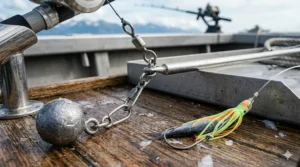
The Danielson Halibut Spreader Bar represents the most cost-effective entry into serious halibut fishing. This stainless steel L-shaped design keeps your leader away from the mainline and weight, eliminating the tangles that plague bottom fishing.
Key Specifications:
- 20-inch long arm, 8-inch short arm
- Heavy-duty stainless steel construction
- Swivel at junction, snap on short arm
Price: $8-15
Attach your 2-4 foot leader to the long arm and your 1-3 pound sinker to the short arm. The geometry keeps everything separated during the descent, even in 400 feet of water with strong currents. The spreader’s simple design means there’s virtually nothing to break—commercial fishermen have used these for decades.
Customers appreciate the no-nonsense functionality. Weekend warriors report the Danielson performs identically to spreaders costing three times as much. The only maintenance required is occasional rinsing after saltwater use.
✅ Pros:
- Unbeatable value for performance
- Proven design used commercially
- Easy to store and transport
❌ Cons:
- No glow features for low-light fishing
- Basic finish can show corrosion if not maintained
4. Gibbs Halibut Spreader Bar with Glow Tubing
When fishing deep or during low-light periods, the Gibbs Halibut Spreader Bar with glow tubing gives you a visibility advantage. The phosphorescent tubing covering both arms creates an attractive target that halibut can locate even in murky conditions or at depths where sunlight barely penetrates.
Key Specifications:
- Glow-in-the-dark tubing on long and short arms
- Heavy-duty swivels rated to 250 pounds
- Quick-release snap for easy weight changes
Price: $14-22
The glow feature proves particularly effective during dawn and dusk feeding periods when halibut are most active. Charge the tubing with a flashlight before dropping, and it provides 15-30 minutes of visibility. The quick-release snap on the weight attachment lets you adjust sinker size without re-rigging your entire setup—invaluable when drifting and needing to match changing depths.
Charter operations running twilight trips report 20-30% more hookups using glow spreaders versus standard models. The effect is most pronounced in waters over 200 feet deep where ambient light is minimal.
✅ Pros:
- Excellent visibility in deep water
- Quick-change weight system
- Durable construction handles big fish
❌ Cons:
- Glow charge fades and requires recharging
- Slightly heavier than basic spreaders
5. Penn US Senator 113N Conventional Reel
The Penn US Senator 113N continues a legacy spanning decades as the workhorse reel for serious halibut anglers. This 4/0 size reel combines old-school durability with modern drag technology, handling everything from 20-pound chickens to 300-pound monsters.
Key Specifications:
- 4.3:1 gear ratio (29 inches of line per crank)
- HT-100 carbon fiber drag washers
- Machined aluminum frame and forged aluminum spool
- Line capacity: 450 yards of 20lb, 300 yards of 30lb
Price: $280-340
The Live Spindle design allows free-spooling for smooth drops to extreme depths without backlash. Six shielded stainless steel ball bearings provide silky-smooth retrieval even under maximum drag pressure. The stainless steel main and pinion gears mesh with precision, eliminating the slop that plagues cheaper reels during hard fights.
Alaskan guides running daily charters report Senators lasting 5-7 seasons with basic maintenance—rinsing, occasional lubrication, and annual drag washer checks. The reel’s reputation for reliability means used Senators hold resale value better than most fishing reels.
✅ Pros:
- Legendary durability and longevity
- Powerful drag system (11 pounds maximum)
- Made in USA with domestic and imported components
❌ Cons:
- Heavier than modern alternatives
- Right-hand retrieve only on most models
6. Okuma Celilo Halibut Graphite Rod CE-C-561Ha
The Okuma Celilo Halibut Rod delivers premium performance at a price point accessible to recreational anglers. Built on an E-glass blank specifically designed for halibut’s combination of subtle bites and explosive power, this rod excels in the 150-400 foot depth range where most halibut fishing occurs.
Key Specifications:
- 5’6″ conventional rod
- Heavy power rating
- E-glass construction for durability and sensitivity
- Aluminum oxide guides
Price: $75-120
E-glass construction provides the backbone needed to lift heavy sinkers and stubborn halibut while maintaining enough flexibility to detect light bites transmitted through hundreds of feet of line. The rod’s balance point works perfectly with 4/0 to 6/0 conventional reels, reducing fatigue during all-day fishing sessions.
The guide train features aluminum oxide inserts compatible with both monofilament and braided lines. The EVA foam grips provide secure handling even with wet, cold hands. At this price point, many anglers buy two—one as primary gear and one as backup.
✅ Pros:
- Exceptional value for performance
- Perfectly balanced for halibut fishing
- Durable enough for charter boat abuse
❌ Cons:
- Shorter length limits casting distance
- Not ideal for fish over 200 pounds
7. Point Wilson Dart Anchovy Jig (4-6 oz)
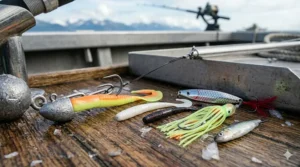
The Point Wilson Dart Anchovy Jig has earned cult status among Pacific Northwest halibut jiggers. These hand-poured metal jigs mimic wounded baitfish with uncanny realism, triggering aggressive strikes from halibut that ignore other presentations.
Key Specifications:
- Available in 1oz to 6oz (4-6oz optimal for halibut)
- Realistic anchovy profile with fluttering action
- Treble or J-hook options
Price: $10-18 each
The anchovy profile creates maximum flutter on the drop, sinking slower than candlefish or herring styles while maintaining fish-attracting action. The jig’s balance causes it to swim horizontally during retrieval, perfectly mimicking a struggling baitfish. Tip the hook with herring, squid, or octopus for added scent attraction.
Vertical jigging with Point Wilson Darts outproduces static bait fishing in certain conditions, particularly when halibut are actively feeding mid-water column. The technique requires more effort but results in healthier, more aggressive fish that fight harder.
✅ Pros:
- Deadly effectiveness on active halibut
- Versatile across multiple species
- Allows covering more water than static fishing
❌ Cons:
- Requires active jigging technique
- Can be expensive if losing jigs to snags
Understanding Halibut Biology and Behavior
Pacific halibut are remarkable predators perfectly adapted to life on the ocean floor. These flatfish begin life swimming upright like salmon, but within six months, one eye migrates to the right side of their head as they transition to bottom-dwelling. This transformation allows them to lie camouflaged on the seafloor with both eyes facing upward, scanning for prey.
According to NOAA Fisheries, Pacific halibut is the largest species of flatfish, with specimens sometimes called barn doors reaching over 8 feet in length and weighing more than 400 pounds. However, these giants are typically spawning females carrying millions of eggs, and most regulations encourage releasing such trophy specimens to preserve breeding populations.
Halibut possess an extraordinary sense of smell, detecting scent concentrations in parts per million. This capability makes scent trails from bait critical to success, especially when anchoring and allowing currents to carry your offering’s scent downstream to feeding fish. Their keen vision in low-light conditions explains why dawn and dusk often produce the best bite windows.
Understanding that halibut are ambush predators rather than pursuit predators shapes effective fishing strategies. They prefer lying in wait near structure, drop-offs, and current breaks where baitfish concentrate, making location selection as important as gear choice.
Essential Components of Halibut Fishing Gear
Rods: Power Meets Sensitivity
Halibut rods must balance contradictory requirements. You need enough backbone to lift 2-3 pound sinkers plus fish from depths exceeding 300 feet, yet sufficient sensitivity to detect subtle bites transmitted through hundreds of feet of line. Most successful halibut anglers use 5’6″ to 7′ conventional rods rated for 30-80 pound line.
Shorter rods provide better leverage for vertical presentations and easier handling in confined boat spaces. E-glass blanks offer superior durability and the forgiving action that prevents pulled hooks during powerful runs. While graphite rods are lighter, they’re more prone to catastrophic failure when slammed into railings or stepped on—common occurrences on crowded charter boats.
Reels: Smooth Drag and Line Capacity
Conventional reels dominate halibut fishing for good reason. Their superior line capacity, powerful drag systems, and ability to handle heavy loads outperform spinning reels in this application. Size 4/0 to 6/0 reels provide the capacity for 300-400 yards of 30-50 pound monofilament or equivalent braid.
Drag systems must be smooth and powerful—halibut make short, powerful runs rather than long screaming sprints. A quality drag prevents break-offs during initial hooksets while allowing you to gradually tire fish without giving them leverage to throw hooks. Star drag systems offer more precise adjustment than lever drags for this fishing style.
Circle Hooks: Game-Changers for Conservation
Halibut circle hooks transformed the fishery by dramatically reducing mortality in released fish. The unique curved design means the hook slides to the corner of the mouth as the fish swims away with bait, eliminating gut-hooking that plagued traditional J-hooks.
Proper circle hook technique requires patience—wait for the fish to fully commit and begin swimming away before smoothly tightening the line rather than setting with a sharp jerk. This counter-intuitive approach results in 85-95% corner-mouth hookups compared to 40-50% with J-hooks. Most regulations now mandate circle hooks for bait fishing, making them non-negotiable halibut fishing gear.
Spreader Bars: Tangle Prevention
Nothing ruins a fishing day faster than spending more time untangling rigs than actually fishing. Halibut spreader bars solve this problem elegantly. The L-shaped design keeps your leader, bait, and hooks separated from your mainline and sinker during the drop and retrieve.
The long arm holds your leader (typically 2-4 feet of 80-150 pound monofilament), while the short arm attaches to your sinker. Your mainline connects to the swivel at the junction. This geometry prevents the twisting and wrapping that plagues slider rigs, especially when fishing from drifting or moving boats.
Weights and Sinkers
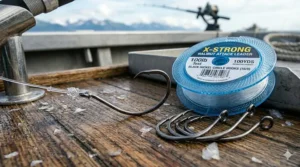
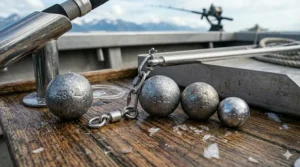
Bottom contact is non-negotiable for consistent halibut success. This requires sinkers heavy enough to reach bottom quickly and maintain position against currents. Pyramid sinkers (1-5 pounds depending on depth and current) dig into soft bottoms, while bank sinkers work better on hard or rocky substrates.
Many experienced anglers use breakaway sinker rigs that allow dropping the weight once a fish is hooked, reducing the total load during the fight. This technique is particularly valuable when targeting trophy-class halibut where every ounce of mechanical advantage matters.
Bottom Fishing for Halibut: Techniques That Produce
Bottom fishing for halibut falls into two primary categories: anchoring and drifting. Each technique has advantages depending on conditions, fish location, and angler preference.
Anchoring Strategy
Anchoring works exceptionally well when you’ve located halibut concentrations through sonar or local knowledge. Position your boat upcurrent of the target area, allowing scent from your bait to drift downstream. Halibut track these scent trails upstream to the source—your offering.
Use a bait bag or jar filled with fish scraps to intensify your scent trail. Some anglers add commercial scent attractants, though fresh herring or squid naturally produces strong scent plumes. Patience is critical with this method—hours of waiting can suddenly transform into frenzied action as fish locate your baits.
The spreader bar rig excels when anchored, keeping everything organized as currents flow past. Drop your rig to bottom, then reel up 2-3 cranks to keep bait off the substrate where crabs can steal it.
Drifting Technique
Drifting allows covering more territory, prospecting for fish across larger areas. This approach works well when fish are scattered rather than concentrated. As your boat drifts with current or wind, your rig drags along the bottom, covering new water continuously.
Monitor your depth sounder constantly while drifting, noting structure changes, depth variations, and baitfish concentrations. Halibut often position along depth transitions, drop-offs, and the up-current sides of humps and pinnacles. When you get bit, mark the GPS coordinates and consider making another drift through the same area.
Drift speed matters tremendously—too fast and you’ll miss subtle bites, too slow and you’ll snag bottom repeatedly. Use drift socks or sea anchors to control speed in windy conditions.
Halibut Circle Hooks: Size and Selection Guide
Circle hook size selection confuses many anglers because traditional sizing doesn’t directly translate to halibut applications. The most popular sizes for Pacific halibut range from 12/0 to 16/0, though effectiveness depends more on gap width and wire diameter than the number alone.
Different manufacturers’ hooks in the same size vary considerably. A 10/0 Gamakatsu has similar gap width to a 16/0 Mustad commercial hook due to different design philosophies. The key measurement is gap—the distance from point to shank—which should accommodate your bait while providing sufficient gape for penetration into tough mouth tissue.
Wire diameter impacts both strength and penetration. Heavier wire (2X strong or 3X strong) handles trophy fish better but requires more force to achieve full penetration. Lighter wire (1X fine or standard) penetrates easier on subtle bites but can straighten on truly massive fish.
Most charter operations standardize on 14/0 or 16/0 as a compromise—large enough for big fish, small enough that 10-20 pound halibut can be hooked effectively. For anglers specifically targeting trophy halibut over 100 pounds, 16/0 or 20/0 offset circles provide extra insurance against straightening or opening.
Halibut Spreader Bars: Setup and Rigging
Proper spreader bar rigging makes the difference between frustration and efficiency. Start by attaching your mainline to the swivel at the junction where the long and short arms meet. Some spreaders come with this swivel pre-attached, while others require adding one.
On the short arm (typically 6-10 inches), attach your sinker using a heavy-duty snap. This allows quick weight changes as you adjust for depth and current without re-rigging. Use enough weight to reach bottom within 30-45 seconds in your fishing depth—longer drops waste time and increase tangle risk.
The long arm (usually 18-24 inches) connects to your leader. Leader length varies from 18 inches to 6 feet depending on technique and personal preference. Shorter leaders (18-36 inches) provide better bite detection and hooksets in deep water. Longer leaders (4-6 feet) give bait more natural movement but sacrifice some sensitivity.
Leader material should be 80-150 pound monofilament for abrasion resistance against bottom structure and fish teeth. Some anglers prefer wire leaders when fishing extremely rocky areas, though this can reduce bites from cautious fish. Crimp your connections rather than tying knots—crimps are stronger and more compact.
Selecting the Right Rod and Reel Combo
Matching your rod and reel creates a balanced system that performs better than mismatched components. The rod’s power rating should complement the reel’s line capacity and drag capability.
For general halibut fishing in 100-300 feet, pair a heavy-power 5’6″-6’6″ rod with a 4/0-6/0 conventional reel. Fill the reel with 30-50 pound monofilament or 50-80 pound braid. This combination handles 95% of halibut encountered while providing enough muscle for trophy fish.
When fishing extreme depths (400+ feet) or specifically targeting trophy halibut over 100 pounds, upsize to a 6/0 reel with 50-80 pound mono or 80-100 pound braid. Pair this with a 6′-7′ heavy or extra-heavy rod. The extra length provides leverage for lifting heavy weights from depth, while the increased line capacity ensures you won’t get spooled by a barn door.
Balance matters tremendously for all-day comfort. The rod and reel should balance at a point that allows comfortable one-handed holding without excessive wrist strain. Many quality halibut rods feature a balance point that aligns with the reel seat when properly matched reels are installed.
Vertical Jigging with Metal Jigs
While bait fishing catches most halibut, vertical jigging with metal jigs like Point Wilson Darts offers advantages in specific situations. Jigging allows covering more water, targeting active fish feeding mid-column, and avoiding bait-stealing crabs on the bottom.
The technique is simple but requires attention. Drop your jig to bottom, then reel up 5-10 feet. Work the jig with sharp upward rod strokes followed by controlled drops. The jig flutters during the fall, mimicking wounded baitfish that trigger strikes. Halibut typically hit on the drop rather than the lift.
Tipping jigs with bait chunks combines visual attraction with scent, often outproducing naked metal. A 2-3 inch strip of herring, piece of squid, or chunk of octopus adds scent without inhibiting the jig’s action. Change bait every 20-30 minutes as scent dissipates.
Jigging requires more physical effort than static bait fishing, but the results justify the work when conditions align. Active halibut feeding aggressively respond better to jigging, while lethargic fish in cold water or high pressure prefer dead baits.
Line Selection: Mono vs Braid
The mono versus braid debate for halibut fishing lacks a clear winner—both have merit depending on priorities. Monofilament excels in abrasion resistance, shock absorption, and forgiveness. Its stretch cushions hooksets and fights, preventing pulled hooks on hard-fighting fish. Mono’s thicker diameter creates more water resistance, helping sinkers maintain bottom contact in current.
Braided line’s advantages include superior sensitivity, smaller diameter (allowing more capacity), and virtually no stretch. You’ll detect subtle bites more clearly and achieve more positive hooksets with braid. The reduced diameter cuts through current better, requiring less weight to maintain bottom contact.
Many experienced halibut anglers compromise by using a braid mainline with a 15-30 foot monofilament topshot. This hybrid approach provides braid’s sensitivity and capacity with mono’s shock absorption and abrasion resistance where it matters most—near the terminal tackle.
Whatever line choice you make, match breaking strength to your fishing conditions and target size. For general halibut fishing, 30-50 pound mono or 50-80 pound braid handles everything except true giants. Upsize if specifically targeting trophy fish or fishing extremely rocky structure.
Bait Selection and Presentation
Fresh bait dramatically outproduces frozen alternatives for halibut. Whole herring (6-12 inches) reign as the gold standard, their oily flesh creating powerful scent trails. Thread the hook through the herring’s mouth and out the gill plate, then through the body to create a curved, natural presentation.
Squid offers another excellent option, particularly its durability—a single squid can catch multiple fish while herring often requires replacement after each hookup. Cut squid into strips or use whole squid bodies depending on circle hook size.
Octopus tentacles produce well when herring and squid are unavailable. Their tough, rubbery texture resists bait-stealing crabs while releasing scent effectively. Salmon belly strips also work, especially in areas where halibut have fed on spawned-out salmon.
Bait size should match hook size and target fish. Smaller baits (4-6 inches) hook more fish overall but include many undersized specimens. Larger baits (8-12 inches) selectively target bigger halibut, though you’ll get fewer bites. Many anglers fish one rod with small bait for action and another with jumbo bait for trophies.
Reading Sonar and Finding Halibut
Modern fish finders transformed halibut fishing from blind luck to strategic hunting. Halibut appear as tight, compact marks on the bottom rather than the arching marks typical of suspended fish. They often blend with bottom structure, requiring experience to distinguish fish from rocks.
Focus on depth transitions, drop-offs, and current breaks where halibut ambush prey. Rocky outcroppings, underwater pinnacles, and the edges of sandbars concentrate baitfish and the halibut that feed on them. Mud-sand transitions also hold fish, with halibut often positioned on the mud side scanning the sandy edges.
Baitfish schools hovering 10-50 feet off bottom indicate productive areas. Halibut position below these schools, occasionally rushing up to snatch prey. If you mark baitfish without halibut below, the area may still be productive—halibut could be camouflaged against structure or positioned just outside sonar range.
Side-scan sonar units provide game-changing capabilities, showing fish and structure to the sides of your boat path. This technology allows covering more water while locating precise fish positions before dropping baits.
Weather and Tides: Timing Your Trips
Halibut fishing success correlates strongly with tidal movement. The best action typically occurs during slack tide transitions—the hour before and after tide changes. Water movement during these periods stirs up baitfish and triggers feeding activity without creating excessive current that makes fishing difficult.
Moderate current flow during incoming or outgoing tides can also be productive, but extreme current makes maintaining bottom contact challenging and reduces bite detection. Very slack water during neap tides sometimes produces slow fishing as halibut become lethargic.
Weather impacts halibut behavior less than many saltwater species. Overcast days often outproduce bluebird conditions, possibly because reduced light encourages halibut to feed more aggressively. Light rain rarely shuts down the bite, though heavy storms and significant weather fronts can reduce activity temporarily.
Water temperature influences feeding behavior, with halibut more active in 42-54°F range. Temperatures outside this range don’t eliminate bites but may require adjusting techniques—slower presentations in cold water, more active jigging in warm water.
Safety Considerations and Fish Handling
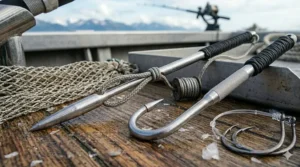
Halibut deserve immense respect both for their size and their surprising explosiveness when brought to the surface. Fish that seemed docile during the fight can suddenly thrash violently once they see the boat, destroying gear and potentially injuring anglers.
Never bring a large halibut (over 50 pounds) into the boat while it’s still alive and active. Use a gaff to secure the fish, then either subdue it with a priest (fish bat) or bleed it immediately. A thrashing 100+ pound halibut in a boat becomes a dangerous projectile.
Proper fish handling ensures quality meat and promotes conservation. If keeping your catch, bleed it immediately by cutting the gills or artery behind the pectoral fin. Place fish on ice as quickly as possible—halibut flesh degrades rapidly at warm temperatures.
For catch-and-release, minimize handling time and avoid removing large fish from water if possible. Circle hooks facilitate quick, easy releases since they’re typically hooked in the corner of the mouth. Use pliers or a dehooking tool to remove hooks without excessive handling.
Regulations and Conservation
Pacific halibut fisheries are managed by the International Pacific Halibut Commission in coordination with NOAA Fisheries, state fish and wildlife departments, and tribal authorities. Regulations vary by location (Alaska, Washington, Oregon, California) and change annually based on stock assessments.
Current regulations typically include bag limits (commonly one halibut per angler per day), size limits (varying by region), and seasonal closures. Some areas implement reverse slot limits, requiring release of very large fish to protect breeding females. Always check current regulations before fishing—penalties for violations are severe.
The halibut fishery has been sustainably managed for decades, with populations generally healthy across their range. This success story results from science-based quotas, enforcement, and angler cooperation. Practicing selective harvest—keeping smaller fish for better eating quality and releasing trophy breeders—helps maintain this resource.
Consider participating in tag-and-release programs that contribute valuable data about halibut movement, growth, and population dynamics. These citizen science initiatives directly inform management decisions.
Caring for Your Halibut Fishing Gear
Saltwater destroys fishing gear quickly without proper maintenance. Rinse all equipment thoroughly with fresh water after each trip, paying special attention to reels. Remove the spool and rinse the drag washers if you’ve been fishing in particularly rough conditions or if the reel was submerged.
Inspect hooks after each trip—discard any with bent points, corrosion, or signs of stress. Circle hooks that have been bent during hooksets lose their effectiveness and should be replaced. Store spare hooks in waterproof containers with moisture-absorbing packets to prevent corrosion.
Lubricate reel bearings and moving parts at least once per season, more frequently if fishing regularly. Use marine-grade grease and oil specifically formulated for saltwater applications. Annual professional servicing extends reel life dramatically and prevents catastrophic failures during fights.
Inspect rod guides regularly for cracks, grooves, or loose windings. Damaged guides create weak points in your line and should be replaced immediately. Check reel seats for corrosion and ensure they grip reels securely.
Frequently Asked Questions
❓ What size circle hook is best for halibut fishing?
❓ Do I need a spreader bar for halibut fishing or can I use a slider rig?
❓ What's the difference between halibut fishing gear and regular bottom fishing tackle?
❓ Can I use the same gear for halibut and lingcod fishing?
❓ How much should I budget for complete halibut fishing gear setup?
Conclusion: Investing in Success
The best halibut fishing gear represents an investment in successful fishing trips and memorable catches. While quality equipment costs more initially, the performance, durability, and reliability justify the expense when you’re battling a trophy halibut in challenging conditions.
Start with proven combinations: a Penn US Senator reel paired with an Okuma Celilo rod creates a rock-solid foundation that will serve you for years. Equip this combo with Mustad or Gamakatsu circle hooks on a spreader bar rig, and you’ll match or outfish anglers using far more expensive gear.
As your skills and commitment grow, upgrade strategically. Perhaps add a premium rod for extreme depths, invest in quality jigging tackle for active fishing, or acquire backup gear to ensure mechanical failures don’t ruin trips. The halibut fishing gear reviewed in this guide has proven itself on countless successful trips from Alaska to California.
Remember that gear is only part of the equation—technique, location knowledge, and persistence matter equally. Even the finest halibut fishing gear won’t catch fish if you’re in the wrong spot or using improper technique. Study local conditions, learn from experienced anglers, and put in your time on the water. The combination of quality gear and growing expertise transforms occasional catches into consistent success.
✨ Don’t Miss These Exclusive Deals!
🎣 Ready to land your trophy halibut? Click on any highlighted product above to check current pricing and availability on Amazon. These proven gear selections will help you succeed on your next bottom fishing for halibut adventure!
Recommended for You
- 7 Best Catfish Fishing Lures and Baits That Actually Work (2026)
- 7 Best Fishing Lures for Crappie and Perch 2026
- 7 Best Snook Fishing Lures and Gear 2026
Disclaimer: This article contains affiliate links. If you purchase products through these links, we may earn a small commission at no additional cost to you.
✨ Found this helpful? Share it with your friends! 💬🤗
