
In This Article
You’ve been standing knee-deep in crystal-clear water for hours, watching steelhead swim right past your lure like it’s invisible. Sound familiar? The difference between going home empty-handed and landing that trophy steelhead often comes down to one thing: having the Best Steelhead Fishing Gear and Lures in your tackle box.
Steelhead—the anadromous form of rainbow trout (Oncorhynchus mykiss)—are notoriously selective. These silver bullets can weigh up to 55 pounds and possess the fighting power of fish twice their size. Whether you’re pursuing winter steelhead in the Pacific Northwest or targeting summer runs in the Great Lakes, success hinges on matching your gear to the conditions and the fish’s mood.
I’ve spent over 20 years chasing these chrome rockets through rivers from Washington to Michigan, and I’ve learned that steelhead fishing isn’t about luck—it’s about preparation. The steelhead fishing tackle you choose determines whether you’ll experience that unforgettable head-shake at the end of your line or watch another trophy swim away. In this comprehensive guide, you’ll discover the exact steelhead fishing gear and steelhead fishing lures that consistently produce results, from budget-friendly options to premium tackle that’ll last a lifetime.
Quick Comparison Table
| Product | Type | Best For | Price Range | Rating |
|---|---|---|---|---|
| Blue Fox Vibrax Spinner | Inline Spinner | All-around versatility | $5-8 | ⭐⭐⭐⭐⭐ |
| Yakima Bait Mag Lip 3.5 | Diving Plug | Boat fishing/Deep water | $8-10 | ⭐⭐⭐⭐⭐ |
| Little Cleo Spoon | Casting Spoon | Low water conditions | $4-6 | ⭐⭐⭐⭐⭐ |
| Mepps Aglia #4/#5 | French Spinner | Trophy steelhead | $6-9 | ⭐⭐⭐⭐⭐ |
| BnR Soft Beads 14-16mm | Drift Bait | Natural presentation | $7-15 | ⭐⭐⭐⭐½ |
| Luhr-Jensen Kwikfish K14 | Plug | Back trolling | $8-12 | ⭐⭐⭐⭐⭐ |
| Lamiglas X-11 Rod 8’6″ | Steelhead Rod | Complete setup | $120-180 | ⭐⭐⭐⭐⭐ |
💬 Just one click – help others make better buying decisions too! 😊
Top 7 Best Steelhead Fishing Gear and Lures: Expert Analysis
1. Blue Fox Vibrax Spinner – The Gold Standard
The Blue Fox Vibrax Spinner isn’t just popular—it’s legendary among steelhead anglers. This inline spinner features a patented two-part machined brass body with internal vibrating rattles that create low-frequency sonic vibrations fish can’t resist.
Key Specifications:
- Available in sizes #3 to #6 (3/8 oz to 5/8 oz)
- Stainless steel shaft with quality VMC treble hooks
- Over 40 color combinations including silver, copper, gold, chartreuse
Price Range: $5.99 – $7.99
I’ve watched this lure trigger violent strikes when nothing else worked. The patented bell-shaped body creates vibrations that practically eliminate line twist—a game-changer when you’re fishing all day. One customer reported: “Caught my personal best 18-pound steelhead on the blue/silver combo in the Deschutes River.”
✅ Pros:
- Legendary track record across North America
- Virtually eliminates line twist
- Works in all water conditions
❌ Cons:
- Blades can occasionally bend on rocky bottoms
- Premium price compared to generic spinners
Perfect for: Bank anglers casting in moderate to fast current, sizes 3-5 excel for steelhead while #6 handles the biggest fish.
2. Yakima Bait Mag Lip 3.5 – Deep Diving Champion
The Yakima Bait Mag Lip 3.5 has become the most popular diving plug across the Pacific Northwest for good reason. This 3.5-inch crankbait features a unique skip-beat action that drives steelhead absolutely wild.
Key Specifications:
- Dives 12-18 feet unassisted
- Heavy-duty size 3 and 4 treble hooks
- Operates effectively up to 4 MPH trolling speed
Price Range: $8.99 – $11.99
The Mag Lip’s reputation for running true straight out of the box saves you hours of frustrating tuning. Boat anglers love backtrolling these through deep holes where trophy winter steelhead hold. According to professional guides, the Doctor Death and NFL color patterns produce most consistently.
✅ Pros:
- Unmatched skip-beat action
- Runs true without tuning
- Dives deeper than most plugs its size
❌ Cons:
- Paint can chip after multiple fish (recent batches)
- Requires specific boat techniques for best results
Target audience: Drift boat anglers and plunkers on larger rivers targeting steelhead in 10-20 feet of water.
3. Little Cleo Spoon – Low Water Legend
The Little Cleo Spoon features a unique humpback design that’s been catching steelhead since 1956. That distinctive wobbling action imitates a wounded baitfish so convincingly that even the most selective steelhead can’t pass it up.
Key Specifications:
- 2/5 oz (most popular steelhead size) to 3/4 oz
- Length: 2-1/4 inches
- Available in 20+ color patterns
Price Range: $3.99 – $5.99
This spoon sinks faster than most spinners, allowing you to get down 7-9 feet before starting your retrieve—critical in low, clear water when steelhead hug the bottom. The nickel and gold variations have accounted for more of my personal hookups than any other colors.
✅ Pros:
- Unbeatable price-to-performance ratio
- Fast-sinking for deep presentations
- Deadly effective in low water
❌ Cons:
- Requires precise casting in snaggy areas
- Split rings occasionally need upgrading
Ideal conditions: Summer steelhead in low flows, winter fish in clear water, and any time steelhead are feeding on smolt.
4. Mepps Aglia #4 and #5 – The French Connection
The Mepps Aglia spinner is the “Original French Spinner” and the world’s #1 lure for trophy fish. Sizes #4 (1/3 oz) and #5 (1/2 oz) specifically target large steelhead, coho, and chinook salmon.
Key Specifications:
- Classic French blade spinning at 60° angle
- Solid brass blade and body
- Premium Sandvik stainless steel shaft
Price Range: $6.49 – $8.99
What separates Mepps from competitors is the consistent blade rotation that creates a rhythmic 1-2-3-4 beat steelhead can detect from 20 feet away. Trophy steelhead anglers in Alaska and the Great Lakes swear by the dressed versions with bucktail for extra attraction.
✅ Pros:
- Time-tested design with 80+ years of results
- Superior blade rotation consistency
- Available dressed or plain for different profiles
❌ Cons:
- Slightly higher price point
- Requires moderate to fast current for best action
Best applications: Swinging through runs, fishing pocket water, and targeting aggressive summer-run steelhead.
5. BnR Soft Beads 14-16mm – Natural Drift Perfection
BnR Soft Beads revolutionized drift fishing for steelhead by perfectly imitating salmon eggs drifting naturally through spawning areas. Their neutral buoyancy and soft consistency create presentations that even educated fish can’t refuse.
Key Specifications:
- Available in 6mm to 25mm sizes (14-16mm ideal for steelhead)
- 30+ color options including mottled patterns
- Includes T-stops for proper rigging
Price Range: $6.99 – $14.99 per pack
These beads drift with such natural buoyancy that steelhead often eat them confidently without hesitation. The mottled cerise and natural colors excel during winter runs when rivers are loaded with real eggs. One angler reported: “Switched to BnR beads and tripled my catch rate in a single season.”
✅ Pros:
- Incredibly realistic drift presentation
- Wide color selection for any water clarity
- Reusable and durable
❌ Cons:
- Requires proper pegging technique
- Some colors can be hard to see in murky water
Perfect scenarios: Drift fishing below spawning salmon, float fishing under indicators, and situations requiring a natural presentation.
6. Luhr-Jensen Kwikfish K14 – Back Trolling Beast
The Luhr-Jensen Kwikfish K14 is a 4-1/4 inch diving plug that’s been the go-to choice for serious boat anglers for generations. Its aggressive wide-wobble action triggers savage strikes from trophy steelhead.
Key Specifications:
- Dives 14-16 feet unassisted
- Size 1 treble hooks (belly) and size 2 (tail)
- Internal rattle chamber for added attraction
Price Range: $7.99 – $11.99
The K14’s banana shape creates that distinctive side-to-side wobble that seems to trigger a predatory response in steelhead. Many guides wrap sardine fillets on the belly to add scent and slow the action—a technique that’s deadly in winter conditions. The UV bright colors strengthen visibility in stained water.
✅ Pros:
- Proven action over 50+ years
- Easily tuned with front screw eye
- Can be wrapped with bait for added attraction
❌ Cons:
- Requires boat for best presentation
- Learning curve for proper tuning
Recommended for: Drift boat anglers backtrolling or plunking on larger rivers like the Columbia, Snake, and Salmon River systems.
7. Lamiglas X-11 Graphite 8’6″ – The Complete Package
The Lamiglas X-11 Graphite steelhead rod represents decades of Pacific Northwest engineering refined into one versatile tool. This 8’6″ medium-heavy spinning rod handles everything from drift fishing to casting hardware.
Key Specifications:
- 2-piece 24-ton carbon graphite construction
- Line weight: 8-17 lb recommended
- Lure weight: 1/4 – 5/8 oz
- Extra-fast action with medium power
Price Range: $120 – $180
What makes the X-11 special is its balanced taper that provides enough backbone to handle 20-pound steelhead while maintaining sensitivity to detect subtle takes. The cork handle feels comfortable during all-day sessions, and the gloss merlot finish looks sharp on the water.
✅ Pros:
- Exceptional value in the $150 range
- Versatile for multiple steelhead techniques
- Proven durability among professional guides
❌ Cons:
- Two-piece design (some prefer one-piece)
- May feel slightly heavy for smaller anglers
Ideal users: Anglers wanting one rod to cover drift fishing, casting spinners/spoons, and float fishing applications.
✨ Don’t Miss These Exclusive Deals!
🔍 Take your steelhead fishing to the next level with these carefully selected products. Click on any highlighted item to check current pricing and availability. These tools will help you land trophy steelhead your friends will envy!
Understanding Steelhead Biology and Behavior
Steelhead are unique among Pacific salmonids as iteroparous fish, meaning they don’t necessarily die after spawning like their salmon cousins. According to NOAA Fisheries, steelhead can spawn multiple times throughout their lives, with some individuals returning to the ocean and back to freshwater for up to three spawning cycles.
Winter vs Summer Steelhead: Key Differences
Winter Steelhead:
- Enter rivers October through April
- Spawn shortly after arrival (1-3 months)
- Prefer water temperatures 38-48°F
- Often darker in coloration
- Feed less aggressively
Summer Steelhead:
- Enter rivers May through October
- Hold in rivers 6-12 months before spawning
- More active feeders
- Brighter, more silver appearance
- Greater propensity to chase lures
Understanding these differences transforms your approach. I’ve found winter steelhead respond better to slower presentations with natural baits like steelhead egg patterns, while summer fish aggressively crush hardware like spinners and spoons.
Essential Steelhead Fishing Tackle Beyond Lures
Rods and Reels
Spinning Setups:
- Length: 8’6″ to 10’6″ (longer for drift fishing)
- Power: Medium to medium-heavy
- Action: Fast to extra-fast
- Line capacity: 8-17 lb monofilament or 10-30 lb braid
Casting Setups:
- Length: 8’6″ to 9’6″
- Power: Medium-heavy to heavy
- Action: Fast
- Ideal for plugs and larger spoons
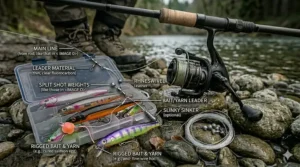
Line Selection
Mainline Options:
- 10-15 lb monofilament: Best all-around choice, provides stretch for hook sets
- 20-30 lb braided line: Superior sensitivity, no stretch for long-distance hook sets
- Fluorocarbon leaders: 8-12 lb for clear water, 12-17 lb for stained conditions
Steelhead Fishing Techniques That Work
Drift Fishing for Steelhead
Drift fishing remains the most productive technique for steelhead across North America. The key is achieving a natural drift where your bait or lure tumbles along the bottom at the same speed as the current.
Setup Requirements:
- Sliding bobber or pencil lead system
- 18-36″ leader
- Bait or lure (soft beads, corky and yarn, or worms)
- Proper weight selection for current speed
Technique Tips:
- Cast upstream and across
- Follow drift with rod tip
- Maintain slight tension to detect takes
- Set hook with firm upward sweep
Hardware Casting Techniques
Casting spinners and spoons requires understanding how steelhead position themselves in current. Target seams between fast and slow water, tailouts of pools, and behind boulders where fish rest.
Presentation Keys:
- Cast at 45° angle downstream
- Allow lure to sink to bottom
- Retrieve just fast enough to maintain blade rotation
- Vary retrieve speed until you find the trigger
Float Fishing (Bobber and Jig)
Float fishing excels in boulder-strewn water where drift fishing hangs up constantly. A float suspends your jig or bait at a precise depth while drifting through productive water.
Critical Components:
- Slip float sized for current speed
- Jig: 1/8 to 1/4 oz depending on depth
- Adjust float depth to fish 6-12″ off bottom
- Use bright yarn or beads for attraction
Seasonal Considerations for Steelhead Fishing Gear
Spring Steelhead (March – May)
Water temperatures rise, bringing increased activity. This prime time sees both late winter fish and early summer runs.
Recommended Gear:
- Bright spinners (chartreuse, pink, orange)
- Medium-sized spoons (1/3 – 2/5 oz)
- Natural-colored soft beads
- 9-10 foot rods for bank fishing
Summer Steelhead (June – September)
Lower, clearer water demands finesse and aggressive fish mean more action.
Top Producers:
- Smaller spinners (#2 – #4)
- Little Cleo spoons in silver/copper
- Fly patterns for low water
- Ultra-light leaders (6-8 lb fluorocarbon)
Fall Steelhead (October – November)
Early winter fish enter rivers as fall salmon finish spawning. Competition for drifting eggs heats up.
Prime Choices:
- Steelhead egg patterns in pink/orange
- BnR soft beads 12-16mm
- Larger spinners returning (#4-#5)
- Plugs for boat anglers
Winter Steelhead (December – February)
Cold water slows metabolism but trophy fish prowl the depths.
Cold Water Tactics:
- Slow-action plugs (Mag Lip, Kwikfish)
- Larger soft beads (16-20mm)
- Natural colors dominate
- Downsize presentation speed
Water Clarity and Lure Selection
Clear Water Strategies
In gin-clear conditions, steelhead spook easily and inspect offerings carefully.
Optimal Choices:
- Natural colors (silver, copper, brown, olive)
- Smaller profiles
- Fluorocarbon leaders mandatory
- Subtle presentations
Stained Water Approaches
Reduced visibility requires increased attraction.
High-Visibility Options:
- Bright colors (chartreuse, pink, orange, purple)
- Larger blade spinners
- Rattles for auditory attraction
- UV-enhanced finishes
Off-Color/Muddy Water
Heavily stained water limits vision to inches.
Maximum Attraction Tactics:
- Loud rattles (Kwikfish, vibrating plugs)
- Large profile lures
- Scent applications
- Slow, deliberate presentations near bottom
River Structure: Where to Find Steelhead
Prime Holding Lies
Steelhead don’t distribute randomly—they select specific holding areas based on current speed, depth, and oxygen levels.
High-Percentage Spots:
- Tailouts of pools (transition zones)
- Inside bends with 4-8 foot depth
- Behind large boulders (current breaks)
- Bucket pools with moderate flow
- Soft water along seams
Travel Lanes
Migrating fish follow predictable routes upriver.
Migration Paths:
- Main current channels
- Deep runs along cliff faces
- Slots between islands
- Scoured pools below rapids
Advanced Steelhead Fishing Tactics
Reading Water Like a Guide
Professional guides assess water differently than average anglers. They identify micro-features that concentrate fish.
What Guides Look For:
- Color Changes: Seams between water colors often mark depth changes
- Surface Disturbances: Boils indicate boulders creating holding water
- Foam Lines: Concentrate drifting food and attract feeding fish
- Bank Structure: Undercut banks provide cover and shade
Weather and Barometric Pressure
Steelhead feeding behavior correlates strongly with atmospheric conditions.
Optimal Conditions:
- Falling barometer (approaching storm)
- Overcast skies (increased confidence)
- Light rain (color in water triggers aggression)
- Stable temperatures
Tough Conditions:
- Rapidly rising barometer (post-frontal)
- Bluebird skies in low water
- Extreme temperature fluctuations
- Heavy snow melt (water too cold)
Steelhead Conservation and Catch-and-Release
Many steelhead runs face challenges from habitat loss, dams, and climate change. Responsible angling practices ensure future generations can experience this incredible fishery.
Proper Handling Techniques
Critical Protocols:
- Keep fish in water whenever possible
- Wet hands before handling
- Support body horizontally (never vertical)
- Remove hooks quickly with forceps
- Revive thoroughly in current before release
- Never touch gills or eyes
Barbless Hooks
Using barbless hooks dramatically improves survival rates:
- Faster hook removal (less handling time)
- Reduced tissue damage
- Easier release while fish remains in water
- Many rivers require barbless by regulation
Common Mistakes Steelhead Anglers Make
1. Wrong Leader Length
The Problem: Too-short leaders spook fish in clear water; too-long tangles constantly.
The Solution: Match leader length to water clarity—18″ in stained water, 36″ in clear conditions.
2. Incorrect Drift Speed
The Problem: Lures moving faster than current look unnatural.
The Solution: Adjust weight so offerings tumble at exact current speed; add a split shot or remove one as needed.
3. Setting the Hook Too Quickly
The Problem: Yanking at the first bump pulls the hook away.
The Solution: Let steelhead load the rod before setting; count “one-one thousand” then sweep firmly.
4. Ignoring Subtle Takes
The Problem: Waiting for rod-bending strikes misses 80% of bites.
The Solution: Watch for line ticks, slight tension, or your float pausing—these signal steelhead mouthing your offering.
5. Fishing Only Obvious Water
The Problem: Everyone hits the perfect-looking tailout while fish stack in the soft inside bend.
The Solution: Fish overlooked water thoroughly; trophy steelhead often avoid crowds.
Steelhead Fishing Gear Maintenance
Post-Trip Care
Saltwater steelhead trips and river grit destroy tackle quickly without proper maintenance.
Essential Routine:
- Rinse all lures with fresh water
- Check treble hooks for sharpness
- Oil reel mechanisms monthly
- Inspect rod guides for cracks
- Replace worn leader material
- Sharpen or replace dull hooks
Storage Best Practices
Lure Organization:
- Store spinners separately to prevent tangling
- Keep soft beads away from plastics (chemical reaction)
- Dry flies thoroughly before storage
- Use rust-preventive spray on metal lures
Rod and Reel:
- Loosen drag completely
- Store rods horizontally or vertically (never leaning)
- Keep reels in cases with moisture absorbers
- Check line for wear every 3-4 trips
FAQ: Best Steelhead Fishing Gear and Lures
❓ What size hooks are best for steelhead fishing?
❓ Can you use the same lures for winter vs summer steelhead?
❓ What pound test line should I use for steelhead?
❓ How do you rig soft beads for steelhead?
❓ What's the difference between steelhead fishing tackle and salmon gear?
Conclusion: Gear Up for Steelhead Success
The Best Steelhead Fishing Gear and Lures for 2026 combine time-tested designs with modern innovations that genuinely catch more fish. From the legendary Blue Fox Vibrax Spinner that’s been fooling steelhead since the 1950s to BnR Soft Beads that perfectly imitate natural eggs, each product in this guide has earned its place through countless hours on the water.
Remember, no single lure works every day. Successful steelhead anglers carry diverse steelhead fishing tackle to adapt to changing conditions—clear water demands natural presentations like Little Cleo Spoons, while stained rivers call for vibration-heavy options like the Yakima Mag Lip. The Lamiglas X-11 provides the versatile platform to fish them all effectively.
Start with these seven essentials, learn to read water and weather patterns, and you’ll consistently connect with these magnificent fish. Whether you’re pursuing winter vs summer steelhead, mastering drift fishing for steelhead techniques, or perfecting steelhead egg patterns, quality gear makes every trip more productive and enjoyable.
Now get out there and make some memories—those chrome beauties are waiting! 🎣
Recommended for You
- 7 Best Halibut Fishing Gear for Trophy Catches in 2026
- 7 Best Catfish Fishing Lures and Baits That Actually Work (2026)
- 7 Best Fishing Lures for Crappie and Perch 2026
Disclaimer: This article contains affiliate links. If you purchase products through these links, we may earn a small commission at no additional cost to you.
✨ Found this helpful? Share it with your friends! 💬🤗
