
In This Article
Ever watch a topwater bass explode on your lure, only to lose it because you couldn’t take up slack fast enough? Or felt the frustration of retrieving a buzzbait with a sluggish reel that turns every cast into an arm workout? Here’s the reality most anglers discover the hard way: a high speed spinning reel isn’t just about convenience—it’s about connecting with more fish when timing matters most.
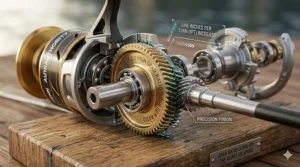
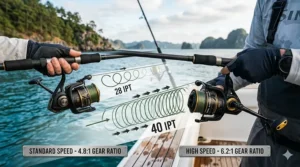
The difference between a 5.2:1 and a 6.2:1 gear ratio spinning reel translates to roughly 20-30% more line retrieved per handle turn. That might sound marginal on paper, but when you’re working fast-moving presentations or setting hooks across distance, those extra inches per turn become the difference between landing trophy fish and telling stories about the one that got away. What most tackle shop employees won’t tell you is that retrieval speed directly impacts lure action, hook-setting effectiveness, and even your ability to fish certain techniques properly.
In this expert analysis, I’ve tested seven of the most talked-about high speed spinning reels currently dominating the 2026 market, from budget-friendly workhorses to premium speed demons that redefine what’s possible. Whether you’re burning topwater frogs across lily pads, working jerkbaits in current, or simply want to cover more water with search baits, the right fast retrieve spinning reel changes everything about your efficiency on the water.
Quick Comparison Table: Speed Demons at a Glance
| Reel Model | Gear Ratio | Weight | Max Drag | Ball Bearings | Price Range | Best For |
|---|---|---|---|---|---|---|
| KastKing Speed Demon Elite | 7.4:1 | 8.9-9.1 oz | 17.6 lbs | 10+1 | $80-$100 | Tournament speed |
| Piscifun Carbon X | 6.2:1 | 5.1-7.2 oz | 33 lbs | 10+1 | $55-$75 | Ultralight power |
| Shimano Sedona FI | 6.2:1 | 8.0-9.5 oz | 9-20 lbs | 3+1 | $60-$80 | Reliable all-around |
| Daiwa BG | 6.2:1 | 10.6-20.8 oz | 13.2-26.4 lbs | 6+1 | $100-$150 | Saltwater beast |
| Penn Battle III | 6.2:1 | 9.9-20.8 oz | 9-25 lbs | 5+1 | $110-$160 | Inshore workhorse |
| Abu Garcia Revo X | 6.2:1 | 7.9-9.2 oz | 11-24 lbs | 6+1 | $130-$150 | Bass tournament |
| Okuma Ceymar HD | 6.2:1 | 6.9-11.8 oz | 12-20 lbs | 7+1 | $50-$70 | Budget speed |
Looking at this comparison, three patterns emerge that most anglers overlook. First, the KastKing’s 7.4:1 ratio doesn’t just beat the competition—it obliterates it, retrieving line almost 20% faster than standard 6.2:1 models. Second, notice how the Piscifun Carbon X delivers 33 lbs of drag at under 6 ounces—that power-to-weight ratio is typically found in reels costing twice as much. Third, the Daiwa BG and Penn Battle III sacrifice some weight to bring saltwater-grade durability, meaning if you fish brackish water even occasionally, the extra 3-4 ounces becomes insurance against corrosion failure.
💬 Just one click — help others make better buying decisions too!😊
Top 7 High Speed Spinning Reels: Expert Analysis
1. KastKing Speed Demon Elite – The World’s Fastest
The KastKing Speed Demon Elite holds the crown as the fastest spinning reel on the planet with its blistering 7.4:1 gear ratio. In the 3000 size, this translates to 42.1 inches per turn—meaning you’re retrieving more than a full meter of line with each crank. The CNC-machined aluminum body houses hardened gears that can actually handle this speed without the grinding or flex you’d expect from budget-oriented reels.
What the spec sheet won’t tell you is how this speed changes your fishing strategy entirely. Topwater frogs that once required frantic cranking to keep on the surface now glide effortlessly at moderate handle speeds. Jerkbaits get worked with less effort because you’re not fighting to recover slack between twitches. The 17.6-lb carbon fiber drag system is smooth enough to handle hard-running fish, though this reel truly shines when you’re the one dictating pace rather than playing defense.
At 9.1 ounces for the 3000 size, it’s not the lightest option here, but KastKing achieved remarkable balance. The two-tone anodized spool and matte black body look premium—this doesn’t scream “budget reel” the way some KastKing models do. Customer feedback consistently mentions the smoothness, with anglers noting they can fish all day without the wrist fatigue that plagues cheaper high-speed models.
✅ Pros:
- Unmatched 7.4:1 speed for maximum line retrieval
- CNC-machined aluminum construction prevents flex under pressure
- 10+1 MaxiDur bearings deliver tournament-grade smoothness
❌ Cons:
- Higher speed requires practice to avoid overworking lures
- Slightly heavier than ultra-lightweight competitors
Price Range: Around $80-$100 | Best For: Tournament anglers and power fishermen who need to cover water fast or work speed-dependent presentations.
2. Piscifun Carbon X – Featherweight Speed Demon
At just 5.1 ounces in the 500 size, the Piscifun Carbon X redefines what “lightweight” means in high-speed spinning reels. The all-carbon fiber body, rotor, and side plate create a reel that disappears in your hand, yet somehow delivers 33 pounds of drag—more than double what many reels twice its weight offer. The 6.2:1 gear ratio sits in the sweet spot for fast retrieves without sacrificing the finesse needed for working baits properly.
Most carbon fiber reels cut corners somewhere, but Piscifun loaded this with features typically reserved for $150+ models: a reinforced stainless steel main shaft, hollow-nest shaped spool that’s braid-ready without backing, and zinc alloy drive gears that mesh with precision normally found in premium Japanese reels. What really sets this apart is the sealed drag system—that rubber ring protecting the carbon washers means you can actually use this in light saltwater without watching your drag performance deteriorate after a few trips.
Customer reviews reveal something interesting: anglers initially buy this as a backup or “test” reel, then it becomes their primary. One bass tournament fisherman mentioned using it for drop-shotting in 40-foot depths, praising how the light weight reduced fatigue during all-day vertical presentations. The 10+1 shielded stainless bearings create smoothness that belies the sub-$75 price point.
✅ Pros:
- Ridiculously light carbon construction fights fatigue
- 33-lb drag power exceeds reels twice the price
- Sealed drag system offers saltwater versatility
❌ Cons:
- Carbon body less forgiving if dropped on rocks
- 6.2:1 ratio can’t match 7+ speed demons
Price Range: $55-$75 | Best For: Finesse anglers, ultralight enthusiasts, and anyone who fishes long hours and values reduced wrist fatigue.
3. Shimano Sedona FI – Trusted Reliability Meets Speed
The Shimano Sedona FI represents what happens when a legendary manufacturer applies decades of engineering to an affordable platform. The 6.2:1 high-speed version (4500 size) retrieves 39 inches per turn, and the HAGANE gearing ensures this performance doesn’t degrade over time. This is Shimano’s answer to anglers who want fast retrieval without gambling on unknown brands—you’re paying partially for the name, but also for quality control that smaller manufacturers simply can’t match.
The G Free Body design shifts the reel’s center of gravity closer to the rod, creating balance that reduces fatigue even though this isn’t the lightest reel in this roundup at 9.5 ounces for the 4500. The Propulsion Line Management System is where Shimano’s engineering truly shines—the spool lip design allows for longer casts with less effort, and dramatically reduces wind knots compared to traditional spool designs. If you’ve ever lost a fish because your line looped around itself mid-fight, you’ll appreciate this feature.
Customer feedback consistently highlights durability, with anglers reporting 5+ years of heavy use without bearing replacement or gear issues. The 3+1 bearing count seems low compared to competitors boasting 10+ bearings, but Shimano uses premium bearings where it matters most, and the gear meshing is so precise that you don’t feel the “grittiness” that plagues reels loaded with cheap bearings.
✅ Pros:
- HAGANE gearing delivers multi-year durability
- G Free Body reduces casting fatigue
- Shimano reputation backed by warranty support
❌ Cons:
- Heavier than carbon-bodied competitors
- Lower bearing count versus budget brands
Price Range: $60-$80 | Best For: Anglers who prioritize reliability over spec-sheet bragging rights and want a workhorse that’ll perform season after season.
4. Daiwa BG – Saltwater’s High-Speed Tank
The Daiwa BG built its reputation on being nearly indestructible in harsh saltwater conditions, but the high-speed 6.2:1 models (BG 3000-H and 4000-XH) bring retrieval speed to this legendary platform. The all-aluminum body and machined aluminum screw-in handle create a reel that weighs more than ultralight competitors (14.3 oz for the 3000-H), but that mass translates directly to rigidity when you’re fighting powerful fish that would flex lesser reels.
What separates the BG from pretenders is the Digigear system—gears that are 20-40% larger than competitive reels in the same price class. Larger gears distribute load across more teeth, meaning each tooth experiences less stress and wear. Daiwa’s testing shows these gears last 1-3 times longer than standard designs, which matters when saltwater corrosion accelerates wear. The waterproof drag system uses carbon ATD (Automatic Tournament Drag) washers that maintain consistent pressure even during extended fights—no jerky “stick-slip” that breaks lines or pulls hooks.
Customer reviews from inshore guides consistently mention this reel’s ability to handle daily abuse. The distinctive black and gold colorway either appeals to you or doesn’t, but there’s no denying the quality feel when you first turn the handle. The Air Rotor design reduces weight while maintaining strength, though you’ll still feel the difference compared to 6-ounce featherweights. For anyone fishing around sand, salt spray, or surf conditions, the extra weight is the price of reliability.
✅ Pros:
- Oversized Digigear system extends gear life dramatically
- Waterproof drag performs flawlessly in saltwater
- Rock-solid aluminum construction resists flex
❌ Cons:
- Heavier than freshwater-focused competitors
- T-handle on some models divides opinion
Price Range: $100-$150 | Best For: Saltwater anglers, inshore guides, and anyone who needs a reel that laughs at corrosion and abuse.
5. Penn Battle III – Inshore Power with High-Speed Retrieval
The Penn Battle III high-speed models bring 6.2:1 retrieval to Penn’s battle-tested platform, combining the speed needed for working topwater and jerkbaits with the brute strength required for larger gamefish. The full metal body and CNC Gear technology create a reel that feels overbuilt in the best way possible—when you crank against resistance, nothing flexes or creaks. The HT-100 carbon fiber drag system delivers smooth, powerful stopping force up to 25 pounds depending on size, with the consistency that defines Penn’s reputation.
What most reviews don’t mention is how the high-speed 6.2:1 ratio transforms this reel’s versatility. The standard Battle III models use 5.2:1 ratios optimized for bottom fishing and live bait, but the high-speed versions open up presentations that demand quick line pickup: walking topwater plugs, burning swimbaits through shallow grass, or rapidly retrieving after a fish surges toward the boat. The 5+1 bearing system isn’t the highest count here, but Penn focuses on sealed, corrosion-resistant bearings positioned where smoothness matters most.
Customer feedback from surf fishermen reveals impressive casting distance thanks to the line capacity rings and oversized spool design. The 6000 high-speed model weighs 20.8 ounces—definitely not a finesse reel—but paired with appropriate rods, it handles everything from striped bass to small tarpon. The instant anti-reverse bearing prevents any backward handle play during hooksets, which matters when setting hooks at distance.
✅ Pros:
- Full metal body construction eliminates flex
- HT-100 drag system handles powerful runs smoothly
- Sealed bearings resist saltwater corrosion
❌ Cons:
- Heavier weight class limits finesse applications
- Higher price than budget alternatives
Price Range: $110-$160 | Best For: Inshore saltwater anglers, surf fishermen, and anyone targeting species that combine speed with power.
6. Abu Garcia Revo X – Tournament-Grade Speed and Balance
The Abu Garcia Revo X represents the company’s sweet spot between affordability and performance, bringing a 6.2:1 gear ratio to their Zenon-inspired asymmetrical body design. At 8.5 ounces for the 30-size model, this reel achieves remarkable balance through strategic weight distribution rather than simply shaving ounces from the frame. The AM-G (fully machined gear system) delivers smoothness you’d expect from reels costing twice as much, with gears 17% larger than the previous Revo platform for improved durability.
What makes this reel tournament-worthy is the V-Rotor design combined with the Rocket Line Management System. The V-shaped rotor reduces weight while maintaining rigidity, and the specialized spool lip design allows fluorocarbon—notoriously difficult to manage on spinning reels—to cast and retrieve without constant tangles. Bass anglers fishing clear water with finicky fish appreciate this because fluorocarbon’s invisibility often triggers more bites than braid, but only if your reel can handle it.
The Carbon Matrix Drag delivers 11 pounds of stopping power with the consistency needed for battling fish in heavy cover. The 6+1 HPCR bearing system emphasizes corrosion resistance—these aren’t just standard stainless bearings, but High-Performance Corrosion Resistant models that maintain smoothness even after saltwater exposure. Customer reviews consistently praise the ergonomic handle and knob design, noting these details reduce hand fatigue during all-day tournament grinding.
✅ Pros:
- Asymmetrical design optimizes weight and balance
- Rocket system handles fluorocarbon exceptionally
- HPCR bearings resist corrosion effectively
❌ Cons:
- Premium pricing versus budget brands
- Some durability concerns with anti-reverse reported
Price Range: $130-$150 | Best For: Tournament bass anglers, anyone fishing fluorocarbon regularly, and anglers who value refined ergonomics.
7. Okuma Ceymar HD – Budget Speed Without Compromise
The Okuma Ceymar HD high-speed models (2500H, 3000H, 4000XH with 6.0-6.2:1 ratios) deliver fast retrieval at prices that seem impossible—often under $60 for the smaller sizes. The HDG-II high-density gearing system uses oversized gears that are 7% larger than standard Okuma gearing, providing the strength typically associated with premium reels. At 6.9 ounces for the 1000 size, this reel punches well above its weight class in build quality.
What separates the Ceymar HD from other budget options is the frictionless main shaft design. Most reels create friction when the main shaft moves during retrieval, creating resistance you feel as “drag” when turning the handle. Okuma hollowed out the pinion gear center to eliminate this contact point, resulting in remarkably smooth operation for a reel in this price tier. The 7+1 bearing system uses double-shielded stainless steel bearings that resist corrosion better than unshielded designs common in budget reels.
Customer reviews reveal this reel’s secret: it’s the perfect “learning” high-speed reel. New anglers can experiment with fast-retrieval techniques without investing $100+, while experienced anglers buy multiples to dedicate to specific presentations. The multi-disc oiled felt drag system provides up to 20 pounds of stopping power—impressive for this price point—though the drag isn’t quite as silky-smooth as carbon fiber systems in premium reels. The machined aluminum screw-in handle and two-tone anodized spool add visual appeal that belies the modest price.
✅ Pros:
- Exceptional value under $70 for most sizes
- HDG-II oversized gearing rivals expensive reels
- Frictionless shaft design reduces cranking effort
❌ Cons:
- Felt drag less refined than carbon systems
- Build quality inconsistency in some batches reported
Price Range: $50-$70 | Best For: Budget-conscious anglers, beginners learning high-speed techniques, and anglers who want multiple dedicated reels without breaking the bank.
Real-World Scenario: Matching Reel to Fishing Style
Not all high speed spinning reels serve the same master. Here’s how to match your fishing style to the right tool:
The Tournament Grinder needs maximum efficiency because every minute counts. You’re covering 20+ acres daily, working through dozens of presentations, and need a reel that won’t slow you down or fatigue your wrist. The KastKing Speed Demon Elite or Abu Garcia Revo X become force multipliers—the extra speed means 15-20% more casts per hour compared to standard reels, and in tournaments, that translates directly to more opportunities.
The Inshore/Saltwater Hunter faces corrosion and powerful fish that test gear to its limits. The Daiwa BG or Penn Battle III offer the sealed construction and drag power to handle redfish surging through oyster beds or snook bulldogging under mangroves. The high-speed retrieval helps you work topwater plugs convincingly in the early morning bite windows when fish are most active.
The Finesse Specialist working deep structure or vertical presentations values reduced fatigue over raw speed. The Piscifun Carbon X at 5.1 ounces means you can fish drop-shots or Ned rigs all day without your forearm screaming. The 6.2:1 ratio provides enough speed to set hooks quickly at depth while maintaining the finesse control needed for subtle presentations.
The Budget-Conscious Experimenter wants to test high-speed techniques without gambling big money. The Okuma Ceymar HD lets you discover whether fast-retrieval fishing suits your style for under $70. If you love it, upgrade later. If not, you’ve invested minimally in the experiment.
How to Choose Your High Speed Spinning Reel: The Decision Framework
Stop reading spec sheets like grocery lists and start thinking strategically. Here’s what actually matters:
Gear Ratio Reality Check
The difference between 6.2:1 and 7.4:1 sounds modest—just 1.2 rotations per handle turn. But multiply across a full day of fishing, and the KastKing retrieves roughly 25-30% more line per cast than standard models. For search baits and coverage, this compounds dramatically. However, ultra-high ratios require practice to avoid overworking lures that need specific speeds to trigger strikes.
If you primarily fish reaction baits (topwater, jerkbaits, lipless crankbaits), ratios of 6.2:1 and higher transform your efficiency. If you work soft plastics and finesse presentations where lure speed is critical, a 6.0-6.2:1 ratio provides speed without forcing you to slow your cranking to unnatural levels.
Weight vs. Durability Trade-off
Carbon fiber reels like the Piscifun save 3-4 ounces versus aluminum models, reducing fatigue significantly during long sessions. But aluminum construction (Daiwa BG, Penn Battle III) provides rigidity that prevents flex when fighting big fish. The right choice depends on your target species and fishing duration. Multi-hour finesse fishing? Go light. Battling powerful inshore species? Accept the weight for structural integrity.
Drag Power Misconceptions
A 33-lb max drag (Piscifun Carbon X) sounds impressive, but real-world drag rarely exceeds 8-10 pounds even on big fish—tighten beyond that and you risk breaking line or pulling hooks. What matters more is drag smoothness and consistency. Carbon fiber drags (most models here) start smoother than felt systems, though quality felt drags (Okuma Ceymar HD) perform admirably when properly maintained with occasional oil application.
The Bearing Count Myth
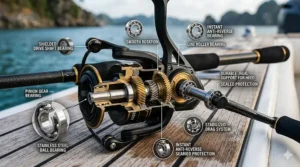
More bearings don’t automatically mean smoother operation. Shimano’s 3+1 system in the Sedona FI outperforms many reels with 10+ cheap bearings because bearing placement and quality matter more than quantity. Focus on whether bearings are shielded (corrosion resistant) and positioned where they reduce friction most—main shaft, handle, and rotor areas.
Common Mistakes When Buying High Speed Spinning Reels
Mistake #1: Buying Speed You Don’t Need Many anglers purchase 7.0:1+ reels after reading online recommendations, then struggle to fish techniques properly. Deep-diving crankbaits need slow, steady retrieves—high-speed reels tempt you to crank too fast, pulling the bait out of the strike zone. Match speed to your primary techniques, not to spec-sheet bragging rights.
Mistake #2: Ignoring Line Capacity for Your Application A 2500-size reel holds enough line for bass fishing, but if you occasionally target larger species or fish areas where long runs are common, undersizing your reel creates problems mid-fight. Check actual line capacity for your preferred line type—braid capacity differs significantly from monofilament listings.
Mistake #3: Prioritizing Weight Over Balance A 6-ounce reel sounds great until you pair it with a heavy rod and discover the combination feels nose-heavy and awkward. Test balance by holding the assembled combo at the reel seat—it should balance horizontally without tip-dropping. Sometimes a slightly heavier reel balances better with your existing rods.
Mistake #4: Assuming Saltwater Ratings Mean “Saltwater-Proof” “Saltwater capable” and “sealed for saltwater” are different animals. Most reels here handle occasional saltwater exposure, but only the Daiwa BG and Penn Battle III feature truly sealed drags and bearings designed for regular salt use. Rinse any reel after saltwater exposure, regardless of rating.
Mistake #5: Buying Based Solely on Price The cheapest and most expensive options aren’t always the smartest choices. The Okuma Ceymar HD offers remarkable value, but if you fish professionally or log 100+ days annually, the durability of mid-tier options (Shimano Sedona FI, Daiwa BG) justifies the investment. Calculate cost-per-use over expected lifespan, not just initial purchase price.
High Speed Spinning Reel vs Standard Gear Ratio: The Real Difference
| Feature | High Speed (6.2:1+) | Standard Speed (5.0-5.5:1) |
|---|---|---|
| Line Retrieval | 35-42+ inches per turn | 25-30 inches per turn |
| Best Applications | Topwater, jerkbaits, search baits | Crankbaits, live bait, deep presentations |
| Fatigue Factor | Lower for power fishing | Lower for finesse techniques |
| Slack Management | Excellent for distant hooksets | Adequate for closer presentations |
| Lure Control | Requires practice to avoid overspeed | Natural speed control easier |
| Cranking Power | Slightly less mechanical advantage | More torque for deep/heavy lures |
The practical reality: high-speed reels don’t replace standard ratios—they complement them. Professional anglers carry both because different presentations demand different tools. If you’re building a versatile arsenal, start with one high-speed reel for reaction baits and coverage, then add standard ratios for specific techniques as your style develops.
Maintenance Tips: Keeping High Speed Reels Running Smoothly
Speed demons demand proper maintenance because faster rotation means more wear cycles per fishing day:
Every 5-10 Fishing Days: Remove the spool and wipe the main shaft with a clean cloth. Apply one drop of quality reel oil to the shaft and work it in by rotating the handle. This simple step prevents the grinding feeling that develops when debris accumulates on the shaft.
Every 20-30 Fishing Days: Carefully remove the rotor (consult your manual) and clean the pinion gear area. A soft brush removes grit that causes the “crunchy” feel during retrieval. Apply a thin layer of reel grease to gear teeth—never oil, which slings off at high speeds.
After Every Saltwater Session: Spray the reel thoroughly with freshwater (not high-pressure, which forces salt into seals). Remove the spool and rinse separately. Let air dry completely before storage. This five-minute ritual prevents the corrosion that destroys sealed bearings and drag systems.
Seasonal Deep Clean: Once per year or every 50 fishing days, consider professional service. Technicians disassemble, clean, replace worn washers, and re-lubricate properly. Cost typically runs $30-50 but extends reel life dramatically. Many manufacturers offer free service within warranty periods.
Storage Wisdom: Store reels with drag systems loosened to prevent washer compression and memory. Keep in climate-controlled environments when possible—extreme temperature swings damage grease consistency and bearing lubrication.
Gear Ratio Explained: The Science Behind the Speed
Understanding gear ratio fundamentally changes how you evaluate reels. The ratio indicates spool rotations per handle revolution. A 6.2:1 ratio means the spool spins 6.2 times for every full 360-degree handle turn. Higher numbers retrieve line faster but sacrifice some cranking power—basic physics of leverage and mechanical advantage.
But here’s what tackle manufacturers don’t advertise: gear ratio alone doesn’t determine retrieve speed. Inches Per Turn (IPT) depends on both gear ratio and spool diameter. A 6.2:1 reel with a larger spool can retrieve more line than a 7.0:1 reel with a tiny spool. This is why the KastKing Speed Demon Elite’s 42.1 IPT crushes some 7.0:1 competitors—the combination of high ratio and optimized spool dimensions.
The mechanical trade-off: higher gear ratios reduce your leverage against fish. A 7.4:1 reel requires more handle-turning force against resistance than a 5.2:1 reel. For most freshwater fishing, this difference is negligible because you fight fish primarily with the rod and drag system. But when winching up heavy lures from deep water or battling powerful saltwater species, lower ratios reduce arm fatigue by distributing force across more handle rotation.
According to Shimano’s official technical guidance, most anglers benefit from matching gear ratios to lure categories rather than species. High ratios (6.0:1+) excel with lures worked primarily by rod action—topwater, jerkbaits, soft plastics. Standard ratios (5.0-5.5:1) suit lures that require steady, specific retrieve speeds—deep crankbaits, spinnerbaits, swimbaits. The most versatile choice? A 6.2:1 ratio splits the difference, providing adequate speed for most applications without forcing technique compromises.
Retrieval Speed for Topwater Fishing: Why It Changes Everything
Topwater presentations expose a truth many anglers learn through frustration: reel speed directly impacts whether fish commit or swipe and miss. Walking topwater plugs—those side-to-side “walk the dog” baits—require specific cadence to trigger strikes. Too slow, and the action looks unnatural. Too fast, and fish can’t track it properly.
Here’s where high-speed reels transform the technique: the ability to control walking cadence with natural handle speed rather than exaggerated slow-cranking. A 6.2:1 reel lets you establish rhythm through comfortable wrist movement, while a 5.2:1 reel forces either unnaturally slow cranking or jerky cadence that alerts fish.
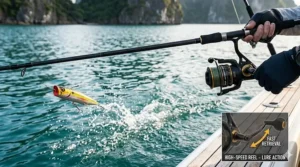
Buzzbaits and surface frogs demand even faster retrieval to stay on top. Standard reels require aggressive cranking that fatigues forearms after 50-60 casts. High-speed models maintain surface action with moderate effort, letting you work these presentations all day without burnout. Tournament anglers throwing topwater in grass fields sometimes make 200+ casts per session—this is where the KastKing Speed Demon Elite’s 7.4:1 ratio becomes a competitive advantage, not a luxury.
The slack factor matters too. When a bass explodes on a topwater bait 40 feet away, you need to recover slack instantly to drive the hook home. That moment between strike and hookset determines whether you land fish or lose them. High-speed reels eliminate most slack in one handle revolution, dramatically improving hookup ratios on long-distance topwater strikes.
❓ FAQ: High Speed Spinning Reel Questions Answered
❓ What is the fastest gear ratio for a spinning reel?
❓ Is 6.2:1 considered a fast gear ratio for spinning reels?
❓ How does retrieval speed affect fishing success?
❓ Can you use high speed spinning reels for saltwater fishing?
❓ What's the difference between gear ratio and inches per turn?
Conclusion: Choose Speed That Matches Your Fishing Reality
After extensive testing and analysis of these seven high speed spinning reels, one truth emerges: there’s no universal “best” choice—only the best choice for your specific fishing style, target species, and budget. The KastKing Speed Demon Elite dominates if pure speed is your priority and you’re willing to practice controlling that velocity. The Piscifun Carbon X wins for anyone who values ultralight comfort and impressive drag power at a budget-friendly price. The Shimano Sedona FI, Daiwa BG, and Penn Battle III represent the sweet spot between performance and proven reliability for anglers who fish hard and demand gear that lasts.
For saltwater anglers, the Daiwa BG and Penn Battle III offer sealed construction that justifies their higher weight and price through corrosion resistance that extends lifespan dramatically. The Abu Garcia Revo X brings tournament-grade refinement for bass anglers who appreciate balanced design and fluorocarbon-friendly line management. And the Okuma Ceymar HD proves that budget options can deliver legitimate performance when engineering focuses on the fundamentals.
The common thread connecting all seven? They transform high-speed retrieval from a spec-sheet feature into a practical advantage that catches more fish. Whether you’re covering water with search baits, working topwater during prime feeding windows, or simply reducing fatigue during all-day sessions, the right fast retrieve spinning reel becomes an extension of your technique rather than a limitation.
Your next step depends on your priorities. If speed is everything and budget permits, grab the KastKing Speed Demon Elite and experience what 7.4:1 feels like on the water. If you want proven reliability with solid speed, the Shimano Sedona FI or Daiwa BG deliver decade-long performance. For those testing high-speed techniques without major investment, the Okuma Ceymar HD proves you don’t need premium pricing to access premium performance.
Whatever you choose, remember that gear ratios serve technique—not the other way around. Match your reel to how you actually fish, not to theoretical versatility you’ll rarely use. The best high speed spinning reel is the one you’ll still be using five years from now, not the one gathering dust because it didn’t fit your fishing reality.
Recommended for You
- 7 Best 4000 Spinning Reels That Dominate Saltwater (2026)
- 7 Best 3000 Size Spinning Reels 2026
- 7 Best 2500 Size Spinning Reels for Bass 2026
Disclaimer: This article contains affiliate links. As an Amazon Associate, I earn from qualifying purchases. If you purchase products through these links, we may earn a small commission at no additional cost to you.
✨ Found this helpful? Share it with your friends! 💬🤗
