
In This Article
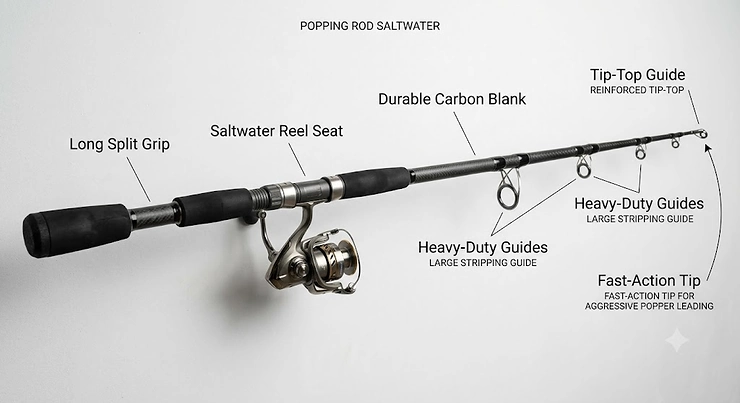
Ask any deckhand who’s watched a hundred-pound yellowfin blow up on a stickbait, and they’ll tell you the same thing: the popper isn’t what wins that fight. The rod is. A popping rod saltwater built for real abuse is a purpose-built casting tool, usually 7 to 8 feet, engineered with a soft-loading tip for launching heavy lures and a stout lower half for turning a fish’s head before it spools you. It’s a different animal than a jigging rod, and treating the two as interchangeable is how anglers lose gear — and fish.
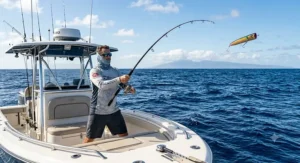
This guide breaks down seven real rods spanning budget, mid-range, and premium territory, all suited to different flavors of topwater work: casual pier and jetty sessions, dedicated GT popping on the flats and reefs, and blue-water tuna popping from a center console. Along the way you’ll get honest analysis of specs, aggregated review sentiment where it’s verifiable, and practical guidance you won’t find on a product listing. None of this is a rewritten spec sheet — it’s the reasoning behind the numbers, because a 500-gram max-drag rating means nothing until you understand what it does to your forearms in hour two of a fight.
Whether you’re outfitting your first surf setup or shopping for a dedicated topwater saltwater rod to chase pelagics offshore, the goal here is the same: match the tool to the fish, the technique, and your budget, without guessing. If giant trevally or blue-water tuna are on your target list, the stakes for choosing the right blank only go up from here.
Quick Comparison: Popping Rod Saltwater Options at a Glance
| Rod | Length | Line/Lure Rating | Best For |
|---|---|---|---|
| Ugly Stik Bigwater Spinning Rod | 7’–8′ | 20–40 lb / up to 4 oz | Budget entry point |
| Daiwa Proteus Popping Rod | 8′ | 55–100 lb braid | Value tuna popping |
| Shimano Grappler A Type C | 7’7″–8’2″ | PE 5–8 | All-around versatility |
| PENN Carnage III Spinning Boat Rod | 7’–8′ | 30–80 lb | Durable mid-range workhorse |
| OTI Tuna Sniper Popping Rod | 7’6″–8’6″ | 40–80 lb | Dedicated tuna specialists |
| Phenix Titan Popping Rod | 7’6″–8’8″ | PE 6–10 | Premium GT and tuna travel rod |
| Ocean’s Legacy Raptus Offshore Popping Rod | 7’6″–8’2″ | PE 6–10 | Heaviest-duty GT popping |
Looking at the spread above, the jump from the Ugly Stik Bigwater Spinning Rod to the Daiwa Proteus Popping Rod buys you a purpose-built popping taper instead of a generalist blank, which matters the moment you’re casting a 3-ounce popper all day. The Shimano Grappler A Type C and PENN Carnage III occupy a similar mid-tier price bracket but solve different problems — one prioritizes blank technology for distance and lightness, the other prioritizes brute durability. At the top, the Phenix Titan Popping Rod and Ocean’s Legacy Raptus aren’t really competing with each other so much as with the fish itself.
💬 Just one click — help others make better buying decisions too!😊
Top 7 Saltwater Popping Rods: Expert Analysis
1. Ugly Stik Bigwater Spinning Rod — toughest budget option for first-timers
The standout here is durability that borders on comical for the price point. The Bigwater blends graphite and fiberglass in what Ugly Stik calls its Ugly Tech construction, and pairs it with one-piece stainless steel guides that simply don’t pop out the way lighter guide frames do after a season of salt exposure. In the 8-foot medium-heavy spinning configuration, it’s rated around 20–40 lb line and up to roughly 4 oz of lure weight — enough to lob a mid-sized popper without a dedicated popping taper doing the finesse work for you. What that spec means in practice: you’re not getting the crisp, fast-loading tip of a true popping rod, so casting distance and lure action will lag behind purpose-built blanks, but you’re also not going to snap it on a curb-side mishap or a green fish thrashing boatside. Reviewers consistently note that the rod survives abuse other budget rods don’t, with several longtime owners reporting a decade or more of hard use on the same stick. This is the rod for someone testing the popping waters before committing real money, or for a mixed-bag angler who wants one setup that handles sharks, jacks, and the occasional surface blowup without babying it.
Pros:
- ✅ Extremely durable one-piece stainless guides
- ✅ Handles rough handling and salt exposure well
- ✅ Lowest price of entry into topwater fishing
Cons:
- ❌ Lacks the fast popping-specific taper of dedicated rods
- ❌ Heavier swing weight limits full-day casting comfort
Price sits in the roughly $60–$90 range depending on retailer and configuration — check current price before buying, since availability shifts model to model — and for a first popping rod saltwater setup, it’s hard to argue with the value.
2. Daiwa Proteus Popping Rod — best value step-up for real tuna popping
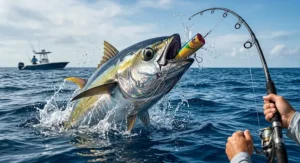
The standout advantage on this one is Daiwa’s HVF carbon construction doing genuine work at a mid-tier price. The Proteus Popping series (models like the PRTB80HXHFS) runs an 8-foot fast-action blank rated for heavy braid with mono topshots, purpose-built — unlike the boat-rod siblings in the Proteus line — for casting heavier plugs and then absorbing a long fight against tuna. What that fast-action rating means at the rail: the tip loads quickly on the cast for distance, then the mid-and-lower section takes over during the fight, so you’re not pumping a fish with a rod that folds in the middle. Anglers on tuna-focused forums who’ve fished this rod against yellowfin in the 50–70 lb class report it casts long, loads predictably, and holds up under repeated hook-sets without the guides or blank showing fatigue. Based on the spec comparison with the boat-rod Proteus models, this popping-specific version trades some lifting brute force for a more forgiving, parabolic bend that’s easier on the angler’s back over a long session.
Pros:
- ✅ Purpose-built fast-action popping taper, not a repurposed boat rod
- ✅ HVF carbon blank keeps weight down for all-day casting
- ✅ Strong reputation among yellowfin anglers on the West Coast
Cons:
- ❌ Composite/graphite blend is heavier than pure high-modulus carbon
- ❌ Standard EVA grips wear faster than upgraded cork options
Expect this rod in the $200–$260 range depending on the specific model and grip upgrade — always check current price, since Daiwa periodically adjusts the lineup. For anglers ready to commit to serious tuna popping without premium pricing, this is the sweet spot.
3. Shimano Grappler A Type C Popping Rod — most refined blank tech in its class
The standout feature is Shimano’s dual Spiral X and Hi-Power X construction, which the company states makes the blank meaningfully more resistant to torsional twist than a standard layup. In practice, that translates to a rod that stays true under load instead of corkscrewing when a big fish runs sideways — a real problem on cheaper blanks during long fights. The Grappler A Type C spans roughly 7’7″ to 8’2″ across PE 5 to PE 8 models, with a soft-tip, fast-action profile designed specifically for casting topwater and subsurface lures rather than vertical jigging, which is what the rest of the Grappler family is built for. Here’s what to weigh: the PE 5 (7’7″) pairs naturally with a 10,000-class reel for yellowfin up to roughly 50–60 lb, while the PE 6–7 (8’2″) models step up for bigger tuna and GT work. Reviewers and forum anglers repeatedly single out the V-Hold grip design for reducing fatigue during extended fights, and several charter captains report using the rod daily without structural issues. What most buyers overlook is that this rod is not interchangeable with Shimano’s jigging-focused Grappler models despite the shared name — the guide layout and taper are genuinely different tools.
Pros:
- ✅ Spiral X/Hi-Power X construction resists twisting under heavy load
- ✅ V-Hold grip reduces fatigue on long fights
- ✅ Wide model range covers everything from inshore jacks to bluefin
Cons:
- ❌ Premium blank tech pushes price above entry mid-range rods
- ❌ Eight-foot-plus models are unwieldy on smaller boats
Pricing generally lands in the $300–$400 range depending on the PE rating and length — prices may vary by retailer, so check current price before ordering. For anglers who want one rod that flexes between yellowfin, GT, and general nearshore casting duty, this is arguably the most versatile entry on this list.
4. PENN Carnage III Spinning Boat Rod — best all-around durability for mixed conditions
The standout here is PENN’s SLS3 blank construction, engineered for a notably thin diameter while still holding up to heavier boat, jig, and nearshore lure work. The 7 to 8-foot spinning models in the Carnage III lineup carry line ratings from roughly 30 to 80 lb, built around Fuji K-Guides and a Sea-Guide or Fuji reel seat that both resist salt corrosion better than budget hardware. What that thinner-diameter blank means in the field: less swing weight for the same lifting power, which shows up directly in reduced arm fatigue after dozens of casts. Reviewers on PENN’s own product pages, along with independent tackle-shop reviews, consistently praise the rod’s balance of lightness and backbone, with multiple owners specifically calling out its performance against 60–100 lb grouper and snapper as evidence it can handle serious offshore pressure, which translates directly to topwater tuna and GT work. On paper this means the Carnage III competes directly with the Grappler A Type C on spec sheet alone, but the real-world difference is componentry philosophy — PENN leans into rugged simplicity, while Shimano leans into proprietary blank tech.
Pros:
- ✅ SLS3 blank keeps diameter thin without sacrificing strength
- ✅ Fuji and Sea-Guide hardware resists saltwater corrosion
- ✅ Strong track record against heavy bottom and pelagic species
Cons:
- ❌ Not purpose-built exclusively for popping — more of a generalist
- ❌ Handle materials attract grime faster than rubberized alternatives
Price generally runs in the $180–$260 range across the spinning boat rod lineup — check current price, as PENN offers several length and power variants at different price points. This is a dependable middle-ground pick for anglers who want one rod to cover boat duty broadly, not just poppers.
5. OTI Tuna Sniper Popping Rod — most trusted name among dedicated tuna anglers
The standout advantage is a genuinely parabolic bend profile that tuna guides and charter captains single out repeatedly as easier on the body during extended fights. Ocean Tackle International’s Tuna Sniper series runs primarily in 7’6″ to 8’6″ lengths rated around 40–80 lb, positioned specifically as a popping and stickbait rod rather than a dual-purpose jig stick. What that parabolic action means practically: instead of a stiff, fast-shutting tip that dumps all the load onto your wrists, the blank bends progressively deeper, spreading the fight across your whole upper body — genuinely useful when you’re an hour into a stubborn yellowfin. Reviewers and forum-based tuna anglers, particularly in Gulf of Mexico floater fisheries, consistently cite the rod’s casting distance with 2–3 oz stickbaits and poppers as a major advantage over stiffer competitors, alongside praise for its slim foregrip suiting anglers with smaller hands. Based on the spec comparison with stiffer GT-oriented rods on this list, the Tuna Sniper trades outright lifting stiffness for casting distance and fight comfort — the right trade for tuna, the wrong one if you’re specifically targeting reef-bound GT that need to be turned immediately.
Pros:
- ✅ Parabolic bend reduces angler fatigue on long tuna fights
- ✅ Excellent casting distance with mid-weight stickbaits and poppers
- ✅ Slim foregrip suits anglers with smaller hands
Cons:
- ❌ Softer action means less immediate lifting power near structure
- ❌ Smaller production runs can mean longer restock waits
Expect a price range around $350–$480 depending on length and power — always check current price, as availability fluctuates by retailer. For serious tuna popping specialists, this rod shows up again and again as a favorite for good reason.
6. Phenix Titan Popping Rod — premium travel-friendly GT and tuna specialist
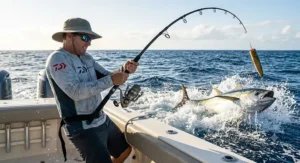
The standout feature is Phenix’s Toray multi-composite blank blended with a proprietary resin formula, built specifically as a 2-piece design that breaks down above the foregrip for travel — a genuinely useful detail for anglers flying to remote GT destinations. Models span roughly 7’6″ to 8’8″ across PE 6 to PE 10 ratings, positioning the Titan squarely in premium territory built for landing large trevally and jumbo tuna. What that 2-piece travel joint means practically: you avoid checking an oversized rod tube or risking a snapped blank in transit, without the noticeable performance penalty that plagued older multi-piece popping rods. Forum discussion among dedicated tuna and GT anglers consistently ranks the Titan among the top handful of popping rods available, with several owners directly comparing it favorably to rods costing two to three times as much, citing its refined, slower-loading tip as ideal for working stickbaits as well as poppers. What the spec sheet won’t tell you, but angler reports suggest, is that the Titan’s action sits notably softer than newer American-style popping blanks like the same brand’s Megalodon line, which matters if you’re deciding between a rod tuned for finesse stickbait work versus raw lifting power.
Pros:
- ✅ Toray composite blank with genuine 2-piece travel convenience
- ✅ Refined tip action favored for stickbaits as well as poppers
- ✅ Strong reputation relative to rods at much higher price points
Cons:
- ❌ Premium pricing puts it out of reach for casual anglers
- ❌ Softer action isn’t ideal for pure lifting-power GT work near structure
Pricing typically runs in the $450–$650 range depending on length and power rating — prices may vary, so check current availability directly. This is a rod built for anglers who travel specifically to chase GT and tuna and need gear that survives the trip as well as the fight.
7. Ocean’s Legacy Raptus Offshore Popping Rod — heaviest-duty option for the biggest GT
The standout here is raw lifting power engineered specifically around one goal: stopping the largest giant trevally in rough water before they reach the reef. The Raptus blank is reinforced with dual Cross Core Carbon layers and a multi-blend Toray graphite layup, built around premium Fuji DPS reel seats and Fuji KW stainless double-foot guides with SiC rings for heat dispersion during long, hard-fought battles. What that reinforced dual-carbon layup means in the field: this rod is built to survive the kind of sustained, bone-jarring pressure that GT fishing near coral structure demands, where losing even a few seconds of control means a cut-off on the reef. The brand states the series was extensively field-tested across genuinely brutal GT fisheries including Cocos (Keeling) Islands, the Montebello Islands, and Fiji, which lines up with why serious GT anglers treat this as a benchmark rod rather than a casual purchase. Reviewers consistently frame the Raptus as an alternative to ultra-premium custom rod brands at a comparatively accessible price, praising both its lifting authority and its component quality. Here’s what to weigh: this stiffness that makes it exceptional for horsing a 100-plus-lb GT off the bottom makes it noticeably less forgiving for finesse stickbait presentations than the softer Phenix Titan.
Pros:
- ✅ Dual Cross Core Carbon construction built for maximum lifting power
- ✅ Premium Fuji componentry rated for extreme heat and stress
- ✅ Field-tested specifically against the largest GT fisheries worldwide
Cons:
- ❌ Stiff action sacrifices finesse for stickbait presentations
- ❌ Among the priciest rods on this list
Price generally sits in the $500–$700 range depending on model and length — always check current price given import and shipping variables. If your target is genuinely oversized GT and structure is unforgiving, this is the rod built for that exact fight.
Practical Usage Guide: Setting Up and Maintaining Your Popping Rod
Getting a new popping rod saltwater-ready starts before the first cast. Rinse the entire rod, reel seat, and guides in fresh water after every single trip — salt crystallizes in guide frames and reel-seat threads within hours, and that’s how a smooth-casting rod starts grinding line within a season. During the first 30 days, most anglers make the same mistake: over-tightening the reel seat locking ring, which can crack composite hoods over repeated trips. Snug is enough; you’re not sealing a jar. Check guide wraps and tip-tops for hairline cracks monthly, especially if the rod travels in a rod tube that shifts around in transit, since a compromised guide can shred braid without any visible warning until it fails mid-fight.
For optimization, match your retrieve cadence to the rod’s action rather than fighting it — a slower, parabolic rod like the Tuna Sniper rewards a smoother sweep-and-pause popping motion, while a stiffer blank like the Raptus can handle a faster, more aggressive walk-the-dog cadence without losing lure control. Store rods horizontally on padded rod racks rather than standing them tip-down in a corner, which stresses the blank unevenly over months of storage. A light coat of reel oil on guide inserts twice a season prevents the salt-induced pitting that eventually roughens SiC and Alconite rings enough to fray expensive braided line.
Real-World Scenarios: Matching the Rod to Your Fishery
Consider three different anglers. First, a weekend pier and jetty angler in Florida targeting jacks, snook, and the occasional king mackerel on a modest budget — the Ugly Stik Bigwater Spinning Rod or entry-level Daiwa Proteus covers this without overspending on capability that never gets used. Second, a Gulf Coast angler running 20–30 miles offshore chasing 50–80 lb yellowfin floaters several times a season — this is exactly the use case the OTI Tuna Sniper and Shimano Grappler A Type C were built for, balancing casting distance with fight-friendly action. Third, a traveling angler booking a trip to Australia or the Seychelles specifically to chase 80-plus-lb GT around coral structure — here, the Ocean’s Legacy Raptus or Phenix Titan justify their price tags, because losing a fish of a lifetime to an underpowered rod is a far more expensive mistake than the rod itself.
Budget, frequency of use, and target species should drive the decision in that order. An angler who fishes twice a year doesn’t need a $600 rod sitting in a closet 350 days out of it; an angler chasing IGFA-class GT on a dedicated trip absolutely does.
How to Choose a Popping Rod for Saltwater
- Match rod length to casting need. Shorter 7-foot rods offer more casting accuracy and control in tight quarters; 8-foot-plus rods add distance, which matters more offshore than inshore.
- Prioritize action over raw power rating. A fast, parabolic action loads better with topwater lures than a generic heavy-power rod not designed for popping specifically.
- Size the rod to your target species’ realistic weight range, not the biggest fish you might theoretically hook — an oversized rod kills lure action on smaller strikes.
- Check guide material and count. SiC and Alconite rings dissipate heat from fast-running braid far better than cheap ceramic alternatives on budget rods.
- Consider reel seat corrosion resistance. Fuji graphite or DPS seats consistently outlast lower-grade aluminum options in daily saltwater use.
- Factor in travel needs. A 2-piece design like the Phenix Titan matters enormously if you’re flying to a remote fishery; it’s irrelevant for a local boat that never leaves the dock.
- Weigh componentry against your actual budget rather than chasing the most expensive rod on the shelf — the mid-tier options on this list genuinely outperform their price point for most anglers.
Topwater Saltwater Rod vs Jigging Rod: Which Do You Need
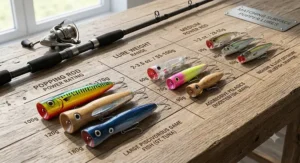
This distinction trips up more first-time buyers than any other spec on the list. A topwater saltwater rod is built around a softer, faster-loading tip designed to cast a popper or stickbait a long distance and then impart the sweeping, walking action that makes the lure work on the surface. A jigging rod, by contrast, is built stiffer through the tip with the load concentrated lower in the blank, since vertical jigging relies on short, sharp rod movements rather than long casts. Shimano’s own Grappler lineup illustrates this well — the Type C popping models and the standard jigging models share a name but are genuinely different tools, with different guide placement and taper specifically because the jobs are different. Buying a jigging rod for popping work (or vice versa) is one of the most common and costly mistakes anglers make, since the wrong taper either kills your casting distance or blunts the popper’s action entirely. If your fishing genuinely mixes both techniques in a single trip, some anglers carry two dedicated rods rather than compromise with a single do-everything blank, since a true hybrid rarely excels at either task.
Surface Popper Rod Action and Power Explained
Action and power are two separate specs that get conflated constantly, and understanding both is the difference between a rod that works and one that fights you. Action describes where along the blank it bends — fast action bends mainly in the top third, which loads quickly for punchy, aggressive popper cadences; slower, more parabolic action bends further down the blank, which favors a smoother retrieve and spreads fight pressure more evenly across the angler’s body. Power, separately, describes how much force it takes to bend the rod at all, typically labeled medium, heavy, or extra-heavy. A surface popper rod matched to your actual lure weight and target species should get both specs right together: a heavy-power, fast-action blank like the Ocean’s Legacy Raptus suits big lures and big fish near structure, while a medium-heavy, more parabolic blank like the OTI Tuna Sniper suits long casts and extended open-water fights. Buying based on power rating alone, while ignoring action, is a common and avoidable mistake — plenty of anglers end up with a rod that’s technically strong enough for their target species but wrong in action for how they actually fish it.
GT Popping Gear: What Giant Trevally Demand From Your Rod
Giant trevally are one of the hardest-pulling inshore and reef species anglers target with surface lures anywhere in the world, and that reputation is exactly why GT popping gear sits at the stiff, heavy-power end of the spectrum. Their size, aggression, and the structure they typically hold near — bommies, drop-offs, and reef edges — is precisely why rods like the Ocean’s Legacy Raptus and Phenix Titan are built around maximum lifting authority rather than casting finesse. In practice, gt popping demands a rod that can turn a fish’s head within the first several seconds of the hookset, because a GT allowed to reach coral will cut the leader on contact almost every time. That’s also why braided mainline paired with a heavy fluorocarbon or wind-on leader is standard practice — abrasion resistance against sharp reef edges matters more here than in almost any other style of saltwater popping. Reviewers who fish GT specifically and repeatedly emphasize that undergunning this fishery is the single most common and costly mistake newcomers make, often after losing an expensive lure and a trophy fish to a rod that simply couldn’t apply enough pressure fast enough.
Tuna Popping Setups: Matching Rod to Species and Reel
A dedicated tuna popping rod typically runs shorter and stiffer than a general surf rod, with a fast or extra-fast action built to deliver quick, precise casts and handle violent surface strikes, though several rods on this list run slightly longer for added casting distance in open water. Anglers targeting yellowfin tuna with poppers regularly favor large spinning setups with powerful drag and high gear ratios, often running 14,000 to 20,000-size reels capable of sustained heavy drag pressure through long runs. That reel-to-rod pairing matters enormously: an undersized reel on a well-matched rod like the Daiwa Proteus or OTI Tuna Sniper will still lose fish, because the rod can only do half the job. Blank technologies like Shimano’s Spiral X and Hi-Power X construction exist specifically to add compressional and torsional rigidity without adding blank weight, which is exactly the property that lets a spinning rod hold up against sustained tuna runs without twisting apart mid-fight. Tuna popping success also depends heavily on presentation — working the popper at sufficient distance from the boat, since fish are noticeably less boat-shy and the retrieve angle works more effectively farther out.
Common Mistakes When Buying a Popping Rod
The most frequent error is buying based on price alone without matching action to technique — a budget rod that’s technically strong enough often has the wrong taper for popping specifically. A close second is oversizing the rod “just in case,” which kills casting accuracy and lure action on the fish you’ll actually encounter most often. Anglers also commonly skip checking guide material, assuming all stainless or SiC guides perform equally, when heat dissipation under a screaming tuna run varies significantly between guide grades. Skipping a proper reel pairing is another frequent misstep — an unbalanced combo, even with a great rod, feels sluggish and casts poorly regardless of blank quality. Finally, many first-time GT anglers underestimate leader and drag requirements relative to rod power, assuming the rod alone determines landing percentage when line, leader, and drag setting all matter just as much.
Features That Actually Matter (And Those That Don’t)
Guide quality, blank construction technology, and reel seat corrosion resistance genuinely matter and directly affect how a rod performs and lasts. A 2-piece travel joint matters enormously for traveling anglers and not at all for a boat-only rig. Cosmetic wrap colors, decorative thread patterns, and branded grip textures make no measurable difference to casting distance, lifting power, or durability, despite often commanding a price premium. Reel seat locking mechanisms genuinely matter — a seat that loosens under repeated hard casts is a functional problem, not a cosmetic one. Marketing terms like “tournament grade” or “pro series” attached to a rod with no accompanying spec detail should be treated skeptically; the actual blank material, action, and componentry tell the real story every time.
Long-Term Cost & Maintenance
A $70 budget rod that needs replacing every two seasons of moderate use isn’t necessarily cheaper over time than a $250 rod that lasts a decade with basic care. Factoring cost-per-year rather than sticker price changes the calculus considerably, especially for anglers who fish weekly rather than a handful of times per season. Guide and tip-top replacement, when needed, typically runs a modest amount at a local tackle shop and extends a quality blank’s life significantly, making repair often more economical than replacement for premium rods. Rod tubes and padded racks are a small upfront cost that meaningfully protects the higher-end investments on this list, particularly the travel-oriented Phenix Titan. Total cost of ownership should also account for reel pairing — an expensive rod paired with an undersized, mismatched reel wastes money on both ends without delivering proportional performance.
Safety and Drag Considerations for Big Game Popping
The IGFA’s international angling rules exist specifically to promote ethical, sporting practices around landing big game fish, and while most recreational anglers aren’t chasing world records, the underlying safety principles apply broadly to any serious popping trip. Setting drag appropriately for your line class prevents both lost fish and rod damage — overtightening drag to compensate for an undergunned rod is a common shortcut that risks snapped rods and pulled hooks alike. Experienced tuna popping anglers often recommend passing the rod to a fresh angler if progress stalls during a long fight, since prolonged battles increase both fish stress and the risk of shark encounters near the boat. Always match your leader strength to your target species’ size and the terrain you’re fishing — heavier fluorocarbon or wire near reef structure, lighter leader in open water where casting distance and stealth matter more.
Frequently Asked Questions
❓ What is a popping rod saltwater anglers should use for tuna?
❓ What's the difference between a popping rod and a jigging rod?
❓ How much should I spend on a first popping rod?
❓ Can I use a popping rod for jigging too?
❓ What line weight should I use with a heavy popping rod?
Conclusion
Choosing the right popping rod saltwater fishing demands isn’t about finding the single “best” rod — it’s about matching action, power, and componentry to the fish you’re actually chasing and how often you’re on the water. The Ugly Stik Bigwater Spinning Rod earns its spot for anglers just starting out, while the Daiwa Proteus Popping Rod and Shimano Grappler A Type C represent the smartest value for anglers ready to get serious about tuna. The PENN Carnage III rounds out the mid-tier as a genuine all-arounder, and the OTI Tuna Sniper remains a favorite among dedicated tuna specialists for good reason. At the top, the Phenix Titan Popping Rod and Ocean’s Legacy Raptus aren’t for casual buyers — they’re built for anglers who travel specifically to test themselves against the biggest GT and tuna in the world. Whatever your budget, the seven rods above cover the full range of legitimate options, backed by real specs and honest analysis rather than marketing copy.
✨ Don’t Miss These Exclusive Deals!
🔍 Take your saltwater popping game to the next level with these carefully selected rods. Click on any highlighted item to check current pricing and availability. These tools will help you land the topwater catch of a lifetime!
Recommended for You
- 7 Best jigging rod saltwater Picks for 2026 (Tested Insights)
- Best Offshore Trolling Rod 2026: 7 Picks That Actually Hold Up
- 7 Best Inshore Saltwater Rod Picks for 2026 (Budget to Pro)
Disclaimer: This article contains affiliate links. As an Amazon Associate, I earn from qualifying purchases. If you purchase products through these links, we may earn a small commission at no additional cost to you.
✨ Found this helpful? Share it with your friends! 💬🤗
