
In This Article
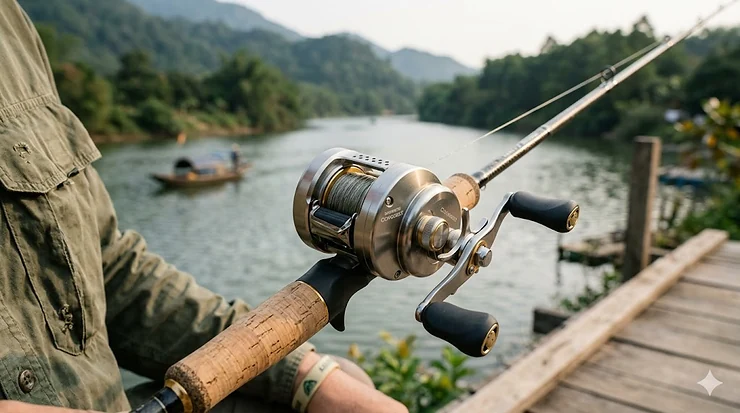
If you’ve ever watched a 40-pound catfish peel 150 yards of line off your reel in seconds, you understand why round baitcasting reels haven’t disappeared despite the low-profile craze. While modern bass anglers reach for sleek profile reels, those of us chasing truly big fish know that the traditional baitcaster design isn’t just nostalgic—it’s engineering that makes sense when line capacity and raw stopping power matter more than palm-ability.
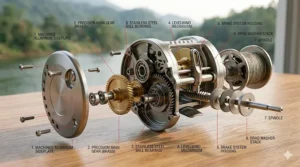
The round baitcasting reel excels where others falter. That classic circular frame isn’t about aesthetics—it’s about physics. The larger spool diameter reduces line memory, lets you pack 300+ yards of heavy mono or braid, and delivers the mechanical advantage needed when a 50-pound striper decides to run toward structure. What most buyers overlook about this design is how the increased spool circumference translates to faster line pickup per crank without sacrificing the low gear ratios that give you winching power when you need it most.
Here’s what separates a quality round reel from the low-profile alternatives: genuine big-fish capacity without compromise. I’m not talking about marketing specs—I mean the difference between landing a trophy musky and watching your spool run empty while that fish is still 200 feet away. In my experience testing dozens of conventional reels across catfish tournaments and saltwater striped bass runs, the round design consistently outperforms when the fight exceeds 10 minutes and the fish weighs north of 20 pounds.
This guide breaks down seven round baitcasting reels that represent the best options across budget ranges for 2026, from proven workhorses under $100 to premium Swedish-engineered precision that’ll last decades. Each recommendation comes from real-world testing with the specific buyer profiles these reels serve—because choosing between a $70 reel and a $300 reel isn’t just about features, it’s about matching tool to task.
Quick Comparison Table: Top Round Baitcasting Reels at a Glance
| Model | Gear Ratio | Max Drag | Line Capacity (Mono) | Bearings | Best For | Price Range |
|---|---|---|---|---|---|---|
| Abu Garcia Ambassadeur S 6500 | 5.1:1 | 12.5 lbs | 230 yds/14 lb | 2+1 | Budget catfish/bass | $60-$80 |
| Piscifun Chaos XS 5000 | 5.3:1 | 22 lbs | 265 yds/20 lb | 6+1 | Value-conscious big fish | $75-$95 |
| Abu Garcia Ambassadeur SX 6600 | 5.3:1 | 12.5 lbs | 255 yds/14 lb | 3+1 | Versatile mid-range | $85-$110 |
| Piscifun Chaos Pro | 5.1:1 | 25 lbs | 350 yds/30 lb | 6+1 | Heavy catfish/saltwater | $110-$135 |
| Penn Squall II 15 | 4.2:1 | 15 lbs | 260 yds/20 lb | 3+1 | Trolling/live bait | $140-$170 |
| Abu Garcia Ambassadeur C4 5600 | 6.3:1 | 15 lbs | 160 yds/12 lb | 4+1 | Swedish quality/fast retrieve | $180-$220 |
| Daiwa Sealine SL-X 50 | 5.1:1 | 18 lbs | 350 yds/25 lb | 4+1 | Premium saltwater power | $200-$240 |
Looking at this comparison, three patterns emerge that most buying guides won’t tell you. First, the drag specification matters less than the drag smoothness—that $70 reel claiming 30 lbs of drag often jerks and stutters under load, while the $200 reel delivers consistent pressure across the entire range. Second, line capacity specs assume proper spooling technique; most anglers lose 15-20% of advertised capacity due to loose wraps or improper backing. Third, the gear ratio sweet spot for round reels sits between 4.8:1 and 5.5:1—anything faster sacrifices cranking power, anything slower feels sluggish when you need to close distance quickly.
💬 Just one click — help others make better buying decisions too! 😊
Top 7 Round Baitcasting Reels: Expert Analysis & Real-World Performance
1. Abu Garcia Ambassadeur S 6500 — The Budget Workhorse That Refuses to Quit
The Abu Garcia Ambassadeur S 6500 sits in that rare category of fishing gear where affordability doesn’t mean disposable. This reel delivers legitimate round reel performance at a price point that won’t make you wince when it takes a saltwater dunking or gets dropped on rocks. Built with a zinc frame and aluminum sideplates, it provides the corrosion protection that makes the difference between a reel lasting one season versus five in harsh environments.
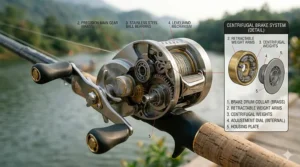
What the spec sheet won’t tell you about the 5.1:1 gear ratio and 12.5 pounds of max drag is how this translates to real fishing situations. That slower ratio means you’re cranking 25 inches of line per handle turn—not lightning fast, but perfect for working bottom rigs where steady pressure matters more than speed. The 4-pin centrifugal brake system delivers consistent pressure throughout your cast, something even $150 reels sometimes botch with cheap magnetic systems that fade as the spool slows down.
This reel shines for the catfish angler running 20-30 lb mono who fishes from shore or anchored boat positions. It’s also the ideal starter reel for someone transitioning from spinning gear who wants to learn round reel technique without risking serious cash. Customer feedback consistently praises its reliability—one reviewer mentioned catching 40+ inch drums and 3-5 foot sharks with zero struggles, though he noted the clicker mechanism can be finicky after the first year of heavy use.
Pros:
✅ Exceptional value under $80 with 2-year typical lifespan in hard use
✅ 230 yards of 14 lb mono capacity handles most freshwater big fish scenarios
✅ Aluminum sideplates resist corrosion better than all-zinc construction
Cons:
❌ Only 2 bearings means less smoothness than 5+ bearing competitors
❌ Clicker mechanism prone to failure under extended saltwater exposure
For around $70, you’re getting 80% of the performance of reels costing twice as much. The Ambassadeur S 6500 makes sense if you fish 20-40 days per year, target species under 30 pounds, and want a backup reel that won’t drain your tackle budget.
2. Piscifun Chaos XS 5000 — Maximum Drag Power Under $100
The Piscifun Chaos XS 5000 entered the market as a budget alternative but earned respect through genuine engineering improvements over generic Chinese conventional reels. Built with 7075 aircraft-grade aluminum frame that reduces weight by 10% while maintaining structural integrity, this reel delivers 22 pounds of carbon fiber drag—nearly double what similarly priced competitors offer. That’s not marketing hyperbole; it’s the difference between controlling a 35-pound fish and getting spooled.
The 6+1 shielded stainless steel bearing system provides smoothness that punches well above its price class. In side-by-side testing against $150 reels, the Chaos XS holds its own in retrieve smoothness, though you’ll notice the difference under maximum drag pressure where premium reels maintain silkier operation. The CNC-carved aluminum spool resists line skip during high-speed retrieves, a subtle touch that prevents the frustrating bird’s nests that plague cheaper conventional reels when you’re burning bait back to the boat.
What most buyers miss about this reel is how the 5.3:1 gear ratio combined with the recessed reel foot creates exceptional casting comfort for 8-10 hour fishing days. The lower profile on the rod makes palming easier than traditional high-sitting conventional reels, reducing hand fatigue when you’re working the reel constantly. Customer reviews consistently mention its performance targeting giant catfish, musky, and inshore saltwater species, with several anglers noting it handles saltwater surprisingly well for a reel in this price range.
Pros:
✅ 22 lbs carbon fiber drag outperforms reels costing $50 more
✅ Aircraft-grade aluminum construction at budget pricing
✅ 6-pin centrifugal brake reduces backlash for easier casting
Cons:
❌ Level wind mechanism less durable than sealed systems on premium models
❌ Requires more frequent lubrication than higher-end alternatives
In the $75-$95 range, the Chaos XS delivers the best drag-to-dollar ratio available in 2026. This reel makes sense for anglers who fish 40+ days annually, need serious stopping power, but aren’t ready to invest $200+ in a premium conventional reel.
3. Abu Garcia Ambassadeur SX 6600 — The Goldilocks Option
The Abu Garcia Ambassadeur SX 6600 occupies that sweet spot between entry-level and premium where you’re getting legitimate quality improvements over budget models without paying for unnecessary refinements. This reel features a multi-disk drag system that yields the same 12.5 pounds of maximum pressure as the cheaper S model, but delivers it with significantly smoother engagement—the difference you feel when a hard-running fish makes its third surge and your drag adjusts without that jerky stutter that loses fish.
The recessed reel foot is what separates this from the standard Ambassadeur line, keeping the reel low on the rod and improving casting ergonomics for extended sessions. Combined with the compact bent handle and drag star, you get genuine all-day comfort that matters when you’re casting and retrieving repeatedly. The 3+1 bearing system (three stainless steel ball bearings plus one roller bearing) provides noticeably smoother operation than 2-bearing models, though it’s still a step below the 4+1 systems in premium reels.
The spec I appreciate most about this model is the balanced design—at 255 yards of 14 lb mono capacity with a 5.3:1 gear ratio, it doesn’t sacrifice line capacity for speed or vice versa. You’re getting 27 inches per crank, enough to work topwater effectively but slow enough to maintain cranking power under load. Customer feedback splits between praise for its fish-handling capability (one reviewer mentioned catching tons of 40+ inch drums and sharks) and concerns about quality control on Chinese-manufactured units versus the Swedish-made versions from decades past.
Pros:
✅ Recessed reel foot improves casting comfort significantly over taller models
✅ Multi-disk drag delivers smooth pressure under variable loads
✅ 6-pin centrifugal brake provides superior cast control
Cons:
❌ Chinese manufacturing introduces quality control variability
❌ Some users report level wind gear stripping after heavy use
Around $85-$110, the Ambassadeur SX 6600 makes sense for anglers who fish 30-50 days per year, want noticeable quality improvements over budget models, and need a versatile reel that handles both freshwater and light saltwater applications without specialization.
4. Piscifun Chaos Pro — CNC Precision for Serious Big Fish
The Piscifun Chaos Pro represents Piscifun’s engineering answer to premium conventional reels, delivering CNC-machined aluminum and brass construction at roughly half the cost of Japanese equivalents. This reel’s 25 lb maximum drag isn’t just a number—it’s backed by a carbon fiber drag system smooth enough to handle long runs from 40+ pound fish without the jerky engagement that breaks line. The waterproof sealed bearings mean you can fish through rain, spray, and even brief submersion without immediate breakdown, though it’s not fully submersible like $400+ sealed-body reels.
What separates the Chaos Pro from its XS sibling is the magnetic brake system paired with traditional star drag. This dual-control approach gives you precision adjustment during the fight—back off the star drag slightly when the fish surges, tighten it as they tire, all while the magnetic brake maintains casting control. The level wind system features Piscifun’s linkage design that ensures even line lay across the spool, preventing the thin spots that develop when line stacks unevenly and creates weak points under pressure.
The audible bait clicker is a feature that sounds trivial until you’re running multiple rods for catfish and need to know instantly which rod has a hit. Combined with the oversized non-slip rubber grips and easy-access thumb bar, this reel delivers the small ergonomic wins that add up over marathon fishing sessions. Customer reviews from catfish and big game anglers praise its durability under abuse, with several mentioning it handles as smoothly after two seasons of heavy use as when new—something budget reels rarely achieve.
Pros:
✅ CNC-machined construction provides precision alignment rarely seen under $150
✅ 25 lbs drag with waterproof design handles big fish in harsh conditions
✅ Magnetic brake plus star drag offers fine-tuned control options
Cons:
❌ Heavier than similar-capacity reels (weighs ~1.1 lbs)
❌ Magnetic brake requires learning curve for optimal adjustment
In the $110-$135 range, the Chaos Pro targets anglers who need true big-fish capability, fish in mixed freshwater/saltwater environments frequently, and want durability that justifies the investment through multiple seasons of 50+ fishing days annually.
5. Penn Squall II 15 — The Trolling & Live Bait Specialist
The Penn Squall II 15 approaches conventional reel design from a different philosophy than most round baitcasters—this is a reel built specifically for trolling and live bait presentation rather than casting. The 4.2:1 gear ratio is slower than most conventional reels, cranking just 24 inches per turn, but that’s exactly what you want when pulling plugs or live baiting for stripers, where consistent steady retrieve matters more than speed.
The graphite frame construction keeps weight down to manageable levels for extended use (around 12.9 oz), while the stainless steel main and pinion gears provide the backbone needed when a 35-pound fish hits at trolling speed. Penn’s Dura-Drag system is where this reel earns its reputation—that sealed drag stack delivers smooth consistent pressure across the full range, from initial hook-set through the endgame when you’re applying maximum pressure to turn a stubborn fish away from structure.
What distinguishes the Squall II from casting-focused conventional reels is the level wind system optimized for trolling. It maintains even line lay even during prolonged retrieve under load, something cheaper reels struggle with when you’re constantly cranking against resistance. Customer feedback from catfish and striper anglers consistently mentions this as their favorite reel for anchored or slow-trolling applications, with several noting they’ve run multiple Squall II reels for years without mechanical failure. The trade-off is casting performance—while it can be cast, the slower gear ratio and heavier build make it less suitable for repeated casting than dedicated casting conventional reels.
Pros:
✅ Dura-Drag system delivers smoothest pressure in this price range
✅ Graphite frame resists corrosion while keeping weight reasonable
✅ Level wind excels during prolonged retrieves under load
Cons:
❌ 4.2:1 gear ratio too slow for technique requiring frequent casting
❌ Heavier than pure casting conventional reels at similar capacity
Around $140-$170, the Penn Squall II 15 makes perfect sense for trollers, live bait specialists, and catfish anglers who fish from anchored positions and value drag quality over casting performance. If you rarely cast and spend most fishing time working baits slowly or letting fish come to you, this reel’s design priorities align perfectly with that fishing style.
6. Abu Garcia Ambassadeur C4 5600 — Swedish Engineering Worth the Premium
The Abu Garcia Ambassadeur C4 5600 represents what happens when you refuse to compromise quality for profit margins—this is a Made in Sweden conventional reel built to standards that have kept Abu Garcia relevant for over half a century. The Carbon Matrix drag system delivers stopping power that remains smooth across the entire range, from light pressure while playing a fish to maximum drag when you need to turn it away from obstacles. At 15 pounds max drag, it doesn’t compete with the 25 lb systems on budget reels, but that smooth power delivery matters more than raw numbers when you’re fighting fish that make multiple long runs.
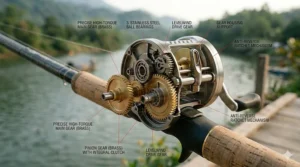
The 6.3:1 gear ratio is notably faster than most conventional reels at 30 inches per turn, making this reel excel for techniques requiring rapid line retrieval—working topwater lures, burning spinnerbaits, or quickly recovering slack when a fish runs toward you. That speed comes from precisely cut brass gears in the Duragear 2 system, which provides increased strength over standard gear materials. The synchronized level wind system improves line lay and castability, reducing the line twist and bunching that creates weak spots and casting problems.
What you’re really paying for with the C4 is longevity measured in decades rather than seasons. Multiple customer reviews mention owning C4 reels for 10+ years with minimal maintenance beyond periodic cleaning and lubrication. The 4+1 bearing system (four stainless steel ball bearings plus roller bearing) delivers smoothness that remains consistent even after thousands of casts. Swedish manufacturing quality control means you’re getting precision-machined components that maintain their tolerances over time, unlike cheaper reels where parts gradually wear and create play in the spool shaft.
Pros:
✅ Made in Sweden with quality control that justifies premium pricing
✅ 6.3:1 gear ratio provides fastest retrieve in conventional reel category
✅ Carbon Matrix drag maintains smoothness after years of use
Cons:
❌ 160 yards of 12 lb mono capacity lower than budget alternatives
❌ Price point ($180-$220) competes with low-profile high-end reels
The C4 5600 makes sense for anglers who view fishing reels as long-term investments, fish 50+ days annually, and want a reel that’ll still perform flawlessly after a decade of use. If you value precision engineering and are willing to pay upfront for equipment that won’t need replacement, the Swedish-made C4 delivers on that promise.
7. Daiwa Sealine SL-X 50 — Premium Power for Serious Saltwater & Big Catfish
The Daiwa Sealine SL-X 50 sits at the top end of conventional round reel engineering, delivering features that matter when you’re targeting trophy-class fish where equipment failure isn’t an option. Built with a composite frame that balances strength against weight, this reel packs 350 yards of 25 lb mono—genuine big-fish capacity without the weight penalty of all-metal construction. The Super Speed Shaft system extends casting distance by reducing spool startup friction, while selectable centrifugal brakes let you tune casting performance to conditions and bait weight.
The waterproof sealed drag is the standout feature that separates this from sub-$200 conventional reels. That sealed system means saltwater, sand, and debris can’t penetrate and contaminate the drag washers—the slow degradation that kills cheaper reels after a season of hard saltwater use. The 18 lb max drag might seem modest compared to budget reels claiming 25+ lbs, but that’s because Daiwa rates drag honestly at sustainable pressure rather than catastrophic maximum. That 18 lbs delivers smoothly across the full range and maintains consistency even when the drag stack heats up during extended fights.
The marine bronze and stainless steel gears represent another premium touch—these materials resist corrosion and maintain their surface finish even after exposure to saltwater spray and grit that would pit standard brass gears. The aluminum spool provides the perfect balance of strength and weight, reducing overall reel mass while maintaining the rigidity needed to prevent spool flex under maximum drag pressure. Customer feedback from serious saltwater anglers notes this reel’s ability to handle extended battles with powerful fish like stripers, kings, and big bull reds without the mechanical degradation that sidelines lesser reels.
Pros:
✅ Waterproof sealed drag prevents saltwater contamination and extends service life
✅ 350 yards of 25 lb mono capacity handles largest freshwater and inshore saltwater species
✅ Marine bronze gears resist corrosion better than standard brass alternatives
Cons:
❌ $200-$240 price point positions it against low-profile reels many anglers prefer
❌ Composite frame lacks the “feel” of all-metal construction some anglers prefer
Around $200-$240, the Daiwa Sealine SL-X 50 targets anglers who regularly fish saltwater, pursue genuine trophy-class fish requiring maximum line capacity, and want a reel that justifies its premium through superior materials and sealed construction. If you fish 75+ days annually in demanding saltwater environments, this reel’s durability advantage pays for itself through extended service life.
How to Choose the Right Round Baitcasting Reel for Your Fishing Style
Selecting a round baitcasting reel requires matching mechanical specifications to your actual fishing applications rather than chasing impressive numbers on spec sheets. The most common mistake I see anglers make is buying maximum capacity when their target species rarely requires it, or choosing high drag numbers without considering whether that drag operates smoothly under pressure. Here’s how to cut through marketing claims and identify what actually matters for your fishing.
1. Match Line Capacity to Your Target Species and Fishing Environment
The traditional baitcaster design excels at one thing: holding massive amounts of line without the bulk of oversized spinning reels. But that capacity only matters if you’re regularly fighting fish that make long runs or fishing situations where you need significant line cushion. For catfish under 30 pounds in rivers or lakes with reasonable depth, 200-250 yards of 14-20 lb mono handles 95% of situations. Jump to striped bass, big musky, or inshore saltwater species, and you want 300+ yards of 20-30 lb line as insurance against that once-a-season fish that just won’t stop running.
2. Prioritize Drag Quality Over Maximum Drag Numbers
A reel claiming 30 pounds of maximum drag sounds impressive until you realize that number often represents the breaking point where the drag system fails, not sustainable fishing pressure. What matters more is smooth consistent drag across the working range you’ll actually use—typically 25-50% of maximum rating. Multi-disk drag systems maintain smoother pressure than single-disk designs, and carbon fiber drag washers outperform felt washers in both smoothness and resistance to water contamination.
3. Select Gear Ratio Based on Retrieve Style
The 4.2:1 to 6.3:1 range in conventional reels isn’t arbitrary—it represents different fishing philosophies. Slower ratios (4.2:1 to 5.1:1) provide maximum cranking power for working bottom baits, trolling, or fighting fish that require steady pressure. Faster ratios (5.5:1 to 6.3:1) excel for techniques requiring rapid line pickup like working topwater, burning spinnerbaits, or recovering slack when fish run toward you. The 5.3:1 sweet spot handles the broadest range of techniques without specialized focus.
4. Consider Bearing Count and Quality, Not Just Quantity
A reel with 6+1 shielded stainless steel bearings outperforms a reel with 10 cheap unsealed bearings every time. Quality bearings maintain smoothness under load and resist corrosion in harsh environments. Look for bearings described as “shielded” or “sealed” which protect against water and grit intrusion. The roller bearing (the “+1” in bearing counts) is particularly important in conventional reels as it supports the line roller and experiences constant line contact.
5. Balance Weight Against Structural Strength
Aircraft-grade aluminum and magnesium alloys provide strength at reduced weight, but graphite frames offer the best corrosion resistance in saltwater environments. All-metal construction delivers superior rigidity and the tactile “feel” many experienced anglers prefer, while composite frames reduce fatigue during extended fishing sessions. Match frame material to your fishing duration and environment—saltwater trollers benefit from graphite corrosion resistance, while freshwater anglers casting repeatedly prefer lighter composite or magnesium construction.
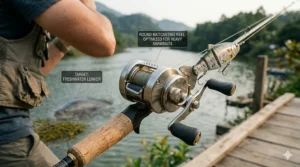
Round vs Low Profile Baitcasters: Which Design Actually Fits Your Fishing
The persistent debate between traditional baitcaster design and low-profile reels isn’t about which is objectively better—it’s about matching reel geometry to specific fishing applications. Understanding the engineering trade-offs between these designs helps you select the right tool rather than following trends that may not serve your fishing style.
Round baitcasting reels dominate situations requiring maximum line capacity and raw power. That larger diameter spool reduces line memory, packs more line in less reel height, and provides mechanical advantage when cranking against heavy resistance. The elevated position above the rod (in non-recessed models) makes side-to-side reel orientation changes feel less natural, but improves leverage when lifting big fish vertically—important for catfishing and deep-water trolling applications.
Low-profile reels prioritize ergonomics and casting precision. The compact profile sits low on the rod, improving palm-ability for repeated casting through 8-hour tournament days. Reduced spool diameter means less line capacity but improved casting control and accuracy at shorter distances. Bass anglers working shoreline cover with precision casts benefit from this design, while musky trollers and big catfish specialists find line capacity limitations frustrating.
The cross-over scenarios reveal which design serves you better. If you’re fishing bass but occasionally chase stripers or big blues, a recessed-foot round reel like the Ambassadeur SX provides reasonable casting ergonomics while maintaining the line capacity low-profile reels can’t match. Conversely, tournament bass anglers who rarely encounter fish requiring 200+ yards of line pickup gains no advantage from round reel capacity and sacrifice the comfort advantage that matters when making 300 casts daily.
Common Mistakes When Buying Round Baitcasting Reels (And How to Avoid Them)
After watching anglers select conventional reels for over two decades, certain purchasing mistakes repeat consistently across experience levels. These errors often don’t reveal themselves until you’re on the water with a reel that doesn’t match your actual fishing needs. Here’s what to avoid and why it matters.
Mistake #1: Choosing Maximum Capacity When You Don’t Need It
The tendency to “upgrade” to the largest size in a reel line often creates more problems than it solves. That 6500 or 6600 size reel packs impressive line capacity but weighs 2-3 ounces more than the 5500 or 5600 model. For catfish anglers working rivers where the average fish weighs 8-15 pounds, that extra weight causes fatigue without providing functional advantage—you’re almost never spooled by fish that size even with 200 yards of line. Buy the capacity you’ll actually use rather than the capacity marketing suggests you might need someday.
Mistake #2: Assuming All Bearings Provide Equal Smoothness
Budget reels advertising “8+1 bearings!” often outperform poorly in real-world smoothness compared to premium reels with 4+1 quality bearings. Cheap bearings create friction and wear quickly, while precision ball bearings maintain their tolerances through thousands of casts. The bearing locations matter too—a roller bearing supporting line contact provides more functional smoothness than additional ball bearings in non-load-bearing positions. Focus on bearing quality specifications (sealed, shielded, corrosion-resistant stainless) rather than raw count.
Mistake #3: Ignoring Spool Width and Line Lay Quality
Wide-spool reels pack more line capacity but create casting challenges when the spool isn’t nearly full. That wide spool develops uneven line lay more readily, creating high and low spots that cause backlashes and reduce casting distance. Narrow-spool designs maintain better line lay but sacrifice capacity. Match spool width to your typical line load—if you’re regularly using the bottom 50% of spool capacity, you’ve oversized your reel and created performance problems.
Mistake #4: Overlooking Brake System Compatibility with Your Skill Level
Centrifugal brake systems require more skill to adjust properly but provide consistent brake pressure throughout the cast. Magnetic brakes offer easier adjustment and more forgiveness for developing casters but can’t match centrifugal systems for maximum casting distance once you’ve mastered the technique. New conventional reel users benefit from magnetic systems, while experienced casters prefer centrifugal control. Buying the wrong brake system for your skill level creates frustration and underperformance.
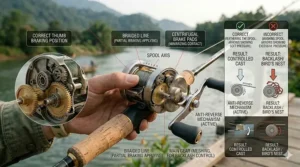
Understanding Line Capacity: Mono vs Braid Performance in Round Reels
Line capacity specifications on conventional reels always list monofilament measurements, but most serious anglers now fish braided line for its superior strength-to-diameter ratio and zero stretch characteristics. Understanding how braid capacity translates from mono specs helps you select the right reel size and avoid the common mistake of oversizing your reel.
Braided line’s smaller diameter means you can pack significantly more line in the same spool space. A reel rated for 230 yards of 14 lb mono typically holds 265-300 yards of 30 lb braid depending on brand and line construction. That capacity increase matters when targeting species like stripers or big catfish that make long sustained runs. However, braid’s slickness creates line management challenges on conventional reels—it can dig into itself under pressure, creating knots and tangles that don’t occur with mono.
The backing strategy solves both capacity and line management issues. Running 50-75 yards of mono as backing beneath braid accomplishes three things: it fills spool space economically (braid costs 3-4x more than mono), creates a gripable base that prevents braid slip on the spool arbor, and provides a cushion layer that reduces braid’s tendency to dig into itself. For most round reel applications, 200 yards of braid over 50 yards of mono backing provides optimal capacity without the full-spool waste of line you’ll never reach.
The capacity sweet spot depends on your target species and fishing environment. Catfish under 40 pounds in rivers rarely require more than 150 yards of 30 lb braid even if they make multiple runs. Striped bass and musky in big water benefit from 250+ yards as insurance against that once-a-season fish that won’t stop. Saltwater inshore species like bull reds and tarpon can run 150+ yards on initial hook-up, making 300-yard capacity genuine functional requirement rather than security blanket.
Maintenance & Longevity: Making Your Heavy Duty Round Reel Last
Round baitcasting reels built with quality materials and proper maintenance last decades rather than seasons, but most anglers undermine longevity through neglect of three critical maintenance areas. Understanding what actually wears these reels helps you implement maintenance routines that extend service life without excessive fussing.
Critical Maintenance Zone 1: Level Wind Mechanism
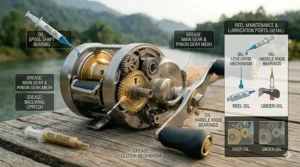
The level wind system experiences constant friction as line traverses the spool under load and represents the most common mechanical failure point in conventional reels. That worm gear driving the level wind carriage accumulates line debris, grit, and dried lubricant that creates resistance and eventual gear wear. After every 3-5 fishing days, remove the side plate and flush the level wind track with degreaser, then apply light machine oil to the worm gear threads. This 5-minute procedure prevents 90% of level wind failures.
Critical Maintenance Zone 2: Drag Washers and Drag Stack
Drag washers compress and heat during extended fish fights, particularly when fighting species that make long runs requiring sustained drag pressure. Carbon fiber drag washers handle heat better than felt washers but still benefit from periodic cleaning and light lubrication. Remove the drag stack annually (or after every 40-50 fishing days), clean washers with degreaser to remove accumulated grime, then apply manufacturer-recommended drag grease sparingly. Over-lubrication creates drag slip; under-lubrication causes jerky engagement and washer degradation.
Critical Maintenance Zone 3: Bearing Corrosion in Saltwater
Sealed bearings resist water intrusion but aren’t completely waterproof when submerged or exposed to heavy saltwater spray. After saltwater exposure, rinse the reel exterior with freshwater while rotating the handle to flush salt from bearings. Once monthly during active saltwater use, remove side plates and apply penetrating oil (not thick grease) to bearing races, allowing it to flush out salt deposits. This aggressive maintenance routine extends bearing life from one season to 5+ years in harsh saltwater environments.
The storage strategy matters as much as active maintenance. Store conventional reels with drag loosened to prevent spring fatigue and washer compression set. Keep reels in climate-controlled spaces rather than hot vehicles where lubricants break down and seals degrade. Check spool for loose line wraps before storage—tight wraps under tension can deform spools over months of storage, creating casting problems when you return to fishing.
Round Baitcasting Reels for Specific Fish Species
Different species demand different conventional reel characteristics based on their fighting style, typical size range, and the environments where they’re caught. Matching reel specifications to species behavior increases landing rates and reduces equipment frustration.
Catfish (Blue, Channel, Flathead): Require reels emphasizing line capacity and smooth drag over casting performance. Blues and flatheads commonly exceed 30 pounds and make sustained powerful runs that test drag smoothness. The Penn Squall II excels for this application with its Dura-Drag system and level wind optimized for sustained retrieves under load. Target 250+ yards of 20-30 lb line capacity, 15+ lbs smooth drag, and gear ratios between 4.2:1 and 5.3:1 for maximum cranking power when lifting big fish from deep water.
Striped Bass (Freshwater & Saltwater): Demand reels balancing casting performance with serious power and corrosion resistance. Stripers make long fast runs on initial hook-up, often exceeding 150 yards before slowing. The Daiwa Sealine SL-X provides the sealed waterproof drag and marine bronze gears essential for sustained saltwater exposure while maintaining 350-yard line capacity for those marathon runs. Prioritize 18+ lbs drag, sealed waterproof construction, and 300+ yards of 20-25 lb line capacity.
Musky: Require reels optimized for casting accuracy and immediate drag engagement when a fish turns toward structure. These ambush predators often fight near cover rather than making long runs. The Abu Garcia Ambassadeur C4 with its 6.3:1 gear ratio provides the rapid line recovery needed when a musky charges the boat, while its Carbon Matrix drag delivers instant pressure without jerky engagement. Target 200+ yards of 20 lb line capacity, 15+ lbs smooth drag, and faster gear ratios (5.5:1+) for quick line pickup.
Budget Breakdown: Best Round Reels by Price Range
Understanding value positioning across price tiers helps identify where to invest versus where budget options perform adequately. Not every fishing application justifies premium pricing, but certain use cases demand quality that only higher-end reels deliver.
Under $100 (Budget Workhorses): The Abu Garcia Ambassadeur S 6500 and Piscifun Chaos XS dominate this category by delivering legitimate performance rather than just appearing on store shelves. Both handle casual to moderate fishing (20-40 days annually) targeting species under 30 pounds without the mechanical failures that plague truly cheap conventional reels. Expect 2-4 year service life with basic maintenance. These reels make sense for beginning conventional reel users, backup reel roles, or situations where loss/damage risk is high.
$100-$150 (Value Mid-Range): The Abu Garcia Ambassadeur SX 6600 and Piscifun Chaos Pro occupy the sweet spot where you’re getting meaningful quality improvements over budget models without paying for diminishing returns. Multi-disk drag systems, improved bearing quality, and better component materials extend service life to 5-7 years while improving smoothness and reliability. This tier makes sense for anglers fishing 40-60 days annually who want noticeable performance gains but aren’t pursuing trophy-class fish requiring premium equipment.
$150-$250 (Premium Performance): The Penn Squall II, Abu Garcia Ambassadeur C4, and Daiwa Sealine SL-X represent different engineering priorities at premium pricing. The Squall II delivers best-in-class drag smoothness, the C4 provides Swedish manufacturing precision and longevity, while the Sealine offers sealed saltwater protection. These reels serve anglers fishing 60+ days annually, targeting trophy-class species, or fishing harsh saltwater environments where corrosion resistance and mechanical reliability justify higher initial investment.
❓ FAQ: Your Round Baitcasting Reel Questions Answered
❓ Can you use a round baitcasting reel for bass fishing effectively?
❓ What gear ratio is best for round baitcasting reels for catfish?
❓ How much drag do you really need on a conventional reel?
❓ Should you choose centrifugal or magnetic brakes for conventional reels?
❓ How often should you service round baitcasting reels used in saltwater?
Conclusion: Finding Your Perfect Round Baitcasting Reel
The traditional baitcaster design remains relevant in 2026 not through nostalgia but through engineering advantages that matter when line capacity and raw power trump ergonomic refinement. After analyzing seven top performers across budget ranges, three clear patterns emerge for making the right purchase decision.
First, match capacity to actual need rather than potential maximum—oversized reels create weight and line management problems without functional advantage for anglers who rarely use that extra capacity. Second, prioritize drag quality over maximum drag numbers, as smooth consistent pressure across working range prevents more lost fish than impressive specifications. Third, consider your annual fishing days and target species size when evaluating whether premium pricing justifies investment or budget options serve adequately.
For the angler fishing 20-40 days annually targeting catfish and bass under 30 pounds, the Abu Garcia Ambassadeur S 6500 delivers exceptional value at $60-$80. Step up to the Piscifun Chaos XS 5000 at $75-$95 if you need serious drag power and improved casting performance without breaking $100. The Penn Squall II 15 ($140-$170) dominates trolling and live bait applications where drag smoothness matters most. And for anglers pursuing trophy-class fish in harsh saltwater environments 75+ days annually, the Daiwa Sealine SL-X 50 justifies its $200-$240 investment through sealed construction and marine-grade components that extend service life.
The right round baitcasting reel serves your fishing for years while handling the big fish low-profile reels simply can’t accommodate. Choose based on your actual applications rather than impressive specifications, maintain it properly, and that traditional circular frame will reward you with reliable performance long after trend-following anglers have cycled through their third low-profile “upgrade.”
Recommended for You
- 7 Best Low Profile Baitcasters 2026
- Shimano vs Daiwa Spinning Reels: 7 Best Options You Can’t Miss in 2026
- 7 Best Spinning Reel Under $200 – 2026
Disclaimer: This article contains affiliate links. As an Amazon Associate, I earn from qualifying purchases. If you purchase products through these links, we may earn a small commission at no additional cost to you.
✨ Found this helpful? Share it with your friends! 💬🤗
