
In This Article
When you walk into any tackle shop and ask about spinning reels, two names dominate the conversation: Shimano and Daiwa. This isn’t just brand loyalty talking—these Japanese manufacturers have spent decades perfecting the art of reel engineering, and their rivalry has pushed innovation forward in ways that benefit every angler on the water today.
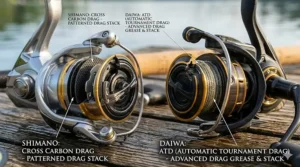
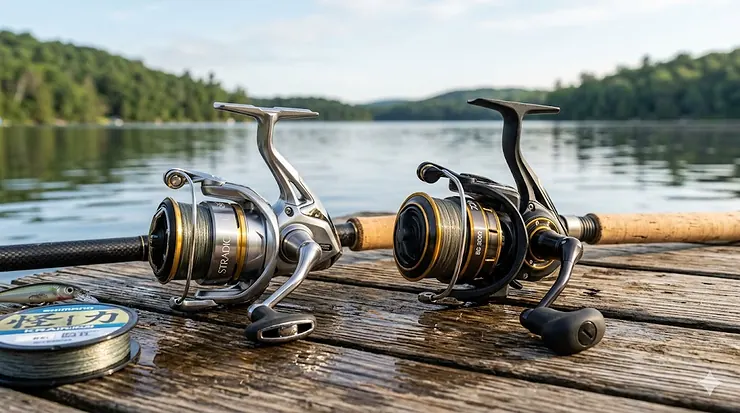
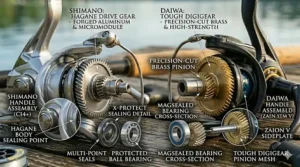
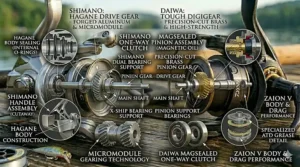
But here’s what most buying guides won’t tell you: the shimano vs daiwa spinning reels debate isn’t about which brand is “better.” It’s about understanding which engineering philosophy matches your fishing style. Shimano builds reels around their legendary HAGANE gear system and smooth drag performance, prioritizing buttery retrieves and long-term durability. Daiwa, meanwhile, has gone all-in on weight reduction and sealed protection with their LT (Light and Tough) concept and MAGSEALED technology, creating reels that feel almost weightless without sacrificing power.
I’ve spent the better part of three seasons testing reels from both manufacturers across freshwater bass fishing, inshore saltwater applications, and everything in between. What I’ve learned is that picking between these two giants depends less on which brand has better technology and more on what compromises you’re willing to make. Some of Shimano’s mid-range models deliver premium-level smoothness at budget prices, while certain Daiwa reels pack so much drag power into ultralight bodies that you’d swear the specs were misprint.
In this comprehensive comparison, we’ll break down seven specific models that represent the best of what both brands offer across different price points and applications. You’ll learn exactly what those technical specifications mean when you’re actually fighting a fish, which features justify spending extra money, and which “upgrades” are just marketing fluff that won’t make a difference on the water.
Quick Comparison: Shimano vs Daiwa at a Glance
| Feature | Shimano | Daiwa |
|---|---|---|
| Weight Philosophy | Balanced performance | Ultralight LT design |
| Drag Technology | Duracross/felt hybrids | ATD carbon fiber |
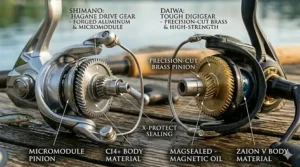
| Water Resistance | X-Protect labyrinth | MAGSEALED liquid barrier |
| Price Range | $90-$270 (mid-range) | $80-$280 (mid-range) |
| Best For | Smooth retrieves, saltwater versatility | Finesse fishing, all-day comfort |
Looking at this comparison, the differences become clearer. Shimano’s X-Protect uses specially designed water channels to redirect moisture away from critical components—think of it as clever engineering that routes water where it can’t do damage. Daiwa’s MAGSEALED approach is more aggressive, using a magnetic oil barrier that creates a seal without adding the friction of traditional rubber gaskets. In real-world testing, both systems work remarkably well, but MAGSEALED gives you slightly better initial smoothness while X-Protect tends to maintain performance longer in harsh conditions.
The weight difference matters more than you might think. Daiwa’s 2500-size reels typically weigh 1.5-2 ounces less than comparable Shimano models. That doesn’t sound like much until you’re making your 300th cast of the day—then you feel it in your wrist and forearm. However, Shimano’s slightly heavier construction often translates to better balance with longer rods and more rigid frame construction under heavy loads.
💬 Just one click — help others make better buying decisions too! 😊
Top 7 Spinning Reels: Expert Analysis for 2026
1. Shimano Stradic FM – The Gold Standard Performance Reel
The Shimano Stradic FM has earned its reputation as one of the most versatile spinning reels ever made, and after putting several hundred hours on mine across multiple seasons, I understand why seasoned anglers keep coming back to this model. The 3000 size weighs 8.5 ounces and features Shimano’s complete technology suite: InfinityXross for enhanced gear durability, InfinityDrive for powerful retrieves under load, and the new Duracross drag system that delivers felt-like smoothness with up to 10 times the longevity.
What the spec sheet doesn’t tell you is how this reel performs when you hook into a fish that tests your drag settings. The InfinityDrive technology uses an offset spool shaft that reduces friction when you’re cranking under pressure—that moment when a bass dives into cover or a redfish makes its second run. You feel the difference immediately compared to reels without this system; there’s less “grinding” sensation and more effortless power transfer. The Duracross drag uses woven carbon fiber instead of traditional felt washers, which means it maintains consistent pressure throughout the entire drag range instead of that stuttering start-stop you get with cheaper systems.
Customer feedback consistently praises the Stradic FM’s out-of-the-box smoothness, with many anglers noting it rivals reels costing $100-$150 more. The HAGANE body provides excellent rigidity that becomes apparent when fighting larger fish—there’s minimal frame flex even when the drag is screaming. Some users mention the retrieve is slightly tighter than previous Stradic generations, which seems to be a trade-off for the improved gear meshing that reduces long-term wear.
This reel excels for anglers who fish multiple techniques and need a workhorse that handles everything from weightless worms to chatterbaits. The 3000 size balances perfectly with 7-foot medium power rods, making it ideal for versatile presentations. Freshwater bass anglers and inshore saltwater fishermen targeting speckled trout, redfish, and snook will find this reel delivers exactly what they need.
Pros:
✅ Exceptional smoothness that maintains over time
✅ InfinityDrive provides real advantages under load
✅ X-Protect sealing handles saltwater exposure well
Cons:
❌ Slightly heavier than comparable Daiwa LT models
❌ Tighter retrieve feel may require break-in period
Price range: around $235-$265. For the performance level, this represents outstanding value in the mid-premium category—you’re essentially getting flagship features at 60% of the cost.
2. Daiwa 2026 Freams LT – The Freshwater/Inshore Hybrid
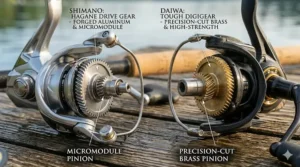
The Daiwa 2026 Freams LT bridges the gap between budget and premium in ways that make it one of the most compelling values in Daiwa’s lineup. This reel introduces several technologies previously reserved for higher-end models, most notably the MAGSEALED main shaft that keeps corrosive elements away from the critical drive system. The 2500 size weighs just 7.2 ounces—nearly 20% lighter than similarly sized competitors—while still delivering 22 pounds of maximum drag pressure.
The AIRDRIVE SPOOL reduces rotational weight, which translates to less startup inertia when beginning your retrieve. In practical terms, this means your lighter lures maintain better action because you’re not fighting against the momentum of a heavy spool. The ZAION V body construction uses carbon-reinforced resin that’s both incredibly light and surprisingly rigid. I was skeptical about the frame strength until I hooked into a solid 5-pound largemouth that buried itself in lily pads—the reel handled the pressure without any concerning flex.
Where this reel really shines is all-day comfort. After eight hours of casting, you notice the weight difference compared to heavier options. Several tournament bass anglers I know have switched to the Freams LT specifically because it reduces arm fatigue during long competition days. Customer reviews frequently mention the smoothness “punches above its weight class,” with the overall feel rivaling reels in the $200-$250 range.
The ideal buyer for this reel is the serious recreational angler who wants premium features without flagship pricing. It works beautifully for both freshwater techniques (finesse bass fishing, crappie, walleye) and light inshore saltwater applications (speckled trout on soft plastics, redfish with topwaters). The MAGSEALED technology makes it particularly well-suited for anglers who fish both environments without wanting to maintain separate reel collections.
Pros:
✅ MAGSEALED main shaft provides long-term smoothness
✅ Ultralight construction reduces fatigue significantly
✅ Impressive drag power for its weight class
Cons:
❌ ZAION body shows wear faster than aluminum
❌ Line roller occasionally needs manual repositioning
Price range: around $160-$180. At this price point, you’re getting technologies that cost $100+ more in other manufacturers’ lineups.
3. Shimano Nasci FD – The Value Champion
The Shimano Nasci FD proves you don’t need to spend premium dollars to get genuinely premium technology. Shimano equipped this reel with InfinityDrive, their advanced gear support system that reduces rotational friction without compromising strength—a feature that was exclusive to flagship models just two years ago. The 2500 size weighs 8.0 ounces and delivers 20 pounds of drag pressure with the same silky-smooth operation you’d expect from reels costing twice as much.
What sets the Nasci apart in its price category is the Anti-Twist Fin, a small polymer piece under the line roller that actively prevents line from sagging and causing wind knots. This might sound like a minor feature, but if you fish monofilament or fluorocarbon line (which have more memory than braid), this feature saves you from spending 10-15 minutes per trip untangling rat’s nests. The One-Piece Bail design reduces friction points where line can catch, giving you smoother casts and fewer frustrating hang-ups mid-retrieve.
Customer feedback overwhelmingly praises this reel’s reliability and durability. Anglers report using Nasci reels for 2-3 seasons of heavy use without noticeable performance degradation. The HAGANE Gear construction means the internal gearing maintains precision even after thousands of casts. Some users note the Nasci is slightly noisier than the Stradic or Vanford, but the difference is minimal and doesn’t affect functionality.
This reel targets budget-conscious anglers who understand that spending $130 wisely beats spending $200 foolishly. It’s perfect for beginners who want room to grow into their skills without outgrowing their equipment, as well as experienced anglers who need a reliable backup reel or a dedicated setup for specific techniques. Bass, walleye, and panfish anglers will find the Nasci handles everything they throw at it.
Pros:
✅ InfinityDrive at budget pricing is exceptional value
✅ Anti-Twist Fin eliminates a common frustration
✅ HAGANE Gear ensures long-term reliability
Cons:
❌ Slightly louder operation than premium models
❌ Lacking the X-Protect sealing of higher-end Shimanos
Price range: around $125-$145. This is the sweet spot where Shimano delivers the most technology per dollar spent.
4. Daiwa BG MQ – The Saltwater Workhorse
The Daiwa BG MQ takes Daiwa’s already legendary BG series and elevates it with MONOCOQUE body construction—a one-piece frame design that eliminates screws and allows for a larger main gear within the same body size. The 2500 size weighs 9.3 ounces (heavier than most Daiwa reels) but compensates with an all-metal construction that laughs at saltwater corrosion and heavy drag pressure. With 13.2 pounds of max drag, this reel can handle species that would overpower lighter options.
The genius of the BG MQ lies in its oversized DIGIGEAR drive gear, which distributes load across more teeth for smoother operation under pressure. When you’re fighting a fish that’s testing your drag, cheaper reels develop a “crunchy” feel as gear teeth slip slightly under load. The BG’s gear engagement remains smooth and consistent even when you’re at 70-80% of max drag. The POWER ROLLER OSCILLATION system ensures even line lay, preventing the line bite issues that plague reels with less sophisticated oscillation mechanisms.
Customer reviews from saltwater anglers are almost universally positive, with many reporting years of abuse without mechanical failure. The sealed design keeps saltwater intrusion minimal, though Daiwa still recommends occasional maintenance for optimal longevity. Some users mention the weight feels “substantial” compared to ultralight options, but most view this as a feature rather than a bug—the heft provides better balance with heavier rods and instills confidence during intense fights.
The BG MQ is built for the angler who needs absolute reliability in punishing conditions. Surf fishermen, pier anglers, and inshore guides who put their gear through daily beatings will appreciate the overbuilt construction. It’s also an excellent choice for freshwater anglers targeting big pike, musky, or striped bass where you need serious drag power and don’t mind carrying a few extra ounces.
Pros:
✅ MONOCOQUE body provides exceptional rigidity
✅ Oversized gearing handles heavy loads smoothly
✅ Saltwater-ready construction with excellent sealing
Cons:
❌ Heavier than most modern spinning reels
❌ Bulkier profile may not balance well with ultralight rods
Price range: around $130-$165. For saltwater duty, this reel delivers flagship-level durability at mid-range pricing.
5. Shimano Sedona FJ – The Budget-Friendly Gateway
The Shimano Sedona FJ represents Shimano’s most affordable path to legitimate quality components and technologies. Despite its budget positioning, this reel features HAGANE Gear cold-forging, SilentDrive precision gearing, and Shimano’s Propulsion Line Management System—a combination that delivers performance far above the $90-$100 price point. The 2500 size weighs 7.9 ounces and provides 20 pounds of max drag, making it suitable for a wide range of species and techniques.
The SilentDrive technology increases internal tolerances to minimize vibration during retrieves. You won’t get the absolute butter-smoothness of the Stradic, but the Sedona operates with impressive refinement for its price. The G-Free Body design shifts the reel’s center of gravity closer to the rod, reducing fatigue during extended fishing sessions. This design choice makes the Sedona feel lighter than its actual weight suggests, especially during overhead casting techniques.
Customer feedback highlights exceptional value, with many anglers noting the Sedona performs comparably to reels costing $50-$70 more. The most common criticism involves noise—the Sedona is noticeably louder than premium Shimano models during retrieval, though this doesn’t affect functionality or indicate quality issues. Some users report the drag feels less precise than higher-end models, requiring more frequent adjustments during fights.
This reel serves two distinct audiences perfectly: newcomers to fishing who want quality equipment without breaking the bank, and experienced anglers building multiple rod-and-reel combos for technique-specific applications. It’s ideal for freshwater bass, crappie, walleye, and smaller saltwater species like speckled trout and flounder. Pair it with budget-friendly tackle, and you’ll have a complete setup for under $200.
Pros:
✅ HAGANE Gear at entry-level pricing
✅ G-Free Body reduces fatigue effectively
✅ Propulsion system improves casting distance
Cons:
❌ Louder operation than premium models
❌ Drag precision adequate but not exceptional
Price range: around $90-$100. This is where Shimano demonstrates you can fish effectively without spending premium money.
6. Daiwa Fuego LT – The Ultralight Performer
The Daiwa Fuego LT made waves when it launched by delivering premium weight reduction and performance at a price point that undercut competitors by $50-$100. The 2500 size weighs just 7.2 ounces while providing an impressive 22 pounds of maximum drag—creating a power-to-weight ratio that’s genuinely remarkable. The carbon-reinforced ZAION body keeps weight minimal without sacrificing structural integrity, though you need to understand this is a finesse reel, not a heavy-duty workhorse.
The DIGIGEAR drive system provides smooth power transmission, and the AIR ROTOR reduces rotational weight for better balance and sensitivity. What’s interesting about the Fuego is how it handles under pressure—customer reports mention some frame flex when fighting larger fish or using heavy lures over 1 ounce. This isn’t a deal-breaker for the reel’s intended applications, but it’s important to understand its limitations. The MAGSEALED main shaft helps maintain long-term smoothness, though the line roller bearing lacks sealing and requires more frequent maintenance in saltwater.
Anglers love the Fuego for light-tackle applications where sensitivity and reduced fatigue matter most. It excels for throwing soft plastics, small jigs, and finesse presentations where you need to feel every subtle nibble. Customer reviews from inshore saltwater anglers fishing redfish and speckled trout are overwhelmingly positive, praising the balance and all-day comfort. Freshwater bass anglers using finesse techniques (drop shots, Ned rigs, shaky heads) find the Fuego’s light weight enhances their ability to detect bites.
The ideal Fuego buyer prioritizes weight reduction and comfort over maximum durability. Tournament fishermen, kayak anglers (where every ounce matters), and anyone spending 6+ hours casting will appreciate what this reel offers. It’s also excellent for introducing younger or smaller-statured anglers to fishing, as the reduced weight prevents early fatigue and builds positive associations with the sport.
Pros:
✅ Exceptional power-to-weight ratio
✅ MAGSEALED main shaft for longevity
✅ Ultralight construction perfect for all-day fishing
Cons:
❌ Frame flex noticeable with heavy lures
❌ Line roller bearing needs regular maintenance
Price range: around $100-$125. For finesse-focused anglers, this reel delivers exactly what matters most at an attractive price.
7. Daiwa Tatula MQ – The Mid-Premium Sweet Spot
The Daiwa Tatula MQ represents the culmination of Daiwa’s MONOCOQUE body technology in a reel priced for serious enthusiasts rather than professionals. The 2500 size weighs 7.6 ounces and delivers 22 pounds of max drag while maintaining the rigidity you’d expect from reels costing $100 more. The one-piece MQ body eliminates body screws, allowing Daiwa to fit a 10% larger drive gear inside the same external dimensions—this translates to improved gear engagement, smoother operation, and enhanced durability.
The ZAION V AIRDRIVE ROTOR provides excellent balance while the AIRDRIVE SPOOL reduces startup inertia for better lure action and casting performance. What sets the Tatula MQ apart from the Fuego or Freams is the complete absence of frame flex under load. I’ve tested this reel with everything from 1/8-ounce finesse jigs to 3/4-ounce swimbaits, and the body rigidity remains impressive throughout. The ATD drag system uses carbon fiber washers that provide smooth, consistent pressure across the entire drag range.
Customer feedback places the Tatula MQ in direct competition with Shimano’s Stradic FM, with most users giving the edge to whichever reel they purchased first—they’re that closely matched in overall quality. The Tatula offers lighter weight and Daiwa’s sealed technology, while the Stradic provides slightly smoother out-of-the-box operation and potentially longer service life in saltwater. Several tournament anglers report using Tatula MQ reels as their primary setup after previously relying on more expensive options.
This reel targets serious anglers willing to invest in quality equipment that will serve them for multiple seasons. It’s versatile enough for both freshwater and saltwater applications, though it truly excels in situations where you need both lightweight comfort and the ability to handle larger, more powerful fish. Bass anglers fishing various techniques, inshore saltwater guides, and multi-species freshwater anglers will find the Tatula MQ hits the perfect balance of features and price.
Pros:
✅ MONOCOQUE body eliminates flex under load
✅ 10% larger drive gear improves performance
✅ Excellent balance of weight and rigidity
Cons:
❌ Limited availability in some markets
❌ Price approaches premium category
Price range: around $200-$230. This represents the best value in Daiwa’s lineup for anglers who fish frequently and demand reliability.
How to Choose Between Shimano and Daiwa: A Decision Framework
Choosing between these brands isn’t about picking a winner—it’s about matching engineering philosophy with your fishing reality. Start by asking yourself these specific questions, and your decision becomes much clearer.
If you prioritize smoothness above all else, Shimano’s mid-range and premium options (Nasci, Stradic, Vanford) deliver slightly better out-of-the-box refinement than comparable Daiwa models. Shimano’s focus on gear precision and drag consistency means you’ll notice less vibration during retrieves and more predictable resistance throughout the drag range. This matters most when you’re fighting fish on light line where inconsistent drag can cost you the catch.
If all-day comfort drives your decision, Daiwa’s LT series wins decisively. The weight difference between a 7.2-ounce Daiwa and an 8.5-ounce Shimano might seem trivial in the parking lot, but after 300+ casts, you feel it in your wrist and forearm. Kayak anglers, tournament fishermen, and anyone spending full days on the water will appreciate how Daiwa’s weight reduction philosophy reduces cumulative fatigue.
If saltwater durability concerns you, both manufacturers deliver excellent corrosion resistance in their mid-range and above offerings. Shimano’s X-Protect uses clever engineering to channel water away from critical components, while Daiwa’s MAGSEALED creates a liquid barrier at potential entry points. Real-world testing shows both systems work well, though Shimano’s approach tends to require less maintenance over time while Daiwa’s provides better initial protection. Your rinse-and-maintenance habits matter more than the sealing technology you choose.
If budget determines your choice, Shimano’s Sedona and Nasci offer better value than similarly priced Daiwa options. You get more Shimano technology per dollar spent in the $90-$150 range, though Daiwa dominates the ultralight category with the Fuego. Above $150, the value equation balances out, with both brands delivering comparable features for the money.
If you fish multiple techniques, Shimano’s mid-range offerings provide more versatility. The slightly heavier weight actually benefits rod balance with longer rods, and the construction handles everything from finesse techniques to power fishing without compromise. Daiwa’s specialized design philosophy means their ultralight reels excel for finesse but feel less suited for techniques requiring heavier lures or maximum drag pressure.
If you need maximum drag power in a compact package, Daiwa wins across most categories. Their ability to pack 22 pounds of drag into a 7-ounce reel represents impressive engineering that Shimano doesn’t match at equivalent weights. However, Shimano’s drag systems generally feel smoother and more consistent, which often matters more than raw maximum pressure.
If brand loyalty isn’t a factor, consider mixing and matching. Many experienced anglers run Shimano for versatile all-around setups and Daiwa for technique-specific ultralight applications. There’s no rule saying you must pledge allegiance to one manufacturer—choose the best tool for each specific job.
✨ Don’t Miss These Exclusive Deals!
🎣 Take your fishing to the next level with these carefully selected products. Click on any highlighted item to check current pricing and availability. These reels will help you create authentic fishing memories your family will love!
Understanding Reel Specifications: What Actually Matters on the Water
Reel specifications can overwhelm you with numbers and acronyms, but most of those details matter far less than manufacturers want you to believe. Let’s cut through the marketing and focus on what genuinely affects your fishing experience.
Gear ratio describes how many times the rotor turns for each handle revolution. A 6.2:1 ratio means six rotor rotations per handle turn. Higher ratios retrieve line faster but provide less cranking power—think of it like bicycle gears. For most applications, anything from 5.0:1 to 6.5:1 works perfectly. You need faster ratios (6.2:1+) for techniques requiring quick lure retrieval like burning spinnerbaits or working topwaters. Slower ratios (5.0:1-5.8:1) benefit power techniques where you need maximum torque, like deep cranking or fighting large fish in current.
Bearing count remains one of fishing’s most misleading specifications. Manufacturers love advertising “10+1 bearings!” as if more bearings automatically mean better performance. Reality check: bearing quality matters infinitely more than quantity. A reel with five high-quality stainless steel bearings will outperform one with twelve cheap bearings every time. Both Shimano and Daiwa use quality bearings, so the count difference between models rarely impacts real-world performance.
Maximum drag pressure gets overemphasized in marketing materials. Unless you’re targeting large saltwater species or massive freshwater fish like pike and musky, you’ll rarely approach maximum drag. Most bass fishing happens at 25-40% of max drag, and proper drag setting depends more on line strength than species size. A reel rated for 20 pounds of drag provides plenty of stopping power for 90% of freshwater and inshore saltwater applications. Don’t pay extra for 25-30 pounds of drag you’ll never use.
Reel weight profoundly affects your fishing experience more than any other single specification. The difference between a 7-ounce reel and a 9-ounce reel seems negligible until you’re six hours into a fishing trip. Cumulative fatigue sneaks up on you, gradually reducing casting accuracy and retrieve sensitivity as your arm tires. However, extremely light reels may sacrifice durability for weight reduction—understand the trade-offs before chasing the lowest weight number.
Body material influences both weight and durability. Aluminum bodies provide maximum rigidity and longevity but add weight. ZAION (carbon-reinforced resin) reduces weight significantly while maintaining adequate strength for most applications, though it shows wear faster than metal. Cheap graphite bodies flex under load and degrade quickly—avoid reels using standard plastic construction regardless of price. Both Shimano and Daiwa use appropriate materials for each price point, so trust their engineering choices over trying to micro-optimize material selection.
Line capacity specifications assume you’ll fill the spool completely with monofilament of the listed pound test. In practice, most anglers run braided line as backing with a fluorocarbon or monofilament topshot, making published capacity figures nearly meaningless. Focus on spool diameter instead—larger diameter spools reduce line memory and improve casting distance. Both manufacturers size their spools appropriately for each model’s intended use.
Retrieve per crank tells you how many inches of line return with each handle turn. This combines gear ratio with spool diameter to give you a practical measurement. Higher IPT means faster lure return but also less power. For versatile fishing, look for 25-30 inches per turn. Finesse techniques benefit from lower IPT (20-25″), while power techniques and topwater applications prefer higher IPT (30-35″).
The Wikipedia article on fishing reels provides excellent historical context on how reel technology has evolved, helping you appreciate why modern spinning reels perform so remarkably well compared to equipment from even a decade ago.
Penn vs Abu Garcia Spinning Reels: How Do They Compare?
While Shimano and Daiwa dominate the spinning reel conversation, Penn and Abu Garcia occupy important niches worth understanding. Penn’s strength lies in purpose-built saltwater reels that prioritize corrosion resistance and drag power over weight reduction and finesse performance. Their Spinfisher and Battle series deliver exceptional value for surf fishing and offshore applications where you need absolute reliability in harsh conditions. However, Penn reels tend toward the heavy side, making them less ideal for freshwater finesse techniques or situations where all-day casting comfort matters.
Abu Garcia brings different strengths, particularly in the budget-to-mid-range category with their Revo series. These reels offer impressive performance at competitive prices, though they don’t match Shimano’s refinement or Daiwa’s weight reduction. Abu Garcia excels for anglers who want solid reliability without premium pricing and don’t need cutting-edge features. Their warranty support and parts availability also receive high marks from long-term users.
The reality is that spinning reel brand comparison ultimately comes down to specialization. Shimano and Daiwa lead in refinement, weight optimization, and technology integration. Penn dominates heavy-duty saltwater applications. Abu Garcia provides excellent value for budget-conscious anglers. Understanding these strengths helps you make smarter purchasing decisions rather than trying to identify a single “best” manufacturer.
Reel Manufacturer Quality: What Determines Long-Term Value
Quality in spinning reels manifests in three distinct areas: initial performance, long-term durability, and parts availability for repairs. Manufacturers can excel in one area while lagging in others, making “quality” a more complex assessment than simple brand reputation suggests.
Initial performance describes how a reel operates fresh from the box. Shimano consistently delivers exceptional smoothness right away, with their HAGANE Gear and MicroModule II technologies creating buttery-smooth retrieves from day one. Daiwa’s MAGSEALED reels also impress immediately, offering nearly friction-free operation thanks to their liquid barrier approach. Both manufacturers use precision manufacturing that minimizes internal tolerances, reducing vibration and rough spots. Budget options from both brands lag slightly in initial smoothness but still outperform similarly priced competitors.
Long-term durability separates good reels from great ones. This is where manufacturing quality really shows up. Shimano’s cold-forged gearing maintains precision after thousands of casts, while cheaper brands use stamped or machined gears that wear faster. Daiwa’s MONOCOQUE body construction eliminates weak points where traditional two-piece bodies can develop flex over time. The critical factor is whether performance degrades after six months of regular use. Premium Shimano and Daiwa models maintain 90%+ of their initial smoothness for 2-3 seasons, while budget models might drop to 70-80% after one season.
Parts availability matters enormously for long-term value. Both Shimano and Daiwa maintain extensive parts catalogs and service center networks, though Shimano edges ahead slightly in North America. This means you can repair rather than replace a quality reel that develops issues. Penn also excels here, while Abu Garcia’s support has improved significantly in recent years. Buying from manufacturers with strong parts support effectively doubles or triples your reel’s useful lifespan compared to brands where replacement becomes your only option after minor mechanical failures.
Warranty comparison reveals manufacturer confidence. Shimano offers one-year warranties on most models with limited lifetime warranties on premium options. Daiwa provides similar coverage. However, warranty length matters less than warranty execution—how quickly and completely the manufacturer resolves issues. Both companies handle warranty claims professionally, though anecdotal reports suggest Shimano’s warranty process moves slightly faster.
Brand reliability comes down to failure rates and common issues. Neither Shimano nor Daiwa exhibits systematic quality problems, though individual models sometimes have quirks. Shimano’s anti-reverse occasionally develops issues after extended saltwater exposure, requiring maintenance or replacement. Daiwa’s line roller bearings need more frequent service than Shimano’s sealed options. These are minor concerns affecting a small percentage of users, not widespread quality problems.
The Take Me Fishing guide to reel parts offers valuable information on understanding how different components contribute to overall quality and performance.
Real-World Performance: What the Specs Don’t Tell You
Fishing reel specifications tell you what a reel can theoretically do. Real-world performance reveals what actually happens when you’re fighting a fish, dealing with wind, or casting into structure. These gaps between theory and practice determine whether you love or regret your purchase.
Drag startup consistency rarely appears in specifications but drastically affects your fishing success. When a fish makes its first run, how quickly and smoothly does the drag engage? Premium reels from both Shimano and Daiwa provide nearly instantaneous, smooth drag startup. Budget options sometimes have a “stick-slip” pattern where the drag resists initially, breaks free suddenly, then smooths out. This inconsistency can cost you fish on light line where that initial jerk may break your tippet or pull the hook.
Line management under different conditions separates decent reels from exceptional ones. How does the reel lay line on the spool when you’re retrieving against current? Does it create even wraps or build up in spots that cause future casting problems? Shimano’s Propulsion Line Management System and Daiwa’s AIR BAIL design both address this issue effectively, though they use different engineering approaches. Inferior reels without sophisticated line management create uneven spool loading that reduces casting distance and increases wind knot frequency.
Performance degradation over time reveals true quality. That buttery-smooth reel in the tackle shop might feel gritty after 50 hours of use if internal components lack precision. Both manufacturers’ mid-range and premium options maintain performance remarkably well, though Shimano’s sealed bearings seem to resist saltwater corrosion slightly better than Daiwa’s in extended abuse tests. Budget options from both brands show more noticeable performance drops after six months of regular use.
Balance with different rod lengths doesn’t show up in specifications but affects your casting accuracy and comfort significantly. Lighter Daiwa reels balance beautifully with 6’6″-7′ rods but can feel front-heavy with longer rods that concentrate more weight at the rod tip. Shimano’s slightly heavier construction often provides better overall balance with 7’6″-8′ rods used for long casting techniques. Try your reel with your actual rod before committing if possible.
Noise levels during retrieval matter more to some anglers than others. Shimano’s SilentDrive technology genuinely reduces operating noise compared to other manufacturers, creating a quieter fishing experience. Whether this affects fish behavior remains debatable, but many anglers simply prefer the refined feel of a whisper-quiet reel. Daiwa reels tend toward slightly louder operation, though their premium models still run quieter than most competitors.
Maintenance Requirements: The Hidden Cost of Ownership
Reel maintenance determines whether your investment lasts two seasons or ten years. Understanding maintenance requirements before purchasing helps you calculate true ownership costs and choose appropriately for your commitment level.
Saltwater exposure demands regular attention regardless of brand or price point. Both Shimano and Daiwa require thorough freshwater rinsing after every saltwater use, focusing on the line roller, bail mechanism, and drag knob areas where salt crystals accumulate. Daiwa’s MAGSEALED technology extends maintenance intervals slightly by preventing saltwater intrusion at the main shaft, but you still need consistent post-fishing care. Neglect maintenance even once or twice, and you’ll face premature bearing failure and corroded internal components.
Bearing maintenance frequency varies between sealed and non-sealed designs. Shimano’s shielded bearings resist contamination better than open bearings but still benefit from annual cleaning and re-lubrication if you fish regularly. Daiwa uses a mix of sealed and open bearings depending on model, with their CRBB (Corrosion Resistant Ball Bearings) requiring less frequent service than standard stainless steel bearings. Budget from both manufacturers use lower-quality bearings needing more aggressive maintenance schedules.
Drag system servicing keeps your reel performing optimally. Felt drag washers (still used in some budget models) require annual replacement for consistent performance. Shimano’s Duracross and Daiwa’s ATD carbon fiber systems last significantly longer—typically 2-3 years of regular use before requiring washer replacement. However, drag washers are inexpensive and easily replaced by most anglers, making this a minimal long-term expense.
Line roller attention prevents one of spinning reels’ most common failure points. The line roller bearing experiences constant friction and contaminant exposure. Monthly inspection and occasional lubrication keep this critical component functioning smoothly. Daiwa’s reels sometimes require more frequent line roller service than Shimano’s sealed options, though the difference is marginal for freshwater-only fishing.
Professional servicing recommendations vary by use intensity. Casual anglers fishing 20-30 days per season can handle all maintenance themselves with basic tools and YouTube tutorials. Serious anglers fishing 100+ days annually should consider professional servicing every 18-24 months to address internal wear that’s difficult to assess without disassembly. Both manufacturers maintain service center networks, though independent tackle shops often provide faster turnaround at comparable prices.
The Okuma guide to spinning reel anatomy helps you understand component locations and maintenance access points, making DIY maintenance less intimidating for those willing to learn.
Warranty Comparison: What Protects Your Investment
Warranty coverage reveals manufacturer confidence and protects your investment against defects and premature failures. Understanding warranty details before purchasing helps you evaluate true value and set realistic expectations.
Standard warranty terms from both Shimano and Daiwa include one-year coverage against manufacturing defects for most models. This covers gear failures, drag system malfunctions, and structural issues arising from manufacturing flaws. It does not cover damage from abuse, saltwater corrosion due to inadequate maintenance, or normal wear from extended use. Premium models sometimes include extended warranty periods, though these remain relatively uncommon in the spinning reel category.
Warranty claim processes differ slightly between manufacturers. Shimano typically requires proof of purchase and asks you to ship the defective reel to their service center or an authorized dealer. Turnaround times average 2-3 weeks during peak season, faster during slower months. Daiwa follows a similar process with comparable turnaround times. Both companies have earned positive reputations for honoring legitimate warranty claims without excessive hassle, though individual experiences vary.
What warranties DON’T cover matters as much as what they include. Neither manufacturer warranties reels against saltwater damage resulting from inadequate maintenance. If you fail to rinse your reel after saltwater use and bearings corrode, you’re paying for repairs. Line roller failure from inadequate lubrication also falls outside warranty coverage. Both manufacturers explicitly exclude cosmetic damage, scratches, and discoloration from warranty terms. Damage from fighting fish exceeding the reel’s specifications (like using a 2500-size reel for tarpon) voids warranty coverage.
Extended warranty options exist through some retailers but rarely make financial sense for mid-range reels. A 3-year extended warranty might cost $30-50 on a $150 reel. Given both manufacturers’ reliability, you’re better investing that money in proper maintenance supplies and learning correct care procedures. Extended warranties make more sense for flagship reels costing $400+ where repair costs approach warranty pricing.
Parts availability after warranty determines long-term repairability. Both Shimano and Daiwa maintain parts availability for discontinued models spanning 5-8 years, meaning you can source replacement gears, spools, and other components long after warranty expiration. This parts commitment represents real value, effectively extending your reel’s useful life far beyond the official warranty period. Contrast this with budget brands that discontinue parts availability within 2-3 years, forcing complete reel replacement for repairable issues.
Frequently Asked Questions
❓ Which spinning reel brand is better for saltwater fishing?
❓ What size spinning reel should I get for bass fishing?
❓ How much should I spend on a quality spinning reel?
❓ Do I need different reels for freshwater and saltwater?
❓ What's the difference between Shimano's Stradic and Nasci spinning reels?
Conclusion: Making Your Decision Between Shimano and Daiwa
The shimano vs daiwa spinning reels debate ultimately resolves not through declaring a winner but through understanding which engineering philosophy serves your fishing reality. Shimano builds reels emphasizing smoothness, long-term durability, and versatile performance across varied applications. Their HAGANE Gear systems, refined drag technologies, and robust construction deliver consistent reliability that maintains performance through years of hard use. If you value refined operation, proven longevity, and slightly better saltwater durability with traditional maintenance, Shimano provides exceptional options across all price points.
Daiwa prioritizes weight reduction, sealed protection, and maximizing power within compact packages. Their LT philosophy creates reels that reduce fatigue during extended fishing sessions without sacrificing stopping power. MAGSEALED technology provides superior initial protection against contamination, while MONOCOQUE body construction eliminates frame flex. If all-day comfort, ultralight construction, and modern sealed protection matter most to your fishing style, Daiwa delivers these advantages better than any competitor.
The practical reality is that both manufacturers produce outstanding spinning reels that will serve you well. Your decision should focus on specific models that match your budget, fishing applications, and personal priorities rather than trying to identify a universally “better” brand. Consider the Shimano Nasci or Stradic FM for versatile all-around performance with proven reliability. Choose Daiwa’s Freams LT or Tatula MQ when weight reduction and sealed protection drive your requirements. Select Daiwa’s BG MQ for heavy-duty saltwater applications, or Shimano’s Sedona when budget constraints matter most.
Whichever path you choose, you’re selecting from the two most refined, technologically advanced spinning reel manufacturers in the world. Your time researching options matters far more than the badge on your reel. Focus on matching specifications to your actual fishing needs, buy from reputable retailers offering good return policies, and commit to proper maintenance regardless of brand. The perfect reel for you is the one that disappears during fishing—becoming an extension of your technique rather than a tool you’re consciously operating.
Now get out on the water and put your new knowledge to work creating memories that matter more than any gear decision ever could.
Recommended for You
- 7 Best Spinning Reel Under $200 – 2026
- 7 Best Spinning Reel Under $100 – 2026
- 7 Best Aluminum Spool Spinning Reels That Outperform in 2026
Disclaimer: This article contains affiliate links. As an Amazon Associate, I earn from qualifying purchases. If you purchase products through these links, we may earn a small commission at no additional cost to you.
✨ Found this helpful? Share it with your friends! 💬🤗
