
In This Article
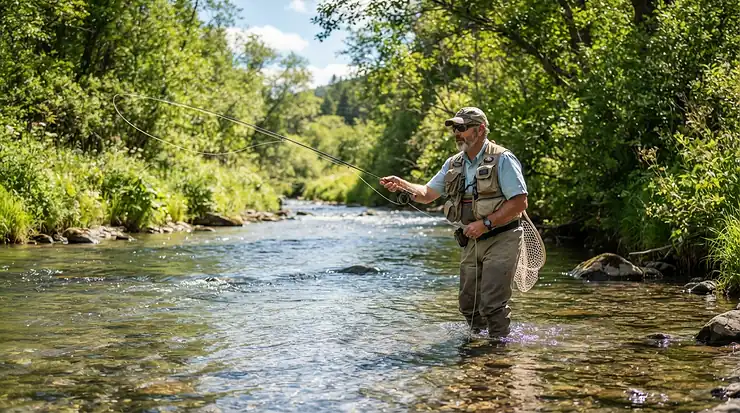
Breathable waders for warm weather fishing are waterproof wading garments built from multi-layer membrane fabrics that let sweat vapor escape while blocking river water. Designed for summer river fishing, the best lightweight pairs convert to waist-high pants, shed heat fast, and keep a 90-degree afternoon from feeling like a sauna.
Here’s the problem nobody mentions on the product page. Waders that are perfect in April become a personal steam room by July. Plenty of anglers learn this the hard way, somewhere around mile two of a trail in full sun, with sweat pooling at the small of the back.
The fix is not “tough it out.” It is smarter fabric, smarter fit, and smarter layering. The membrane inside a quality wader contains billions of microscopic pores. Gore’s own technical explanation describes pores far too small for liquid water but large enough for vapor to pass, and that principle is what lets a good pair breathe.
This guide ranks seven real, widely available models across budget, mid-range, and premium tiers. Every pick gets honest analysis built on published specs and aggregated reviewer sentiment, not marketing copy. You’ll also get the breathability numbers decoded, a layering system, a safety checklist, and three buyer scenarios, so you can pick the right pair and not just the popular one.
Quick Comparison: Breathable Waders for Warm Weather Fishing at a Glance
| Product | Fabric | Approx. Price Range | Front Zip | Best For |
|---|---|---|---|---|
| Frogg Toggs Canyon II | 4-ply nylon | $70–$140 | No | First-timers and backup pairs |
| Orvis Clearwater | 4-layer nylon, 30K/8K rating | $250–$300 | No | Convertible value |
| Simms Tributary | 3-layer upper, 4-layer lower polyester | $280–$300 | No | Hard-use entry-level |
| Simms Freestone | 4-layer Toray QuadraLam | $350–$400 | No | All-around summer workhorse |
| Orvis Ultralight | Lightweight stretch shell | High $300s | No | Long hikes in |
| Simms Flyweight Packable | Ultralight shell, reinforced zones | High $300s | No | Backpacking and travel |
| Patagonia Swiftcurrent Traverse Zip Front | 4-layer H2No | Mid $500s | Yes | Zipper convenience |
Prices are approximate ranges at the time of research and shift often, so check current pricing before you buy. The table shows a clear split. The cheapest pair relies on basic nylon and a lot of forgiveness, the middle tier trades on proven laminates, and the top two lightweight models spend their money on shaving weight. The Orvis Clearwater and Simms Freestone are the practical center of gravity, and both can drop to waist-high when the thermometer climbs.
💬 Just one click — help others make better buying decisions too!😊
Top 7 Breathable Waders for Warm Weather Fishing: Expert Analysis
1. Frogg Toggs Canyon II — cheapest way into breathable
The Frogg Toggs Canyon II is the gateway drug of the category. It is a 4-ply nylon chest wader with 4mm double-taped neoprene booties, attached gravel guards with lace hooks, Y-back suspenders, and an adjustable wading belt with a quick-release buckle.
On paper, 4-ply nylon is not premium fabric. In practice, it is light, and weight is half of heat management. Reviewers in this price class often single out the Frogg Toggs Canyon II for decent breathability relative to cost. Just remember that the 4mm neoprene feet stay warm, and your legs inside the shell won’t enjoy the same ventilation as your torso.
This is a “spec sheet won’t tell you” situation: the knees are unreinforced, so brush-heavy approaches will find the weak spots. Retailer feedback is mixed. Buyers praise comfort, light weight, and value, while a minority report leaks, sometimes early in the pair’s life. That variance is typical when a product competes on price.
Pros:
- ✅ Very light, with an easy-wearing fit
- ✅ Useful pockets, including a zippered flip-out one
- ✅ Lowest entry cost in this roundup
Cons:
- ❌ No reinforced knees for brushy banks
- ❌ Leak reports appear in a minority of reviews
Price: roughly $70–$140, depending on sales. Verdict: strong value for occasional use, but not a pair to bet a hard season on.
2. Orvis Clearwater — convertible value with a stated breathability rating
The Orvis Clearwater earns its place by being one of the few mid-priced waders that publishes numbers. It uses a 4-layer nylon shell with a polyurethane membrane and a tricot liner, rated 30K for waterproofness and 8K for breathability.
That 8K figure is respectable, though not elite. It means competent venting for moderate effort, so expect it to work harder than a budget nylon pair but not outbreathe the thinnest premium laminates. The real summer trick is the opposing side-release buckles. Release them and the top folds down into waist-high pants, which beats any membrane at dumping heat.
The anatomical neoprene booties include integrated gravel guards, and the modern fit trims the bulk that makes older designs feel like wearing a sleeping bag. Roundups repeatedly cite it as a best-value or best-budget pick. The recurring complaint is customer service response times, so set expectations around warranty claims.
Pros:
- ✅ Convertible to waist-high with easy buckles
- ✅ Published 30K/8K waterproof and breathable ratings
- ✅ Streamlined fit with integrated gravel guards
Cons:
- ❌ No front zipper for quick relief breaks
- ❌ Warranty experiences reported as slow
Price: around $250–$300. Verdict: arguably the smartest mid-tier buy for hot-weather versatility.
3. Simms Tributary — entry-level Simms toughness
The Simms Tributary is Simms’ budget door, but it doesn’t feel like a stripped-down compromise. The upper is 3-layer waterproof-breathable polyester and the lower is 4-layer, so the abuse zone gets more armor while the chest stays more flexible.
Published weights land around 33–36 ounces, depending on the source and size, which is moderate rather than featherweight. Features include a fleece-lined hand-warming pocket, a chest pocket, a fly patch, built-in gravel guards with elastic hems, and neoprene stockingfeet with an anti-microbial finish.
Here’s what it means in July: the 3-layer chest ventilates more freely than a uniform 4-layer build, but the hand-warmer pocket is dead weight in heat. The gravel guard is also less streamlined than on premium models, a point several roundups note. Reviewers frame the Simms Tributary as premium behavior at a mid-tier price, while also reminding readers it is the entry-level Simms, not the flagship.
Pros:
- ✅ Reinforced 4-layer lower for rough wading
- ✅ Anti-microbial neoprene feet reduce odor
- ✅ Established brand repair and warranty network
Cons:
- ❌ Heavier than ultralight competitors
- ❌ Gravel guards are less streamlined
Price: around $280–$300. Verdict: ideal for anglers who bushwhack and want durability first, breathability second.
4. Simms Freestone — the summer workhorse with convertible suspenders
The Simms Freestone is built from 4-layer Toray QuadraLam, a fabric developed specifically for fishing waders. Simms lists the weight at roughly 38 ounces, with built-in gravel guards, a reach-through fleece pocket, a chest pocket, a fly patch, and a removable tippet tender pocket.
Toray is durable and breathable, though one lineup breakdown notes it doesn’t match Gore-Tex for venting. That honest trade is the point. You’re buying puncture resistance and consistency, and the opposing-buckle suspenders convert the chest wader into waist-high protection when it’s hot.
Reviewers praise breathability, comfort, and durability, and some bought it specifically as a lighter alternative to heavier flagship pairs for late spring through early fall. Complaints cluster around the revised gravel guard design and baggy sizing in larger sizes. Simms’ published coverage includes a 60-day no-questions replacement window and a free repair if the waders leak within the first year, a strong safety net for the money.
Pros:
- ✅ Rugged 4-layer Toray throughout the body
- ✅ Chest-to-waist conversion for hot afternoons
- ✅ Strong published return and repair policy
Cons:
- ❌ Less breathable than premium Gore-Tex laminates
- ❌ Some report loose fit in larger sizes
Price: roughly $350–$400. Verdict: the most balanced pick if you fish hard and fish warm.
5. Orvis Ultralight — magnetic top, built for the long hike in
The Orvis Ultralight exists for anglers who count ounces. In a Fly Fisherman lightweight wader test, the tester praised the Fidlock magnetic mechanism that holds the top up for protection and releases easily when temperatures climb.
That magnet matters more than it sounds. Fiddling with buckles on a hot, sweaty hike is annoying, and a one-handed release makes venting a reflex instead of a chore. The stretch fabric reportedly held up through two weeks of all-day walking in dwarf willows and Russian olive, which is a decent argument that light doesn’t have to mean delicate. The 4mm neoprene booty ran warm, and the tool loops add useful organization.
The tradeoffs are real. There’s no rear belt loop, so the back can swim a bit and require belt hitching, and with no zipper, bathroom breaks mean shedding the pack, suspenders, and belt.
Pros:
- ✅ Magnetic top converts in seconds
- ✅ Stretch fabric survived brush in testing
- ✅ Anatomical booty patterning cuts bulk
Cons:
- ❌ No rear belt loop, so fit can shift
- ❌ No zipper makes breaks cumbersome
Price: in the high-$300s. Verdict: a standout for warm-region hiking anglers who prize freedom of movement.
6. Simms Flyweight Packable — lightest in the test, built to disappear in a pack
The Simms Flyweight Packable was the lightest of three waders in that same Fly Fisherman comparison, with fabric described as gossamer where robustness isn’t needed and sturdier where it is. The tester also called its included belt the most substantial seen on any waders.
Targeted material placement is exactly what backcountry summers demand, since the lighter the wader, the less heat you drag up the trail. It’s available in men’s sizing only, in regular, short, and long.
The compromises sting a little. The 1.5mm compressed neoprene booty felt shockingly cold in early-season water, though that’s a feature if you’re wading warm streams. The booty patterning left excess material in normal-width feet, and the shoulder strap silicone didn’t hold the top up while moving, especially with a loaded front pocket. There’s no zipper either.
Pros:
- ✅ Lightest wader in the comparison
- ✅ Heavy-duty included wading belt
- ✅ Packs small for travel and backpacking
Cons:
- ❌ Top section can sag while active
- ❌ Thin booty runs cold in chilly water
Price: in the high-$300s. Verdict: a specialist’s tool, best for warm water and long walks.
7. Patagonia Swiftcurrent Traverse Zip Front — premium comfort with a real zipper
The Patagonia Swiftcurrent Traverse Zip Front is the odd one out. It runs about 40 percent heavier than the lightest wader in that test, yet the tester was won over by the full feature set, including a full front zipper, zip chest pockets, and an internal zip pocket. One roundup lists a 4-layer H2No waterproof-breathable shell.
The zipper is a summer superpower. Quick relief, fast ventilation by unzipping and folding down the top, and easy on-off after a hot day beat any buckle system. The cam-lock suspenders held position reliably, the hip belt was as substantial as aftermarket belts, and the 4mm booty was warm.
The downsides are weight and fit. The body of the wader ran generous even when the tester provided precise measurements, so size down thoughtfully. Forum threads regularly mention Patagonia’s warranty as a selling point, though that’s anecdotal sentiment, not a guarantee.
Pros:
- ✅ Full front zipper for fast relief and venting
- ✅ Plentiful pockets for half-day trips
- ✅ Substantial hip belt and secure cam-locks
Cons:
- ❌ Noticeably heavier than ultralight rivals
- ❌ Body sizing runs generous
Price: in the mid-$500s. Verdict: worth it if you fish often and value convenience over carry weight.
What Are Breathable Waders for Warm Weather Fishing, Really?
Strip away the marketing and a breathable wader is a layered sandwich. A tough outer face fabric takes the abuse. A thin membrane stops liquid water. An inner liner keeps skin from touching that membrane. Heat and sweat vapor move outward through the membrane, driven by the difference in temperature and humidity between inside and outside.
That last part is the catch for summer. Breathability works best with a steep gradient, so it thrives in cold, dry air and struggles in hot, humid conditions. A climbing-gear explainer makes the same point about membranes in general. In a muggy July evening, even the best fabric can feel less magical than the spec sheet promised.
That’s why warm-weather wader design leans on more than fabric. It rewards convertible tops, lighter shells, and zippers that let you dump heat manually. Treat the membrane as one tool in a kit, not the whole answer.
Breathability Ratings Explained: What the Numbers Mean
Breathability ratings usually show up as MVTR, short for moisture vapor transmission rate. As Advnture’s breathability guide explains, it measures how much water vapor passes through a square meter of fabric in 24 hours, so a 20,000 rating moves twice as much as a 10,000 rating in lab conditions.
The Orvis Clearwater‘s 8K rating gives you a concrete number to anchor on. Most other pairs here don’t publish one, which means comparing them requires fabric clues instead.
| Fabric Type | What It Means in Heat | Example | Best For |
|---|---|---|---|
| Basic 4-ply nylon | Light and acceptable, but vents modestly | Frogg Toggs Canyon II | Occasional anglers |
| 4-layer Toray | Durable, balanced breathability | Simms Freestone | Hard-use summer wading |
| 4-layer nylon, 8K rated | Moderate, published venting | Orvis Clearwater | Value-minded shoppers |
| Thin ultralight laminates | Lightest, best heat management | Orvis Ultralight | Long hikes in |
Read the table as a continuum between toughness and ventilation, not a ranking of quality. Lab MVTR numbers also overstate real-world performance, since sweat, humidity, and layers all interfere. The practical takeaway: weight, convertibility, and what you wear underneath often matter more than a ratings difference of a few thousand points.
Moisture-Wicking Wader Fabric: What Actually Touches Your Skin
Here’s a fact that surprises people. The best moisture-wicking wader fabric won’t help if you wear the wrong thing underneath. Simms’ own care guidance warns against jeans, which are abrasive from the inside and trap moisture, and recommends proper layering to wick sweat so the waders can breathe.
Think of the liner as a second skin you can swap daily. Synthetic or merino base layers move sweat to the membrane’s inner surface, where it can vaporize and escape. Cotton does the opposite, absorbing sweat, clinging, and turning warm days into a swampy mess.
For summer, aim for a thin synthetic or merino-blend base layer under quick-dry shorts or light pants. Skip anything thick, and skip anything cotton. If your waders have a polyester or nylon tricot liner, as the Orvis Clearwater does, a smooth wicking layer slides without bunching, which also reduces chafing.
One more thing the spec sheet won’t tell you: the neoprene feet never breathe, whatever the upper does. Sweaty feet are normal. Moisture-wicking socks and a rinse-and-dry routine matter more than any fabric upgrade.
How to Choose Lightweight Breathable Waders
Lightweight breathable waders are a category defined by tradeoffs. Use these steps to cut through them.
- Decide your heat strategy. If you fish in humid heat, favor convertible or zippered designs over fabric ratings, since venting by hand beats venting through a membrane.
- Weigh the carry. If you hike miles to the water, ounces matter. Published weights run from the high 30s down to the ultralight class, and every ounce rides on your back.
- Check the lower leg build. Brushy banks demand reinforced lower layers, like the 4-layer lower on the Simms Tributary.
- Pick a closure style. Zipper, magnet, or buckles each solve different problems. Zippers help with comfort breaks, while magnets and buckles help with ventilation speed.
- Match the booty to water temperature. A 4mm neoprene foot stays warm. A 1.5mm foot suits warm streams but feels cold early in the season.
- Read warranty terms. A written repair-or-replace policy beats vague promises, and the 60-day replacement window on the Simms Freestone is a good benchmark.
- Size carefully. Generous sizing, like on the Patagonia Swiftcurrent Traverse Zip Front, can add weight and heat.
Features That Actually Matter (And Those That Don’t)
Marketing loves a feature list. Summer fishing doesn’t.
What matters: weight, convertibility, gravel guard design, and a belt you can actually trust. Gravel guards keep debris out of your boots, which prevents blisters and wear, and a good one also reduces water drag. A well-built belt is a safety item as much as a comfort item.
What’s overrated for warm weather: fleece hand-warmer pockets. They’re lovely on a cold morning and wasted on a 90-degree afternoon. Heavy pocket arrays add weight and heat too, so unless you carry lots of gear, extra pockets can be dead weight. Even the thickest neoprene boot is a liability in hot water.
What’s underrated: tool loops and attachment points. They keep forceps and nippers on your chest, which means fewer trips into your pack and less sweat from fiddling. The Orvis Ultralight gets this right with loops placed exactly where hands go.
Finally, treat “breathable” as a promise about fabric, not a guarantee about comfort. Fit, layers, and ventilation habits decide whether you’re cool or cooked.
Summer River Fishing: What to Expect in Real-World Performance
Summer river fishing has its own rhythm. Mornings are cool, middays are brutal, and evenings bring a bug-and-trout bonanza. Waders that cope with all three are rare.
On paper, a good pair of breathable waders feels almost invisible. In practice, heat arrives in waves. The first hour is comfortable, the midday hike is damp, and the evening session needs a layer. A convertible design like the Simms Freestone or Orvis Clearwater lets you adapt quickly, folding the top down at noon and pulling it up at dusk.
Water temperature changes the story too. Warm shallow rivers invite thin booties and lighter gear, while tailwaters and spring creeks stay cold even in July. Cold water can still chill you in hot weather, which is why safety guidance stresses that hypothermia is possible even on warm days.
Expect a little sweat no matter what you buy. The goal isn’t dryness from the inside out. It’s staying comfortable enough to keep fishing at full concentration, which is the whole point.
🔍 Ready to cool off on the river?
Click any highlighted product above to check current pricing and availability, and find the pair that matches your summer routine! ✨
Breathable Waders vs. Neoprene Waders and Wet Wading
| Option | Heat Comfort | Protection | Packability | Best For |
|---|---|---|---|---|
| Breathable waders | Good, especially convertible | Full dry coverage | Good | Variable-temperature days |
| Neoprene waders | Poor above roughly 70°F | Warm, bulky | Poor | Cold-water and winter use |
| Wet wading | Excellent | None from cold or abrasion | Excellent | Warm, shallow, clean water |
Breathable waders have largely replaced neoprene as the standard for most fly fishing, since they’re lighter, more packable, and comfortable across a wider temperature range. Neoprene earns its place only when water is cold and the day is short on mobility demands.
Wet wading looks tempting in heat, but it sacrifices abrasion protection and cold-water insurance. If the river drops to a chilly temperature or you wade through rocky, brushy runs, you’ll want fabric between you and the elements. A convertible breathable wader is the compromise that covers both ends, so it’s the safer bet for anglers who fish more than one water type.
Warm Weather Wading Gear: Building the Full Summer Kit
Warm weather wading gear is more than the waders. The rest of the kit decides whether those waders ever feel comfortable.
Start with boots. Lightweight wading shoes dry faster and reduce foot fatigue, and comparison reviews note that trail-runner-style options like the Simms Flyweight boot dry much faster than heavier alternatives, though they trade away some support. Pair them with quick-dry socks, never cotton.
Add a wading belt with a quick-release buckle, a collapsible wading staff, and a hydration source. Dehydration masquerades as fatigue on hot days, and fatigue leads to missteps in current. A vented hat, polarized sunglasses, and a sun hoodie finish the picture.
Finally, think about storage. A light sling pack beats a bulky vest in heat, and a small dry bag protects your phone. The fewer items riding on your chest, the cooler you’ll stay inside your waders.
Practical Usage Guide: Your First 30 Days in Summer Waders
Day one: fit check. Put them on with your intended underlayers and squat, step up on a rock, and reach overhead. If the crotch binds or the shoulders pull, size up or change cut. Adjust suspenders so the chest sits where it won’t strangle you when folded down.
First outing: belt on. Wear the belt every time, and tighten it snugly. Add the staff, and test your footing in shallow water before going deeper.
Venting routine. Fold the top down during hikes, then zip or buckle up before wading deeper. Make it a habit, not an emergency measure.
After every trip. Rinse with fresh water, and dry inside and outside. Simms advises pulling gravel guards up to dry the feet, then flipping them down to finish the rest. Never use a dryer, because heat can damage seam tape and may void your warranty.
Common mistakes in the first month:
- Wearing cotton or jeans underneath
- Stuffing wet waders in a trunk for days
- Ignoring a small leak until it becomes a big one
- Skipping the belt because the water looks shallow
Real-World Scenarios: Three Anglers, Three Pairs
These are illustrative profiles, not individual testimonials.
The weekend trout angler on a budget. Fishes a few Saturdays a month, mostly drive-up access, budget around the low $100s. The Frogg Toggs Canyon II fits the frequency and the wallet, with a layering plan to handle cooler mornings. Accept that durability is a gamble, and keep a repair kit handy.
The hiking angler covering miles to remote water. Fishes 20 days a season, hikes two miles in, and cares about every ounce. The Orvis Ultralight or Simms Flyweight Packable makes sense, because lighter loads mean more energy at the water. This angler should plan around a missing zipper, with a quick-off routine for breaks.
The daily river regular. Fishes year-round, values relief breaks and convenience, and doesn’t mind carrying a bit extra. The Patagonia Swiftcurrent Traverse Zip Front earns its price through daily comfort, while the Simms Freestone is the sensible alternative for a lower outlay and similar durability.
Long-Term Cost and Maintenance: What Waders Really Cost Per Season
Cheap waders cost less up front and more over time. A rough way to compare is cost per season. A low-cost pair that lasts one or two seasons can end up pricier than a mid-tier pair that lasts four. One brand notes that the typical lifespan of waders is roughly three to five years, with failures beyond manufacturing defects handled at its discretion.
| Tier | Price Range | Products | What You Gain | Best For |
|---|---|---|---|---|
| Budget | $70–$140 | Frogg Toggs Canyon II | Low entry cost | Occasional use |
| Mid-range | $250–$400 | Orvis Clearwater, Simms Tributary, Simms Freestone | Better build, warranty | Regular anglers |
| Premium | High $300s–mid $500s | Orvis Ultralight, Simms Flyweight Packable, Patagonia Swiftcurrent Traverse Zip Front | Weight savings or features | Specialists |
The mid-range is where value concentrates, since warranty coverage and build quality both jump while prices stay reasonable. Premium pairs justify themselves through a specific advantage, like weight or a zipper, not general durability. Whichever tier you choose, drying, rinsing, and avoiding abrasive layers stretch lifespan more than any upgrade.
Wading Safety Guide for Hot-Weather Anglers
Warm air hides cold risk. Institutional guidance such as Roger Williams University’s wader safety procedures calls for a wading belt, warns that hypothermia can happen even on warm days, and advises against wading above waist depth.
A belt limits how fast water floods your waders if you fall. A staff gives a third point of contact in current. Cold shock can hit within the first minute of sudden immersion, so respect any water that’s colder than the air suggests.
The old myth that waders will drag you under has been debunked repeatedly. Still, a full wader can become a heavy, awkward load, so practice floating on your back with feet downstream. If you fish big or fast water, a lightweight inflatable vest is cheap insurance.
Check conditions before every trip, since rising water changes everything. Wear a belt, bring a staff, and never wade alone in water you can’t read.
FAQ
❓ Are breathable waders too hot for summer wading?
❓ Can I convert chest waders to waist-high for hot days?
❓ What should I wear under breathable waders in summer?
❓ How long do lightweight breathable waders last?
❓ Are cheap breathable waders worth it for warm weather fishing?
Conclusion
The best breathable waders for warm weather fishing aren’t the ones with the loudest spec sheet. They’re the ones that match how you actually fish. If you want maximum value, the Orvis Clearwater and Simms Freestone are the practical standouts, both built to convert when the heat rises. If budget is the priority, the Frogg Toggs Canyon II gets you on the water, with honest expectations about longevity.
Hikers who count ounces should look hard at the Orvis Ultralight and Simms Flyweight Packable, accepting the missing zipper as part of the deal. Anglers who live in their waders will appreciate the zipper on the Patagonia Swiftcurrent Traverse Zip Front, and rugged-use anglers on a tighter budget should consider the Simms Tributary.
Whatever you choose, layer smart, vent early, wear a belt, and dry your gear after every trip. Those habits beat any fabric upgrade.
Recommended for You
- Hip Waders For Bank Fishing: 7 Best Picks For 2026
- Chest Waders For Fly Fishing: 7 Best Picks In 2026
- Rain Gear For Kayak Fishing: 7 Best Picks To Stay Dry In 2026
Disclaimer: This article contains affiliate links. As an Amazon Associate, I earn from qualifying purchases. If you purchase products through these links, we may earn a small commission at no additional cost to you.
✨ Found this helpful? Share it with your friends! 💬🤗
