
In This Article
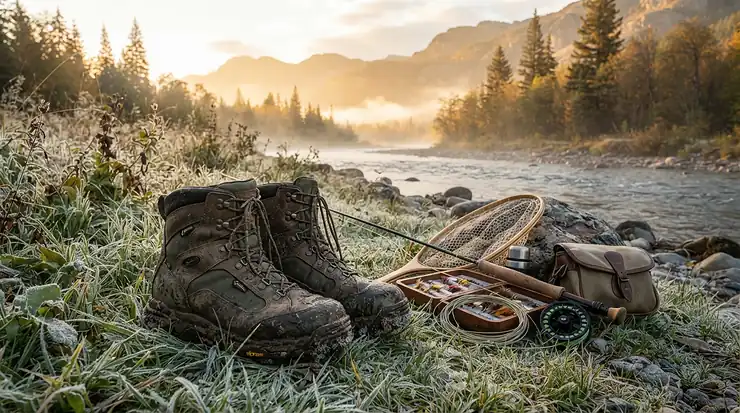
Studded wading boots for icy terrain are river boots built with metal studs, carbide spikes, or aluminum bars that bite through ice, frozen algae, and slick rock where plain rubber and felt skate. They pair a supportive boot body with replaceable metal traction, so you can cross winter water and frozen banks without gambling on every step.
Winter rivers are beautiful and quietly hostile. Trout still feed, steelhead still run, and the crowds vanish. But skim ice glazes the cobble, banks harden into frozen shelves, and one bad step can end in a swim nobody wants. The National Weather Service explains in its cold water safety guidance that falling into water below 50°F can trigger cold shock within minutes. That’s why footing is a safety decision long before it’s a comfort one.
Choosing a boot is where it gets confusing. Some boots ship with studs in the box. Others merely accept them. One premium option skips studs entirely and uses aluminum bars. This guide compares seven real options using manufacturer specs, published editorial reviews, and aggregated retailer feedback. None of the boots were worn or tested for this article, so you’ll get honest analysis instead of invented war stories.
Along the way, you’ll see metal stud wading boots explained, a straight-talking look at ice traction fishing footwear alternatives, and what cold weather river fishing really demands of your feet.
Quick Comparison: Studded Wading Boots for Icy Terrain at a Glance
| Boot | Traction Setup | Closure | Price Range* | Best For |
|---|---|---|---|---|
| Korkers River Ops BOA | Vibram + Studded Vibram (36 carbide studs) | BOA dial | ~$240-$320 | Korkers River Ops BOA suits long winter days and rough approaches |
| Korkers Darkhorse | Kling-On + Studded Kling-On | BOA dial | ~$185-$250 | Korkers Darkhorse suits all-round winter anglers |
| Korkers Devil’s Canyon | Kling-On + Studded Kling-On (tungsten carbide) | BOA dial | ~$170-$250 | Korkers Devil’s Canyon suits light packers and hikers |
| Simms Freestone | Vibram Idrogrip; add HardBite studs or cleats | Laces | Low-$200s | Simms Freestone suits anglers who want to pick their own studs |
| Orvis PRO | Michelin rubber; add PosiGrip studs | Laces | High-$200s | Orvis PRO suits ankle support seekers |
| Patagonia x Danner Foot Tractor | Vibram Idrogrip + aluminum bars | Laces | ~$450-$500 | Patagonia x Danner Foot Tractor suits buy-once, wide-foot buyers |
| Frogg Toggs Hellbender Cleated | Cleated rubber sole, stud-ready | Speed lace | Under $120 | Frogg Toggs Hellbender Cleated suits budget starters |
*Approximate ranges at the time of research. Prices vary by retailer and sole package, so check current price before buying.
Looking at the table, the big divide is “studs included” versus “studs sold separately.” The two Korkers BOA boots and the Korkers Devil’s Canyon ship with a studded sole, which makes them the simplest path to winter-ready traction. The Simms Freestone and Orvis PRO reward buyers willing to add traction studs themselves, and the Frogg Toggs Hellbender Cleated gets you in the door for the least money. Budget buyers should expect to spend a little extra on studs, while the Patagonia x Danner Foot Tractor is the long-haul play for anglers who hate replacing boots.
Two quick habits will make the rest of this guide easier to use. First, read the “Best For” column as a starting point, not a verdict, because your hike length and river type matter as much as the sole. Second, remember that every boot here is stud-capable but none is magic. The sections below explain what each setup does well and where it falls short.
💬 Just one click — help others make better buying decisions too!😊
Top 7 Studded Wading Boots for Icy Terrain: Expert Analysis
Each pick below is judged on its traction setup, build, and real-world trade-offs. I’ve leaned on published reviews and aggregated retailer feedback, and where review pools are small, I say so.
1. Korkers River Ops BOA — guide-grade armor with 36 carbide studs
The standout here is simple: the winter sole is already in the box. Korkers packages the Korkers River Ops BOA with Vibram XS Trek rubber soles plus a Studded Vibram set carrying 36 carbide studs, so you can swap between hiking-friendly rubber and full ice-biting mode without buying extras.
Specs, translated: the claimed weight is about 3 lb 6 oz per pair, with a 9-inch shaft and internal ankle-wrap padding. That isn’t featherweight, but the extra structure steadies your ankle on frozen cobble. The BOA dial also matters more in winter than in July, because turning a dial with cold fingers beats wrestling stiff, icy laces.
Based on the spec comparison, this is the most complete winter package on the list. It fits guides, steelheaders, and anyone who’d rather pay once than piece together a boot plus aftermarket cleats.
Field & Stream’s reviewer wore it for a full trout season and leaned on the studded soles for stability. The same review flagged that the sole latch may wear and the BOA dial can fail after heavy use. Retailer review pools are tiny, so editorial coverage carries more weight here.
Pros:
- ✅ Studded Vibram soles included in the box
- ✅ BOA dial adjusts quickly with cold hands
- ✅ Reinforced build with a two-year warranty at some retailers
Cons:
- ❌ Priciest of the Korkers boots
- ❌ Sole latch and BOA dial reported to wear
Expect roughly $240-$320 depending on retailer and package. For a boot that arrives with studded soles ready to go, that’s fair value if you’ll fish through winter, but check current price first.
2. Korkers Darkhorse — the do-it-all studded all-rounder
Hatch Magazine’s reviewer described the Korkers Darkhorse as the “9-foot 5-weight” of wading boots, meaning a do-it-all choice rather than a specialist. In the Kling-On and Studded Kling-On package, you get sticky rubber plus a studded sole for slick riverbeds.
Backcountry lists a size 11 at about 1 lb 13.5 oz per boot with the plain Kling-On sole and about 2 lb 1 oz with the studded one. That means the studs cost you roughly 3.5 ounces per foot, a trivial penalty for ice grip. Add Achilles support above the heel, internal drainage, and an M2 BOA dial, and the spec sheet reads like a boot that tries to do everything reasonably well.
The analytical take: this suits anglers who split time between a trail walk and a river crossing. You can leave the studded sole on for ice and snow, then switch to plain rubber when the terrain dries out.
Retailer feedback is limited, though the one Backcountry listing shows a perfect rating on a handful of reviews. A Hatch reviewer of the women’s version said studded soles take gait adjustment on hard ground, and they tripped repeatedly on the walk from the truck.
Pros:
- ✅ Studded Kling-On sole included in this package
- ✅ BOA lacing plus Achilles support
- ✅ Modest weight penalty for studs
Cons:
- ❌ Studded soles feel awkward on hard trails
- ❌ Small retailer review pool
Roughly $185-$250 depending on retailer and sole package at the time of research, which is strong value for a studded, BOA-equipped boot. Check current price.
3. Korkers Devil’s Canyon — featherweight with swap-ready studded soles
If hiking to the river is half your day, the Korkers Devil’s Canyon is the lightweight pick. Backcountry lists a claimed 3 lb 2 oz per pair, and GearJunkie called it one of the lightest wading boots on the market. The FB4120 package pairs Kling-On rubber with Studded Kling-On soles, and Korkers says the studs are 100 percent tungsten carbide.
Translated into practice: a lighter, more flexible 420D synthetic upper means less fatigue on a long approach, but less rigid protection than the Korkers Darkhorse or Korkers River Ops BOA. The plain Kling-On sole is non-marking and safe for boats, so you can swap out the studded sole when a guide asks.
One reviewer at GritrOutdoors, who normally prefers felt, was surprised by how much grip the studded Kling-On delivered. Trident Fly Fishing’s sole comparison found studded Kling-On slightly behind felt in the water but better in algae-rich conditions. Backcountry’s pool is small and mixed, about 3.3 out of 5 on four reviews. One long-term owner praised the BOA for staying tight.
Pros:
- ✅ Lightest boot in this lineup
- ✅ Non-marking plain sole for boat days
- ✅ BOA dial stays snug through the day
Cons:
- ❌ Softer upper offers less rigid protection
- ❌ Small, mixed retailer review pool
Expect roughly $170-$250 depending on sale timing and package. It’s a smart value for hikers if the fit works for you, so check current price.
4. Simms Freestone — proven platform that welcomes your own studs
The Simms Freestone is the name many anglers already know, and its Vibram Idrogrip rubber sole is built to accept studs and cleats. Simms lists compatibility with HardBite Star Cleats, Alumibite Star Cleats, and HardBite Studs. A synthetic full-grain leather upper sheds water, and the neoprene-lined collar adds comfort for hiking and wading.
Here’s what the spec sheet won’t tell you, but owners do: bare rubber isn’t enough for slimy rocks. Simms itself recommends studs for moss, algae, and slime, because studs penetrate the film to reach the rock beneath. One retailer reviewer called the studs a big step up on mossy bottoms. Another said the boots slid on rocks and gravel until carbide star cleats went on, then called the difference night and day.
That makes the Simms Freestone a good fit for buyers who want to choose their own metal and replace it as it wears. Retailer ratings run high, with Backcountry showing a score near 4.9 out of 5 at the time of research. The catch is that you’re paying twice, once for the boot and once for the cleats.
Pros:
- ✅ Compatible with several Simms stud and cleat options
- ✅ Water-repellent upper and neoprene-lined collar
- ✅ Strong retailer ratings
Cons:
- ❌ Slick on algae without added studs
- ❌ Studs and cleats cost extra
Low-$200s at list, with cleat packs typically around $30-$40 extra. Good value if you’ll install the studs, so check current price.
5. Orvis PRO — Michelin rubber and a stud-ready midsole
The Orvis PRO is built around a Michelin Outdoor Extreme outsole, which Orvis says delivers 25 percent better abrasion resistance and 43 percent better wet-rubber traction than traditional wading boots. Those are manufacturer claims, so treat them as marketing rather than lab-verified fact. What matters for winter is the co-molded ESS plate in the midsole, designed to hold Orvis PosiGrip studs. Those screw-in, tungsten-carbide-tipped studs need at least a half inch of midsole depth, and a pack contains 20.
Translated: the plate should help studs stay put through repeated flexing, a known weak point on cheaper rubber boots. Hatch Magazine’s reviewer praised the ankle support and said rubber-only traction felt as expected. The same review carried a “needs studs” warning for serious wading and wished for BOA lacing after breaking laces in the past. One commenter on that review said the ankle support was the best they’d used.
Who is it for? Anglers who value support on long boulder-field hikes and don’t mind adding studs themselves. Skip the hybrid version for winter, since felt collects snow and ice.
Pros:
- ✅ Excellent ankle support, per reviewers
- ✅ ESS plate designed to hold studs
- ✅ Durable Michelin rubber outsole
Cons:
- ❌ Laces only, no BOA option
- ❌ PosiGrip studs sold separately
High-$200s at list in the rubber version. It’s worth it if support is your priority, but check current price.
6. Patagonia x Danner Foot Tractor — built-for-years aluminum bar traction
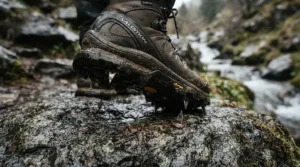
The Patagonia x Danner Foot Tractor isn’t strictly one of the metal stud wading boots, but it’s the closest cousin. It pairs a Vibram Idrogrip sticky rubber sole with recessed, replaceable aluminum bars, and the boot is co-developed with Danner and handcrafted in Portland, Oregon. Hatch Magazine’s reviewer found the bars equal to, and perhaps better than, felt, partly because aluminum is soft enough to mold to rock yet hard enough to cut algae.
Two practical points stand out. First, a published review reports that Patagonia says the bars won’t grip sheet ice or untextured slate, so no metal system is a guarantee on glazed ledges. Second, Vail Valley Anglers notes you can wear these in a raft or drift boat, unlike studded boots.
Reviewers also call it the most comfortable wading boot they’ve worn, and F&S listed it for wide feet. One retailer review warns it’s heavy, which fits the thick sole and leather build. Deneki Outdoors called it the most expensive wading boot on the market, while a fishing guide argued the cost-per-use works out if you log a couple hundred days.
Pros:
- ✅ Replaceable aluminum bars with counter-sunk screws
- ✅ Hiking-boot comfort and wide-foot fit
- ✅ Boat-friendly bar design
Cons:
- ❌ Heavy compared with Korkers options
- ❌ Premium price
Around $450-$500 in the U.S. at the time of research. Worth it only if you fish enough to amortize it, so check current price.
7. Frogg Toggs Hellbender Cleated — budget entry to winter traction
The Frogg Toggs Hellbender Cleated is a cleated rubber wading shoe with recessed stud attachments, an oversized heel kick plate, a leather and 1,200-denier nylon upper, and a speed-lace system. In plain English, it’s a stud-ready platform at a price that won’t make you wince.
Reviewer sentiment is split. At Tractor Supply, the men’s version sits near 3.2 out of 5 on six reviews, with complaints about soles detaching and poor wet grip. A much larger marketplace listing shows about 4.5 out of 5 across more than 2,000 ratings, praising value, light weight, and fit. Recurring gripes include slow-drying laces and boot material, and at least one buyer expected studs to be included. Another said the sole accepted studs easily.
The honest take: buy it if you’re trying winter wading for the first time, and budget for studs plus a gentle break-in. If you expect to log many days, the premium Korkers options probably justify the jump.
Pros:
- ✅ Lowest price on this list
- ✅ Recessed spots designed for studs
- ✅ Lightweight with a padded ankle collar
Cons:
- ❌ Some reports of soles separating
- ❌ Dries slowly, and laces wear
Under $120 at the time of research, usually a bit more with studs. It’s a decent starter value, so check current price.
Side-by-Side: How the Top 7 Stack Up
| Boot | Metal Traction Style | Review Signal | Best For |
|---|---|---|---|
| Korkers River Ops BOA | Studded Vibram, 36 carbide studs | Small retailer pool; editorial positive with durability caveats | Rough approaches and daily use |
| Korkers Darkhorse | Studded Kling-On | Small pool, strong ratings | All-round winter wading |
| Korkers Devil’s Canyon | Studded Kling-On, tungsten carbide | Small, mixed pool; editorial positive | Long hikes |
| Simms Freestone | Add HardBite studs or star cleats | Retailer rating near 4.9/5 | Custom stud setups |
| Orvis PRO | Add PosiGrip studs via ESS plate | Editorial positive, “needs studs” | Ankle support |
| Patagonia x Danner Foot Tractor | Replaceable aluminum bars | Editorial praise; price is the main complaint | Buy-once, wide feet |
| Frogg Toggs Hellbender Cleated | Stud-ready cleated rubber | Split: about 3.2/5 at one retailer, 4.5/5 on a large listing | First winter on a budget |
The pattern is clear: pre-studded packages from Korkers trade some premium finish for convenience, while the Simms Freestone and Orvis PRO reward buyers who will bolt on their own metal. The Patagonia x Danner Foot Tractor is the only option here that bets everything on bars, which is why its price makes sense only for frequent waders. And while the Frogg Toggs Hellbender Cleated looks tempting, its split reviews suggest you should inspect sole bonding early.
✨ Don’t Miss These Cold-Weather Essentials!
🔍 Take your winter river days to the next level with these carefully selected boots. Click on any highlighted item to check current pricing and availability. The right pair will help you wade, hike, and cast with the confidence your feet have been missing! 🎣❄️
How to Install and Care for Traction Studs (Step-by-Step)
Traction studs only work if they stay in the sole, so a little prep pays off. Here’s a practical routine built from manufacturer guidance and reviewer reports.
- Confirm compatibility first. Simms lists which boots take studs versus star cleats, Orvis recommends at least a half inch of midsole depth, and Korkers boots avoid the question by swapping entire soles.
- Use the molded stud positions. Many soles have predefined notches, so follow them instead of freelancing.
- Drive screws snug, not crushed. Orvis includes a drill adapter with its PosiGrip studs. A gentle, even pressure helps keep the sole intact.
- Spread traction across heel and forefoot. Winter wading involves braking on downhill banks and pushing off cobble, so balance matters.
- Inspect before each trip. Look for loose or worn studs and replace them early.
- Wash and dry fully. Korkers recommends washing boots and soles after each session and letting them dry out completely.
Material choice matters too. Simms describes Alumibite cleats as softer and better at molding, while HardBite uses carbide for longer life. A MidCurrent reviewer concluded that studded rubber is the clear winter upgrade because it bites through thin ice and holds on frozen banks without the snow buildup felt produces. Replacement soles for Korkers boots generally run around $40-$70, and cleat packs from Simms sit in the $30-$40 range.
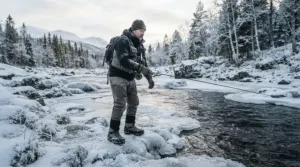
Real-World Scenarios: Matching Boots to Your Winter River
Specs only mean something when they match your days on the water. Here are three buyer profiles, with reasoning rather than invented anecdotes.
The weekend steelheader. You fish perhaps 15-20 winter days, walk a mile or two on frozen trails, and want a boot around $250. The Korkers Darkhorse fits: studded soles for the river, plain rubber for dry stretches, and a BOA dial for cold fingers.
The high-volume guide or devoted regular. You wade 100-plus days a year. The Korkers River Ops BOA earns its price through its included studded sole and rugged build, while the Patagonia x Danner Foot Tractor makes sense if you want one boot to outlast several cheaper pairs and ride in a drift boat. Divide a roughly $450-$500 price by 200 outings and the per-day cost lands around $2-$3, which is the logic behind the cost-per-use argument.
The beginner on a $120 budget. Buy the Frogg Toggs Hellbender Cleated, set aside money for studs, and check the sole bond early. If winter wading sticks, step up to something like the Simms Freestone with HardBite studs later.
If you also fish from a boat, the Korkers Devil’s Canyon is the easiest to adapt because its non-marking Kling-On sole replaces the studded one when a guide objects.
Winter Wading Problems and Their Solutions
Every winter has its recurring headaches. These five come up repeatedly in reviewer reports and retailer feedback, along with sensible fixes.
Problem 1: Studs skate on sheet ice. Studs help, but no metal system grips glaze. Shorten your stride, use a wading staff, and skirt ice-glazed ledges. A published Patagonia comment says even aluminum bars won’t grip sheet ice.
Problem 2: Snow balls up under your soles. Felt is the usual culprit, since Orvis notes it holds water, freezes, and collects snow. Choose rubber with studs for approaches.
Problem 3: Boots freeze stiff overnight. Dry them indoors and consider BOA dials, which are easier to operate than frozen laces.
Problem 4: Studs loosen or fall out. Pick boots with stud plates or interchangeable soles. Reviews of the Simms Tributary include complaints that it doesn’t hold studs for long, which is why the Simms Freestone and Orvis PRO are better stud platforms.
Problem 5: Studded soles feel clumsy on the walk in. Swap to a plain sole for the trail if your boots allow it, as with the Korkers Darkhorse, or take shorter steps until your gait adjusts.
How to Choose Studded Wading Boots for Icy Terrain
To choose studded wading boots for icy terrain, prioritize a rubber sole that accepts metal studs, then match closure, fit, and weight to your winter routine. Here’s the checklist, in order of importance.
- Start with the sole. Choose rubber (Vibram, Michelin) over felt, because felt freezes and collects snow and ice.
- Verify stud compatibility. Look for molded stud positions, an ESS-style plate, or interchangeable soles.
- Pick your metal. Carbide lasts longer, aluminum conforms better, and bars like the Foot Tractor’s spread the load.
- Match the closure to your hands. A BOA dial helps in cold, while laces are simpler and cheaper to repair.
- Size for insulation. Simms advises ordering your regular street size to leave room for neoprene stockingfoot waders, and thick socks may need extra room.
- Weigh your hike. Heavier boots steady you on rough ground, while lighter ones reduce fatigue on long approaches.
- Check local rules and boat policies. Some waters restrict felt, and many boat owners dislike studs aboard.
Metal Stud Wading Boots Explained: Carbide, Aluminum, and Bars
Not all metal is equal, so here’s how the main types differ. Metal stud wading boots use tiny, hard points that dig into ice, algae film, and wet rock. Carbide studs, such as Simms HardBite, Orvis PosiGrip, and the tungsten-carbide spikes on Korkers’ studded soles, stay sharp longer. Aluminum is softer and conforms to rock surfaces, which is why Simms describes Alumibite cleats as better at molding.
Placement matters as much as material. Studs concentrated at the heel help you brake on downhill banks, while forefoot studs help you push off. A well-designed sole has molded positions for this, which is why random screw-ins on a smooth sole often disappoint. Orvis states that metal studs add gripping power for fast, slippery bottoms, and MidCurrent notes that adding studs or cleats often rivals the traction of the stickiest soles.
Aluminum bars, as on the Patagonia x Danner Foot Tractor, offer a different trade-off. They’re replaceable and boat-friendlier than studs, but they won’t pierce ice the way spikes do. If your priority is slick frozen ledges, studs usually make more sense. If you mostly deal with algae-covered river rock, bars deserve a look.
Ice Traction Fishing Footwear: Studded Wading Boots vs Ice Cleats and Pac Boots
Ice traction fishing footwear spans more than wading boots, and your best pick depends on whether you’re in the water or on it. Here’s how the main categories compare.
| Footwear | Strength | Weakness | Best For |
|---|---|---|---|
| Studded wading boots | Grip on ice, algae, and rock; replaceable metal | Awkward on hard ground; boat restrictions | River wading and frozen banks |
| Felt-soled wading boots | Strong on wet rock | Freeze, collect snow; banned in some places | Warm-weather wading where legal |
| Plain rubber wading boots | Light and boat-friendly | Slick on algae and ice | Short, dry-bank outings |
| Insulated pac boots like the Korkers Polar Vortex 1200 | Warmth for hardwater and standing | Not designed for wading | Ice fishing on lakes |
The takeaway: studded wading boots are the right tool when your day involves moving water, while insulated pac boots like the Korkers Polar Vortex 1200 (around $240 and up) are built for standing on a frozen lake. Outdoor Life named it its warmest ice fishing boot, which tells you its strength is insulation, not river work. Clip-on ice cleats may help on a frozen trail, but they aren’t designed for submerged use, so treat them as a walking aid rather than a wading solution.
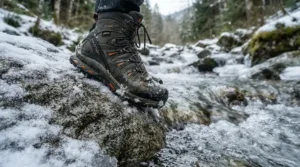
Cold Weather River Fishing: What to Expect in Real-World Performance
Cold weather river fishing changes how every boot behaves, and the spec sheet only hints at it. Expect slower, more deliberate steps. Metal-studded soles bite hard on frozen cobble, but the same studs can feel clumsy on smooth, dry trails, so plan for a short adjustment period. Reviewers of studded boots repeatedly describe it as a gait change, not a flaw.
Warmth comes from layers, not boots. Wading boots mostly sit over neoprene stockingfoot waders, and Simms sizes its boots specifically to accommodate that neoprene foot. Reviewers of cold-water boots, including one Frogg Toggs buyer, mention warm toes as a bonus, but you should still treat insulating socks and well-fitted waders as the real heat source.
Snow and ice also behave differently on banks than in the current. Frozen ground favors aggressive studs, while submerged rock coated in algae favors sharper carbide or aluminum. That’s why many anglers keep two soles, one for walking and one for wading. In short, the best cold weather river fishing boots are those that let you adapt, and interchangeable-sole systems do that most elegantly.
Common Mistakes When Buying Studded Wading Boots
A few pitfalls show up again and again in reviews. Avoid them and you’ll save money and frustration.
Assuming sticky rubber is enough. Reviewers of the Simms Tributary and Simms Freestone report slipping on slime and algae until they added studs. If the water is slick, plan for metal.
Ignoring stud retention. Some budget rubber soles hold studs poorly. Boots with plates or interchangeable soles, like the Orvis PRO or the Korkers lineup, reduce that risk.
Buying felt for winter. Orvis notes felt freezes and collects snow, and some places restrict it entirely. Alaska’s Department of Fish and Game publishes an FAQ on its felt-soled wading footwear ban, and other jurisdictions, including Yellowstone National Park, have restricted felt as well. Rules change, so verify the waters you’ll fish.
Sizing without insulation in mind. Leave room for neoprene feet and thicker socks, or your toes will pay for it.
Forgetting boat policies. Many boat owners refuse studs or bars aboard, so a swappable sole can save a trip.
Overbuying premium. If you fish a handful of winter days, a mid-priced option like the Korkers Darkhorse may serve you as well as a $450-plus boot.
Long-Term Cost & Maintenance: What Studded Boots Really Cost
Upfront price is only part of the story. Here’s the total-cost view.
| Boot | Upfront Range | Replaceable Traction | Value Take |
|---|---|---|---|
| Korkers River Ops BOA | ~$240-$320 | Soles roughly $40-$70 | Strong if you use both soles |
| Korkers Darkhorse | ~$185-$250 | Soles roughly $40-$70 | Best mid-range value |
| Korkers Devil’s Canyon | ~$170-$250 | Soles roughly $40-$70 | Good for hikers |
| Simms Freestone | Low-$200s | Cleats about $30-$40 | Flexible, but pay twice |
| Orvis PRO | High-$200s | Studs sold separately | Support-focused value |
| Patagonia x Danner Foot Tractor | ~$450-$500 | Replaceable bars | Pays off with heavy use |
| Frogg Toggs Hellbender Cleated | Under $120 | Studs extra | Cheapest entry |
Cost per use tells the real story. A $475 boot used 200 days works out to about $2-$3 per outing, while a $110 boot that lasts 40 days lands in the same neighborhood. The cheaper boot wins only if it survives, and the Frogg Toggs Hellbender Cleated has mixed reports on sole durability. Meanwhile, the Korkers soles are modular, so wear on one sole doesn’t kill the whole boot. Maintenance is cheap: rinse, dry fully, check studs, and replace worn metal before it fails mid-river.
Winter Wading Safety: A Practical Guide
Winter wading safety starts with accepting that cold water leaves little margin. Studded boots reduce slips, but they don’t replace judgment. The Virginia Department of Wildlife Resources advises a wading belt, a buddy, and basic safety gear such as a whistle, wading staff, and bright clothing. It also recommends synthetic, insulating layers for cold-water wading.
Wading belts matter because they limit how much water enters your waders during a fall. A staff adds a third point of contact on uneven bottoms, which pairs nicely with studded soles. Fly Lords Magazine also warns about ice dams along banks, where a solid-looking shelf can hide open water beneath.
Watch for the early signs of hypothermia, including persistent shivering, numb fingers or toes, fumbling with gear, and confusion. If you notice them, exit the water and warm up. Whenever possible, fish with a partner, tell someone your plan, and cover exposed skin on the coldest days.
Finally, remember that studs are an aid, not an invitation to push harder. Cross where the water is shallow and the bottom is visible, and skip crossings that make you hesitate.
FAQ
❓ Are studded wading boots worth it for winter fishing?
❓ Can I add studs to any wading boot?
❓ Can I wear studded wading boots in a drift boat?
❓ How much do studded wading boots cost?
❓ Do studded boots grip sheet ice?
Conclusion
Winter doesn’t have to keep you off the river, but it does demand respect for your footing. The best studded wading boots for icy terrain combine a rubber sole, replaceable metal traction, and a fit that works with your waders and socks.
If you want the most complete package, the Korkers River Ops BOA ships with studded soles and a rugged build. The Korkers Darkhorse is the balanced all-rounder, and the Korkers Devil’s Canyon is the light option for long hikes. If you’d rather choose your own metal, the Simms Freestone and Orvis PRO are strong platforms, while the Patagonia x Danner Foot Tractor is the premium, buy-once choice. And if the budget is tight, the Frogg Toggs Hellbender Cleated gets you started, as long as you watch the sole bond and plan for studs.
Whatever you choose, pair it with sensible winter wading safety habits: a wading belt, a staff, a buddy, and respect for cold water. Studs buy you grip, not immunity. Prices and availability change often, so check current listings before you decide.
Recommended for You
- Wading Boots Under $100: 7 Proven Picks That Last (2026)
- Rubber Sole Wading Boots For River Fishing: 7 Proven Picks For 2026
- Felt Sole Wading Boots For Slippery Rocks: 7 Best Picks 2026
Disclaimer: This article contains affiliate links. As an Amazon Associate, I earn from qualifying purchases. If you purchase products through these links, we may earn a small commission at no additional cost to you.
✨ Found this helpful? Share it with your friends! 💬🤗
