
In This Article
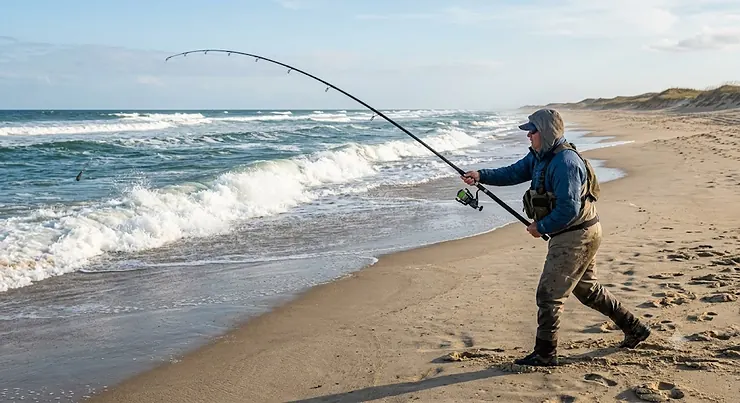
Somewhere between the 7-foot pier stick your uncle keeps in the garage and the 12-foot cannon the guys at the jetty use to launch bait into next week, there’s a length that just makes sense for most people: nine feet. A 9 foot surf rod is short enough to fit in a car trunk, light enough to fish for hours without your shoulder filing a complaint, and still long enough to punch a lure past the first sandbar. That’s the sweet spot this guide is built around.
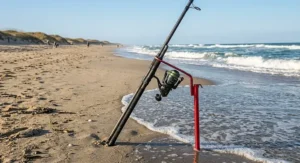
So, what is a 9 foot surf rod? It’s a spinning or casting rod, typically 9 feet long and built in one or two pieces, designed for casting bait or lures from the beach, a jetty, or a calmer bay shoreline — favoring control and portability over the maximum distance longer 10-to-13-foot rods are built for.
Whether you’re chasing striped bass off a rocky point or just want something you can toss in the back seat for a spontaneous beach trip, understanding what makes a nine-footer tick — and which real models actually earn their price tag — will save you from buying the wrong stick twice. This kind of casual, land-based game fishing has quietly become one of the most accessible entries into the sport, which is exactly why the gear market for it has exploded with options in every price bracket.
Below, you’ll find seven real, currently available 9 foot surf rods — from a $90 workhorse to a premium graphite build — broken down honestly, along with the practical knowledge (setup, mistakes, matching rod to angler) that most product listings skip entirely. No fabricated field tests, no invented five-star quotes — just spec analysis, aggregated review sentiment, and straight talk about who each rod actually fits.
Quick Comparison Table
| Rod | Power | Price Range | Best For |
|---|---|---|---|
| Ugly Stik Bigwater | Medium-Heavy | $80–$100 | Budget-first durability |
| St. Croix Mojo Surf | Medium | $180–$220 | Long-term primary rod |
| Penn Battalion II Surf | Medium / Med-Light | $100–$140 | All-around beach angling |
| Fiblink 9′ Travel Rod | Medium-Heavy | Under $60 | Compact surf fishing rod & travel |
| Okuma Longitude Surf | Heavy | $50–$90 | Budget muscle for bigger baits |
| KastKing ReKon | Medium | $60–$95 | Lighter surf rod, smaller species |
| Daiwa BG Surf / Team Daiwa | Medium-Heavy | $150–$220 range | Premium finesse and control |
Looking at the spread above, there’s no single “best” nine-footer — there’s a best nine-footer for your budget and your target species. The Ugly Stik Bigwater and Okuma Longitude Surf dominate the value end, while the St. Croix Mojo Surf and Daiwa BG Surf justify their higher price ranges with lighter blanks and better guide hardware that pays off over hundreds of casts. If portability is the priority over raw casting distance, the Fiblink and KastKing ReKon below solve two very different problems — one is about fitting in a suitcase, the other is about matching rod power to smaller, finesse-oriented species.
💬 Just one click — help others make better buying decisions too!😊
Top 7 9 Foot Surf Rods: Expert Analysis
1. Ugly Stik Bigwater — the workhorse that refuses to die
The Ugly Stik Bigwater 9-foot spinning rod has built its reputation on one thing: it doesn’t break, even when it probably should. This medium-heavy, two-piece rod blends graphite and fiberglass in what Ugly Stik calls Ugly Tech construction, and the result is a blank that flexes deep under load instead of snapping.
On paper, the specs are modest — a 20-40 lb line rating and a lure range built for standard bait rigs and mid-weight lures — but what actually matters is the one-piece stainless steel guide construction, which eliminates the insert pop-outs that plague cheaper rods after a season of sand exposure. Paired with a Fuji reel seat and EVA grips, this is a rod built for anglers who want gear that survives being left in a hot truck bed more than gear that maximizes casting distance.
Reviewers consistently report exceptional durability relative to price, with several long-term owners noting the rod has outlasted multiple reels mounted on it over the years. A common thread in aggregated feedback is that first-time surf anglers appreciate not having to baby the rod.
Pros:
- ✅ Extremely durable one-piece stainless guides resist pop-outs
- ✅ Backed by a long manufacturer warranty for peace of mind
- ✅ Forgiving blank that tolerates rookie casting mistakes
Cons:
- ❌ Heavier in hand than graphite-forward competitors
- ❌ Less sensitive tip for detecting light bites
Priced in the $80–$100 range, the Bigwater is the rod to buy if you want one nine-footer that will still be fishing five years from now, and honestly, that value proposition alone makes it worth a look for any first-time surf angler.
2. St. Croix Mojo Surf — most refined casting feel in its class
The St. Croix Mojo Surf 9-foot spinning rod is what happens when a company known for freshwater bass rods decides to build a proper surf stick. Constructed from premium SCII graphite, this two-piece, medium-power, moderate-fast rod is noticeably lighter in the hand than most rods in its length class — a difference you’ll actually feel after three hours of casting.
The standout feature here is the weight-saving surf guide system with zirconium rings, which St. Croix engineered specifically to reduce line slap on long casts. Based on the spec comparison with other rods on this list, that guide upgrade alone explains a meaningful chunk of this rod’s price premium — zirconium-ringed guides shed friction that eats into casting distance on windy days.
What most buyers overlook about this rod is the offset ferrule design on the two-piece build, which is engineered to perform like a one-piece blank once assembled — a detail that matters more than it sounds, since cheap two-piece rods often have a noticeable “dead spot” at the joint. Reviewers frequently cite the rod’s grip comfort and casting accuracy as reasons they upgraded from a big-box store rod.
Pros:
- ✅ Lightweight SCII graphite blank reduces casting fatigue
- ✅ Zirconium-ring guides cut line slap on long casts
- ✅ Five-year warranty with real manufacturer support
Cons:
- ❌ Premium price compared to composite alternatives
- ❌ Lighter blank means less brute lifting power for oversized fish
At around $180–$220, the Mojo Surf sits toward the top of this list, but for anglers who fish often enough to feel the difference between an 11-ounce rod and a 14-ounce rod, it’s the kind of upgrade that changes how much you enjoy a session.
3. Penn Battalion II Surf — the balanced all-rounder
The Penn Battalion II Surf 9-foot spinning rod occupies the middle ground almost perfectly — not the cheapest, not the lightest, but arguably the most balanced option for someone who wants one rod to handle plugs, bait rigs, and metal lures without constantly second-guessing the setup.
Its composite blank pairs with Fuji Alconite guides, a genuine step up from generic aluminum oxide inserts because Alconite rings run cooler and smoother under heavy braided line — the kind of detail that never shows up on a spec sheet but shows up in your casting distance after 40 throws. The 12-20 lb line rating and 3/4-3 oz lure range on the medium model make this rod a natural companion to Penn’s own Battle III or Spinfisher VI reels, which is worth knowing if you’re building a matched setup rather than piecing one together.
Aggregated owner feedback highlights the rod’s versatility across techniques — from soaking cut bait to working topwater plugs — as its biggest selling point, with several anglers noting they’ve replaced dedicated single-purpose rods with just this one.
Pros:
- ✅ Fuji Alconite guides handle braided line smoothly
- ✅ Versatile enough for bait, plugs, and metal lures
- ✅ Lightweight at under 12 ounces for the 9-foot model
Cons:
- ❌ Line and lure ratings are narrower than heavy-duty rivals
- ❌ Cork-free rubber grip feels less premium to some anglers
Expect to pay in the $100–$140 range depending on retailer and the specific power option (a medium-light 9-footer is also available for lighter tackle), which puts this rod squarely in the “buy once, fish for years” category without spending premium-tier money.
4. Fiblink 9′ Two-Piece Travel Surf Rod — the compact surf fishing rod built for suitcases
If your priority is a compact surf fishing rod that survives airline baggage handlers and fits in a closet rather than a garage, the Fiblink 9-foot two-piece rod solves a very specific problem cheaply. Built from a graphite-fiberglass blend with stainless steel guides and ceramic inserts, it breaks down into two roughly 4.5-foot sections, which is short enough for most checked luggage and nearly all car trunks.
Here’s what the spec sheet won’t tell you, but reviewers note: at this price point, you’re trading some blank refinement for portability, and that’s a fair trade for someone who fishes twice a year on vacation rather than every weekend. The rod’s reel seat uses a plastic wheel construction with a stainless tapered hood, which is adequate for occasional use but not built for the abuse a daily surf rod takes.
Available feedback highlights strong value-for-price sentiment, with buyers comparing the casting performance favorably against rods costing two to three times as much, though a subset of reviewers flag long-term guide-insert durability as a concern worth monitoring after heavy use.
Pros:
- ✅ Breaks down to roughly 4.5-foot sections for real portability
- ✅ Genuinely low price of entry for occasional anglers
- ✅ Surprisingly capable casting distance for a travel-first design
Cons:
- ❌ Plastic reel seat components feel less durable long-term
- ❌ Not built for daily heavy-surf abuse
At under $60, this is the easiest recommendation on this list for the vacation angler, the small-apartment angler, or anyone who just wants a backup rod without a backup-rod price tag.
5. Okuma Longitude Surf — heavy-duty casting on a beer-budget
The Okuma Longitude Surf 9-foot rod exists to answer one question: how much casting power can you buy for under $90? The answer, based on its graphite composite blank and heavy-power rating, is quite a lot. This rod is built with a 20-40 lb line rating and stainless steel double-foot guides with aluminum oxide inserts — hardware normally reserved for rods costing twice as much.
What stands out on the spec sheet is the double-footed guide frame on every guide, not just the stripper guides. Double-foot construction resists twisting under heavy braid tension far better than the single-foot guides found on many budget rods, which in practice means less line fouling when you’re chunking bait with a 4-6 oz sinker into a stiff onshore wind.
Reviewers describe the rod as a legitimate value pick for species like striped bass and catfish, with multiple owners noting it performs on par with rods costing considerably more, though the trade-off is a stiffer, less nuanced tip than the graphite-forward options higher up this list.
Pros:
- ✅ Double-foot stainless guides rare at this price point
- ✅ Heavy power handles large baits and stiff wind
- ✅ Cork-taped handle feels premium despite the low cost
Cons:
- ❌ Stiffer action reduces bite sensitivity
- ❌ Heavier overall build than composite alternatives
Priced around $50–$90 depending on retailer promotions, the Longitude Surf is the rod to hand a beginner who might lose interest — or a backup rod for anglers who don’t want their best gear near the rocks.
6. KastKing ReKon — a lighter surf rod built for smaller species
Not every surf session calls for heavy-power gear, and that’s exactly the gap the KastKing ReKon 9-foot spinning rod fills. Built with a two-piece Power Transition System blank and zirconium ceramic guides on stainless frames, this rod is marketed toward medium and medium-heavy applications, making it a genuinely lighter surf rod option for anglers targeting smaller species surf fishing scenarios — pompano, whiting, small bluefish, and other fish that don’t require a broomstick to fight.
Based on the spec comparison with heavier rods on this list, the ReKon’s lighter tip translates directly into better bite detection — you’ll feel a light pompano peck that a heavy-power rod would simply mask. The graphite locking reel seat is a nice touch at this price, keeping mid-size reels secure even when a surprise bigger fish takes the bait.
Aggregated review sentiment describes the build quality as punching well above its price class, with multiple long-time saltwater anglers noting the rod’s versatility across techniques as a standout, though it’s clearly not designed as a heavy-surf bruiser rod.
Pros:
- ✅ Lighter tip improves sensitivity for smaller species
- ✅ Zirconium ceramic guides reduce friction and heat
- ✅ Secure graphite locking reel seat for its price class
Cons:
- ❌ Not rated for the heaviest surf conditions or largest fish
- ❌ Fewer power/length options than bigger-name competitors
Landing in the $60–$95 range, the ReKon earns its spot here specifically for anglers who’ve decided a 9-foot heavy rod is overkill for their local calm beach fishing or bay-adjacent target species.
7. Daiwa BG Surf / Team Daiwa — the premium finish
Closing out this list is the Daiwa BG Surf lineup (also sold as the Team Daiwa surf series), a 9-foot medium-heavy graphite composite rod that represents the ceiling of what this list covers. Built with EVA foam grips, aluminum oxide guides, and Daiwa’s reputation for precise blank tapering, this rod is designed for anglers who’ve outgrown entry-level gear and want a dedicated surf setup that pairs with a quality reel like Daiwa’s own BG series.
What most buyers overlook about this tier of rod is that the real upgrade isn’t raw power — it’s consistency. A well-tapered premium blank loads evenly through the whole cast, which means less energy lost to blank “wobble” and more of it transferred directly into lure distance. On paper this means marginal gains per cast, but over a full session those marginal gains add up to real yardage.
Reviewers who’ve paired this rod with the matching BG reel consistently praise the combo’s balance and describe landing large striped bass with no signs of strain on the rod, framing it as serious gear rather than a casual purchase.
Pros:
- ✅ Precision-tapered blank loads evenly through the cast
- ✅ Pairs naturally with Daiwa’s trusted BG reel series
- ✅ Component quality built for serious, frequent surf anglers
Cons:
- ❌ Highest price range on this list
- ❌ Arguably more rod than casual, occasional anglers need
Typically found in the $150–$220 range depending on configuration, this is the “graduate to” rod once you know surf fishing is a habit rather than a one-time hobby experiment.
✨ Don’t Miss These Exclusive Deals!
🔍 Take your surf fishing setup to the next level with these carefully selected rods. Click on any highlighted model above to check current pricing and availability. The right nine-footer will help you land authentic, memorable catches your whole family will enjoy!
Setting Up Your 9 Foot Surf Rod: The First 30 Days
Getting a new rod out of the box is the easy part — setting it up correctly is what determines whether your first month goes smoothly. Start by matching reel size to rod power: a medium 9-footer like the Penn Battalion II Surf or KastKing ReKon pairs best with a 4000-5000 size spinning reel, while heavier options like the Okuma Longitude Surf or Ugly Stik Bigwater balance better with a 6000-8000 size reel.
Spool with braided line first, then add a 2-3 foot monofilament or fluorocarbon leader — braid alone lacks the abrasion resistance needed near rocks or jetties, and the stretch-free nature of braid transmits bite detection far better than straight mono. When threading the rod for the first time, run line through every guide, including the tip-top; skipping a guide is the single most common first-cast mistake new surf anglers make, and it usually ends with a wind knot you’ll be picking apart for ten minutes.
For maintenance, rinse your rod with fresh water after every saltwater session, paying particular attention to the guides and reel seat threads where sand and salt accumulate fastest. Every few months, apply a light reel oil to the guide inserts on rods without ceramic coatings, and inspect two-piece ferrules for looseness — a wobbly ferrule connection is an early warning sign of a future break, not a cosmetic issue to ignore.
Real-World Scenarios: Which Angler Needs Which Rod
Matching a rod to your actual fishing habits beats matching it to a spec sheet every time. Consider a college student living near the coast, fishing twice a month off a public beach with a modest budget — the Ugly Stik Bigwater or Okuma Longitude Surf makes sense here, since both deliver durable, forgiving performance without demanding a big upfront investment or delicate handling.
Now picture a retiree who fishes calm beach fishing spots three mornings a week, targeting whiting and small drum in gentle surf. This is precisely the KastKing ReKon scenario — a lighter surf rod that rewards finesse and bite detection over raw casting distance, since the fish in calmer water rarely require max-power gear to land.
Finally, imagine a frequent traveler who wants to surf fish on every beach vacation without checking oversized luggage. The Fiblink 9′ Travel Rod exists specifically for this profile — a compact surf fishing rod that breaks down small enough to disappear into a duffel bag, ready whenever a coastal trip comes up unplanned. None of these anglers need the same rod, and that’s the entire point of this comparison.
Packing a Travel Surf Rod: What to Know Before You Fly or Drive
A travel surf rod is only useful if it actually survives the trip. Two-piece and three-piece rods like the Fiblink 9′ Travel Rod break down into sections short enough for a rod tube that fits in most car trunks and many airline checked-bag allowances — always verify your specific airline’s sporting equipment policy before assuming a rod tube counts as a standard bag, since policies vary and change.
Invest in a hard rod tube rather than a soft case for any flight; checked luggage handling is rough, and a soft case offers little protection against a baggage cart running over a bundle of rods. Pack reels separately in your carry-on when possible, since reels are both more fragile and more valuable than the rod blank itself, and airline compensation for lost checked baggage rarely covers the true replacement cost.
Once you arrive, give a travel rod a quick visual inspection before its first cast — check ferrule alignment, look for hairline cracks near the joints, and make sure guides haven’t shifted during transit. A five-minute check beats losing a rod tip to a hidden crack on your first cast of the vacation.
How to Choose a 9 Foot Surf Rod
Picking the right nine-footer comes down to a handful of decisions, best made in this order:
- Define your primary target species. Larger, harder-fighting fish like striped bass call for medium-heavy to heavy power; smaller species like pompano or whiting are better served by a lighter, more sensitive tip.
- Match power to typical conditions. Rough, wind-heavy beaches favor a heavier rod that can control a cast in bad conditions; calmer bays or protected coves let you fish lighter gear comfortably.
- Decide on one-piece versus two-piece construction. Two-piece rods trade a small amount of blank sensitivity for dramatically easier transport and storage — worth it for most anglers.
- Set a realistic budget band. Spending more buys lighter materials and better guides, but a $90 rod fished properly will outperform a $200 rod that’s neglected.
- Check guide material and count. Aluminum oxide, zirconium, and ceramic-ringed guides all resist line wear better than basic stainless inserts, particularly with braided line.
- Consider your storage space. A compact surf fishing rod that breaks down small is worth prioritizing if you live in an apartment or travel frequently.
- Read the fine print on warranty coverage. Rods that see regular saltwater exposure benefit enormously from a real multi-year warranty, not just a 90-day return window.
Before locking in a purchase, it’s also worth understanding the basics of saltwater recreational fishing registration requirements, since most coastal states require some form of license or registration regardless of which rod ends up in your hands.
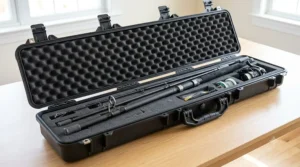
Compact Surf Fishing Rod vs Longer Surf Rods: 9 vs 10-12 Feet
The most common length debate in surf fishing isn’t about brand — it’s about whether nine feet is “enough.” A 9 foot surf rod trades maximum casting distance for control, weight savings, and ease of transport, while 10-to-12-foot rods are built to punch bait or lures well beyond the first sandbar when fish are feeding out past the breakers.
In practice, the length that matters most is dictated by where you actually fish. Anglers working from rocky points, jetties with obstructions behind them, or calmer back-bay shorelines rarely need the extra reach a 12-foot rod provides — and that extra length becomes a liability in tight casting spaces where a longer blank risks clipping rocks or nearby anglers on a crowded beach. Conversely, anglers working wide-open beaches where fish routinely feed 80-100 yards out will genuinely lose distance with a shorter rod, no matter how good the guides are.
The honest takeaway: a compact surf fishing rod like the ones in this guide isn’t a compromise for open-beach anglers chasing maximum distance, but it’s the objectively better tool for jetty fishing, back-bay fishing, and anyone who values one rod that does most jobs well over a specialized rod that excels at only one.
A Lighter Surf Rod: What to Expect in Real-World Performance
Choosing a lighter surf rod like the KastKing ReKon changes the entire feel of a session, and it’s worth setting expectations before you buy. On the water, a lighter-power rod transmits far more information through the blank — you’ll feel structure changes on the bottom, subtle taps from smaller fish, and the difference between a nibble and a genuine take, none of which come through clearly on a heavy-power blank built to survive 6-ounce sinkers.
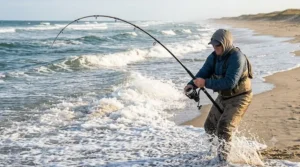
The trade-off shows up when something bigger than expected takes the bait. A lighter rod has less lifting power and a narrower safe drag range, meaning you’ll need to fight larger fish more patiently and let the rod’s flex — rather than brute force — do the work. Reviewers who’ve fished lighter surf rods in mixed conditions consistently note this exact dynamic: better feel on typical fish, more careful technique required on the occasional surprise.
What the spec sheet won’t tell you is that lighter rods also reduce fatigue dramatically over a multi-hour session, which matters more than most first-time buyers expect. If you’re fishing three-hour sessions regularly, the cumulative shoulder and wrist strain of a heavy rod adds up in a way that’s easy to underestimate until you’ve tried the lighter alternative back-to-back.
9 Foot Surf Rod for Smaller Species Surf Fishing
Smaller species surf fishing — targeting pompano, whiting, small bluefish, croaker, and similar fish — rewards a completely different rod philosophy than trophy-hunting for striped bass or big red drum. Sensitivity beats raw power here, since these species often produce subtle bites that a stiff, heavy-power blank simply won’t transmit clearly to your hand.
A medium-power 9-foot rod like the KastKing ReKon or the medium-light configuration of the Penn Battalion II Surf line is purpose-built for this style of fishing. The lighter tip loads properly with smaller lures and lighter sinkers, which also improves casting accuracy when you’re targeting a specific trough or cut rather than blasting a cast as far as possible.
It’s also worth noting that gear choice interacts directly with regulations for these species — bag limits, size minimums, and seasonal closures vary significantly by state and by species, so pairing the right rod with a quick check of current seasons, sizes, and possession limits in your region prevents an otherwise perfect day from ending with a fine.
Calm Beach Fishing: Matching Rod Power to Mellow Surf Conditions
Not every beach fights back. Protected coves, back-bay shorelines, and calm-water beaches common along much of the Gulf Coast and parts of the Pacific Northwest simply don’t demand the same rod power as an exposed Atlantic beach getting hammered by three-foot surf. Fishing a heavy-power 9-foot rod in genuinely calm conditions is a bit like using a sledgehammer to hang a picture frame — it works, but you’ll feel every bit of the mismatch.
In calm beach fishing conditions, a medium or medium-light 9-footer casts more accurately, tires your arm less, and — most importantly — actually improves your hookup ratio, since a softer tip won’t rip a hook out of a lightly-biting fish’s mouth the way a stiff heavy-power rod can. This is exactly the scenario where the KastKing ReKon or a medium Penn Battalion II Surf shines, and it’s also where the growing popularity of accessible, land-based fishing becomes obvious — recreational fishing overall has grown into a meaningful piece of the outdoor economy, reflecting just how many casual anglers are wading into calmer water with exactly this kind of gear.
If you’re fishing primarily protected water, resist the marketing pull toward the heaviest, most “serious-looking” rod on the shelf. Matching power to actual conditions, not to the biggest fish you might theoretically encounter, produces a noticeably better day on the water.
Common Mistakes When Buying a Compact Surf Fishing Rod
The most frequent mistake is buying based on length alone without considering power rating — a 9-foot ultralight and a 9-foot heavy rod are built for completely different fishing, despite sharing a length spec. Always check power and line rating together, not length in isolation.
A second common error is ignoring guide construction to save money. Cheap single-foot guides with basic inserts wear out fast under braided line, and replacing guides costs more in time and money than simply buying a rod with better hardware upfront. Third, many first-time buyers skip verifying local size and possession regulations before choosing a rod suited to their intended species — worth resolving before purchase, since rules can change between seasons and it’s smarter to plan gear around current regulations than outdated assumptions.
Finally, don’t assume a compact rod means a weak rod. Several 9-foot options on this list, particularly the Okuma Longitude Surf and Ugly Stik Bigwater, handle serious line weights despite their manageable length — length and power are separate variables, and conflating them leads to either overbuying or underbuying.
Long-Term Cost & Maintenance
The sticker price of a 9 foot surf rod is only part of the real cost. A budget rod like the Fiblink 9′ Travel Rod or Okuma Longitude Surf may need guide or ferrule replacement sooner under heavy, frequent use, while a premium build like the Daiwa BG Surf or St. Croix Mojo Surf is engineered with corrosion-resistant hardware designed to hold up over years of saltwater exposure with proper care.
Factor in the cost-per-use math honestly: a $90 rod fished twice a month for three years works out to roughly $1.25 per outing, while a $200 rod fished at the same frequency runs closer to $2.75 per outing — the premium option only “wins” financially if the added durability and performance genuinely extend its usable life well beyond the budget alternative, which, based on warranty terms and component quality, it generally does for frequent anglers.
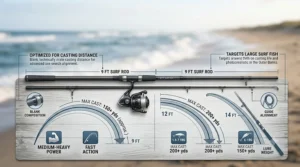
Routine maintenance is the biggest lever anglers control directly. A thorough freshwater rinse after every session, periodic guide inspections, and proper storage away from direct sun (UV exposure degrades blank resins over time) will extend any rod’s usable life significantly, regardless of price tier.
Frequently Asked Questions
❓ Is a 9 foot surf rod long enough for real surf fishing?
❓ What size reel pairs with a 9 foot surf rod?
❓ Can a 9 foot surf rod handle striped bass?
❓ Are two-piece 9 foot surf rods weaker than one-piece rods?
❓ What's the best 9 foot surf rod for a beginner?
Conclusion
A 9 foot surf rod isn’t a compromise pick — for the majority of surf, jetty, and calm-beach anglers, it’s genuinely the smarter length choice over bulkier 11-to-13-foot alternatives. The right one for you depends less on brand prestige and more on an honest look at where you fish, what you’re targeting, and how often you’ll actually use it.
If durability and forgiveness matter most, the Ugly Stik Bigwater and Okuma Longitude Surf deliver real value without asking you to baby the gear. If you’re chasing a noticeably better casting feel and plan to fish often, the St. Croix Mojo Surf and Daiwa BG Surf justify their higher price ranges. And if portability or finesse is the priority — a compact surf fishing rod for travel, or a lighter surf rod for smaller species and calm beach fishing — the Fiblink 9′ Travel Rod, KastKing ReKon, and Penn Battalion II Surf each solve that problem in their own way.
Whichever model you land on, the fundamentals stay the same: match power to your actual conditions, maintain the rod properly, and check your local regulations before your first cast. Do that, and any rod on this list will serve you well for years of beach mornings to come.
Recommended for You
- 12 Foot Surf Casting Rod: 7 Top Picks for Distance in 2026
- 10 Foot Surf Rod: 7 Best Picks for Every Budget in 2026
- Jetty Fishing Rod Guide 2026: 7 Rods That Won’t Snap on Rocks
Disclaimer: This article contains affiliate links. As an Amazon Associate, I earn from qualifying purchases. If you purchase products through these links, we may earn a small commission at no additional cost to you.
✨ Found this helpful? Share it with your friends! 💬🤗
