
In This Article
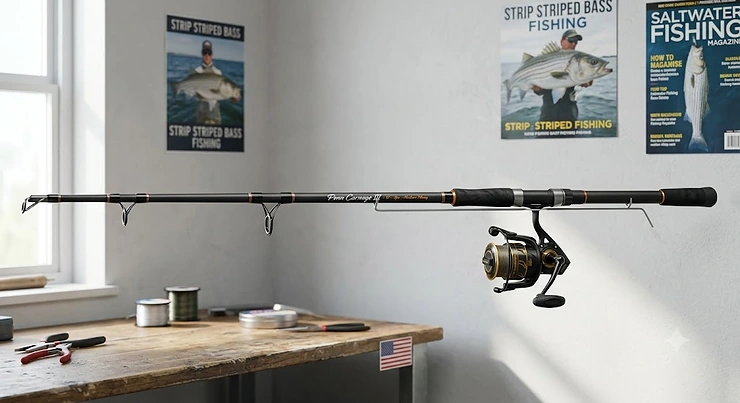
Standing at the wash with a rod that’s wrong for the job is its own special kind of misery. You watch the guy twenty yards down the beach lob a bait past the second bar while your line plops into the foam like a dropped ice cream cone. A 10 foot surf rod is the length that most American beach anglers eventually land on, and there’s a reason for that — not hype, just physics. What is a 10 foot surf rod? It’s a spinning or conventional rod measuring roughly 10 feet, built with enough backbone to sling 2 to 6 ounces of weight past the breakers while still staying light enough to hold comfortably for hours. It’s the Goldilocks length: long enough to clear the first wave zone, short enough that your shoulder doesn’t file a complaint by hour three.
This guide pulls together real specs, real aggregated review sentiment, and honest side-by-side analysis on seven actual rods you can buy right now, from a budget-friendly workhorse to a genuinely premium stick that costs more than some people’s tackle box. We’ll walk through what separates a 10ft surf casting rod that performs from one that just looks good on a rack, how beach conditions change your rod choice, and where a medium length surf rod fits against its longer and shorter cousins. According to the background on surf fishing technique, the sport’s entire premise revolves around casting distance and lure control from the shoreline — which is exactly what rod length and action are built to solve.
Quick Comparison Table
Before we dig into the deep-dive reviews, here’s the fast version for anyone standing in a tackle shop aisle right now.
| Rod | Power/Action | Price Range | Best For |
|---|---|---|---|
| Ugly Stik Bigwater | Medium Heavy, Moderate | Around $80-$100 | Beginners and budget-first anglers |
| BERRYPRO Full Carbon | Medium, Moderate-Fast | Around $60-$90 | Lightest budget option |
| Okuma Longitude | Heavy, Moderate-Fast | $90-$140 range | Best all-around value |
| Tsunami Airwave | Medium Heavy/Xtra Heavy | $150-$180 range | Long-distance casting |
| Penn Battalion II | Medium Heavy, Moderate-Fast | $130-$160 range | Balanced mid-range pick |
| St. Croix Mojo Surf | Medium/Medium Heavy | $200-$250 range | Sensitivity-focused veterans |
| Star Rods Stellar Surf | Medium Heavy, Fast | $150-$200 range | Underrated premium alternative |
Looking at the table, the split is pretty clean: Ugly Stik Bigwater and BERRYPRO Full Carbon own the entry-level tier, the Okuma Longitude, Tsunami Airwave, and Penn Battalion II compete in the crowded mid-range where most anglers actually shop, and St. Croix Mojo Surf with Star Rods Stellar Surf fight it out for anglers who’ve decided a rod is worth investing in. None of these are automatically “better” in isolation — it depends entirely on how often you fish and what you’re willing to carry.
💬 Found a rod that catches your eye already? Tap through to check today’s availability before it sells out of your size!
Top 7 10 Foot Surf Rods: Expert Analysis
1. Ugly Stik Bigwater — nearly impossible to break
The standout here isn’t casting distance, it’s survival. Ugly Stik built its entire reputation on rods that shrug off abuse, and the Bigwater 10-footer keeps that promise. The blank uses Ugly Tech construction, a graphite-and-fiberglass hybrid, paired with Ugly Tuff one-piece stainless steel guides that eliminate the insert pop-outs that plague cheaper rods after a season of sand exposure. That fiberglass content means it won’t feel as crisp in your hands as a full-carbon blank, but it also means stepping on it in the truck bed probably won’t end your fishing trip.
Practically speaking, the fiberglass blend sacrifices some sensitivity for shock resistance — you’ll feel bites a beat later than on the more premium picks here, but you’ll also survive the inevitable rod-versus-car-door incident that claims so many rookie setups. Based on the spec comparison, this is squarely a rod for someone just getting into the sport, or anyone who fishes rock jetties where gear takes a beating. Reviewers consistently describe it as a dependable workhorse that outlasts rods costing twice as much, and the 7-year warranty backs that reputation with something concrete rather than just marketing copy.
Pros:
- ✅ Backed by a genuine 7-year manufacturer warranty
- ✅ Fiberglass-graphite blend resists breakage on rocks or in transport
- ✅ Fuji reel seat feels premium for the price tier
Cons:
- ❌ Less sensitive than full-carbon or composite blanks
- ❌ Heavier swing weight during all-day casting sessions
At around $80-$100, this is one of the least expensive genuinely durable options on this list, and for a first surf rod, that durability-per-dollar math is hard to beat.
2. BERRYPRO Full Carbon — lightest blank under $100
What most buyers overlook about entry-level rods is that weight fatigue matters more than any single spec sheet number, and this is where the BERRYPRO earns its spot. Built on an X-Carbon technology blank, it’s noticeably lighter in hand than the fiberglass-hybrid competition, which matters when you’re holding a rod out over breaking waves for four hours straight.
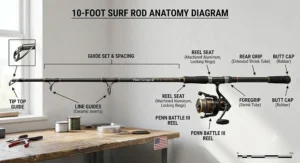
The stainless steel guides use ceramic ring inserts to cut down on line friction, and the reel seat is rated for the line and lure weights you’d expect in the 15-27lb / 1-3oz range depending on the exact model chosen. Here’s what to weigh: at this price, something has to give, and that something is guide durability under heavy saltwater exposure over multiple seasons — a fair trade if you’re testing the surf-fishing waters before committing serious money. Aggregated buyer sentiment on major retail sites frequently highlights the light swing weight and price-to-performance ratio as the rod’s biggest selling points, with some buyers noting the reel seat hardware feels less refined than name-brand competitors, which tracks with the price gap.
Pros:
- ✅ Genuinely light carbon blank reduces arm fatigue
- ✅ Ceramic guide inserts smooth out long casts
- ✅ Multiple length/action variants for different beaches
Cons:
- ❌ Hardware feels less refined than premium brands
- ❌ Limited long-term saltwater durability data available
Priced in the $60-$90 range, this is the rod to hand a friend who wants to try surf fishing without you loaning out your good gear.
3. Okuma Longitude — best backbone-to-price ratio
The Longitude’s standout feature is straightforward: it delivers components you’d expect on pricier rods — double-footed stainless guide frames with aluminum oxide inserts — at a price point that undercuts most of the field. Aluminum oxide handles braided line abrasion notably better than the basic stainless inserts found on some budget competitors, which matters since most serious surf anglers have moved to braid for the added casting distance it provides.
The graphite composite blank in the Heavy power rating is built for hauling bait and sinkers through rocky structure and current rather than finesse lure work, and the cork-wrapped handle with EVA cushioning keeps grip comfortable across a long tide change. Based on the spec comparison against the Bigwater and BERRYPRO, the Longitude sits in a sweet spot: heavier-duty hardware without jumping into premium pricing. FishUSA’s aggregated customer sentiment specifically calls it a “great bait rod for the price” and notes its ability to handle both light and heavy sinkers without a second rod purchase.
Pros:
- ✅ Aluminum oxide guides handle braided line well
- ✅ Genuinely versatile across light and heavy sinker weights
- ✅ Comfortable cork-and-EVA grip for long sessions
Cons:
- ❌ Heavy power rating overkill for light lure work
- ❌ Fewer color/cosmetic options than competitors
At $90-$140, this is the rod most likely to satisfy someone who wants one setup that handles both bait-soaking and occasional lure casting.
4. Tsunami Airwave — built specifically for distance
Surf casting is fundamentally a distance game, and the Airwave’s High Fiber Density graphite blank construction exists purely to solve that problem. High-pressure manufacturing techniques strip excess weight from the blank without sacrificing power, so the rod loads and releases energy faster through the cast — the practical result is more yards per cast for the same amount of effort compared to a heavier hybrid blank.
Depending on which power rating you pick, you’re looking at a 15-30lb line rating with a 2-4oz lure window (Medium Heavy) or a 20-40lb line class handling 3-6oz (Extra Heavy) — meaning you should match the model to your typical sinker weight rather than grabbing whichever one is in stock. Reviewers consistently note the rod’s lighter swing weight compared to similarly-priced competitors, and multiple tackle shop write-ups describe it as premium performance without the premium price tag. What the spec sheet won’t tell you is that the PacBay Hardloy guide inserts on this series are specifically chosen for braid compatibility, so pairing it with braided line rather than mono unlocks most of the distance advantage this blank is designed to deliver.
Pros:
- ✅ Purpose-built blank engineering for maximum casting distance
- ✅ Braid-friendly guide inserts for long-distance line management
- ✅ Multiple power ratings to match your typical sinker weight
Cons:
- ❌ Premium performance means a step up in price from entry-level rods
- ❌ Extra Heavy model can feel like overkill for lighter bait rigs
Expect to pay in the $150-$180 range, positioning it as a genuine mid-range distance specialist rather than a jack-of-all-trades.
5. Penn Battalion II — the balanced generalist
The Penn Battalion II doesn’t try to be the lightest or the most powerful rod on this list — its standout trait is balance. The composite blank construction splits the difference between graphite sensitivity and fiberglass forgiveness, giving you a rod that telegraphs bites reasonably well without punishing casting mistakes the way a stiffer pure-graphite blank might.
Fuji Alconite guides resist line groove wear from braided line better than basic stainless inserts, and the tough rubber shrink-tube handle stays grippy even when your hands are wet from spray or bait juice. Reviewers consistently report accurate casts with a variety of lure types — swimming plugs, metal spoons, bucktails — paired with 40lb braid, and note the Medium Heavy version handles moderate wind without losing accuracy, something lighter-power rods struggle with on an open beach. Here’s what to weigh: this rod is designed to pair specifically with Penn’s own Spinfisher VI or Battle III reels, and while it works fine with other brands, the balance point is optimized around that combination, so factor that into your reel budget too.
Pros:
- ✅ Fuji Alconite guides resist braided line wear
- ✅ Handles wind and casting accuracy well in Medium Heavy trim
- ✅ Versatile across bait and lure presentations
Cons:
- ❌ Balance is optimized around Penn’s own reel lineup
- ❌ Mid-pack pricing without a single standout specialty
Priced around $130-$160, it’s the rod for someone who wants “good at everything” rather than “great at one thing.”
6. St. Croix Mojo Surf — sensitivity worth paying for
The 10-foot St. Croix Mojo Surf in Medium power weighs approximately 12.3 ounces — genuinely light for a rod this length, and that number matters more than it sounds like it should. Less mass in the blank means less arm fatigue after hours of casting and noticeably better transmission of subtle structure bites and current changes back to your hand.
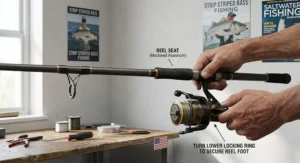
The SCII graphite blank pairs with weight-saving surf guides featuring zirconium rings, and the sloped guide frames specifically reduce the line-tangling that plagues cheaper guide setups during wind-blown casts. Offset ferrules on the two-piece construction are engineered to perform like a one-piece blank, meaning you’re not sacrificing the casting feel that typically comes with rod breakdown points. On paper this means better accuracy and less break-off risk when you’re fighting a fish through structure. Reviewers frequently describe this as the first 10-foot rod they could “really cast well with,” a meaningful endorsement from anglers who’ve cycled through cheaper options first. The trade-off is straightforward honesty: you’re paying a real premium for real engineering, not just a name on the blank.
Pros:
- ✅ Exceptionally light blank reduces fatigue and boosts sensitivity
- ✅ Zirconium guide rings and sloped frames cut down tangles
- ✅ 5-year warranty backed by established rod manufacturer
Cons:
- ❌ Meaningfully more expensive than mid-range alternatives
- ❌ Lighter build demands more careful handling on rocks
At $200-$250, this is an investment rod, best justified by anglers who fish often enough that the sensitivity and weight savings compound over dozens of trips.
7. Star Rods Stellar Surf — the overlooked premium pick
Star Rods doesn’t have the marketing budget of the big names, which is exactly why the Star Rods Stellar Surf rarely comes up in casual conversation despite genuinely competitive engineering. The standout is the high modulus graphite blank, which prioritizes rebound strength and hook-setting power — in practice, that translates to a noticeably crisper, faster-loading cast compared to the composite blanks used in several mid-range competitors on this list.
Fuji guides and reel seat components appear throughout the lineup, paired with cross-wrap rubber shrink grips that hold up well to repeated saltwater exposure. Based on the spec comparison, this rod competes directly with the Airwave and Battalion II on paper, but its smaller production runs mean it doesn’t benefit from the same volume of aggregated review data as the bigger brands — so while the specs and hands-on tackle shop write-ups are consistently positive, verified customer review volume is genuinely thinner than for the mass-market picks on this list, and that’s worth acknowledging honestly rather than papering over. What most buyers overlook is that “less popular” doesn’t mean “lower quality” here — it often just means less marketing spend, which can translate to more rod for your dollar.
Pros:
- ✅ High modulus graphite blank for crisp, fast-loading casts
- ✅ Quality Fuji hardware throughout the build
- ✅ Handcrafted production with attentive quality control
Cons:
- ❌ Smaller review pool makes long-term durability harder to verify
- ❌ Less brand recognition may affect resale value
Priced in the $150-$200 range depending on retailer, it’s worth cross-shopping against the Airwave and Battalion II before you default to the bigger names.
Setting Up Your 10 Foot Surf Rod: A Practical Usage Guide
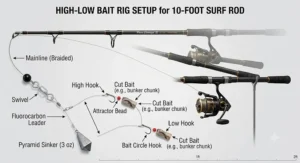
Getting a new 10ft surf casting rod out of the box is the easy part; getting it dialed in for real beach conditions takes a bit more care. Start by matching reel size correctly — a 5000 to 6000-size spinning reel is the standard pairing for a 10-foot rod, since anything smaller struggles to balance the blank and anything larger adds unnecessary swing weight. When spooling line, fill to about 1/8 inch from the spool lip; braided main line with a mono or fluorocarbon shock leader (25-40lb, roughly triple your main line’s diameter in length) protects against abrasion from sand, shells, and structure during the cast and fight.
In your first 30 days, the most common mistake is overloading the rod past its rated lure weight to “cast farther” — this stresses the blank unevenly and is the single biggest cause of premature breakage on new rods. Rinse the rod in fresh water after every session, paying particular attention to the reel seat threads and guide inserts where salt crystallizes fastest. Store it horizontally or in rod holders rather than leaning it vertically against a wall, since gravity plus heat can very slowly warp a graphite blank over months of storage. A quick monthly check of guide inserts for hairline cracks (run a cotton ball through each guide — it’ll snag on damage invisible to the eye) catches problems before they shred your line mid-fight.
✨ Check Today’s Prices! 🎣 See current availability on any rod featured above before heading to the beach this weekend.
Real-World Scenarios: Matching the Rod to the Angler
Not every 10-foot surf rod suits every angler, so here are three realistic profiles. First, the weekend beginner: someone fishing twice a month from a public beach with mostly bait rigs for whiting or croaker. The Ugly Stik Bigwater or BERRYPRO Full Carbon make sense here — low financial risk while you’re still learning knot-tying and casting mechanics, and durability matters more than sensitivity at this stage. Second, the dedicated weekly angler chasing striped bass or redfish from open beaches, often casting metal lures or larger plugs at range — this profile benefits most from the Tsunami Airwave or Penn Battalion II, since distance and lure versatility start paying real dividends once you’re fishing several times a month.
Third, the serious surfcaster who fishes tournaments, dawn patrols, or travels specifically to chase migrating fish — this angler benefits from the St. Croix Mojo Surf or Star Rods Stellar Surf, where the sensitivity gains and reduced fatigue over an 8-hour session genuinely change how many fish you detect and land. Budget, frequency, and target species should always drive the decision more than brand loyalty or what’s trending on social media.
How to Choose a 10 Foot Surf Rod
- Match power rating to your typical sinker/lure weight. A Medium rod struggles with 5oz pyramid sinkers; an Extra Heavy rod feels like a broomstick with 1oz jigs.
- Consider your beach’s typical wave energy. Rougher, high-energy beaches generally call for slightly heavier power ratings to punch through wind and chop.
- Check the guide material. Aluminum oxide or zirconium-ring guides handle braided line far better than basic stainless inserts over time.
- Weigh the blank material trade-off. Fiberglass-hybrid blanks survive abuse; full-carbon blanks feel lighter and more sensitive but demand gentler handling.
- Confirm the reel seat pairing. A rod balanced for a 5000-6000 reel will feel off if paired with something significantly larger or smaller.
- Factor in warranty length. A 5-to-7-year warranty is a meaningful signal of manufacturer confidence, not just marketing.
- Buy for your actual fishing frequency, not your aspirational fishing frequency — an occasional angler rarely needs a $250 rod.
10 Foot Surf Rod vs Other Lengths: Why a Medium Length Surf Rod Wins the Beach
A medium length surf rod — generally the 9 to 11-foot range that a 10-footer sits comfortably inside — hits a genuine sweet spot between casting reach and everyday usability. Shorter rods under 8 feet sacrifice too much casting distance for open beach work, while rods over 12 feet are typically reserved for anglers specifically targeting the biggest fish that require casting well beyond the surf zone. There’s also a practical ceiling: casting past where the fish are actually holding wastes effort, since baitfish and gamefish alike tend to stack up in the wash and around sandbars rather than far offshore.
| Length Category | Casting Range | Best Use Case |
|---|---|---|
| Under 8 ft | Short | Jetties, rocks, tight backcasting room |
| 9-11 ft (medium length surf rod) | Moderate-Long | Open beach, general surf fishing |
| 12+ ft | Maximum | Big game surf species, widest beaches |
The middle row is where a 10 foot surf rod earns its popularity: it’s long enough to comfortably clear breaking waves on most beaches without requiring the two-handed casting stance and extra storage hassle that come with 12-foot-plus rods. For the vast majority of U.S. surf anglers fishing open Atlantic, Gulf, or Pacific beaches rather than specifically hunting sharks or giant stripers, that middle ground consistently outperforms the extremes in day-to-day usability.
Common Mistakes When Buying a 10ft Surf Casting Rod
The single most common mistake is buying based on length alone and ignoring power rating entirely — a Medium 10ft surf casting rod and an Extra Heavy 10ft surf casting rod are built for completely different jobs despite sharing a length spec. Another frequent misstep is skipping the two-piece versus one-piece consideration; while one-piece rods theoretically cast marginally better, a quality two-piece with offset or spigot ferrules performs close enough that the storage and transport convenience usually wins for most anglers. Buyers also commonly underestimate shipping and handling damage risk with lower-cost rods that arrive in flimsy packaging rather than a hard tube, so checking return policies before buying matters more than people expect.
A less obvious mistake is ignoring the 50/50 versus 60/40 break point mentioned by seasoned surf guides — a 60/40 split with a shorter butt and longer tip section produces a more even bend through the rod for a more powerful cast, something worth checking in product descriptions before buying. Finally, plenty of first-time buyers pair a quality rod with a mismatched, undersized reel and blame the rod for poor casting performance when the reel was actually the bottleneck.
What to Expect: Beach Fishing Distance and Real-World Casting Performance
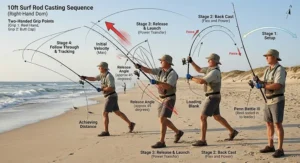
Beach fishing distance depends on far more than rod length alone — line type, sinker weight, wind direction, and casting technique all move the needle as much or more than the blank itself. As a rough real-world benchmark, a well-matched 10-foot rod paired with 4-6oz sinkers and braided line can realistically reach the 150-200 yard range in the hands of an experienced caster using a proper pendulum or off-the-ground technique, though most recreational anglers casting overhand will land considerably closer to 80-120 yards, which is still plenty to clear the average sandbar and reach feeding fish.
Wind direction matters enormously and is often underestimated: a stiff onshore breeze can cut 20-30% off your realistic casting distance regardless of how good your rod is, while a light offshore wind can add distance almost for free. This is also where a rod’s guide spacing and blank stiffness genuinely show up in results — a rod like the Tsunami Airwave, purpose-engineered around fast energy recovery, will consistently out-cast a similarly-priced but less distance-focused rod like the Ugly Stik Bigwater by a meaningful margin once you account for these variables, even though both are rated for similar sinker weights.
Wave Casting and Moderate Surf Conditions: Matching Rod Action to the Beach
Wave casting technique changes noticeably depending on whether you’re working in moderate surf conditions or dealing with heavier chop, and your rod’s action should reflect that reality rather than being an afterthought. In genuinely moderate surf conditions — waist-high breakers, moderate wind, clean sandbars — a Medium or Medium Heavy power rod like the Penn Battalion II or St. Croix Mojo Surf provides plenty of casting authority without feeling like overkill, and the more forgiving action helps detect subtler bites in calmer water.
Once conditions push past moderate — building wind, larger sets, heavier current pulling on your line — stepping up to a Heavy or Extra Heavy rated rod like the Okuma Longitude or the Extra Heavy Tsunami Airwave configuration becomes the more sensible move, since you’ll typically need heavier sinkers just to hold bottom. A useful wave casting habit regardless of rod choice: timing your release to the lull between wave sets rather than fighting an incoming wave face tends to add real distance for free, since you’re not casting into rebounding water resistance. The International Game Fish Association notes that consistent, repeatable casting mechanics matter more for long-term success than any single piece of tackle, which tracks with what most experienced surfcasters will tell you directly.
Long-Term Cost & Maintenance
Sticker price only tells part of the value story. A $250 St. Croix Mojo Surf backed by a 5-year warranty works out to roughly $50 per year of coverage if you fish it hard and it needs eventual replacement parts, while an $85 Ugly Stik Bigwater with a 7-year warranty computes to just over $12 per year — a genuinely different value equation depending on how you weigh upfront cost against long-term durability backing. Guide inserts, reel seat corrosion, and blank fatigue from repeated hard casting are the most common failure points across every price tier, and none of them are fully preventable, only slowed through the rinse-and-inspect routine covered earlier.
Total cost of ownership should also include the reel, line, leader material, and terminal tackle you’ll cycle through regardless of which rod you choose — line alone, replaced once or twice a season for a regular angler, often adds up to more than the price gap between a budget and mid-range rod over a two-year window. Viewed that way, spending a bit more upfront on better guide inserts that resist line wear can actually reduce your total line-replacement costs over time, which is a genuinely underappreciated piece of the value calculation.
Safety and Regional Regulations Guide
Surf fishing regulations vary meaningfully by state and even by specific beach, covering everything from bait restrictions to seasonal closures protecting spawning fish, so checking current rules before you head out matters as much as picking the right rod. NOAA Fisheries’ recreational fishing resources provide federal-level guidance and links to state-specific regulatory bodies, which is the right starting point if you’re fishing an unfamiliar coastline. Beyond regulations, basic surf safety deserves real attention: check tide charts and rip current forecasts before wading out, never turn your back on the ocean while focused on casting, and be especially cautious around jetties and rock structure where footing gets treacherous when wet.
Sinker and hook selection can also carry regional rules — some states restrict certain hook types near protected spawning grounds, and circle hooks are increasingly required or encouraged for catch-and-release species. A quick call to a local tackle shop before your trip often surfaces region-specific knowledge that no national guide, including this one, can fully replace.
Features That Actually Matter (And Those That Don’t)
Guide material and reel seat quality matter enormously over the life of a rod — these are the components exposed most directly to sand and saltwater corrosion, and cutting corners here shortens a rod’s usable life regardless of how nice the blank feels on day one. Warranty length is a genuinely useful signal too, since manufacturers backing a rod for 5-7 years are making a real financial bet on their own durability claims. On the other hand, cosmetic details like blank color, wrap thread patterns, and flashy branding contribute nothing to casting performance or durability, despite often driving purchase decisions for first-time buyers browsing by looks alone.
Lure and line rating windows matter far more than raw power labels — a rod marketed as “Heavy” from one brand can behave completely differently from another brand’s “Heavy” rating, so always check the actual oz and lb numbers printed on the blank rather than trusting the power name alone.
Take Me Fishing’s beginner resources reinforce this point well: focusing on fit-for-purpose specs over marketing labels consistently produces better buying outcomes than chasing brand reputation alone.
Frequently Asked Questions
❓ How long should a surf rod be for beginners?
❓ What reel size pairs with a 10ft surf casting rod?
❓ Can a 10 foot surf rod handle moderate surf conditions and heavier chop?
❓ What's the difference between a medium length surf rod and a longer 12-foot rod?
❓ How much does a quality 10 foot surf rod cost?
Conclusion
Choosing the right 10 foot surf rod really comes down to matching the rod’s power rating, blank material, and price point to how often you’ll actually be standing in the wash. Beginners and occasional anglers get excellent value from the Ugly Stik Bigwater or BERRYPRO Full Carbon, weekly surfcasters chasing real distance and versatility should look hard at the Tsunami Airwave, Okuma Longitude, or Penn Battalion II, and dedicated anglers who fish often enough to feel the difference in sensitivity and fatigue owe it to themselves to consider the St. Croix Mojo Surf or the underrated Star Rods Stellar Surf. None of these seven rods is objectively “the best” — the best one is the one that matches your beach, your budget, and how many mornings a year you’re actually willing to get sand in your boots.
🎣 Ready to Gear Up for Your Next Beach Session?
Take another look at the seven rods above and check current pricing before you head out — availability and stock levels shift quickly on popular models, so don’t wait too long once you’ve found the right match!
Recommended for You
- Jetty Fishing Rod Guide 2026: 7 Rods That Won’t Snap on Rocks
- Pier Fishing Rod Saltwater: 7 Top Picks Anglers Trust in 2026
- 7 Best Popping Rod Saltwater Picks for GT & Tuna (2026)
Disclaimer: This article contains affiliate links. As an Amazon Associate, I earn from qualifying purchases. If you purchase products through these links, we may earn a small commission at no additional cost to you.
✨ Found this helpful? Share it with your friends! 💬🤗
