
In This Article
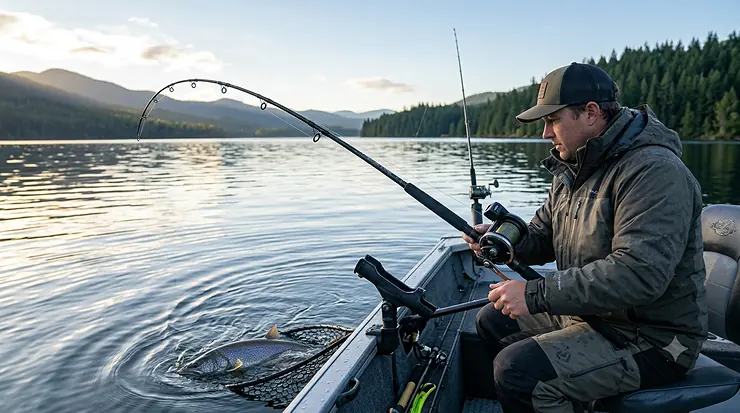
A lake trout trolling rod is a rod built specifically to handle downriggers, diving planers, and lead-core or copper line at slow trolling speeds in deep, cold water — favoring a moderate action and enough backbone to fight fish without collapsing under drag pressure. That’s the textbook answer. The real answer is messier, because lakers don’t play fair. They sit in a thermocline you can’t see, they hit like a tug on a garden hose instead of a slam, and the wrong rod will either miss the bite entirely or fold like wet cardboard the second a 20-pounder decides to sound.
If you’ve ever watched a rod tip barely twitch while a fish quietly loads up 60 feet down, you already know why generic spinning rods don’t cut it out here. Lake trout (Salvelinus namaycush) are a cold-water species that behaves nothing like a bass or a walleye, and background on the species’ deep, cold-water habits explains a lot about why trolling technique — and rod choice — looks so different out here. Lake trout trolling asks for something narrower and more purpose-built: enough moderate bend to keep a dodger or flasher working correctly, enough steel in the butt section to handle a downrigger release, and guides tough enough to survive years of being racked, dropped, and occasionally stepped on. This guide breaks down seven real rods worth your money, spread across budget, mid-range, and premium tiers, plus the comparisons, mistakes, and setup advice that actually matter once you’re standing at the gunwale.
We’ll also dig into where a downrigger trout rod earns its keep versus a jigging setup, what a deep trolling setup should actually include, and why Great Lakes trolling in particular punishes anyone who skimps on backbone. None of this is about chasing the fanciest rod on the rack — it’s about matching the rod to the technique, the depth, and the fish you’re actually after.
Quick Comparison Table
| Rod | Length | Power/Action | Best For |
|---|---|---|---|
| Daiwa Wilderness Downrigger Trolling Rod | 7’–9’6″ | Medium to Medium-Heavy | Budget-conscious anglers building a full spread |
| Shimano TDR Trolling Rod | 7’–9′ | Medium to Heavy | Great Lakes charter-style downrigger work |
| Ugly Stik Bigwater Conventional Rod | 7’–9′ | Light to Medium | Anglers who abuse gear and want it to survive |
| Okuma Classic Pro GLT Downrigger Rod | 7’–8’6″ | Light to Heavy | All-around Great Lakes trolling value |
| St. Croix Eyecon Trolling Rod | 7’–10′ | Medium to Medium-Heavy | Anglers who want premium sensitivity and warranty |
Even in this short list, the spread tells a story. Budget rods like the Daiwa Wilderness Downrigger Trolling Rod and Ugly Stik Bigwater Conventional Rod are built to survive abuse across a multi-rod spread, while the St. Croix Eyecon Trolling Rod trades some of that toughness for a blank sensitive enough to register the softest laker strike. The Shimano TDR Trolling Rod and Okuma Classic Pro GLT Downrigger Rod sit in the middle, offering the sweet spot most Great Lakes trollers actually settle on after a season or two of trial and error.
💬 See a rod here that fits your boat? Click through to check its current price and availability before your next trip out.
💬 Just one click — help others make better buying decisions too!😊
Top 7 Lake Trout Trolling Rods: Expert Analysis
Choosing gear for lakers isn’t about brand loyalty — it’s about matching blank material, action, and length to how deep you’re fishing and what you’re pulling behind the boat. Below are seven real, currently available rods that cover the full range from “outfit six rod holders without flinching” to “buy once, never think about it again.”
1. Daiwa Wilderness Downrigger Trolling Rod — best budget workhorse for a full spread
The standout here is simple math: you can outfit an entire downrigger spread for what a single premium rod costs elsewhere. Built on a durable fiberglass blank with ceramic insert guides and an EVA handle, the Wilderness is rated from 8-17 lb up to 15-30 lb line depending on the model, with lengths running 7′ to 9’6″ across medium, medium-light, and medium-heavy powers. In practice, that fiberglass build means a forgiving, parabolic bend that loads gradually rather than snapping tight — exactly what you want when a diving planer or dodger is already putting tension on the line.
Based on the spec spread, this rod is built for anglers running four, six, or more rods off the back of a boat who need consistency more than finesse; it’s a poor match if you’re chasing ultra-light bites on a single line. Reviewers consistently report that the rod holds up far better than its price suggests, with several anglers noting they’ve run the same Wilderness rods on Lake Michigan and Lake Erie for years without a guide failure, though a few mention the guides can arrive slightly bent out of the box.
Pros:
- ✅ Extremely low cost per rod for outfitting a full spread
- ✅ Durable fiberglass blank handles downrigger pressure well
- ✅ Wide range of lengths and powers for different techniques
Cons:
- ❌ Heavier in-hand than graphite-composite alternatives
- ❌ Some units arrive with guides needing minor adjustment
Priced in the budget tier — typically under $40 per rod — this is the rod you buy in multiples, and the value proposition only gets stronger the more rod holders you’re filling.
2. Shimano TDR Trolling Rod — Great Lakes charter-captain favorite
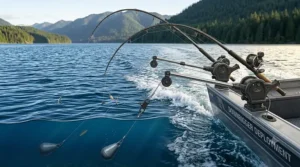
What stands out about the TDR is how often it shows up as the unofficial default on Great Lakes charter boats, and that’s not an accident. The rod uses an all-fiberglass blank with high-density EVA handles across downrigger, dipsy diver, and leadcore-specific models (the leadcore version swaps in wire-frame guides to handle wire line without grooving). Available in medium and medium-heavy actions from roughly 7′ to 9′, it’s engineered to keep a diver or dodger tracking straight without over-flexing.
What most buyers overlook about this rod is that its real strength isn’t sensitivity — it’s consistency under sustained load, which matters more than bite detection when you’re running dipsy divers or wire line all day. Anglers on Great Lakes trolling forums consistently point to the TDR as the rod they buy in pairs specifically because it survives years of being cranked in and out of rod holders. A common theme in aggregated feedback is that anglers pair it with line-counter reels like the Okuma Convector for a complete, no-nonsense combo.
Pros:
- ✅ Proven track record specifically for Great Lakes trolling
- ✅ Handles wire line and lead core without excess wear
- ✅ Simple, durable build with minimal failure points
Cons:
- ❌ Limited finesse for lighter, single-line applications
- ❌ Fiberglass blank adds noticeable swing weight
Expect this rod to sit in the $30–$45 range, which explains why so many trollers own three or four of them rather than one expensive alternative.
3. Ugly Stik Bigwater Conventional Downrigger Rod — toughest blank for anglers who abuse gear
The standout feature is right in the name — Bigwater rods are engineered for anglers who treat gear like it owes them money. The blank uses Ugly Tech construction, a graphite-fiberglass hybrid, paired with the brand’s Clear Tip design and one-piece stainless “Ugly Tuff” guides that resist popping out under stress. Lengths run 7′ to 9′ with line ratings generally spanning 6-20 lb up to heavier configurations, and the rod carries a notably long warranty backing that durability claim.
Here’s what the spec sheet won’t tell you, but reviewers note repeatedly: the Ugly Tuff guides are the actual differentiator, since standard aluminum-oxide guide inserts are what typically fail first on a hard-used trolling rod. This is the rod for the boat that gets slammed by waves, where rods get knocked around in transit, or where guests who aren’t gentle with gear are part of the regular crew. Aggregated review sentiment consistently praises the rod’s resilience, with multiple anglers noting they’ve replaced reels multiple times while the original rod is still going strong.
Pros:
- ✅ Exceptional guide durability under rough handling
- ✅ Long manufacturer warranty backs up the toughness claim
- ✅ Hybrid blank balances strength with usable sensitivity
Cons:
- ❌ Slightly less refined tip action than premium graphite rods
- ❌ Bulkier feel compared to lighter trolling-specific blanks
Priced in the $35–$55 range depending on length and configuration, the Bigwater is the rod you hand to the least careful person on your boat and stop worrying about it.
4. Okuma Classic Pro GLT Downrigger Rod — best all-around downrigger value
The Classic Pro GLT earns its standout tag by nailing the “no serious price, still a serious rod” pitch. Built on an E-glass blank with a tip-over-butt ferrule connection and stainless steel guides, it’s specifically tuned for downriggers, dipsy-diver-type discs, and copper or leadcore sinking lines — the three techniques that dominate Great Lakes trolling. Lengths span roughly 7′ to 8’6″ across light through heavy actions, giving you real options for both dipsy work and dedicated leadcore duty.
Based on the spec comparison against other budget-tier rods, the GLT’s advantage is its uplocking Fuji-style reel seat and heavy-duty double-foot guides, both details that typically only show up on pricier rods. That matters because reel seats and guide feet are common failure points on cheaper trolling rods subjected to years of saltwater-adjacent freshwater abuse. Reviewers consistently describe the GLT as punching well above its price point, and it’s frequently cited as the rod anglers recommend to someone just getting into structured Great Lakes trolling.
Pros:
- ✅ Technique-specific actions matched to downriggers and divers
- ✅ Reel seat and guide quality above its price class
- ✅ Wide model range covers most trolling scenarios
Cons:
- ❌ E-glass blank is heavier than graphite-hybrid alternatives
- ❌ Less tip sensitivity than premium composite rods
Sitting around $30–$50 per rod, this is frequently the rod anglers point to when asked “what should my first real trolling rod be?”
5. Okuma Convector GL Trolling Rod — lightest hybrid blank in its class
The standout here is construction: an E-glass core wrapped in an outer graphite layer, which trims noticeable weight compared to straight fiberglass builds while keeping the strength trolling demands. Available around 8′ in medium-light configurations (with other lengths in the broader Convector GL lineup), it’s designed as a lighter-in-hand option for anglers running multiple rods for extended hours.
What most buyers overlook about hybrid blanks like this is that the graphite outer layer doesn’t just save weight — it also transmits vibration faster than pure fiberglass, meaning subtle laker taps register sooner in your hand. That’s a real advantage when you’re staring at a rod tip for hours, since fatigue makes missed bites more likely on a heavier stick. Anglers discussing Great Lakes trolling setups in forums consistently mention pairing this rod with line-counter reels for combined dipsy and lead-core duty, citing the lighter swing weight as the reason they switched away from all-glass options.
Pros:
- ✅ Noticeably lighter than comparable fiberglass-only rods
- ✅ Graphite outer layer improves bite transmission
- ✅ Solid mid-range value for multi-rod spreads
Cons:
- ❌ Narrower size range than some competing lineups
- ❌ Graphite layer adds some cost over pure E-glass rods
Expect a price range in the $35–$60 territory, positioning it as a natural step up once you’ve outgrown pure entry-level fiberglass rods.
6. Fenwick Eagle Trolling Rod — best telescoping rod for small boats and tight storage
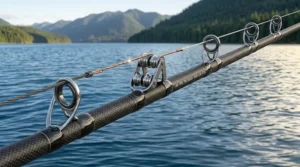
The standout feature is portability without the usual telescoping-rod compromise. Constructed to hold up as a genuine trolling tool rather than a novelty travel rod, the Eagle series is offered in multiple lengths with a durable tip section and a reputation among anglers for surviving where cheaper telescopic designs fail. For anyone running a smaller boat, a kayak, or simply short on rod-locker space, that collapsing design changes what’s actually possible on the water.
On paper this means giving up a small amount of the parabolic smoothness you get from a dedicated 2-piece downrigger blank, but reviewers and longtime users consistently note the Eagle closes that gap better than most telescoping alternatives, citing a genuinely usable tip that doesn’t feel disconnected from the butt section. Anglers who fish from car-top boats or fly-in trips to remote lakes report relying on the Eagle specifically because it collapses down to a fraction of its extended length without sacrificing the backbone a laker fight demands.
Pros:
- ✅ Collapsible design solves real storage and transport problems
- ✅ Holds up better than typical telescoping trolling rods
- ✅ Versatile across both dedicated trolling and general use
Cons:
- ❌ Slightly slower action than true 2-piece dedicated blanks
- ❌ Telescoping ferrules need periodic inspection for wear
Mid-range pricing, generally in the $40–$65 range, makes this an easy add for anglers who need one flexible rod rather than a rack of specialized sticks.
7. St. Croix Eyecon Trolling Rod — most sensitive premium trolling blank
The standout is blank composition: a dynamic blend of SCII graphite and 100% linear S-glass, engineered specifically for a moderate action that loads smoothly under trolling pressure while still transmitting far more feel than fiberglass-only rods. Lengths run from roughly 7′ to 10′ with 1-piece and multi-piece options, line ratings generally in the 10-20 lb range, and premium touches like Kigan guides, a Fuji-style reel seat, and a five-year warranty backed by the manufacturer’s service program.
Based on the spec comparison with every other rod on this list, the Eyecon is the only one built with a genuinely premium blank composite rather than E-glass or fiberglass-graphite hybrids, and that shows up most in how early you feel a soft laker take. Reviewers consistently describe the sensitivity as a noticeable step above budget and mid-range trolling rods, though a recurring complaint in aggregated feedback involves occasional guide-eyelet issues on certain models — worth inspecting closely on arrival regardless of price point.
Pros:
- ✅ Premium composite blank delivers class-leading sensitivity
- ✅ Five-year warranty backed by established manufacturer service
- ✅ Refined components throughout, from reel seat to guides
Cons:
- ❌ Meaningfully higher price than every other rod on this list
- ❌ Some units reported minor guide-eyelet quality concerns
Priced well above the rest of this list — often in the $100–$160 range depending on length — the Eyecon is the rod for anglers who’ve already decided sensitivity and warranty coverage are worth paying for.
Practical Usage Guide: Building a Deep Trolling Setup That Actually Works
Buying the right rod is half the equation; rigging it correctly for a deep trolling setup is the other half, and it’s the part most first-timers skip. Start by matching line to technique: braided line in the 20-30 lb range cuts water resistance and gets lures deeper for standard trolling, while dedicated leadcore setups need actual leadcore line backed by 50 lb braid for capacity. Either way, always run a 10-20 foot fluorocarbon leader in the 10-15 lb test range between your main line and lure — it’s the single most overlooked detail in a first-time downrigger trout rod setup, and skipping it costs you strikes to line-shy fish.
Before your first trip, set your downrigger release tension correctly — too tight and you’ll never trigger it on a bite, too loose and it’ll pop on every wave. Deploy your rod holder at roughly a 45-degree angle to the water; this lets the rod load properly on a strike and gives you a clear visual indicator when a fish hits. In your first 30 days, the most common mistake is dragging the downrigger ball along bottom instead of letting it just tick it occasionally — you want contact, not constant friction, which fouls your presentation and buries your lure in silt.
Maintenance is straightforward but easy to neglect: rinse rods and reel seats with fresh water after every outing (especially if you’re anywhere near brackish water), check guide inserts for grooving every few trips since grooved guides shred line invisibly, and inspect ferrules on 2-piece or telescoping rods for looseness before each season. A five-minute check now prevents a snapped rod mid-fight later.
✨ Ready to build out your spread? Check current pricing on the rods above before your next trip.
Real-World Scenarios: Matching a Rod to Your Fishing Life
The weekend Great Lakes angler running a full spread. If you’re heading out on Lake Michigan or Lake Huron three or four times a season with two downriggers and a couple of dipsy diver rods, budget consistency matters more than premium sensitivity. A pairing of the Daiwa Wilderness Downrigger Trolling Rod for downrigger duty and the Shimano TDR Trolling Rod for divers gets you a full, durable spread without a four-figure gear bill.
The solo angler fishing a remote inland lake by kayak or small car-top boat. Storage space is your real constraint here, not budget. The Fenwick Eagle Trolling Rod solves the transport problem directly, collapsing down for a drive or a portage while still handling laker fishing duty once you’re on the water.
The dedicated angler chasing trophy lakers who wants every edge. If you’re fishing deep, cold structure specifically for trophy-class fish and want to feel every subtle take through 80-100 feet of water, the sensitivity of the St. Croix Eyecon Trolling Rod is worth the premium — this is the buyer for whom warranty coverage and blank quality outweigh sticker price.
Problem → Solution: Fixing Common Deep Water Trout Rod Frustrations
Problem: You’re missing subtle bites entirely. Lake trout strikes at depth often feel like a heavy “weight” rather than a hit, and a stiff, insensitive rod buries that signal. Solution: step up to a hybrid or premium blank like the Okuma Convector GL Trolling Rod or St. Croix Eyecon Trolling Rod, and resist the urge to slam the rod upward on contact — point it at the fish, engage the reel, and use a long sweeping hookset instead.
Problem: Guides are grooving and shredding your line. This usually comes from aluminum-oxide inserts wearing under years of braid or wire line use. Solution: rods with stainless steel or Ugly Tuff-style guides, like the Ugly Stik Bigwater Conventional Downrigger Rod, resist this failure mode significantly better.
Problem: Your downrigger presentation looks unnatural, and you’re not sure why. Often this traces back to using too stiff a rod for the dodger or flasher weight in play. Solution: a rod with genuine parabolic, moderate action — such as the Daiwa Wilderness Downrigger Trolling Rod — lets the terminal gear work as designed instead of fighting the blank.
Problem: You’re storing rods in a cramped boat or towing vehicle and things keep getting damaged. Solution: a genuinely durable telescoping option like the Fenwick Eagle Trolling Rod removes the storage conflict entirely.
Problem: You bought one expensive rod and it doesn’t cover every technique. Solution: rethink the spread. Great Lakes trolling generally rewards owning multiple technique-specific rods (downrigger, dipsy, leadcore) over a single do-everything premium rod — this is exactly why budget and mid-range picks dominate most serious anglers’ rod lockers.
How to Choose a Lake Trout Trolling Rod
- Match length to your boat and position. Shorter rods (6′-7′) work better for solo anglers netting their own fish; longer rods (8′-9’6″) are easier to manage from a crowded gunwale with a second person netting.
- Pick moderate action, not fast action. A moderate bend keeps flashers and dodgers working correctly and won’t rip a hook from a soft-biting laker’s mouth.
- Choose power based on your terminal tackle. Heavier flashers, larger diving discs, or copper line call for medium-heavy power; lighter presentations do fine on medium or medium-light.
- Decide fiberglass versus graphite-hybrid based on priorities. Fiberglass favors toughness and price; graphite-composite blends favor sensitivity and lighter swing weight.
- Check guide material against your line type. Wire line and lead core chew through cheap guide inserts — prioritize stainless steel or reinforced guides if that’s your plan.
- Confirm reel seat compatibility with your reel size. Line-counter reels used for deep trolling setups are often bulkier than standard casting reels, so verify seat sizing before buying.
- Weigh warranty against how hard you fish. If your boat sees rough conditions or careless guests, a longer warranty and reinforced guides matter more than marginal sensitivity gains.
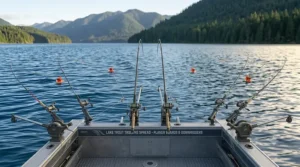
Common Mistakes When Buying a Downrigger Trout Rod
The most frequent mistake is buying a single “do it all” rod and expecting it to handle downriggers, dipsy divers, and leadcore equally well — technique-specific rods exist because these jobs put genuinely different stress patterns on a blank. A close second is under-buying on guides while over-buying on blank material; a expensive graphite rod with cheap guide inserts will still groove out under years of braided line, wasting the investment in the blank itself.
Anglers also frequently mismatch action to technique, grabbing a fast-action bass-style rod because it’s what’s already in the garage. Fast action concentrates bend near the tip, which works against you on a downrigger where you want the whole rod loading progressively. Finally, many first-time buyers skip checking line rating against their actual leader and main line combination, ending up with a rod rated for 10-20 lb line paired with 30 lb braid — a mismatch that either overloads the blank or leaves it unable to set the hook properly on bigger fish.
Downrigger Trout Rod vs Standard Casting Rod
A dedicated downrigger trout rod and a standard casting rod look similar at a glance, but they’re engineered for opposite jobs. Casting rods are typically built with faster actions and stiffer tips to maximize casting distance and accuracy, which is exactly the wrong profile for trolling — a fast tip transmits every bit of downrigger drag and boat motion straight into your hands and can tear hooks free on a soft strike. Trolling-specific rods trade that casting performance for a moderate, parabolic bend that absorbs constant tension gracefully.
| Feature | Downrigger Trout Rod | Standard Casting Rod |
|---|---|---|
| Action | Moderate, progressive bend | Fast, tip-concentrated bend |
| Best Use | Downriggers, dipsy divers, leadcore | Casting lures, jigging |
| Guide Setup | Reinforced for constant line tension | Optimized for casting distance |
| Handle Design | Rod-holder friendly grips | Casting-friendly ergonomic grips |
Looking at the comparison above, a rod like the Okuma Classic Pro GLT Downrigger Rod simply isn’t interchangeable with a casting rod despite superficial similarity — the guide spacing, blank taper, and handle shape are all optimized differently. If your fishing genuinely mixes casting and trolling in the same session, it’s worth owning both rather than compromising with one rod that does neither job particularly well.
What to Expect: Real-World Performance During Great Lakes Trolling
On paper, spec sheets tell you line ratings and lengths. In practice, great lakes trolling means long stretches of nothing punctuated by a sudden, heavy pull rather than a violent strike — lakers don’t slam gear the way aggressive predators do. A quality trolling rod telegraphs that weight clearly instead of masking it, which is the entire reason blank quality matters more here than raw casting performance.
Expect your rod to spend most of its working life bent into a gentle static arc from downrigger or diver tension, not actively fighting fish — durability under that sustained load, not burst strength, is what separates a good trolling rod from a mediocre one. Lake trout are notably slow-growing and long-lived, with the U.S. Fish and Wildlife Service noting they can live up to 50 years and take 8 to 10 years to mature, which explains why serious trolling programs on the Great Lakes chase specific depth bands tied to thermocline location rather than blind casting — your rod is one piece of a broader system built around finding where these slow-growing fish are actually holding.
Deep Water Trout Rod Picks for Beginners vs Experienced Anglers
Beginners chasing their first laker on a deep water trout rod setup are usually better served starting with budget fiberglass options like the Daiwa Wilderness Downrigger Trolling Rod or Shimano TDR Trolling Rod — the learning curve on downrigger release tension, hookset timing, and line management is steep enough without also worrying about damaging an expensive blank. These rods forgive mistakes, survive being dropped in the boat, and won’t wreck your budget if year one is mostly a learning experience.
Experienced anglers who’ve already fished a season or two of downriggers typically know exactly what they’re missing — usually sensitivity to detect softer bites at greater depths, or a lighter overall rig for long days running multiple rods. That’s the point at which stepping up to the Okuma Convector GL Trolling Rod or the St. Croix Eyecon Trolling Rod starts paying real dividends, since the angler already has the technique dialed in and can actually benefit from the additional feel.
Long-Term Cost & Maintenance
Total cost of ownership on trolling rods isn’t just the sticker price — it’s replacement frequency and guide longevity that determine real value over a decade of fishing. A $35 fiberglass rod that survives eight seasons of hard use delivers better cost-per-use than a $150 rod replaced every two years due to guide failure or ferrule wear.
| Rod Tier | Typical Price Range | Expected Lifespan (Moderate Use) | Best For |
|---|---|---|---|
| Budget (Daiwa Wilderness, Shimano TDR) | Under $45 | 5-8 seasons | Multi-rod spreads, beginners |
| Mid-Range (Okuma GLT, Convector GL, Fenwick Eagle) | $35-$65 | 6-10 seasons | Regular trollers wanting balance |
| Premium (St. Croix Eyecon) | $100-$160 | 10+ seasons, warranty-backed | Dedicated anglers prioritizing feel |
Looking at the numbers above, the mid-range tier consistently delivers the best cost-per-outing math for anglers fishing more than a handful of trips per year, since the jump in durability from budget to mid-range is proportionally larger than the jump from mid-range to premium. Maintenance costs stay low across all tiers if you rinse gear after outings and inspect guides annually — the real cost driver is neglect, not blank material.
FAQ
❓ What is the best rod length for lake trout trolling?
❓ How deep should I troll for lake trout?
❓ Can I use a spinning rod for downrigger trolling?
❓ Do I need a line counter reel for Great Lakes trolling?
❓ What line works best for a deep trolling setup?
Conclusion
Picking a lake trout trolling rod really comes down to matching blank material and action to how you actually fish — the technique you’re running, the depths you’re chasing, and how many rods you need to outfit without blowing the budget. Budget fiberglass options like the Daiwa Wilderness Downrigger Trolling Rod and Shimano TDR Trolling Rod make sense for building out a full spread or learning the ropes, mid-range picks like the Okuma Classic Pro GLT Downrigger Rod, Okuma Convector GL Trolling Rod, and Fenwick Eagle Trolling Rod balance durability with real sensitivity gains, and the St. Croix Eyecon Trolling Rod rewards anglers ready to pay for premium feel and warranty coverage.
It’s also worth remembering that the fishery itself is a genuine conservation success story — lake trout populations in Lake Superior were declared fully restored in 2024 after nearly seventy years of rehabilitation work, which is part of why responsible harvest practices matter alongside gear choice. None of these rods will replace good technique — finding the thermocline, running the right depth, and rigging a proper leader still matter more than which blank you choose. But the right rod makes every one of those variables easier to execute, and that’s ultimately what separates a frustrating day on the water from a boat full of lakers.
Recommended for You
- 7 Best Tenkara Rod Trout Picks for 2026: Honest Buyer’s Guide
- Euro nymphing rod: 7 Best Picks That Actually Earn Their Price Tag (2026)
- 6 Foot Trout Rod: 7 Best Picks for Tight Water in 2026
Disclaimer: This article contains affiliate links. As an Amazon Associate, I earn from qualifying purchases. If you purchase products through these links, we may earn a small commission at no additional cost to you.
✨ Found this helpful? Share it with your friends! 💬🤗
