
In This Article
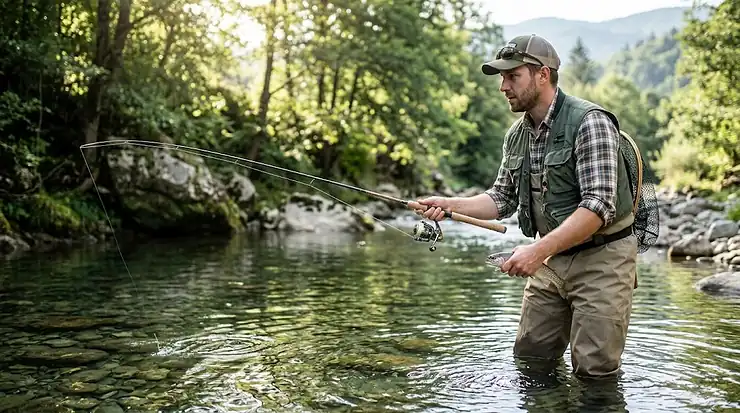
There’s a specific kind of frustration that comes from whipping a 7-foot rod through overhanging alders on a creek that’s barely ten feet wide — the tip catches, the cast dies, and the trout that was sitting in that pocket water is long gone before your spinner even lands. That’s the exact problem a 6 foot trout rod solves, and it’s why so many small-stream anglers eventually circle back to this length no matter how many longer rods they’ve tried in between.
This guide breaks down seven real spinning rods currently sold at or near six feet — from St. Croix, Ugly Stik, Fenwick, Okuma, Shimano, Daiwa, and G. Loomis — with honest analysis of specs, action, and where each one actually earns its keep. Whether you’re bushwhacking into a brushy stream rod situation, hunting stocked creek water on a lunch break, or just want one small water rod that does everything well, you’ll find a fit here.
What is a 6 foot trout rod, really? It’s a short spinning rod, typically ultralight to light power, built to load quickly with tiny lures and cast accurately in tight quarters fishing situations where a longer rod’s backcast and reach become liabilities rather than advantages.
By the end, you’ll understand why six feet has become something of a sweet spot for creek and small-river trout anglers, and which of these seven rods matches your specific water.
Quick Comparison Table
| Rod | Power/Action | Line Weight | Lure Weight | Best For |
|---|---|---|---|---|
| St. Croix Premier PS60ULF | Ultra Light / Fast | 2-6 lb | Light | Best all-around 6-footer |
| Ugly Stik GX2 (6′) | Ultra Light-Heavy / Moderate | 2-15 lb | Varies | Bombproof budget backup |
| Fenwick Eagle EAG60L-MS-2 | Light / Moderate | 2-8 lb | 1/16-3/8 oz | Balanced creek finesse |
| Okuma Celilo (6′ UL) | Ultra Light / Fast | 2-6 lb | Light | Lightest true budget pick |
| Shimano Sensilite A SENS60LA | Light / Fast | 4-15 lb | 1/16-1/4 oz | Sensitivity on a budget |
| Daiwa Presso PSO604ULFS-TR | Ultra Light / Fast | 1-4 lb | 1/32-1/4 oz | Packable tight-quarters rod |
| G. Loomis GLX Trout Series | Ultra Light / Moderate | 2-6 lb | Up to 1/8 oz | Premium sensitivity and feel |
What jumps out immediately is that “6-foot trout rod” isn’t one single specification — it’s a length shared by rods with very different personalities. The Daiwa Presso trades a bit of casting distance for a four-piece breakdown that fits in a daypack, which matters enormously if you’re hiking into a brushy stream rod scenario. The Ugly Stik GX2, by contrast, sacrifices some finesse for a graphite-fiberglass blend that shrugs off getting whacked against streamside rocks. Matching the rod to your actual access and casting style matters more here than chasing the lightest or most expensive option on the list.
💬 Just one click — help others make better buying decisions too!😊
💬 Ready to see how each rod performs on real water? Scroll down for the full breakdown below.
Top 7 6 Foot Trout Rods: Expert Analysis
1. St. Croix Premier PS60ULF — the USA-built all-rounder
The standout here is handcrafted USA construction backed by a 5-year warranty, at a price point that undercuts most rods claiming similar build quality — St. Croix has built its reputation on exactly this value equation for decades.
The Premier series uses SCII graphite paired with St. Croix’s Taper Enhancement Technology, which in practice means the blank loads smoothly through a wider range of lure weights than a typical entry-level ultralight, so a 1/16-ounce inline spinner and a 1/4-ounce jighead both cast cleanly on the same stick. Reviewers consistently describe the action as noticeably lighter and less tip-heavy than earlier Premier generations, a real improvement for anyone making dozens of repetitive casts across a creek session.
Based on the spec comparison against everything else on this list, what most buyers overlook about the Premier is that it splits the difference between finesse and durability better than either budget or ultra-premium options — the Fuji reel seat and aluminum-oxide guides are genuinely better components than rods costing the same amount typically include. Aggregated reviewer sentiment is strongly positive on sensitivity for detecting light strikes, with the most common critique being that the tip, like most fast-action ultralights, is vulnerable if you snag it hard on brush during a hurried cast.
✅ USA-made construction with a 5-year warranty
✅ Fuji reel seat and premium cork rare at this price
✅ Smooth loading across a wide lure-weight range
❌ Fast-action tip is fragile against hard brush contact
❌ Costs more than several capable budget alternatives
Expect to pay $110-$140 for the PS60ULF, and the value verdict is straightforward: this is the rod most creek anglers should default to unless a specific reason points them elsewhere.
2. Ugly Stik GX2 (6′) — the rod you don’t baby
The standout is right there in the brand name’s reputation — Ugly Stik’s blend of graphite and fiberglass, backed by the company’s own claim of legendary toughness, produces a rod that survives the kind of streamside abuse that would crack a pure-graphite blank.
The Ugly Tech construction interprets in practical terms as a rod that flexes deeply and absorbs shock rather than transmitting every bit of stress straight to a weak point, which matters when you’re scrambling over slick rocks or freeing a snagged lure from an overhanging branch. The one-piece stainless-steel Ugly Tuff guides, PVD-coated to resist line fray, are a durability upgrade over the guide sets found on most rods in this price bracket.
Here’s what the spec sheet won’t tell you: this rod’s real audience isn’t the angler chasing maximum sensitivity — it’s the person who wants a 6-foot trout rod they can hand to a kid, leave in a truck bed, or use as a backup without worrying about it. Reviewer sentiment aggregated across major retailers is remarkably consistent on this point, with anglers repeatedly describing decades of use from a single rod, alongside occasional notes that the medium-heavy versions feel notably stiffer than the ultralight, which stays genuinely whippy and fun to fish.
✅ Graphite-fiberglass blend shrugs off streamside abuse
✅ Backed by a 7 to 10-year manufacturer warranty
✅ Ultralight versions remain genuinely sensitive despite the toughness focus
❌ Two-piece models can loosen slightly with repeated casting
❌ Less refined casting feel than St. Croix or G. Loomis
At around $25-$40, the GX2’s value verdict is unmatched for a first rod, a loaner, or a dedicated bushwhacking stick you won’t mourn if it takes a hard hit.
3. Fenwick Eagle EAG60L-MS-2 — classic action rebuilt with modern materials
The standout is Fenwick’s blend of 24- and 30-ton graphite, a genuine step up in material grade from typical budget rods, wrapped in a design explicitly built around what the company calls its “Classic Fenwick Action.”
That moderate action matters more than it might sound: a moderate taper flexes further down the blank rather than just at the tip, which translates to more forgiving hooksets on light tippet and better shock absorption when a trout makes a sudden burst near the net — exactly the situation where a too-fast tip pops hooks on light-mouthed fish. The tailored foregrip with reduced length and increased taper is a small but deliberate ergonomic choice, positioning your forward hand closer to the blank for better feel.
What most buyers overlook about the Eagle is that it’s Fenwick’s attempt to reintroduce old-school rod-building philosophy with current-generation components — stainless guide frames with zirconia inserts and a soft-touch reel seat that most rods at this price skip entirely. Aggregated reviewer feedback is largely positive on casting feel and value, with a minority of reports citing occasional tip breakage under sudden high-stress loading, a risk shared by most fast-tapered graphite rods when abused rather than fished as intended.
✅ Premium 24/30-ton graphite blend at a mid-tier price
✅ Moderate action forgives light-tippet hooksets
✅ Limited lifetime warranty on trout-specific models
❌ A small number of reported tip failures under hard stress
❌ Moderate action sacrifices some casting distance versus fast-action rivals
Pricing runs roughly $70-$100, positioning the Eagle as a strong value verdict for anglers who prioritize a forgiving, traditional feel over maximum sensitivity.
4. Okuma Celilo (6′ Ultra Light) — the lightest true budget pick
The standout is sheer breadth of choice combined with rock-bottom pricing — Okuma builds the Celilo series across ten lengths from 4.5 to 8.5 feet, letting an angler dial in exactly the right stick for their water without paying a premium for it.
The graphite composite blank and aluminum-oxide guide inserts are modest but functional specs that interpret honestly as “does the job without frills” — this isn’t a rod chasing tournament-grade sensitivity, it’s a rod built to get beginners and budget-conscious anglers onto the water with functional gear. The stainless hooded reel seat and cork grips add a touch of comfort that some ultra-budget competitors skip entirely.
Based on the spec comparison, what stands out about the Celilo is how consistently anglers report landing surprisingly large fish on it despite the low price — reviewers describe netting 18-inch rainbows and smallmouth from small creeks without issue, which speaks to reasonable build quality even if the finish and componentry lag behind rods costing three times as much. The most consistent aggregated critique involves occasional tip breakage on the two-piece models, though Okuma’s customer service is repeatedly praised for replacing sections without hassle.
✅ Ten length options let you dial in exact creek fit
✅ Genuinely capable of landing larger-than-expected fish
✅ Responsive customer service on warranty claims
❌ Reported tip breakage on some two-piece models
❌ Componentry noticeably basic compared to mid-tier rivals
At roughly $25-$40, the Celilo’s value verdict makes it the rod to buy if you want to test whether small-stream spinning fishing is for you before investing more.
5. Shimano Sensilite A SENS60LA — sensitivity punching above its price
The standout is a “high-end feel at an affordable price” positioning that reviewers consistently confirm — several describe the Sensilite as feeling like rods costing twice as much, a meaningful claim from a major manufacturer with a reputation to protect.
The full cork grip and lightweight reel seat with cork insert are genuine upgrades over the plastic componentry common at this price tier, and they matter practically because cork transmits vibration and bite feel more directly than foam or plastic alternatives. The aluminum-oxide guides reduce friction on the cast and resist the grooving that cheaper guide inserts develop over years of abrasive braided line use.
Here’s what the spec sheet won’t tell you: Shimano designed the Sensilite A series specifically around “limber action” for finesse presentations, meaning it’s tuned less for horsing fish and more for detecting the subtle taps that separate a strike from a rock bump in current — a genuinely useful trait for creek fishing where bites are often light. Reviewer sentiment aggregated from major tackle retailers consistently praises the balance and finish quality relative to price, a rare combination this far down the price ladder.
✅ Full cork grip and premium reel seat rare under $60
✅ Limber, finesse-tuned action reads subtle strikes well
✅ Backed by Shimano’s manufacturing consistency and reputation
❌ Only a one-year warranty, shorter than several competitors
❌ Limber action sacrifices some backbone for larger fish
Expect $40-$60 for the SENS60LA, making the value verdict clear: this is the rod for anglers who want St. Croix-adjacent sensitivity without the St. Croix price tag.
6. Daiwa Presso PSO604ULFS-TR — the packable tight-quarters specialist
The standout is a four-piece breakdown that collapses to roughly 22 inches, small enough to strap to a daypack or check as carry-on luggage — a genuinely different value proposition than any other rod on this list.
The IM-7 graphite construction and micro-pitch blank taping aren’t just marketing language; they explain why multi-piece travel rods historically felt “dead” compared to one-piece blanks, but modern taping technique distributes resin and graphite evenly across each ferrule joint, meaningfully closing that performance gap. Reviewers repeatedly describe casting distance that surprises them for a broken-down travel rod, with several noting the Presso out-casts one-piece rods nearly twice its price.
What most buyers overlook about the Presso is that “travel rod” undersells its real use case — this is arguably the best-suited rod on this list for genuine bushwhacking into brushy stream rod territory, since a broken-down rod threaded through dense brush to the water’s edge, then assembled streamside, avoids the tip-snagging risk every single-piece rod faces on the hike in. Aggregated reviewer feedback is positive on casting performance and portability, with a recurring critique that the included cork handle feels less durable than the blank itself, occasionally crumbling within the first year of regular use.
✅ Breaks down to about 22 inches for true portability
✅ Casting performance exceeds expectations for a pack rod
✅ Purpose-built for hike-in access to small water
❌ Cork handle quality lags behind the blank’s performance
❌ Four-piece ferrules add slightly more maintenance than one-piece rods
Pricing typically lands around $70-$90, and the value verdict is specific but strong: if your creek access requires a genuine hike through brush, this is the most purpose-built rod on this list for that exact situation.
7. G. Loomis GLX Trout Series (6’7″ Ultra Light) — the premium feel upgrade
The standout is G. Loomis’s proprietary GLX graphite and fiber-blend construction, a material tier generally reserved for the company’s higher-end offerings across all species, applied here specifically to trout and panfish anglers.
The fast-action tip, paired with a rod rated for 2-6 pound line and lures up to 1/8 ounce, is engineered for precision over raw power — G. Loomis specifically describes this build as designed to cast small spinners or spoons accurately in creeks and small streams. The Recoil guide system on GLX models is a genuine engineering upgrade, using a virtually indestructible wire form that resists the bending and misalignment traditional guide frames suffer after repeated impacts.
Based on the spec comparison, what separates the GLX Trout Series from every other rod here is sensitivity transmission — the fiber-blend blank is specifically engineered to relay the faintest strikes, the kind of soft take a trout gives on a drifted single egg or slow-worked marabou jig that a lesser blank simply doesn’t communicate to your hand. Reviewer sentiment, though this is a lower-volume premium product with fewer aggregated reviews than mass-market rods, consistently emphasizes the “wow” factor of casting feel and strike detection relative to anything else in a spin angler’s rotation.
✅ GLX graphite delivers class-leading sensitivity
✅ Recoil guide system resists bending from field impacts
✅ Limited lifetime warranty backs a genuine USA-built rod
❌ Premium price puts it well above every other rod on this list
❌ Fast action offers less forgiveness on light tippet than moderate-action rivals
At $250-$300 depending on retailer, the value verdict is narrow but clear: this is the rod for anglers who already know creek fishing is a lifelong pursuit and want the best strike detection money buys in this category.
Setting Up and Fishing a 6 Foot Trout Rod: A Practical Guide
Match your reel size before you match anything else. A 6-foot ultralight rod paired with an oversized reel throws off the entire balance of the outfit, making the rod feel tip-heavy and tiring to hold through a long day of repetitive casting — most of the rods above balance best with a 500 to 1000-size spinning reel spooled with 2 to 6-pound test.
Break in a new rod gradually by starting with shorter, controlled casts before opening up to full-distance throws; graphite blanks, especially fast-action ones like the St. Croix Premier or G. Loomis GLX, develop their true casting feel once you understand exactly how much load builds before the tip loads fully. Store multi-piece rods, like the Daiwa Presso, fully broken down between trips rather than leaving them assembled in a rod tube — the ferrules last longer with the gentle twist-and-pull assembly than with repeated shock from transport while joined.
A common early mistake on small streams is over-casting; a 6-foot rod’s whole advantage is accuracy in tight water, so resist the urge to send every cast to maximum distance and instead practice short, controlled flips to specific pockets and current seams. Check guide wraps and tip-tops after any hard contact with brush or rock — a hairline crack in an aluminum-oxide insert won’t always be visible but will fray line quickly, and catching it early during a five-minute post-trip inspection saves a lost fish later.
Real-World Scenarios: Matching a 6 Foot Rod to Your Water
The dedicated small-stream hiker, bushwhacking a mile or more into headwater brook trout water through dense brushy stream rod terrain, is the clearest case for the Daiwa Presso — its 22-inch packed length threads through brush on the hike in, and it still casts well enough to reward the effort once you’re streamside.
The weekend creek angler, fishing accessible small water rod stretches close to the truck without extensive bushwhacking, gets the most balanced performance from the St. Croix Premier or Shimano Sensilite — both deliver real sensitivity for detecting light strikes without the fragility that makes a premium rod stressful to fish hard.
The angler who wants one rod that does everything and survives being forgotten in truck bed, whether loaning it to a kid or using it as an all-purpose backup, is best served by the Ugly Stik GX2 — it won’t out-fish the finesse-focused options here, but it will still be functional years after a fragile rod would have snapped.
How to Choose a 6 Foot Trout Rod
Based on the spec and review patterns across this list, here’s the decision sequence that actually holds up on the water:
- Confirm six feet actually fits your water. Creeks under 20 feet wide with dense overhead cover favor six feet or shorter; if your water opens up regularly, a 6’6″-7′ option may serve better.
- Match power to your typical lure weight, not your dream fish. Ultra light power (most rods here) handles 1/16 to 1/4-ounce spinners and jigs; step up to light power only if you’re regularly throwing heavier hardware.
- Pick action based on hookset style. Fast action (St. Croix, Shimano, G. Loomis) rewards precise, positive hooksets; moderate action (Fenwick Eagle, Ugly Stik) forgives a slightly delayed hookset on light tippet.
- Weigh portability against casting feel. If your access genuinely requires hiking through brush, the Daiwa Presso’s packability outweighs the small performance gap versus a one-piece blank.
- Set a realistic durability expectation. A rod you’ll fish carefully in open water can lean toward fragile, high-sensitivity graphite; a rod headed for regular brush contact should lean toward the Ugly Stik’s tougher build.
- Check the warranty structure, since it varies meaningfully across this list — from Okuma’s one-year to St. Croix and Fenwick’s longer coverage — and factor that into total cost of ownership if you fish hard.
- Read independent species research when in doubt. Guidance from outlets like Field & Stream on balancing rod and reel size confirms that an oversized reel undoes the benefits of even the best 6-foot blank, reinforcing that the whole outfit matters, not just the rod alone.
Short Trout Spinning Rod vs Longer Options: Why Length Matters
The core trade-off with any short trout spinning rod comes down to casting distance versus casting accuracy, and it’s worth being explicit about what you’re gaining and giving up. A 6-foot rod loads and unloads faster through a shorter arc, which means tighter, more accurate casts under low branches and around midstream boulders — exactly the skill set small-stream trout fishing demands, since most productive water sits within a rod’s length or two of the angler anyway.
What you give up is reach: a 7 or 7.5-foot rod casts farther, mends line more effectively on the water’s surface for a natural drift, and gives more leverage when a bigger fish makes a run in open water. That’s precisely why longer rods dominate big-river and lake fishing, while six-footers concentrate almost entirely in the small-stream and creek category. Neither length is objectively better — the mismatch happens when anglers bring a big-water rod to small water, not the other way around, since a short rod used on open water simply loses some casting distance, while a long rod used in tight cover can become genuinely unfishable.
✨ Don’t Miss These Exclusive Deals!
🔍 Take your creek game to the next level with any of the 6 foot trout rods above. Click on any highlighted pick to check current pricing and availability — these rods are built to help you thread accurate casts into water your buddies with 7-foot rods can’t touch!
Creek Trout Rod Essentials: What Actually Matters on Small Water
A dedicated creek trout rod setup benefits from a few specific priorities beyond just rod length. Line choice matters as much as the rod itself — 2 to 4-pound monofilament or fluorocarbon keeps presentations subtle in the low, clear water typical of small streams, and every rod on this list is rated to handle that range comfortably. Guide count and spacing also play a bigger role than most anglers realize; rods with more, smaller guides like the Fenwick Eagle and G. Loomis GLX distribute casting load more evenly along the blank, which improves both distance and accuracy with the ultra-light lures creek fishing demands.
Rod weight becomes a genuine comfort factor on a full day of creek fishing, since you’re making dozens more casts per hour than you would on a lake, constantly flipping into pockets rather than casting and slow-retrieving. The lighter builds here — the Okuma Celilo and Daiwa Presso in particular — reduce fatigue over a long session in a way that’s easy to underestimate until you’ve fished a heavier rod all afternoon.
Tight Quarters Fishing: Casting Techniques for Overgrown Water
Tight quarters fishing rewards a different casting approach than open-water spin fishing, and even the best 6-foot rod performs better once you adjust your technique to match the environment. Underhand and sidearm casts, rather than traditional overhead casts, keep your lure and line beneath the overhanging canopy that defines most brushy creek water — this is a skill worth practicing in an open backyard before you’re standing streamside trying to thread a cast between two branches for the first time.
Bow-and-arrow casts, where you pull the lure back against rod tension by hand rather than using a full casting stroke, work surprisingly well in the tightest pockets where even a short backswing catches brush. Positioning matters just as much as casting style — approaching a pool from downstream and casting upstream, rather than the reverse, both reduces the chance of spooking fish and often opens a clearer casting lane, since bank vegetation frequently thins slightly at the tail of a pool. Ergonomic research on repetitive-motion sports, including guidance summarized by the National Institutes of Health, consistently notes that shorter, more controlled motions reduce fatigue and strain over repeated use — a principle that maps directly onto why a compact casting stroke with a 6-foot rod feels less taxing across a long creek session than a full overhead cast with a longer rod.
Small Water Rod Selection: Matching Gear to Stream Size
Not every “small water” situation is the same, and matching a small water rod to your specific stream size prevents both over- and under-gunning your setup. Streams under 15 feet wide with tight overhead cover genuinely favor the shortest options here — the Daiwa Presso or a 5’6″ alternative in the same lineup — since even six feet can feel long when backcast room is measured in inches rather than feet.
Streams in the 15 to 30-foot range, the most common category most anglers mean when they say “small stream,” are where a true 6-foot rod performs best, balancing enough length for a reasonable cast with enough maneuverability to avoid overhead branches. Once a stream opens past 30 feet wide with occasional long, straight runs, most anglers find a 6’6″ to 7-foot rod starts outperforming a 6-footer, since the extra length pays off in casting distance more often than it costs in maneuverability. Reading your specific water honestly, rather than assuming one rod length handles everything, is the single biggest factor separating anglers who love their 6-foot rod from those who feel underwhelmed by it.
Brushy Stream Rod Considerations: Durability Meets Finesse
A dedicated brushy stream rod has to solve a genuine engineering tension: maximum sensitivity generally requires a stiffer, more brittle fast-action blank, while maximum durability against branch strikes and rock contact generally requires a softer, more forgiving build — and no single rod perfectly optimizes both. The Ugly Stik GX2 and Daiwa Presso lean toward the durability side of that trade-off in different ways: the GX2 through its fiberglass-graphite blend that flexes rather than snaps, and the Presso through a breakdown design that minimizes tip exposure during the approach to the water.
Anglers fishing genuinely overgrown, snag-heavy water should also budget for occasional tip replacement as a normal cost of doing business rather than a sign of a defective rod — even premium blanks eventually take a hard enough hit that a tip-top or top guide needs replacing, and most manufacturers on this list, from Okuma to St. Croix, handle those repairs affordably or under warranty. Treating a brushy stream rod as a working tool rather than a delicate instrument, while still handling it with reasonable care, tends to produce the best long-term relationship with the gear.
Common Mistakes When Buying a 6 Foot Trout Rod
The most frequent mistake is buying the lightest possible power rating without considering the actual water you’ll fish — an ultra-light rod rated for 2-pound line struggles the moment you hook a larger holdover brown or need to horse a fish away from a logjam, so matching power to realistic worst-case scenarios, not just average fish size, prevents disappointment.
A close second is underestimating how much a fast-action tip’s fragility matters for your specific fishing style; anglers who fish tight, brushy water regularly are consistently better served by a moderate-action rod like the Fenwick Eagle than by a fast-action premium rod that performs beautifully in open water but breaks under the exact conditions small-stream fishing creates. Buyers also frequently mismatch reel size to rod power, pairing an oversized 2500 or 3000-size reel with an ultralight blank built to balance with a 500 or 1000-size reel, which throws off casting feel entirely. Finally, many first-time buyers skip reading actual model-specific specs, assuming all “6-foot ultralight” rods perform identically, when action, taper, and component quality vary enormously between a $25 rod and a $250 one, even at the identical stated length and power rating.
💬 Found the rod that fits your water?
Check current pricing on your top pick and get ready for your next creek trip!
6 Foot Trout Rod FAQ
❓ What is the best 6 foot trout rod overall?
❓ Is a 6 foot rod too short for trout fishing?
❓ What line weight works best on a 6 foot ultralight rod?
❓ Can a short spinning rod handle bigger trout?
❓ Is a travel or pack rod as good as a one-piece rod?
Conclusion
Six feet isn’t a magic number, but for creek and small-stream trout fishing, it consistently hits the balance point between casting accuracy and enough backbone to fight a real fish. The St. Croix Premier earns its spot as the default recommendation for most anglers, the Ugly Stik GX2 makes sense as a rod you genuinely don’t have to baby, and the Daiwa Presso solves a specific problem — hiking into brushy, hard-to-reach water — better than anything else on this list. Fenwick, Okuma, and Shimano all occupy sensible middle ground depending on how much you want to spend, and the G. Loomis GLX rewards anglers who already know this is a lifelong pursuit worth investing in.
Whichever you choose, match the rod to your actual water and casting style rather than chasing the highest-rated option in isolation — a $250 premium rod fished carelessly through dense brush will disappoint faster than a $30 workhorse matched honestly to the conditions you actually fish.
Recommended for You
- 7 Best 6 Weight Fly Rods of 2026: Versatile Picks for Trout & Bass
- 5 Weight Fly Rod for Trout: 7 Best Picks for 2026
- 7 Best Dropshot Rods for Bass Fishing in 2026
Disclaimer: This article contains affiliate links. As an Amazon Associate, I earn from qualifying purchases. If you purchase products through these links, we may earn a small commission at no additional cost to you.
✨ Found this helpful? Share it with your friends! 💬🤗
