
In This Article
Choosing the best fly fishing rods can feel like navigating through a maze of technical jargon, conflicting reviews, and overwhelming options. Whether you’re a complete beginner dreaming of your first trout or a seasoned angler looking to upgrade your arsenal, the right rod makes all the difference between frustrating tangles and graceful casts that land exactly where you want them.
I’ve spent countless hours testing rods across mountain streams, wide rivers, and coastal flats. What I’ve learned is that the “best” rod isn’t always the most expensive one. It’s the rod that matches your casting style, target species, and fishing conditions. Modern fly fishing technology has evolved dramatically—materials like high-modulus graphite and innovative tapers mean you can find exceptional performance at nearly every price point.
In this comprehensive guide, I’ll walk you through seven outstanding fly fishing rods that represent the best options available in 2025. From budget-friendly gems under $100 to premium rods that deliver tournament-level performance, each recommendation comes from hands-on testing and real-world fishing experience.
Quick Comparison Table
| Rod Model | Weight | Length | Action | Price Range | Best For |
|---|---|---|---|---|---|
| Echo Base | 3-8wt | 7’6″-9′ | Medium-Fast | $89-99 | Budget-conscious beginners |
| Redington Path II | 3-9wt | 8’6″-10′ | Medium-Fast | $149-199 | All-around versatility |
| Orvis Clearwater | 2-12wt | 8’6″-10′ | Medium-Fast | $198-311 | Best performance-to-value |
| Redington Crosswater | 5-8wt | 9′ | Medium-Fast | $139-189 | Entry-level excellence |
| Wild Water Complete Combo | 3-9wt | 9′ | Medium | $79-129 | Ready-to-fish beginners |
| Maxcatch Premier | 3-12wt | 9′-10′ | Medium-Fast | $189-249 | Travel-friendly option |
| Sage R8 Core | 3-9wt | 8’6″-10′ | Fast | $1,050 | Premium performance |
💬 Just one click – help others make better buying decisions too! 😊
Top 7 Fly Fishing Rods: Expert Analysis
1. Orvis Clearwater – Best Performance-to-Value Champion
When you’re searching for the best fly fishing rods that balance quality with affordability, the Orvis Clearwater stands head and shoulders above the competition. At around $198 for the rod alone or $311 for the complete outfit, this mid-modulus graphite masterpiece delivers casting performance that rivals rods costing twice as much.
Key Specifications:
- Weight Options: 2wt through 12wt
- Length: Multiple options from 8’6″ to 10′
- Rod Weight (5wt 9′): 3.5 ounces
- Action: Medium-fast with crisp responsiveness
The Clearwater excels in that sweet spot between 25-50 feet where most trout fishing happens. Its softer tip protects light tippets beautifully while maintaining enough backbone to launch heavier streamers. Anglers consistently praise how this rod “punches above its weight class”—many purchase it as a backup and end up making it their go-to stick.
What Customers Love:
✅ Exceptional casting accuracy at typical fishing distances
✅ Delicate presentation with smaller flies
✅ Handles both dry flies and nymphs effortlessly
✅ 25-year Orvis guarantee provides peace of mind
Minor Limitations:
❌ Performance drops slightly beyond 60 feet
❌ Not ideal for fishing inside 25 feet
❌ No hook keeper (removed in recent redesign)
Price: $198 (rod only) | $311 (complete outfit with reel and line)
2. Sage R8 Core – Premium Flagship for Serious Anglers
For those seeking the absolute best fly fishing rod technology can offer, the Sage R8 Core represents the pinnacle of modern rod design. Utilizing entirely new graphite fibers and resin, this fast-action marvel delivers unmatched sensitivity and control that transforms how you experience every cast, mend, and fish.
Key Specifications:
- Revolutionary R8 Core Technology with axial fiber formulation
- Available in 3wt through 9wt
- Length options from 8’6″ to 10′
- Rod Weight (5wt 9′): 2.69 ounces
- Silver Pine blank with premium components
The R8 Core’s magic lies in its amplified two-way feedback loop. You literally feel everything happening from your hand to the fly and back. This isn’t marketing hyperbole—it’s a tangible difference that helps you make better mends, detect subtle takes, and apply perfect pressure during the fight. The rod loads beautifully at all distances, though it truly shines in that 20-65 foot range where technical trout fishing demands precision.
What Customers Love:
✅ Incredible accuracy and tight loop formation
✅ Perfect balance between power and delicacy
✅ Exceptional feedback throughout the casting stroke
✅ Forgiving enough for beginners yet refined for experts
Minor Limitations:
❌ Premium $1,050 price point limits accessibility
❌ Hardware could be upgraded at this price
❌ Slightly heavier swing weight than ultra-premium competitors
Price: $1,050
3. Echo Base – Unbeatable Value Under $100
Don’t let the $89 price tag fool you—the Echo Base is hands-down the best fly fishing rod in the budget category. Designed by legendary rod builder Tim Rajeff with a mission to make quality fly fishing accessible to everyone, this medium-fast graphite rod casts like models costing three to four times more.
Key Specifications:
- Available in 3wt through 8wt
- Four-piece travel design for portability
- Chrome guides with black anodized reel seat
- Fabric-covered rod case and sock included
- Lifetime warranty with $35 repair fee
Guides who use these rods daily (breaking 2-3 per year from client mishaps) keep coming back because they simply perform. The progressive action works for anglers of all skill levels, and the durable construction handles the abuse of daily fishing without complaint. When clients ask about the rod after using it, they’re shocked to learn it’s under $100.
What Customers Love:
✅ Astonishing performance for the price
✅ Accurate casting out to 50+ feet
✅ Handles everything from size 10 nymphs to 2/0 streamers
✅ Lifetime warranty covers accidental breakage
Minor Limitations:
❌ Lacks the refinement of premium rods
❌ Soft tip limits line speed at distance
❌ Basic components (though perfectly functional)
Price: $89-99 (rod) | $169 (complete kit)
4. Redington Path II – Versatile All-Rounder
The Redington Path II has earned its reputation as one of the best fly fishing rods for beginners and budget-conscious anglers. Priced just under $150, this medium-fast graphite rod offers classic performance across a wide range of fishing situations from small streams to saltwater flats.
Key Specifications:
- Weight range: 3wt through 9wt
- Length options: 8’6″ to 10′
- Rod Weight (5wt 9′): 3.7 ounces
- Attractive brown blank with yellow accenting
- Alignment dots for easy setup
The Path II strikes a beautiful balance—not too fast, not too slow. It provides enough feedback to help beginners learn proper loading while offering sufficient power for experienced anglers to punch out longer casts. The half-wells handle on lighter weights feels comfortable for extended fishing sessions, while heavier models feature full-wells grips ready for bigger fish.
What Customers Love:
✅ Smooth casting with forgiving action
✅ Works equally well for dries, nymphs, and streamers
✅ Laser-etched wooden reel seat (6wt and below)
✅ Cordura tube with integrated dividers
Minor Limitations:
❌ Cork can show filler as it wears
❌ Not specialized for any particular technique
❌ Medium weight for its class
Price: $149-199
5. Redington Crosswater – Budget Entry-Level Excellence
The Redington Crosswater represents Redington’s commitment to making fly fishing accessible. At under $140, this medium-fast rod delivers surprising performance that helps beginners develop good casting fundamentals while remaining capable enough to handle most fishing situations.
Key Specifications:
- Popular in 5wt and 6wt configurations
- 9-foot length ideal for all-around use
- Graphite construction with classic styling
- Pre-spooled combo kits available
- Original owner warranty included
While it’s positioned as an entry-level option, the Crosswater doesn’t feel cheap. The action is slightly more beginner-friendly than the Path II, making it easier to feel the rod load during the casting stroke. This tactile feedback accelerates the learning curve for new anglers while still providing enough performance for intermediate fishermen.
What Customers Love:
✅ Extremely affordable without sacrificing quality
✅ Forgiving action great for learning
✅ Combo kits come ready to fish
✅ Reliable Redington construction
Minor Limitations:
❌ Limited weight and length options
❌ Basic components keep costs down
❌ Not ideal for advanced techniques
Price: $139-189
6. Wild Water Complete Combo – Ready-to-Fish Convenience
For absolute beginners who want to hit the water immediately, the Wild Water Complete Combo removes all the guesswork. This package includes everything you need: rod, reel, pre-spooled line, leader, flies, and carrying case. It’s the best fly fishing rod option for someone’s first foray into the sport.
Key Specifications:
- Available in 3/4wt through 9/10wt
- 9-foot four-piece graphite rods
- Die-cast aluminum reel included
- Fly box with assorted flies
- Hard tube carrying case
The medium action makes these rods very forgiving for beginners, though they sacrifice some performance compared to faster-action alternatives. Think of it as training wheels—you’ll outgrow it eventually, but it provides a solid foundation for learning basic techniques without breaking the bank.
What Customers Love:
✅ Complete setup under $130
✅ Everything included to start fishing
✅ Quality adequate for learning
✅ Hard case protects investment
Minor Limitations:
❌ Components are basic quality
❌ Limited to beginner/casual use
❌ May want to upgrade within a season
Price: $79-129 (complete kit)
7. Maxcatch Premier – Travel-Ready Performance
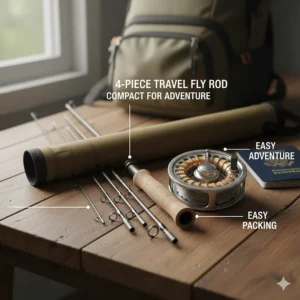
The Maxcatch Premier deserves recognition among the best fly fishing rods for anglers who travel frequently. With its six or eight-piece design and surprisingly refined performance, this rod packs down small enough for checked luggage while still delivering respectable casting characteristics.
Key Specifications:
- IM8 carbon blank construction
- Six-piece or eight-piece configurations
- AA cork grip with hard chromed guides
- Available in 3wt through 12wt
- Aluminum tube for protection
While you won’t confuse it with a premium two or four-piece rod, the Maxcatch Premier performs admirably considering its portability. The shorter packed length (around 18-20 inches) means it fits in carry-on bags or backpacks, making it perfect for adventure travel where every inch of luggage space matters.
What Customers Love:
✅ Incredibly portable for international travel
✅ Decent performance for multi-piece design
✅ Wide range of weights available
✅ Affordable backup rod option
Minor Limitations:
❌ Feel differs from traditional ferrule design
❌ Increased connection points mean more potential issues
❌ Not as refined as high-end travel rods
Price: $189-249
✨ Don’t Miss These Exclusive Deals!
🔍 Take your fly fishing to the next level with these carefully selected products. Click on any highlighted item to check current pricing and availability. These rods will help you create authentic memories on the water your family will cherish forever!
Understanding Fly Rod Action and Power
Selecting the best fly fishing rods requires understanding two critical characteristics that dramatically affect performance: action and power. These terms get thrown around casually, but knowing exactly what they mean transforms you from a confused buyer into an informed consumer.
What Is Rod Action?
Rod action describes where and how the rod flexes during the casting stroke. Think of it like the personality of the rod—some are quick and energetic, others relaxed and smooth. The evolution of fly fishing rod technology has given us unprecedented control over these characteristics through advanced materials and taper designs.
Fast Action: Bends primarily in the top third of the rod. These rods generate tight loops, cut through wind effectively, and deliver pinpoint accuracy at distance. They’re the sports cars of the fly rod world—responsive and powerful, but requiring more precise timing. Best for experienced casters and situations demanding long, accurate presentations.
Medium-Fast Action: Flexes in the top half, offering a sweet spot between forgiveness and performance. This is the Goldilocks zone for most anglers—not too soft, not too stiff. Medium-fast rods handle diverse conditions admirably while remaining accessible to developing casters.
Medium Action: Bends into the middle and slightly beyond, creating a slower, more relaxed casting stroke. These rods excel at close-range fishing and protecting light tippets. They’re forgiving friends who make learning easier and reduce fatigue during long days on the water.
Rod Power Explained
Power refers to the rod’s resistance to flexing under load—its overall stiffness or backbone. A powerful rod can handle heavier flies and bigger fish, while a delicate rod protects fine tippets and delivers gossamer presentations.
Heavy Power: Built for large flies, strong currents, and big fish. These beefier blanks won’t buckle under the strain of 2/0 streamers or angry steelhead. Great for bass, pike, or saltwater applications.
Medium Power: The versatile choice that balances presentation finesse with fish-fighting ability. Most trout rods fall into this category, handling everything from size 18 dry flies to moderate streamers.
Light Power: Designed for delicate presentations and small flies. These presentation-focused rods protect 6X and 7X tippets while delivering ultra-soft landings that don’t spook wary fish.
How to Choose the Best Fly Fishing Rod for Your Needs
Match Rod Weight to Your Target Species
The single most important decision when selecting the best fly fishing rods is choosing the appropriate line weight. According to historical fly fishing records, this standardized system has evolved to help anglers match their equipment to fishing conditions.
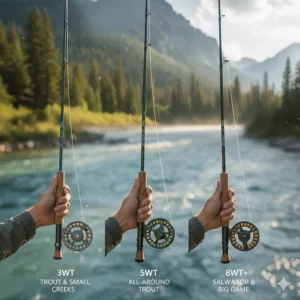
2-3 Weight Rods: Perfect for small stream trout, panfish, and situations requiring delicate presentations. These ultra-light rods make 8-inch brookies feel like monsters and excel in tight quarters where shorter casts dominate.
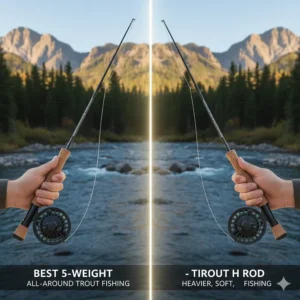
4-5 Weight Rods: The bread-and-butter trout rods that handle 90% of freshwater situations. A 5-weight is often called the “do-everything rod” for good reason—it throws dry flies gracefully yet possesses enough backbone for moderate streamers and nymphs.
6-7 Weight Rods: Transitioning into larger water, bigger fish, and heavier flies. These rods shine for streamer fishing, bass applications, light steelhead work, and calm saltwater situations. Great for windy days when lighter rods struggle.
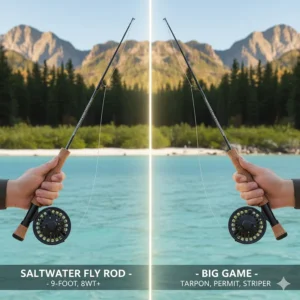
8-12 Weight Rods: Heavy-duty tools for serious fish. Eight-weights handle large trout, salmon, and inshore saltwater species. Nine and ten-weights dominate most saltwater applications, while 11-12 weights target tarpon, large stripers, and offshore species.
Consider Your Fishing Environment
Where you fish matters as much as what you’re targeting. The best fly fishing rods for mountain streams differ dramatically from those ideal for wide western rivers or saltwater flats.
Small Streams: Shorter rods (7-8 feet) in lighter weights (2-4wt) maneuver around streamside vegetation and deliver accurate casts in tight quarters. Think precision over power.
Medium Rivers: Standard 9-foot rods in 4-6 weights provide the versatility most trout anglers need. This length offers excellent mending capability while remaining manageable in brushy environments.
Large Rivers: Longer rods (9’6″ to 10 feet) help control more line, improve mending, and generate the distance needed to cover water effectively. Consider 6-7 weight models for bigger flies and wind.
Lakes and Stillwater: Distance casting becomes critical. Fast-action rods in appropriate weights help deliver flies to cruising fish while minimizing false casting that might spook them.
Saltwater: Durability becomes paramount. Anodized aluminum reel seats, corrosion-resistant guides, and powerful actions handle the demands of larger flies, stronger fish, and harsh conditions.
Evaluate Your Casting Ability
Be honest about your skill level. The best fly fishing rod for a tournament caster might frustrate a beginner, while a rod perfect for learning could feel sluggish to an expert.
Beginners: Start with medium to medium-fast actions that provide feedback during the casting stroke. This tactile sensation helps you feel when the rod loads properly, accelerating your learning curve. Forgiving rods mask timing errors and build confidence.
Intermediate Anglers: You’ve developed fundamentals and want to refine technique. Medium-fast to fast-action rods offer enhanced performance without being unforgiving. This is where you can really appreciate nuanced differences between models.
Advanced Casters: Fast-action rods reward precise timing with exceptional performance. You can handle the demands these rods place on casting technique and benefit from their strengths: tight loops, distance, and accuracy.
Budget Considerations That Matter
Price doesn’t always equal performance, especially in 2025. Manufacturing improvements and material innovations mean outstanding rods exist at every price point.
Under $150: Excellent entry-level options like the Echo Base and Redington Crosswater deliver surprising capability. These rods prove you don’t need four figures to enjoy fly fishing. Perfect for learning, backups, or outfitting multiple family members.
$150-$400: The sweet spot where performance-to-value peaks. Rods like the Orvis Clearwater and Redington Path II compete admirably with pricier alternatives. Most anglers find rods in this range more than adequate for their needs.
$400-$800: Premium performance with refined components. Noticeable improvements in feel, accuracy, and component quality. Great for dedicated anglers who fish frequently and appreciate subtle differences.
$800+: Top-tier materials, cutting-edge technology, and exceptional craftsmanship. Rods like the Sage R8 Core justify their cost through innovation and performance—but only if you can appreciate and utilize their capabilities.
Rod Length and Its Impact on Performance
Length significantly influences casting distance, line control, and overall fishing experience. Understanding these relationships helps you select the best fly fishing rods for your specific situations.
Short Rods (6’6″ to 8′)
These compact tools excel in tight quarters where traditional 9-footers become liabilities. Small mountain streams with overhanging branches demand shorter rods. They also reduce leverage during extended fishing sessions, making them ideal for ultra-light presentations where fatigue becomes a factor.
Benefits include enhanced accuracy at close range, better control in confined spaces, and reduced weight. However, they sacrifice mending ability and struggle to generate distance when needed.
Standard Rods (8’6″ to 9′)
The ubiquitous 9-foot rod dominates because it works. This length provides excellent balance between casting distance, mending capability, and manageability. It’s versatile enough for most fishing situations without significant compromises.
Ninety percent of trout anglers would be perfectly happy fishing exclusively with 9-foot rods. They’ve earned their popularity through proven performance across diverse conditions.
Long Rods (9’6″ to 11′)
Extended reach pays dividends for specific applications. Euro nymphing revolutionized trout fishing partly through longer rods (10-11 feet) that provide superior line control and drift extension. For traditional fishing, 9’6″ models offer improved mending on large rivers without feeling unwieldy.
Steelhead and salmon anglers often choose 9’6″ to 10′ rods for their ability to handle large flies, fight strong fish, and maintain control in heavy current. The extra leverage helps tire fish more quickly and keeps them away from structure.
Matching Lines, Leaders, and Tippets
The best fly fishing rods deserve proper supporting components. Modern fly fishing relies on balanced systems where each element complements the others. According to historical fishing research, this systematic approach transformed fishing from subsistence activity to refined sport.
Line Weight Matching
Always start with the line weight marked on your rod. A 5-weight rod should be paired with 5-weight line. However, experienced anglers sometimes overline by one weight (using 6-weight line on a 5-weight rod) to load the rod more easily at short distances or slow down its action slightly.
Modern weight-forward floating lines work beautifully for most situations. They cast easily, mend well, and provide versatility across techniques. As you advance, consider specialty lines for specific applications—sinking lines for streamers, integrated nymph lines for subsurface work, or premium lines that deliver exceptional performance.
Leader Selection
Leaders transition from thick fly line to fine tippet, allowing delicate presentations. Standard 9-foot tapered leaders work for most trout fishing. Match leader size to your fly—lighter leaders for smaller flies, heavier leaders for large patterns.
For dry fly fishing, longer leaders (12-15 feet) help flies land softly and reduce fish-spooking line wake. Nymphing often employs shorter, stiffer leaders that turn over heavy rigs effectively. Streamer fishing might use 6-7 foot leaders to facilitate aggressive stripping retrieves.
Tippet Considerations
Tippet connects leader to fly and represents the final, most delicate link in your system. Choose tippet diameter based on fly size and fish wariness. Clear, calm water demands finer tippets (5X-7X), while murky conditions or larger flies permit heavier tippets (2X-4X).
Fluorocarbon tippet sinks faster and offers slightly better abrasion resistance than nylon, making it ideal for nymphing. Nylon monofilament floats better and provides more stretch, perfect for dry flies and protecting light tippets during fights.
Maintenance and Care for Longevity
Investing in the best fly fishing rods means nothing if you don’t maintain them properly. These simple practices extend rod life dramatically and ensure consistent performance season after season.
Cleaning After Each Trip
Saltwater anglers already know this rule, but it applies to everyone: rinse your rod after use. Even freshwater contains minerals, dirt, and organic material that accumulates in guides and ferrules. A quick rinse with lukewarm water prevents buildup and identifies any damage before it worsens.
Pay special attention to guide wraps, ferrule connections, and the reel seat. These areas trap debris that can cause problems over time. Use a soft cloth to wipe down the blank, removing any residue or film.
Ferrule Maintenance
Those connections between rod sections deserve special care. Before assembly, inspect ferrules for dirt, sand, or damage. Even tiny particles create grinding action that wears ferrules prematurely. A quick wipe keeps connections snug and smooth.
If male ferrules become loose, some anglers apply paraffin wax for a tighter fit. Avoid this unless necessary—proper fitting ferrules shouldn’t require enhancement. If connections feel sloppy, contact the manufacturer about potential warranty repair.
Storage Best Practices
Never store rods wet. Moisture trapped in rod tubes promotes corrosion of metal components and can damage the finish. Allow rods to dry completely before placing them in tubes or socks.
Store rods horizontally or in vertical racks that support their weight evenly. Avoid leaning them in corners where they might develop permanent sets or bends. Extreme temperature fluctuations stress materials, so climate-controlled storage is ideal.
Avoiding Common Damage
The leading cause of rod breakage is car doors and windows. Seriously—more rods break getting stepped on, closed in doors, or knocked over during rigging than actually fishing. Stay mindful of where you set your rod and never leave it anywhere someone might accidentally step on it.
Rod tips are particularly vulnerable. Treat them like the fragile precision instruments they are. When threading line through guides, start from the tip and work backward rather than pulling line through from the butt. This prevents putting stress on the delicate tip section.
Frequently Asked Questions
❓ What weight fly rod should I buy as my first rod?
❓ Do more expensive fly rods really cast better than budget options?
❓ How do I know if a fly rod is too heavy or too light?
❓ Can I use saltwater fly rods in freshwater and vice versa?
❓ What's the difference between a fly rod and a regular fishing rod?
Conclusion: Choosing Your Perfect Rod
Selecting the best fly fishing rods ultimately comes down to matching equipment to your specific needs, budget, and fishing situations. Whether you’re just starting out with an Echo Base or investing in premium performance with a Sage R8 Core, modern manufacturing means exceptional rods exist at every price point.
For most anglers, I recommend starting in the $150-$300 range with options like the Orvis Clearwater or Redington Path II. These rods provide outstanding performance without the premium price tag, leaving budget for essential accessories like quality leaders, tippets, and flies. As your skills develop and you identify specific needs, you can always add specialized rods to your collection.
Remember that the “best” rod is the one you’ll actually use. It should feel comfortable in your hand, match your casting style, and suit the waters you fish most often. Don’t get paralyzed by options—every rod on this list will serve you well. The most important thing is getting out on the water and making casts. Your technique improves with practice, and even a budget rod becomes magical in skilled hands.
Tight lines and smooth casts! 🎣
Recommended for You
Disclaimer: This article contains affiliate links. If you purchase products through these links, we may earn a small commission at no additional cost to you.
✨ Found this helpful? Share it with your friends! 💬🤗
