
In This Article
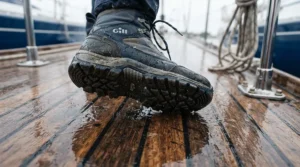
Boat shoes for fishing on wet decks are low-profile, grippy shoes with siped or sharply patterned rubber outsoles. They channel water out from under your foot, so you stay planted on slick gelcoat, fiberglass, and dock boards while spray, slime, and bait pile up. The best pairs also drain fast, dry quickly, and leave no scuffs behind.

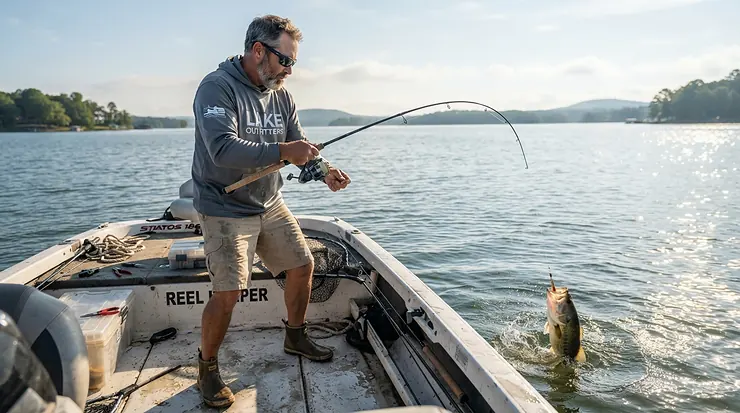
Here’s what nobody mentions until you’ve done a slow-motion pirouette next to a livewell: a wet deck is a skating rink with a tackle box on it. Gelcoat is smooth by design. Add a film of water, a smear of baitfish slime, and a boat rocking on a two-foot chop, and your everyday sneakers become a liability. The fix isn’t exotic. It’s a sole engineered for the job.
The origin story is a good one. According to Wikipedia’s boat shoe entry, Paul Sperry noticed his dog running over ice without slipping. In 1935 he cut siping into a shoe sole with a knife. Nearly a century later, that same principle sits under almost every pair of non slip boat deck shoes worth buying.
This guide sorts through seven real options: classic leather, vented sneakers, waterproof deck shoes, and quick-drain hybrids. You’ll get spec-by-spec interpretation, aggregated review themes (labeled as such), honest trade-offs, and practical advice for matching shoes to how you actually fish. Prices appear as ranges only, so check current price before you buy.
Quick Comparison of the Best Boat Shoes for Fishing on Wet Decks
| Product | Style | Wet-Grip Sole Highlights | Price Range | Best For |
|---|---|---|---|---|
| Sperry Authentic Original 2-Eye | Leather boat shoe | Razor-cut Wave-Siping, non-marking | $90-$130 | Marina-to-dinner versatility |
| Columbia PFG Bahama Vent | Vented slip-on sneaker | Omni-Grip, razor siping, non-marking | $70-$100 | Warm-weather value |
| OluKai Moku Pae | Breathable mesh hybrid | Wet Grip Rubber, non-marking | $110-$130 | Dock-to-deck comfort |
| Huk Rogue Wave Shoe | Waterproof slip-on | Grip-X, non-marking | $120-$140 | Spray and cool mornings |
| Xtratuf Ankle Deck Boot | Waterproof ankle boot | SRA-rated chevron, non-marking | $110-$150 | Wet, messy offshore days |
| Keen Newport H2 | Closed-toe sandal | Non-marking rubber, toe protection | $90-$130 | Hot days and launch ramps |
| Simms Pursuit Shoe | Wading/deck hybrid | Siped, non-marking | $135-$155 | Anglers who wade and boat |
Looking at the table above, the Columbia PFG Bahama Vent delivers the lowest entry price for a proper siped, non-marking sole, while the Simms Pursuit Shoe charges a premium for wading-grade grip. If your feet stay dry only on lucky days, the waterproof Huk Rogue Wave Shoe and Xtratuf Ankle Deck Boot change the equation. Everything else comes down to climate and how much shoe you want on your foot.
💬 Just one click — help others make better buying decisions too!😊
Top 7 Boat Shoes for Fishing on Wet Decks: Expert Analysis
Every pick below is a real, currently sold model. The commentary rests on published specs and aggregated review themes, not on invented testing, so treat each entry as reasoned analysis of what the spec sheet means in practice.
1. Sperry Authentic Original 2-Eye — the original siped sole, still the style benchmark
Few shoes carry as much history on their soles as the Sperry Authentic Original 2-Eye, and that history is the point.
It pairs a hand-sewn leather moc-toe upper with a non-marking rubber outsole cut with razor Wave-Siping. It also has a 360-degree lacing system with rust-resistant eyelets, an EVA heel cup, and an OrthoLite footbed. In practice, the thin grooves flex open as your foot rolls, spreading water sideways instead of letting it film under the tread. The all-around lacing lets you cinch the shoe snug when the deck starts bucking.
Based on the spec comparison, this is the best-looking shoe on the list and a respectable, not class-leading, grip option. Boating-press coverage describes its traction as respectable but not the best among its peers. That fits the design, since leather and a flat siped sole favor all-day wear over aggressive drainage. It suits anglers who go from marina to charter dock to dinner without changing shoes. It’s less ideal if you’ll stand ankle-deep in washdown water.
Reviewers across retail and editorial roundups repeatedly mention out-of-the-box comfort and long wear life. A recurring complaint is that the fit runs narrow for some feet.
Pros:
- ✅ Siped non-marking sole grips damp decks
- ✅ Comfortable straight out of the box
- ✅ Looks right on and off the water
Cons:
- ❌ Leather dries slowly after a soaking
- ❌ Fit runs narrow for some feet
Expect roughly the $90-$130 range depending on color and leather, so check current price. It’s good value if you split time between the dock and dry land.
2. Columbia PFG Bahama Vent — vented, quick-drain comfort at the friendliest price
The Columbia PFG Bahama Vent is the sneaker-style answer for anglers who hate soggy feet.
Its Omni-Grip rubber outsole is razor-siped and non-marking, and the Techlite midsole carries drainage ports that let water exit instead of pooling. The mesh-and-synthetic upper is light, with one retailer listing the claimed weight at around 8 ounces per shoe. That matters on a 10-hour day, when heavy shoes quietly drain your legs.
On paper, the Columbia PFG Bahama Vent is the best-value non slip boat deck shoes option here. The slip-on design is convenient, but it offers less lockdown than a laced shoe when the boat is rocking. Rinse it after saltwater trips and it will dry fast, which is where mesh beats leather.
Aggregated reviews skew strongly positive. Retail listings show high satisfaction across hundreds of reviews, with repeated praise for comfort, easy on-off, and grip on boat decks even when wet. A common theme is that the shoe runs slightly large, and several reviewers suggest sizing down.
Pros:
- ✅ Drainage ports shed water quickly
- ✅ Lightweight, comfortable for long days
- ✅ Razor-siped non-marking Omni-Grip sole
Cons:
- ❌ Runs large, so sizing takes care
- ❌ Slip-on fit is less locked-in
Most versions land around the $70-$100 range, so check current price. It’s one of the strongest values for wet traction fishing footwear.
3. OluKai Moku Pae — barefoot-style mesh with a drop-in heel
If a boat shoe and a slide had a very practical child, it would look like the OluKai Moku Pae.
The breathable engineered mesh upper vents heat and dries quickly. The no-tie laces and Drop-In Heel let you wear it as a shoe or fold the heel down for a slide. The non-marking Wet Grip Rubber outsole uses razor siping, and OluKai calls siping the single most important traction feature for decks and wet docks. The footbed is removable and washable, a small detail that pays off once fish slime enters the picture.
My analysis of the specs says this suits anglers who value ease and comfort over armor. Mesh doesn’t protect against a dropped weight or a snagged hook the way a rubber upper does. On a charter or day-boat trip with moderate spray, though, it hits a sweet spot.
Aggregated review themes include good traction on boats, quick drying, easy cleaning, and a roomy, wider-than-average fit. A minority of critical reviews raise durability concerns, so wear patterns are worth watching.
Pros:
- ✅ Breathable mesh dries fast
- ✅ No-tie laces plus drop-in heel flexibility
- ✅ Removable, washable footbed
Cons:
- ❌ Mesh offers little protection from hooks or impacts
- ❌ Priced above entry-level options
Expect the $110-$130 range, so check current price. It’s a fair value if you’ll wear it daily, not only on the boat.
4. Huk Rogue Wave Shoe — waterproof low-cut that shrugs off spray
The Huk Rogue Wave Shoe is for anglers whose boat shoes need to stay dry when the deck doesn’t.
The upper combines neoprene and rubber with breathable mesh liners, and the Grip-X outsole is non-marking. An 8mm molded EVA footbed adds cushion, and reinforced webbing pull-straps make slip-on easy. The waterproof construction blocks splash and washdown from entering the shoe, something mesh models can’t do. The low-cut design keeps the weight down and lets your ankle move freely.
Reading the specs this way, it’s one of the better picks for cooler mornings, spring and fall, and boats that take spray. The trade-off is warmth. Neoprene holds heat, so in a hot summer it can feel like wearing a wetsuit for your feet. The company’s own review summaries describe the sizing as slightly narrow and suggest sizing up if you’re between sizes. Because those summaries sit on the brand’s site, weigh them alongside independent reviews. Outdoor Life named the Rogue Wave boot version its Best Value fishing boot, and the shoe shares the same sole concept.
Pros:
- ✅ Waterproof neoprene-and-rubber upper
- ✅ Non-marking Grip-X outsole for slick decks
- ✅ Padded 8mm EVA footbed
Cons:
- ❌ Warm in hot weather
- ❌ Narrow toe box for some
The shoe usually runs in the $120-$140 range, so check current price. The value is strong if wet feet are your main enemy.
5. Xtratuf Ankle Deck Boot — the SRA-rated, rinse-and-go workhorse
The Xtratuf Ankle Deck Boot is what you wear when “wet deck” really means wet deck.
Retailer listings describe a molded rubber upper, a non-marking chevron outsole with an SRA slip-resistance rating, an XPRESSCOOL antimicrobial lining, and pull tabs. They also list a claimed weight of about 1 pound 9 ounces per boot. In practice, you can step in a puddle, hose off blood, and carry on. The 6-inch shaft guards your ankles without the bulk of a tall boot.
The analysis is simple: this is the most protective option here, and the most specialized. It excels in messy offshore conditions and fails the “wear it everywhere” test in summer heat. Ankle deck boots are the common compromise, since retailers like West Marine point out they’re lighter and easier to move in than tall boots.
Aggregated reviews are mixed on longevity. Many buyers love the comfort and grip, while a recurring theme is durability complaints: creasing or cracking at flex points, torn pull straps, and soles separating.
Pros:
- ✅ Fully waterproof, easy to rinse
- ✅ SRA-rated non-marking chevron outsole
- ✅ Ankle-height protection without full-boot weight
Cons:
- ❌ Durability complaints in some reviews
- ❌ Heavier and warmer than shoes
Plan on roughly $110-$150, so check current price. It pays off when the conditions are consistently sloppy.
6. Keen Newport H2 — toe-protected sandal built for hot days
Sandals might sound like a strange entry in a list of boat shoes for fishing on wet decks, but the Keen Newport H2 earns its slot.
It’s a closed-toe hybrid with a hydrophobic synthetic upper, a protective toe cap, and a non-marking outsole. OutdoorGearLab calls it perhaps the premier watersports sandal, praising its wet traction while noting it can falter on extremely slick surfaces like slimy river rocks. The listed weight is about 2 pounds per pair in a size 12. The covered toe fixes the biggest flaw of regular sandals, which is stubbing a toe on a cleat or tackle box.
The honest take: the Keen Newport H2 shines for hot weather, launch ramps, and wading off the boat. It’s less ideal when you want a locked-in shoe for rough water. Sand and gravel can also sneak in, a point reviewers raise repeatedly.
Across thousands of retail reviews, the pattern is strong satisfaction, with most reviews at four or five stars. Common themes are the need to size up half a size, and fit varying by colorway. Some reviewers report straps separating after limited use.
Pros:
- ✅ Protected toe box
- ✅ Drains instantly, dries fast
- ✅ Comfortable straight away
Cons:
- ❌ Sizing and fit vary by colorway
- ❌ Debris can slip in
Expect the $90-$130 range, so check current price. Good value for hot-weather anglers.
7. Simms Pursuit Shoe — wading-grade grip for mixed boat-and-shore days
The Simms Pursuit Shoe is aimed at anglers who spend as much time stepping off the boat as standing on it.
The quick-drain mesh upper pairs with a non-marking siped outsole with multi-directional lugs. A quick-lace system, an integrated EVA midsole, and a design meant for thin wading socks complete the package. Simms markets it as a hybrid wet-wading and on-deck shoe, and the lugs add bite for rocky banks without scarring the deck.
My analysis is that it’s the choice for drift-boat, skiff, and kayak anglers who wade. It costs more than the others, so you’re paying for a performance category, not a fashion statement.
Reviews skew positive, citing grip, comfort, and fast drying. Some reviewers report blisters, delamination, or poor traction on slick wet logs, so expectations should stay realistic. Wearing thin wading socks, as the design intends, helps with chafing.
Pros:
- ✅ Lugged siped sole bites on rocks and decks
- ✅ Quick-lace system fine-tunes the fit
- ✅ Light, fast-draining mesh
Cons:
- ❌ Premium price
- ❌ Reports of blisters and delamination
Expect roughly $135-$155, so check current price. It’s worth it if you wade often.
How to Choose Boat Shoes for Fishing on Wet Decks
The best way to choose boat shoes for fishing on wet decks is to start with the sole, then match drainage, closure, and protection to your climate and fishing style. Follow these steps in order.
- Check the outsole first. Look for siped or sharply patterned rubber and confirmation that it’s non-marking. Everything else is secondary, because grip is the shoe’s whole job.
- Decide how wet your feet will get. Frequent spray or washdown points to waterproof models like the Huk Rogue Wave Shoe or Xtratuf Ankle Deck Boot. Warm, open boats favor mesh like the Columbia PFG Bahama Vent.
- Prioritize drying speed. Wet shoes that stay wet cause blisters and odor. Mesh and synthetics beat leather here.
- Evaluate lockdown. Laces or a stretch collar keep the shoe on when you lunge for a net. Slip-ons are convenient but looser.
- Consider toe protection. If you move around cleats, rod holders, and tackle crates, a closed toe or toe cap matters.
- Match the fit to swelling feet. Feet swell in heat and on long days, so leave a little room.
Outdoor Life’s tested roundup frames the ideal pair around three jobs: absorbing shock, keeping feet dry, and gripping wet decks. That’s a useful filter for any shopping list.

Features That Actually Matter (And Those That Don’t)
Start with what matters. Non-marking soles protect your gelcoat from black scuffs, which is why many classic designs use white or light rubber. Siping and tread design create wet traction, a principle that dates back to Sperry’s knife cuts in 1935. Quick-drying materials prevent that heavy, clammy-foot feeling by mid-afternoon. A footbed that supports your arch is easy to overlook, but standing for hours is where it pays off.
Now the hype. “Slip-resistant” on a label is often a brand claim. A standard exists, ASTM F3445-21 for slip-resistant footwear, but many fishing and boat shoes don’t publish a certification against it. Treat marketing phrases as a starting point, and look at the actual sole design and independent reviews. Likewise, stain-repellent coatings help for a while, but they won’t stop fish blood from stinking. Fashion details like contrast stitching have no effect on traction.
Finally, don’t overpay for features you won’t use. A waterproof upper is brilliant on a cold, wet offshore day and a sauna in July. Choose the features that match your real conditions, not the ones with the best marketing copy.
Boat Deck Safety: Why Wet Decks Bite and How Footwear Helps
Boat deck safety isn’t only about big, dramatic emergencies. Coverage of the Coast Guard’s 2024 report noted that falls were among the leading causes of boating injuries. It also noted that about 17 percent of incidents occurred while vessels were tied to a dock or moored, so slips and falls happen even when you’re not underway. You can browse the underlying data through the Coast Guard’s recreational boating statistics.
Footwear is one layer of the picture. The Coast Guard’s broader advice includes wearing a life jacket, taking a boating safety course, attaching the engine cut-off switch, and boating sober. Shoes won’t replace any of that, but they address a hazard you face every minute: stepping on a slick surface in motion.
The physics are blunt. Smooth gelcoat plus a thin water film plus slime creates very low friction. A siped sole disperses that film, and a flexible sole conforms to the surface. Non-marking soles keep your boat looking good, and quick-drying uppers keep feet comfortable and warm. Think of good boat deck safety footwear as cheap insurance: relatively modest money against a fall you can’t predict.
Boat Shoes vs Deck Boots vs Water Sandals
Which style is right depends on conditions. Here’s the head-to-head.
| Type | Wet Grip | Dry Time | Protection | Best For |
|---|---|---|---|---|
| Leather boat shoes | Good | Slow | Moderate | Sperry Authentic Original 2-Eye |
| Mesh boat shoes/hybrids | Good to very good | Fast | Light | Columbia PFG Bahama Vent, OluKai Moku Pae, Simms Pursuit Shoe |
| Waterproof deck shoes/boots | Very good | Stays dry | High | Huk Rogue Wave Shoe, Xtratuf Ankle Deck Boot |
| Closed-toe sandals | Good | Very fast | Toe only | Keen Newport H2 |
Looking at the comparison, mesh hybrids offer the best balance for warm-weather anglers who get wet feet anyway, while waterproof options win in spray and cold. Leather trades drying speed for style. Sandals are unbeatable for heat and quick on-and-off, but they leave the top of your foot exposed.
A written comparison fills in what a table can’t. Deck boots keep water out, but once water gets in over the top, they hold it. Mesh lets water in and out, so your feet are never dry, just never soggy. If you value dry socks, choose waterproof. If you hate heavy, hot feet, choose mesh. Neither is wrong; it depends on the day.
What to Expect: Real-World Performance
Specs translate into specific moments on the water. In the first hour, comfort and fit decide your mood. Shoes that need break-in, like some leather models, can rub, while mesh options usually feel ready immediately. By midday, drainage and breathability take over. Feet in a vented shoe stay manageable, and feet in a waterproof boot start to warm up.
Then comes the real test: a wet, slimy deck. Siped soles earn their keep here, spreading the water film and keeping contact. A shoe with a worn or glossy sole will start sliding, so grip is about condition as much as design. When a wave hits and you take a step sideways, a snug fit helps your foot stay in the shoe instead of rolling.
By the end of the day, hygiene matters. Mesh with a removable footbed, like the OluKai Moku Pae, is easier to clean and dry. Leather needs more patience. Also expect trade-offs in protection: the Xtratuf Ankle Deck Boot guards ankles and handles spills, while the Keen Newport H2 protects the toes but leaves everything else open.
Practical Usage Guide: Break-In, Cleaning, and Maintenance
A good pair of shoes still needs care. Here’s a simple routine.
First wear. Wear new shoes around the house or on short dock trips first. Check the fit with the socks you plan to use. Leather models like the Sperry Authentic Original 2-Eye benefit from a short break-in.
After every trip. Rinse with fresh water, especially after saltwater. Remove the footbed if it’s removable, as on the OluKai Moku Pae, and let everything air dry in the shade. Avoid direct sun or heaters, which can damage adhesives and foam.
Monthly. Scrub the outsole with a soft brush and mild soap to clear slime, sunscreen, and grit from the grooves. Clogged sipes lose their grip.
Every season. Check the sole for smooth patches, and check seams and glue lines. Signs of wear, like the pull-strap and sole issues some reviewers describe on the Xtratuf Ankle Deck Boot, show up early if you look.
Common mistakes in the first 30 days. Skipping the rinse, drying shoes in a hot car, and wearing your boat shoes for everything, which wears down the sole before the season starts. Keep a second pair for walking around town if you can.
Real-World Scenarios: Matching Shoes to Your Fishing Style
Seeing how the shoes map to real situations helps more than any spec list.
The weekend lake angler. You fish a bass boat two or three times a month, mostly warm weather, on a modest budget. The Columbia PFG Bahama Vent is the logical match: vented, light, grippy, and priced for a casual angler. Add thin socks if you get blisters.
The offshore day-boat regular. You fish saltwater most weekends, spray flies, and mornings run cold. The Huk Rogue Wave Shoe or Xtratuf Ankle Deck Boot is the better fit, since waterproofing and a tough sole matter more than breathability. Budget in the $110-$150 range and expect to rinse them after every trip.
The skiff-and-flats wader. You pole a skiff, step out to wade, and then climb back in. The Simms Pursuit Shoe is built for this switch, and the Keen Newport H2 is a hot-weather alternative with toe protection. Both drain fast, so you can walk out of the water and straight back on deck.
Each profile has different priorities: budget, environment, and frequency of use. Pick the scenario closest to yours, then use the Sperry Authentic Original 2-Eye or OluKai Moku Pae if you want a shoe that works beyond the boat.
Problem → Solution Guide
Problem: my shoes feel slippery even though they’re “non-slip.” Clean the grooves with a brush and soapy water, since slime and sunscreen build up. If the sipes look worn smooth, replace the pair.
Problem: wet feet and blisters. Try thin synthetic or wading socks, and choose a shoe that drains, like the Simms Pursuit Shoe or Columbia PFG Bahama Vent. Constant wetness plus a loose fit causes rubbing.
Problem: cold, wet feet in spring and fall. Move to a waterproof option like the Huk Rogue Wave Shoe or Xtratuf Ankle Deck Boot, and add insulating socks.
Problem: smell. Remove removable footbeds and wash them, then dry fully in the shade. Rotate between pairs so each dries completely.
Problem: black marks on the deck. Switch to non-marking soles and test on a hidden patch of the deck. Dark lugged soles from hiking shoes are the usual culprit.
Common Mistakes When Buying Boat Shoes for Fishing
The first mistake is shopping by looks. A pretty shoe with a flat, hard sole won’t keep you upright on wet gelcoat. The second is trusting the label. “Non-slip” is easy to print and hard to verify, so read the sole description and independent reviews.
Third, many buyers ignore sizing quirks. Reviews of the Columbia PFG Bahama Vent say it runs large, while the Keen Newport H2 often runs small and the Huk Rogue Wave Shoe suggests sizing up for half sizes. Order with those notes in mind.
Fourth, people forget wear. Slip-resistance research from NIOSH found that a program supplying highly rated slip-resistant shoes was followed by 67 percent fewer workers’ compensation claims for slips on wet or greasy floors among food service workers. It’s a different workplace, but the lesson transfers: tread design matters, and shoes that grip are only protective while the tread is intact.
Finally, don’t buy one shoe for every condition. A hot-weather mesh and a cold-weather waterproof pair together cover more days than a single compromise.
Long-Term Cost & Value Analysis
The cheapest pair isn’t always the cheapest pair to own. Consider cost per trip. A shoe in the $120 range worn about 40 days a year for three seasons works out to roughly a dollar per outing, which is less than a bait bucket refill. A $70 pair that wears out in a season costs more per use.
| Tier | Products | Typical Range | Value Verdict | Best For |
|---|---|---|---|---|
| Budget | Columbia PFG Bahama Vent, Keen Newport H2 | $70-$130 | Strong value for warm-weather use | Casual and hot-weather anglers |
| Mid-range | Sperry Authentic Original 2-Eye, OluKai Moku Pae, Huk Rogue Wave Shoe, Xtratuf Ankle Deck Boot | $90-$150 | Balanced; pay for materials and protection | Regular boaters |
| Premium | Simms Pursuit Shoe | $135-$155 | Worth it if you wade often | Skiff and drift-boat anglers |
The table suggests mid-range picks give the best balance of durability and grip for most people. Budget options save money upfront but ask for more care, and the Simms Pursuit Shoe justifies its price only if you’ll use its wading strengths. Maintenance, a few minutes of rinsing and brushing, extends the life of any of them.

FAQ
❓ Are boat shoes good for fishing on wet decks?
❓ Do non slip boat deck shoes work on slimy decks?
❓ How often should I replace slip resistant footwear used on a boat?
❓ Can I wear boat shoes for fishing without socks?
❓ Do non-marking soles actually protect my deck?
Conclusion
Choosing boat shoes for fishing on wet decks comes down to one question: how will your feet actually be wet? If spray and washdown are constant, the Huk Rogue Wave Shoe or Xtratuf Ankle Deck Boot keeps water out. If warm days and fast drying matter most, the Columbia PFG Bahama Vent, OluKai Moku Pae, or Keen Newport H2 make more sense. If you wade as much as you boat, the Simms Pursuit Shoe is built for that switch. And if you want a classic that moves from deck to dinner, the Sperry Authentic Original 2-Eye has been proving itself since 1935.
Across all seven, the common thread is the sole. Siped, non-marking rubber is the foundation of non slip boat deck shoes, and good wet traction fishing footwear keeps your balance when the deck gets slick. Add careful rinsing, a quick brush of the grooves, and a pair that fits, and you’ve covered most of the practical side of boat deck safety.
Match the shoe to the day, check current price on your top pick, and spend your energy on the fish, not your footing.
Recommended for You
- Wading Boots For Saltwater Flats Fishing: 7 Proven Picks 2026
- Studded Wading Boots For Icy Terrain: 7 Proven Picks (2026)
- Wading Boots Under $100: 7 Proven Picks That Last (2026)
Disclaimer: This article contains affiliate links. As an Amazon Associate, I earn from qualifying purchases. If you purchase products through these links, we may earn a small commission at no additional cost to you.
✨ Found this helpful? Share it with your friends! 💬🤗
