
In This Article
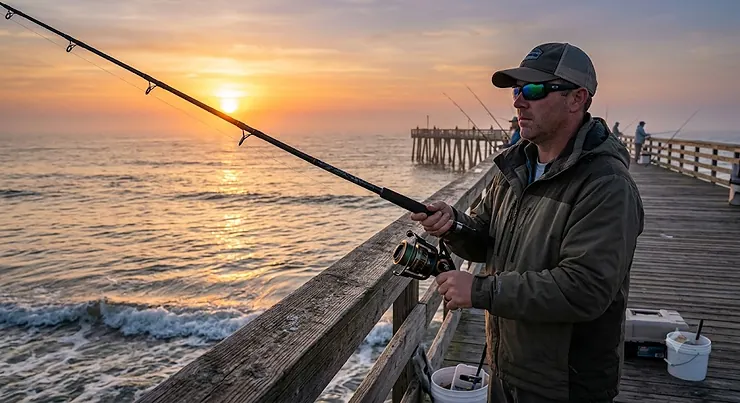
Standing at the end of a weathered wooden pier at 6 a.m., watching the sun crack open over the water, you realize pretty fast that not every rod in your garage was built for this. A pier fishing rod saltwater trip demands is a different animal than the ultralight spinning setup you use for bass in the local pond. Salt corrodes cheap guides in a season. Pilings shred light line. And the fish you’re after — sheepshead, redfish, striped bass, black drum — don’t care that your rod was on sale.
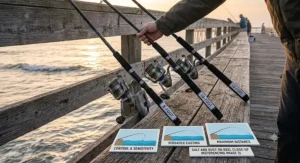
So what is a pier fishing rod saltwater anglers should actually buy? In short: a rod built with corrosion-resistant guides, a graphite-composite or carbon blank rated for 10 to 40 pound line, and enough backbone to horse a fish away from structure before it wraps you around a barnacle-covered piling. Length usually runs 7 to 12 feet, depending on whether you’re casting bait past the breakers or working bottom rigs straight down.
This guide breaks down seven real rods worth your money, from a nearly bulletproof budget option to a handcrafted premium build, plus the casting technique, structure-reading know-how, and public access information that most gear roundups skip entirely. Every recommendation here is grounded in real specs and aggregated review sentiment — not guesswork, and not a rewritten Amazon listing. Let’s get into it.
Quick Comparison Table
| Rod | Length | Power | Line Rating | Best For |
|---|---|---|---|---|
| Ugly Stik Bigwater | 8 ft | Medium Heavy | 20-40 lb | Budget durability, beginners |
| Penn Prevail III Surf | 9 ft | Medium | 12-20 lb | All-around value casting |
| KastKing Estuary Inshore | 8 ft | Heavy | 20-40 lb | Bottom fishing near structure |
| Okuma Cedros Surf CSX | 10 ft | Medium Heavy | 14-40 lb | Long cast pier rod distance |
| Penn Squadron IV Surf | 12 ft | Heavy | 20-40 lb | Reaching past pier pilings |
| Shimano Teramar SE | 7.5 ft | Medium Heavy | 10-20 lb | Sensitivity around structure |
| St. Croix Avid Inshore | 7.25 ft | Medium Heavy | 10-20 lb | Premium build quality |
Looking at this table, you’ll notice a pattern: shorter rods (7 to 8 feet) trade casting distance for sensitivity and structure control, while the 10 to 12 foot models in the middle exist almost entirely to launch bait past the crowd fishing closer to the rail. The Penn Prevail III Surf sits in a sweet spot for anglers who want one rod that does a bit of everything, while the St. Croix Avid Inshore is for someone who has already decided exactly what they’re targeting and wants the best tool for that specific job.
💬 Already know your budget? Jump to the pick that fits and check today’s price before it changes!😊
Top 7 Pier Fishing Rods for Saltwater: Expert Analysis
1. Ugly Stik Bigwater Spinning Rod — nearly indestructible for beginners
The Bigwater earns its reputation the unglamorous way: by refusing to break. This is the rod pier regulars hand to a kid or a first-timer without flinching.
The 8-foot medium-heavy model (BW2040S802) blends graphite and fiberglass through Ugly Stik’s proprietary construction, rated for 20-40 pound line and 3/4 to 4 ounce lures. In practice, that composite blend means the rod flexes deep into a big fish’s run instead of transferring all that shock straight to your wrists — a meaningful difference when a bull redfish decides to test your drag. The one-piece stainless steel guides are a doubled-footed design built specifically for saltwater spinning setups, which matters more than most buyers realize, since guide failure is the number-one reason budget rods die early.
Based on the spec comparison with other sub-$100 rods, the Bigwater’s main trade-off is precision. Reviewers consistently report that the 20-40 pound window can feel mismatched if you’re fishing lighter 15-pound line for finesse presentations, and one detailed review score put its performance rating around 7.9 out of 10, citing solid hook-setting power but “uneven control” across varied lure weights. What the spec sheet won’t tell you: this rod rewards anglers who fish one style consistently rather than switching techniques every trip.
Pros:
- ✅ Stainless steel guides resist saltwater corrosion for years
- ✅ Graphite-fiberglass blend absorbs shock from big fish
- ✅ Extremely low price for the durability delivered
Cons:
- ❌ Line and lure range can feel broad and imprecise
- ❌ Heavier in hand than pure-graphite competitors
The Ugly Stik Bigwater typically runs in the $60-$80 range depending on length and retailer, making it one of the best dollar-for-dollar value picks on this list for anyone who wants a rod that survives being left in a rod holder through a nor’easter.
2. Penn Prevail III Surf Spinning Rod — best all-around value for long casts
If you only buy one rod for pier fishing this year, the Prevail III is the one most tackle shop staff will point you toward, and the spec sheet backs up why.
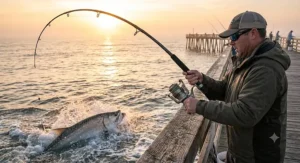
The 9-foot medium power model uses a graphite composite blank paired with one-piece stainless steel Dura-Guides for durability across all line types. Translated into real fishing terms: that moderate-fast graphite composite loads well on the forward stroke, which is exactly what you want when you’re casting a fish-finder rig with 3-4 ounces of lead past the surf line. One angler noted pairing the 9-foot model with a Battle IV 4000 reel and landing a 34-inch striped bass on just his second trip out — the kind of result that lines up with what the spec sheet promises for distance and backbone.
Here’s what to weigh: at medium power, this particular length is better suited to bait fishing and moderate lure weights than heaving the heaviest pyramid sinkers. Anglers targeting bigger sinker weights in rough surf conditions off a pier should look at the heavier-power variants in the same Prevail III lineup instead. Reviewers frequently mention the value proposition — Penn built a genuinely mid-tier rod at a price that undercuts comparable Shimano and St. Croix options by a wide margin.
Pros:
- ✅ Graphite composite blank casts smoothly with moderate weights
- ✅ Dura-Guides hold up well against saltwater corrosion
- ✅ Excellent value relative to build quality
Cons:
- ❌ Medium power limits heavy sinker and big-bait casting
- ❌ Cork/rubber grip wears faster than premium cork alone
Priced in the $70-$100 range, the Penn Prevail III Surf is the rod I’d point a first-time pier angler toward if budget matters but “cheap” isn’t the goal.
3. KastKing Estuary Inshore Saltwater Spinning Rod — best bottom fishing pier rod for structure
When you’re dropping a fish-finder rig or a knocker rig straight down next to a piling, sensitivity in the tip matters more than casting distance, and this is where the Estuary earns its spot.
The 8-foot heavy power model carries a 20-40 pound line rating and 3/4 to 3 ounce lure rating, weighing just 8.12 ounces, built around Toray IM7 graphite blanks. That light rod weight paired with a fast action tip means you can actually feel a sheepshead mouthing a fiddler crab against a piling rather than just feeling the current — a distinction that decides whether you go home with a stringer or an empty bucket. American Tackle Microwave Air guides are engineered specifically to resist saltwater corrosion, which matters enormously for a rod that will spend its life inches from barnacle-covered structure.
Reviewers who’ve fished it around redfish and black drum in structure-heavy water describe being surprised at how light the blank feels relative to how much fighting power it delivers against 20-plus pound fish. That’s a meaningful data point: a rod this sensitive could reasonably be expected to underperform on bigger fish, and multiple owners report it doesn’t. For anglers whose whole game plan revolves around fishing pilings and structure rather than open-water casting, this is the more specialized — and arguably smarter — buy over a generic surf rod.
Pros:
- ✅ Toray IM7 blank delivers excellent bite sensitivity
- ✅ Corrosion-resistant guides built for structure fishing
- ✅ Lightweight design reduces fatigue on long sessions
Cons:
- ❌ Shorter length limits casting distance versus surf models
- ❌ Cork handle needs regular rinsing to avoid salt buildup
Expect to pay in the $70-$90 range for the KastKing Estuary Inshore, which represents strong value for a rod this purpose-built for structure and bottom work.
4. Okuma Cedros Surf CSX Spinning Rod — best long cast pier rod for distance
Every crowded public pier has that one angler whose bait always lands 40 yards past everyone else’s. More often than not, they’re holding something like the Cedros CSX.
Built from 30-ton carbon fiber blanks with a moderate-fast taper, this rod is engineered specifically to increase responsiveness and power compared to traditional IM-6 graphite, and the 10-foot medium-heavy model is rated for 14-40 pound line. On paper this means a blank that loads deeper on the cast and releases that stored energy more efficiently — the actual mechanism behind the extra distance anglers report. 316-grade stainless steel guide frames with zirconium inserts are built specifically for braided line, which most serious long-distance pier casters run instead of monofilament because braid’s thinner diameter cuts wind resistance further.
Based on the spec comparison against fiberglass-heavy competitors at similar price points, the 30-ton carbon construction is the standout differentiator here — it’s lighter without sacrificing the backbone needed to control a fish once it’s hooked 80 yards out. The trade-off reviewers mention most is that faster, stiffer blanks like this one transmit less cushioning on a light-biting fish, so it rewards anglers using circle hooks and patient hooksets over aggressive yanking.
Pros:
- ✅ 30-ton carbon blank maximizes casting distance
- ✅ Stainless guides purpose-built for braided line
- ✅ Moderate-fast taper loads smoothly under heavy weight
Cons:
- ❌ Faster action offers less forgiveness on light bites
- ❌ Two-piece ferrule needs periodic wax maintenance
The Okuma Cedros Surf CSX runs roughly in the $150-$170 range, a fair price for the extra 15-20 yards of cast distance it typically delivers over composite-blank competitors.
5. Penn Squadron IV Surf Rod — best for reaching past pier pilings
Some piers stretch fish-holding structure well beyond casting range of a standard 8-footer. That’s exactly the scenario the Squadron IV was designed to solve.
At 12 feet with a heavy power rating and a 20-40 pound line rating, this rod is built for anglers who need to reach fish holding well beyond the pier structure. Here’s what that length actually buys you in practice: every additional foot of blank adds leverage during the cast, and 12 feet is close to the functional ceiling before a rod becomes too unwieldy for one person to manage solo on a crowded rail. Reviewers who fish it against strong current report it holds bottom rigs steady even when lesser rods start bouncing with the tide.
What most buyers overlook about a rod this long is handle placement — the extended butt section isn’t just for looks, it’s there to add casting leverage on the forward stroke, so anglers used to shorter rods sometimes need a session or two to adjust their casting motion before hitting full distance. Once that adjustment happens, the payoff is real: this is a rod built to put bait meaningfully past where 90% of pier traffic is casting.
Pros:
- ✅ 12-foot length reaches well beyond typical pier structure
- ✅ Heavy power handles big sinkers and strong current
- ✅ Graphite composite keeps a long blank manageable
Cons:
- ❌ Length makes storage and transport more cumbersome
- ❌ Overkill for anglers targeting smaller inshore species
Priced around $100-$130, the Penn Squadron IV Surf rewards anglers willing to trade portability for genuine extra reach.
6. Shimano Teramar SE Inshore Spinning Rod — best for sensitivity around structure
Shimano built its reputation on blank technology, and the Teramar SE inshore lineup shows exactly why serious structure anglers are willing to pay up for it.
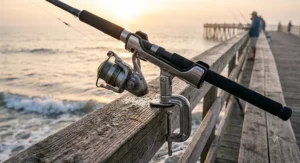
The rod uses Shimano’s TC4 blank construction for unmatched durability, paired with an optimized SeaGuide guide train for improved overall rod balance. In real-world terms, TC4 construction manages to be simultaneously lighter and stiffer than standard graphite layups, which is what lets a 7.5-foot medium-heavy model detect a subtle tap from a sheepshead nibbling bait tight against a piling while still having enough backbone to pull that same fish away from the structure before it wraps your line. Models at heavy power and above add a rubber gimbal for security when fighting bigger coastal species.
Reviewers consistently point to the balance and in-hand feel as the standout traits — several owners specifically compare it favorably against rods costing considerably more. On paper this means Shimano priced genuine tournament-grade blank technology into what’s still a mid-tier rod. The honest downside: at medium-heavy power and a shorter overall length, this isn’t the rod for anglers whose primary goal is maximum casting distance; it’s built for close-quarters precision instead.
Pros:
- ✅ TC4 blank offers exceptional sensitivity-to-power ratio
- ✅ SeaGuide train improves overall casting balance
- ✅ Rubber gimbal aids control on bigger fish
Cons:
- ❌ Shorter length trades away long-distance casting range
- ❌ Premium components mean a higher price than entry rods
Expect the Shimano Teramar SE to run in the $140-$180 range — a fair ask for TC4-level blank technology in a structure-focused package.
7. St. Croix Avid Inshore Spinning Rod — best overall craftsmanship
For anglers who’ve already cycled through two or three cheaper rods and know exactly what they want, the Avid Inshore is where most of them eventually land.
Completely redesigned to be lighter with improved balance, the rod is built from premium high-modulus SCIII graphite, using Kigan Master Hand Zero Tangle guides with titanium frames for saltwater corrosion protection. The 7.25-foot medium-heavy model (ASIS73MHF) is rated for 10-20 pound line. What that titanium guide frame buys you in practice is a rod that can sit in a beach bag through years of salt exposure without the guide inserts corroding or popping loose — a failure point that kills cheaper rods within a season or two. A Fuji DPS reel seat with gunsmoke hoods rounds out a build that feels genuinely handcrafted rather than assembled.
Based on the spec comparison against every other rod on this list, the Avid Inshore’s real edge isn’t raw power — it’s refinement. Owners repeatedly describe it as the rod that finally eliminated the “why does my arm hurt after four hours” problem that cheaper blanks create. St. Croix builds this series entirely in the USA, which explains both the premium price and the backing 15-year transferable warranty. The honest trade-off: you’re paying a real premium for incremental gains in feel and longevity that a beginner may not notice for a season or two.
Pros:
- ✅ Titanium guide frames resist corrosion for years
- ✅ SCIII graphite blank is lighter with excellent balance
- ✅ Backed by a 15-year transferable warranty
Cons:
- ❌ Highest price point of any rod on this list
- ❌ Line rating limits it against the biggest surf species
The St. Croix Avid Inshore typically sits in the $220-$260 range, positioning it as the investment pick for anglers who fish structure often enough to justify paying for longevity.
Pier Casting Technique: Setup, First Trips, and Common Mistakes
Getting a new rod out of the box is the easy part; setting it up correctly determines whether your first few trips go well. Start by spooling with 10-20 pound braid for inshore-focused rods like the Shimano Teramar SE or St. Croix Avid Inshore, or 20-40 pound braid for surf-length rods like the Penn Squadron IV Surf. Braid’s thin diameter meaningfully increases both casting distance and bite sensitivity compared with monofilament of the same strength.
Before your first cast, walk the rod’s guides with a cotton ball — any snag reveals a rough spot that will fray your line over time, a five-minute check that saves you from a lost fish later. Practice your casting stroke on an empty stretch of pier before the crowds arrive; a smooth pendulum motion loads the rod’s tip properly, while a rushed overhand snap tends to produce tangles and shortened distance. In your first 30 days, the single most common mistake is over-tightening the drag out of excitement — a fish’s first run should peel line smoothly, not lock up and risk snapping your leader.
After every trip, rinse the entire rod, reel seat, and guides with fresh water and let it dry fully before storage; salt left to sit is what kills guide inserts and reel bearings within a single season. Check guide wraps for cracking every few months, and re-wax two-piece ferrule joints periodically to keep the sections from binding or loosening.
✨ Ready to Upgrade Your Setup? Compare current prices on your top pick before your next trip!🎣
Real-World Scenarios: Matching the Rod to Your Pier
Consider three anglers with different needs. A college student fishing a public pier twice a month on a tight budget wants durability above all else — the Ugly Stik Bigwater or Penn Prevail III Surf covers that use case without asking for a big investment, and both can handle whatever a beginner throws at them, literally and figuratively.
A weekend angler who fishes a long pier where the good structure sits 60-plus yards out needs distance first. That’s squarely the Okuma Cedros Surf CSX or Penn Squadron IV Surf territory — both are built around maximizing the cast, and the extra length pays off every single trip once you’re consistently out-casting the crowd around you.
Finally, picture a dedicated structure angler who fishes the same pier three times a week, targeting sheepshead and black drum tight against the pilings. Casting distance barely matters to this angler; sensitivity and corrosion resistance over years of use matter enormously. That’s where the KastKing Estuary Inshore, Shimano Teramar SE, or St. Croix Avid Inshore earn their keep, trading raw distance for the refined feel that turns subtle bites into hooksets.
Bottom Fishing Pier Rod Problems and Solutions
Problem: Bait keeps getting swept away from the piling by current. Solution: switch to a heavier bottom fishing pier rod like the KastKing Estuary Inshore at 20-40 pound rating and add enough weight to hold position without a rod so stiff it kills sensitivity entirely.
Problem: You can’t tell a bite from current movement. Solution: this usually means your rod tip is too stiff for the presentation. A faster-tip, lighter rod such as the Shimano Teramar SE telegraphs subtle taps far better than a heavy surf blank.
Problem: Fish keep cutting you off on barnacles near the pilings. Solution: this is a leader problem more than a rod problem — step up to a heavier fluorocarbon leader, but also favor a rod with enough backbone, like the St. Croix Avid Inshore, to turn a fish’s head before it reaches the structure.
Problem: Guides are rusting or seizing after only a few months. Solution: you likely bought a rod with painted or lower-grade guide inserts. Rods with titanium or stainless zirconium guides, such as the Okuma Cedros Surf CSX, resist this far longer, but a thorough freshwater rinse after every single trip remains non-negotiable regardless of rod quality.
Problem: Casts keep falling short of the fish-holding water. Solution: check your rod’s actual power rating against your sinker weight — a medium rod paired with a 4-ounce pyramid sinker will always underperform. Match sinker weight to rod rating, or move up to a rod built for it like the Penn Squadron IV Surf.
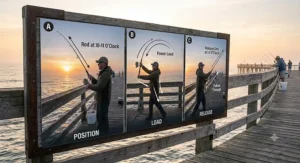
How to Choose a Pier Fishing Rod Saltwater Anglers Trust
- Match rod length to your pier’s layout. Shorter 7-8 foot rods excel at structure and bottom fishing close to pilings; 10-12 foot rods exist to cast well past the crowd.
- Choose power rating based on your target species. Medium rods suit smaller inshore fish; medium-heavy to heavy rods handle bigger surf species and heavier sinkers.
- Prioritize guide material over blank cosmetics. Stainless steel, titanium, or zirconium-insert guides survive saltwater far longer than budget alternatives, regardless of how the blank looks.
- Consider two-piece portability if you walk to your pier. Modern ferrules perform nearly identically to one-piece blanks for most anglers.
- Set a realistic budget band before shopping. Spending more only pays off if you fish often enough to notice the refinement; occasional anglers rarely need a premium build.
- Check the reel seat and handle material. Cork resists salt buildup better than EVA foam over the long run, though EVA is more affordable and durable against impact.
- Read aggregated review sentiment, not just star averages. A 4.5-star rod with recurring guide-corrosion complaints tells you more than the number alone suggests.
Long Cast Pier Rod: What Actually Adds Distance
Anglers chasing maximum distance often over-focus on rod length alone, but length is only part of the equation. Blank material plays an outsized role: 30-ton carbon fiber blanks like those in the Okuma Cedros Surf CSX increase responsiveness and available power compared with traditional IM-6 graphite, meaning the rod stores and releases more energy on the same casting stroke. A long cast pier rod also needs guides matched to your line choice — braid-specific zirconium or titanium inserts reduce friction during the cast far more than standard guides do, which is why serious distance casters rarely run cheap guide sets regardless of blank quality.
Technique matters just as much as gear. A slower, deeper-loading rod paired with a smooth pendulum cast consistently outperforms a stiff rod muscled through a rushed overhand throw. Reviewers and tournament surf casters alike note that line diameter, not just rod power, drives real-world distance — thinner braid cuts through wind resistance that thicker monofilament simply can’t match. If distance is your priority, the Okuma Cedros Surf CSX and Penn Squadron IV Surf are purpose-built for it; shorter structure rods like the St. Croix Avid Inshore were never designed to compete on this metric, and comparing them on distance alone misses what each rod actually does well.
Structure Fishing From a Pier: Reading Pilings, Rocks, and Drop-Offs
Structure fishing rewards patience and positioning over raw casting power. Pilings create current breaks where baitfish shelter, which in turn draws predatory species like sheepshead, black drum, and snook to hold tight against the shaded, barnacle-covered surface. The most productive presentation is usually a vertical drop rather than a long cast — get your bait down next to the structure and let it sit, rather than casting past it and reeling through.
| Approach | Best Rod Length | Typical Line | Best For |
|---|---|---|---|
| Vertical structure fishing | 7-8 ft | 10-20 lb | Sheepshead, black drum, tautog |
| Long-distance surf casting | 10-12 ft | 20-40 lb | Striped bass, redfish, pompano |
| General-purpose pier fishing | 8-9 ft | 12-20 lb | Mixed species, beginners |
The table above illustrates why a single “best” pier rod doesn’t really exist — vertical structure work and long-distance casting are close to opposite disciplines. Anglers focused on structure fishing should prioritize sensitivity and corrosion-resistant guides, since the rod spends most of its working life within a few feet of abrasive pilings, while distance-focused anglers should prioritize blank power and guide design suited to braid. Trying to force one rod into both roles usually means it does neither particularly well.
🎣 Found your structure-fishing match? Check current availability before your next trip out!
Common Mistakes When Buying a Pier Rod
The most common mistake is buying based on length alone without considering power rating — a 12-foot rod in light power will feel whippy and underpowered the moment a real fish takes line. A close second is ignoring guide material entirely; a beautiful blank paired with painted or low-grade guides will corrode and fail well before the rod itself wears out. Reviewers across nearly every rod in this guide flag guide corrosion as the number one long-term failure point, far more often than blank breakage.
Another frequent misstep is buying a single rod to do everything. As the structure-fishing comparison above shows, distance casting and vertical structure work genuinely call for different tools, and anglers who try to cover both with one all-purpose medium rod often end up frustrated with compromises on both ends. Finally, many first-time buyers skip checking their local public fishing access rules before investing in gear, only to discover the pier they had planned to fish requires a permit or license they don’t have.
Public Fishing Access: Where You Can Cast for Free
Before buying any pier fishing rod saltwater setup, it’s worth confirming what public fishing access actually looks like where you plan to fish, since rules vary considerably by state. In California, a fishing license is not required when recreationally fishing from a designated “public pier” in ocean or bay waters, though other regulations like minimum size and bag limits still apply. For more on what qualifies, California’s Department of Fish and Wildlife maintains an official list of free public piers, jetties, and breakwaters.
Other coastal states extend similar courtesy. Several Gulf and Atlantic states exempt anglers fishing from designated public ocean piers from state license requirements, since the pier itself often holds a blanket permit covering everyone fishing from it — though this varies enough by state and even by individual pier that it’s always worth a quick check before you go. If you plan to fish federal waters or aren’t sure whether your state requires registration, NOAA Fisheries’ National Saltwater Angler Registry is the definitive federal resource for confirming what’s required.
For anglers who fish competitively or want their catch to count toward a record, tackle setups also need to meet formal standards. The International Game Fish Association publishes detailed line-class and equipment rules that govern everything from rod length minimums to leader specifications for anyone chasing an official record catch.
Long-Term Cost & Maintenance for Saltwater Pier Rods
A $70 rod that needs replacing every season isn’t necessarily cheaper than a $200 rod that lasts a decade, and running the actual numbers makes this clear. At roughly 20 trips a year, a Ugly Stik Bigwater replaced every two to three seasons averages out to a modest annual cost, while a St. Croix Avid Inshore at double or triple the upfront price but backed by a 15-year warranty and titanium guide frames can easily work out cheaper per year of use for anglers who fish often.
Maintenance costs matter too. Guides are the most common failure point across every rod in this guide, and replacing a single guide typically costs more in time and hassle than the rinse-and-dry routine that prevents the problem in the first place. Reel seats and cork handles also degrade faster without regular fresh-water rinsing, regardless of price point. The real long-term cost driver isn’t the rod price tag — it’s how consistently you maintain the gear you already bought.
Features That Actually Matter (And Those That Don’t)
Guide material and construction matter enormously — stainless steel, titanium, or zirconium inserts are the single biggest predictor of how long a rod survives regular saltwater exposure. Blank material matters too, but mostly for casting performance and sensitivity rather than durability; a 30-ton carbon blank casts differently than a graphite-fiberglass composite, but neither is inherently more “durable” in a vacuum.
What matters far less than marketing suggests: cosmetic blank finishes, flashy color schemes, and marginal weight differences of half an ounce or less. None of these meaningfully change how a rod performs on the water. Reel seat material is a middle-ground feature — cork feels better and resists heat, but well-built graphite or aluminum seats perform just as reliably and often cost less. Buyers chasing the lightest possible rod on paper sometimes overlook that a few extra ounces rarely matter once the rod is loaded with a big fish; backbone and guide quality matter far more than shaving grams.
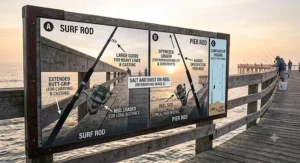
Frequently Asked Questions
❓ What is the best pier fishing rod saltwater for beginners?
❓ How long should a pier fishing rod be?
❓ What line rating is best for pier fishing?
❓ Do I need a license to fish from a public pier?
❓ Can one rod handle both bottom fishing and long casting?
Conclusion
There’s no single best pier fishing rod saltwater anglers should buy blind — the right pick depends entirely on whether you’re fishing tight to structure, casting for distance, or just want one dependable rod that handles whatever a Saturday morning throws at you. The Penn Prevail III Surf remains the safest all-around recommendation for most anglers starting out, while dedicated structure fishermen will get more mileage from the KastKing Estuary Inshore or St. Croix Avid Inshore, and distance casters should look hard at the Okuma Cedros Surf CSX or Penn Squadron IV Surf.
Whatever you choose, remember that guide quality and consistent freshwater rinsing will do more for your rod’s lifespan than any single spec on the page. Pier fishing rewards patience, preparation, and gear that’s actually built for saltwater — not just labeled for it. Take the scenario that matches your fishing style, check current pricing, and get back out on the rail.
🔍 Don’t Miss These Exclusive Deals!
Take your pier fishing rod saltwater setup to the next level with these carefully selected picks. Click through to check current pricing and availability before your next trip out. The right rod turns a slow morning into a stringer full of fish your family will actually want to eat!
Recommended for You
- 7 Best Popping Rod Saltwater Picks for GT & Tuna (2026)
- 7 Best jigging rod saltwater Picks for 2026 (Tested Insights)
- Best Offshore Trolling Rod 2026: 7 Picks That Actually Hold Up
Disclaimer: This article contains affiliate links. As an Amazon Associate, I earn from qualifying purchases. If you purchase products through these links, we may earn a small commission at no additional cost to you.
✨ Found this helpful? Share it with your friends! 💬🤗
