
In This Article
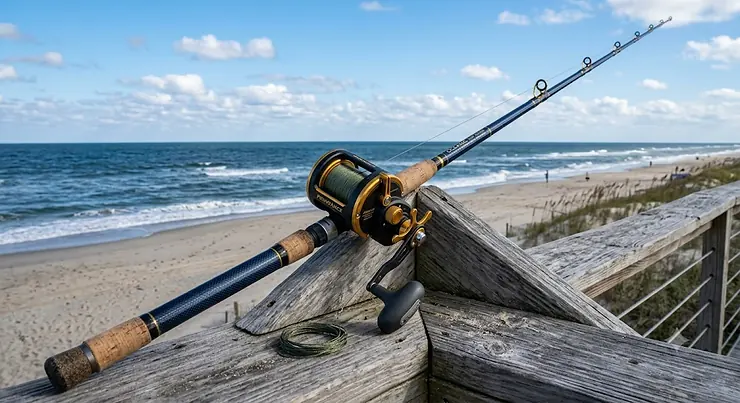
Somewhere between the third broken rod tip and the first cobia that shrugged off your drag like it was nothing, you start to understand why so many beach anglers eventually switch to a conventional surf rod. A conventional surf rod is a surf-casting rod built to pair with a revolving-spool (conventional) reel instead of a spinning reel, giving anglers more lifting power, higher line capacity, and better control for big baits and big fish. It’s not the setup that shows up in starter combos at the big-box store. It’s the setup that shows up in the truck bed of the guy who’s been fishing the same stretch of beach since before you had a driver’s license.
The pull toward conventional tackle usually happens for a reason: you got tired of a spinning reel’s drag giving up mid-fight, or you finally hooked something big enough to remind you that not all surf gear is built equally. This guide breaks down seven real, currently available conventional surf rods — from budget-friendly fiberglass workhorses to rods that were clearly designed by people who’ve actually fought a striper in a rip current at 2 a.m. We’ll walk through specs, honest analysis pulled from real spec sheets and aggregated review sentiment, and where each rod actually earns its keep. For a deeper primer on the discipline itself, the surf fishing overview on Wikipedia is a solid starting point if you’re newer to the sport.
Quick Comparison Table
Before we go deep on all seven, here’s the condensed version for anyone standing in an aisle right now trying to make a decision before the tide turns.
| Rod | Length | Power | Best For | Price Range |
|---|---|---|---|---|
| Ugly Stik Bigwater Conventional | 10′ | Medium | Budget durability | Under $100 |
| Daiwa Beefstick BSS1202MHS | 12′ | Heavy/XXH | Crab snares & abuse | Around $80-$120 |
| PENN Squadron IV Surf Conventional | 10′-12′ | Med-Heavy | Best value guides | $100-$150 range |
| Tsunami Trophy II Surf Conventional | 12′ XH | Extra Heavy | Upgrading from glass | $150-$220 range |
| PENN Battalion II Surf Conventional | 12′ | Heavy | Balanced all-rounder | $150-$220 range |
| Tsunami Carbon Shield II Big Bait Conventional | Varies | Heavy | Genuinely big fish | $220-$300 range |
| PENN Carnage III Surf Conventional | 10′-11′ | Medium-Heavy | Serious conventional anglers | $250-$350 range |
Look at that spread for a second, because it tells you something important: this isn’t a category where “best” means one rod for everybody. The Ugly Stik Bigwater Conventional and Daiwa Beefstick occupy the same rough price tier but solve different problems — one is a general-purpose bruiser, the other is basically a crowbar with guides, purpose-built for anglers who snare crabs or beat their gear against jetty rocks. Meanwhile the PENN Carnage III Surf Conventional and Tsunami Carbon Shield II Big Bait Conventional sit at the top not because they cast the farthest, but because their blanks and guide trains are engineered around a specific job: stopping something big before it stops you.
🎣 Ready to see current pricing on any of these? Tap a highlighted rod above to check availability before your next trip.
Top 7 Conventional Surf Rods: Expert Analysis
Below are seven real, currently sold conventional surf rods spanning budget, mid-range, and premium territory. Each one earns its spot for a specific type of angler, so read the “who it’s for” section carefully before you buy based on price alone.
1. Ugly Stik Bigwater Conventional — the budget rod that refuses to snap
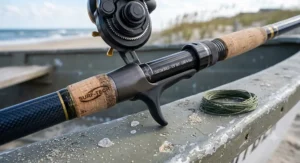
Let’s start with the rod that has become something of a legend among anglers who fish hard and don’t baby their gear: the Ugly Stik Bigwater Conventional. The standout feature here isn’t sensitivity — it’s survival. This is a 10-foot, medium-power, two-piece rod built around Ugly Stik’s proprietary Ugly Tech construction, which blends graphite and fiberglass to create a blank that bends dramatically under load instead of cracking.
On paper, the 12-30 lb line rating and 11-guide layout with UglyTuff inserts put this squarely in “general surf duty” territory rather than big-game specialization. What that means in practice: you can chuck bait rigs, bottom rigs, and moderate metal lures without worrying that a rogue wave-slam or an accidental car-door slam is going to end the rod’s career. Reviewers consistently report that the blank’s flex is almost cartoonish — it bows deep into a fight and keeps working rather than folding — which is exactly the trait budget-conscious anglers should prioritize over raw casting distance.
Based on the spec comparison against pricier composite blanks, the trade-off is sensitivity: you won’t feel a soft-mouthed fluke bite the way you would on a higher-modulus graphite rod. But for crab snaring, bottom fishing for whiting, or a first conventional setup while you’re still learning to thumb a spool, that’s an acceptable compromise.
Pros:
- ✅ Genuinely hard to break under real fishing pressure
- ✅ Excellent value for a first conventional rod
- ✅ Comfortable EVA grip for long sessions
Cons:
- ❌ Limited sensitivity for finicky, light-biting species
- ❌ Heavier swing weight than composite competitors
The Ugly Stik Bigwater Conventional typically sits under $100, and at that price point it remains one of the best value entries into conventional surf fishing available today.
2. Daiwa Beefstick BSS1202MHS — the fiberglass tank for crab snares and abuse
If the Ugly Stik is tough, the Daiwa Beefstick BSS1202MHS is borderline indestructible. This 12-foot solid fiberglass conventional rod is the standout for anglers who need a rod that survives being dragged across jetty rocks, dropped on concrete boat ramps, and used to snare crabs with a technique that would snap a graphite rod in half.
The solid (not tubular) fiberglass blank construction is the key spec here, and it means something specific: unlike hollow graphite blanks, a solid glass blank essentially cannot be crushed, and it flexes rather than shattering on impact. Paired with heavy-framed, cut-proof ceramic guides and a stainless hooded reel seat, this rod is engineered for a fishing style where durability outranks finesse every time. What most buyers overlook about solid glass is the weight penalty — it’s noticeably heavier in hand than a composite blank of the same length, which matters if you’re casting all day rather than setting rods in sand spikes.
Aggregated buyer sentiment consistently frames this rod as a “beater” rod in the best sense — the one you bring when conditions are ugly and you don’t want to risk your good gear. Reviewers note the finish holds up well against sand and salt exposure over multiple seasons.
Pros:
- ✅ Virtually impossible to crush or crack
- ✅ Cut-proof guides handle abrasive line and heavy sinkers
- ✅ Excellent for crab snares and rock-jetty abuse
Cons:
- ❌ Noticeably heavy for all-day casting sessions
- ❌ Limited tip sensitivity compared to graphite composites
Priced in the roughly $80-$120 range depending on retailer, the Daiwa Beefstick BSS1202MHS delivers strong value specifically for anglers whose fishing style is harder on gear than average.
3. PENN Squadron IV Surf Conventional — best guide-train upgrade for the money
The PENN Squadron IV Surf Conventional earns its spot by solving a very specific, very common surf-rod failure point: guide insert pop-outs. PENN’s DURA-GUIDES are one-piece stainless steel guides rather than a frame-and-insert design, which eliminates the ceramic or SiC insert popping loose after repeated impacts from heavy sinkers and braided line — a failure mode that plagues cheaper rods after a season or two of hard use.
In practice, that construction choice matters more than it sounds. A popped guide insert doesn’t just look bad; it creates a friction point that can fray braid mid-fight, right when you can least afford it. Based on the spec sheet and aggregated review commentary, this rod holds up to two months of regular use with guides that reviewers describe as still looking new — a notable claim for a rod in this price bracket.
This is a conventional (baitcasting-style) rod meant to pair with conventional reels, not spinning reels, so double-check your reel before buying. Multiple reviewers flagged shipping and packaging damage as a recurring issue, so inspect the rod carefully on arrival regardless of retailer.
Pros:
- ✅ One-piece steel guides resist insert pop-out over time
- ✅ Performance reviewers compare favorably to $400 custom builds
- ✅ Trusted PENN build quality at a mid-range price
Cons:
- ❌ Shipping damage reported by multiple buyers — inspect on arrival
- ❌ Conventional-only; won’t work with spinning reels
Expect to pay in the $100-$150 range, which makes the PENN Squadron IV Surf Conventional one of the stronger value plays in this whole lineup.
4. Tsunami Trophy II Surf Conventional (12′ XH) — the upgrade path from stock fiberglass
For anglers ready to step up from solid glass to a genuine composite blank without spending premium money, the Tsunami Trophy II Surf Conventional is the logical next rod. Available up to a 12-foot XH (extra-heavy) conventional model, it uses the same high-performance carbon fiber blend proven across several seasons of Tsunami’s Trophy jigging rod line, repurposed into a longer, stiffer surf blank.
What that carbon fiber blend buys you in real terms is a lighter overall rod that still has the backbone to control heavy bait rigs and pyramid sinkers in moving surf — something a pure fiberglass blank can’t match without adding bulk. Based on the spec comparison with entry-level fiberglass rods, the Trophy II’s blank recovers faster after a big cast or a hard hookset, which translates to less fatigue over a long tide.
Reviewers and dealers position the Trophy II as the rod for anglers who’ve outgrown their first conventional setup but aren’t ready to spend PENN Carnage-tier money. It’s a “graduation rod” in the truest sense.
Pros:
- ✅ Noticeably lighter than comparable fiberglass rods
- ✅ Faster blank recovery for repeated hard casts
- ✅ XH power option handles genuinely heavy bait rigs
Cons:
- ❌ Premium over entry fiberglass rods for similar length
- ❌ Fewer size options than PENN’s surf lineup
Typically priced in the $150-$220 range, the Tsunami Trophy II Surf Conventional is where “budget” conventional fishing starts becoming “serious” conventional fishing.
5. PENN Battalion II 12′ Surf Conventional — the most balanced all-around pick
The PENN Battalion II 12′ Surf Conventional is the rod I’d point most anglers toward if they only want to own one conventional surf rod. Its standout feature is genuine versatility: a 25-50 lb line rating, heavy power, moderate-fast action, and a 6-12 ounce lure rating that covers everything from bait rigs to mid-sized metal lures.
The nine Fuji Alconite guides matter more than they sound like they should — Alconite inserts resist grooving from braided line better than cheaper ceramic alternatives, which extends usable rod life significantly if you’re a braid-only angler. Paired with the Fuji Graphite Reel Seat and a rubber shrink-tube butt for grip during hard hooksets, this rod covers the “do everything reasonably well” niche that a lot of anglers actually need, rather than a specialized niche most anglers don’t.
Reviewers frequently describe this rod as dependable rather than exciting — which, for a surf rod that’s going to spend years getting sand-blasted and salt-soaked, might be the single highest compliment available.
Pros:
- ✅ Genuinely versatile lure and line rating range
- ✅ Alconite guides resist braid-line grooving over time
- ✅ Reliable, moderate-fast action suits most techniques
Cons:
- ❌ Not specialized enough for true big-bait duty
- ❌ Heavier than some 12-foot graphite-only alternatives
Priced in the $150-$220 range, the PENN Battalion II 12′ Surf Conventional consistently earns its reputation as a dependable, no-drama daily driver.
6. Tsunami Carbon Shield II Big Bait Conventional — built for genuinely giant fish
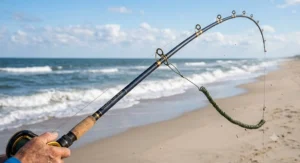
Now we get into rods built for a different conversation entirely. The Tsunami Carbon Shield II Big Bait Conventional exists for one purpose: hauling monster bait out to tarpon, tuna, trophy striped bass, and monster drum without the blank folding under the strain of the fight that follows.
The IM7 graphite blank with D16 Nanotech construction is the headline spec, and here’s what it means in practice — Nanotech resin construction increases a blank’s strength-to-weight ratio significantly compared to standard graphite layups, which is why this rod can stay relatively light in hand while still delivering serious lifting power once a big fish turns and runs. The braid-ready Fuji Fazlite guides, double-wrapped and epoxy-coated, resist the line grooving that heavy fights and abrasive braid cause over time, and the genuine Fuji touch-through palming reel seat is designed specifically for anglers who palm the spool during a fight rather than relying purely on drag — a technique that matters when a fish is genuinely testing your gear.
The hard-vinyl gimbal is a tell: this rod is meant to be used with a fighting belt, which is not something casual surf anglers typically own. Based on the spec sheet, this is a specialist tool, not a general-purpose rod.
Pros:
- ✅ Exceptional lifting power for genuinely large species
- ✅ Nanotech blank keeps weight manageable under load
- ✅ Fighting-belt-ready gimbal for extended battles
Cons:
- ❌ Overkill and underwhelming for typical inshore species
- ❌ Premium price for a narrow use case
Priced in the roughly $220-$300 range, the Tsunami Carbon Shield II Big Bait Conventional is a purpose-built tool — buy it because you’re targeting genuinely big fish, not because the name sounds impressive.
7. PENN Carnage III Surf Conventional — best overall for serious conventional anglers
If there’s a single rod in this roundup that most surf-fishing publications point to as the benchmark conventional pick, it’s the PENN Carnage III Surf Conventional. The standout feature is the SLS3 graphite composite blank — the same blank technology that powers PENN’s well-regarded spinning Carnage III, adapted here for conventional reel seats and heavier casting stress.
That blank buys real stiffness: enough backbone to cast 2 to 4-ounce sinkers beyond 150 yards, according to manufacturer and reviewer testing, which is a genuinely long cast for surf-based gear. The Fuji K-Series guides with SiC inserts keep heavy monofilament or braid running smoothly under load, and the Fuji DPS reel seat locks a conventional reel down tight enough to eliminate the wobble that develops on cheaper reel seats during aggressive retrieves — a small detail that experienced anglers notice immediately when they switch rods mid-session.
Here’s the honest trade-off, based on the spec comparison: at up to 22.5 ounces on the 11-foot model, this is the heaviest rod in the lineup, and that weight is noticeable over a full day of casting. It’s also stiff enough that switching back to a spinning rod afterward feels strange for a session or two. This rod is built for a specific job — targeting large striped bass, cobia, or big bluefish with heavy bait rigs — and it does that job about as well as anything in its price class.
Pros:
- ✅ Genuine 150+ yard casting capability with heavy sinkers
- ✅ Premium Fuji guides and reel seat resist wear
- ✅ Reel seat eliminates wobble during hard retrieves
Cons:
- ❌ Heaviest rod in this roundup at up to 22.5 oz
- ❌ Length makes beach transport awkward without a rod holder
Typically priced in the $250-$350 range, the PENN Carnage III Surf Conventional justifies its position at the top of most “best conventional surf rod” lists for anglers who fish hard and often.
Conventional Surf Rod vs Traditional Spinning Surf Rod
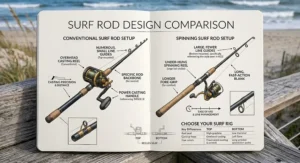
Most surf anglers start on spinning tackle, and plenty never leave it — for good reason. So why does a traditional surf fishing rod paired with a conventional reel keep earning loyalty from experienced anglers? The honest answer is that each system solves a different problem better than the other.
| Category | Conventional Rod System | Spinning Rod System |
|---|---|---|
| Casting Power | Higher — better for max distance & heavy weights | Good, but limited at extreme weights |
| Line Capacity | Higher on comparable reel sizes | Lower for same reel size |
| Learning Curve | Steeper — requires thumb control | Gentler — nearly foolproof |
| Best For | Big bait, big fish, long casts | Beginners, finesse presentations |
Reading that table, the pattern is clear: conventional systems win on raw power and control once you’ve learned to manage the spool, while spinning systems win on forgiveness and ease of use. A conventional reel’s revolving spool design gives it a genuine mechanical edge in casting power and line capacity, but that same free-spinning spool is exactly what causes backlash if your thumb technique isn’t dialed in — which is why conventional gear has a real learning curve that spinning tackle simply doesn’t. As the folks at American Sea Fishing note in their surf rod comparison guide, conventional setups particularly shine for casting large baits and heavy lures the long distances that species like sharks and striped bass often require.
✨ Torn between conventional and spinning? Check current pricing on the rods above and see which fits your budget before deciding.
Practical Usage Guide: Setting Up Your Conventional Surf Rod
Buying the rod is the easy part. Getting it dialed in correctly during the first 30 days is where most new conventional anglers either fall in love with the system or swear it off forever — usually because of preventable mistakes.
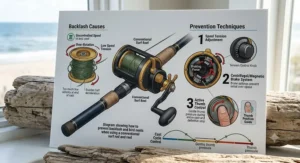
Start by matching reel to rod power honestly; an undersized reel on a heavy-power blank leaves line capacity and drag headroom on the table, while an oversized reel throws off the rod’s balance point during long casting sessions. Once paired, spool your reel with fresh line and immediately practice your thumb control on an open field or empty beach before you ever tie on a hook — backlash on your first real cast, with a hook and sinker attached, is how conventional rods earn a bad reputation they don’t deserve. Set your magnetic or centrifugal brake system on the higher/tighter setting for your first few sessions, then gradually back it off as your thumb timing improves; most beginners set brakes too loose too early and pay for it in tangled line.
Rinse the rod, reel seat, and guides with fresh water after every saltwater session — sand and salt working into a reel seat’s threads is one of the most common, entirely preventable failure points on conventional setups. Inspect your guide inserts every few trips for grooving, since a grooved guide will silently fray your braid until it fails at the worst possible moment.
Real-World Scenarios: Matching Anglers to Big Bait Surf Fishing Setups
Consider three anglers with genuinely different needs, because “best conventional surf rod” depends heavily on who’s asking.
The weekend angler fishing local piers for whiting and small bluefish, on a tight budget, fishing maybe twice a month — this person should look at the Ugly Stik Bigwater Conventional or Daiwa Beefstick BSS1202MHS. Neither rod demands specialized technique, both survive being tossed in a truck bed, and neither requires a meaningful financial commitment to a hobby that’s still being tested out.
The regular surf angler chasing striped bass and bluefish two or three nights a week, ready to commit to the conventional learning curve — this angler fits the PENN Battalion II or Tsunami Trophy II Surf Conventional profile. Both rods reward the practice time a regular angler puts in without demanding the premium price of top-tier gear.
The serious big bait surf fishing angler specifically targeting cobia, large striped bass, or sharks with genuinely heavy bait rigs and long casts — this is where the PENN Carnage III and Tsunami Carbon Shield II Big Bait Conventional justify their price tags. Big bait surf fishing puts real strain on a blank and reel seat that lighter-duty rods simply weren’t engineered to absorb.
Problem → Solution: Fixing Common Conventional Rod Headaches
Backlash on nearly every cast usually traces back to brake settings that are too loose for the angler’s current thumb control — tighten the brake, practice on grass, and loosen gradually as timing improves. A reel seat that feels loose or wobbly after a season typically means sand has worked into the threads; a thorough freshwater rinse and light reel-seat grease usually resolves it, though persistent wobble may point to needing a rod with a better-quality reel seat like the Fuji DPS found on the PENN Carnage III. Guides that groove and fray braided line after heavy use are a durability problem, not a technique problem — inspecting guides regularly and stepping up to one-piece steel guides like PENN’s DURA-GUIDES on the PENN Squadron IV Surf Conventional solves it structurally rather than through maintenance alone. Finally, a rod that feels “dead” or overly stiff for smaller species usually means the power rating is mismatched to your target fish — a heavy-power rod built for big bait surf fishing will feel numb and joyless on small whiting, so match rod power to your actual target species rather than buying the heaviest rod available “just in case.”
How to Choose a Traditional Surf Fishing Rod
- Identify your target species first. A rod built for whiting and a rod built for cobia are not interchangeable, and buying power you don’t need just adds fatigue.
- Match rod length to your beach conditions. Longer rods (11-12 ft) generally cast farther and clear breaking waves better; shorter rods (9-10 ft) offer more control on jetties and piers.
- Check the line and lure rating against your actual rigs. If you regularly fish 4-6 ounce sinkers, a rod rated for 1-3 ounces will fight you all day.
- Prioritize guide quality over guide count. One-piece steel or SiC-insert guides resist grooving far better than budget ceramic inserts under heavy braid use.
- Consider reel seat material honestly. Stainless or Fuji graphite seats resist saltwater corrosion better than lower-grade alternatives, extending real-world rod life.
- Weigh transport and storage realistically. An 11-12 foot rod is a genuine commitment for apartment dwellers or anglers without a truck.
- Budget for the reel at the same time as the rod. A premium blank paired with an undersized reel wastes most of what you paid for.
Common Mistakes When Buying for Heavy Duty Surf Fishing
The most common mistake is buying based on brand reputation alone without checking whether the specific model’s power rating matches the angler’s actual fishing style — a rod built for heavy duty surf fishing on big bait is genuinely miserable for finesse presentations, and vice versa. A close second is skipping the reel-to-rod pairing conversation entirely; a mismatched reel undersells even the best blank on this list. Many first-time buyers also underestimate shipping risk with longer rods — as reviewers of the PENN Squadron IV Surf Conventional noted, inspecting a rod immediately upon arrival catches shipping damage before it becomes a return-window problem. Finally, plenty of anglers assume more guides automatically means better performance, when guide material and construction quality matter considerably more than raw guide count.
What to Expect: Real-World Performance of a Multiplier Reel Surf Rod
Specs on paper rarely translate directly into a “feel,” so here’s the honest version. A properly matched multiplier reel surf rod delivers noticeably more casting distance on heavy rigs than an equivalent spinning setup once your thumb technique is dialed in — reviewers and manufacturers alike point to figures in the 150-yard-plus range for premium blanks like the PENN Carnage III under ideal conditions with 2-4 ounce sinkers. What the spec sheet won’t tell you is the sensory difference during the cast itself: a well-tuned conventional reel gives continuous feedback through your thumb about spool speed, letting you feel a cast going wrong before it becomes a backlash, in a way that a spinning reel’s closed bail system simply can’t replicate. That feedback loop is, according to experienced surfcasters, part of the appeal rather than a downside — it turns casting into an active skill rather than a passive motion.
During an actual fight, the heavier blanks in this lineup transmit less of the fight to your arms and more to the fish, which matters over a long battle with a big striper or cobia. Lighter-power rods like the Ugly Stik Bigwater Conventional, by contrast, telegraph every headshake directly into your hands — exciting on smaller fish, exhausting on bigger ones.
Features That Actually Matter in a Powerful Surf Setup
Marketing copy loves to lead with blank material names, but a genuinely powerful surf setup depends on a shorter list than most listings suggest. Guide quality matters enormously — one-piece steel or SiC inserts resist the line grooving that silently ruins braid over a season, while guide count past a certain point offers diminishing returns. Reel seat construction matters just as much, since a seat that corrodes or loosens undermines even the stiffest blank underneath it. Power and action ratings matter more than length alone; a shorter rod rated correctly for your target species will outperform a longer rod rated incorrectly, every time.
What matters considerably less: cosmetic finish, handle color, and marketing terms like “military-grade” or “aerospace” that describe materials without specifying what those materials actually do differently from a standard composite blank. If a listing leads with adjectives instead of numbers, that’s usually a sign to keep reading rather than keep believing.
Long-Term Cost & Maintenance
A conventional surf rod’s true cost isn’t the sticker price — it’s the sticker price plus however many guide replacements, reel-seat repairs, or premature rod failures happen because of skipped maintenance. Budget rods like the Ugly Stik Bigwater Conventional and Daiwa Beefstick BSS1202MHS carry lower upfront cost but may need guide inspection more frequently under heavy braid use, since their guide materials are built to a lower spec than premium alternatives. Mid-range rods like the PENN Battalion II and Tsunami Trophy II Surf Conventional generally offer the best cost-per-season ratio for anglers fishing multiple times a week, balancing durable components against a price that doesn’t sting if the rod eventually needs replacing.
Premium rods like the PENN Carnage III and Tsunami Carbon Shield II Big Bait Conventional cost more upfront but their higher-grade Fuji components typically last multiple seasons longer under identical conditions, which can make the true cost-per-year lower than it initially appears — provided you’re actually fishing hard enough to justify it. A rod that spends most of the year in the garage doesn’t benefit from premium components the way a rod fished three nights a week does.
Safety, Regulations & Compliance for Surf Anglers
Owning the right rod is only part of responsible surf fishing — knowing the regulations for what you’re targeting matters just as much. Striped bass, one of the most commonly targeted species from conventional surf rods on the Atlantic coast, are currently managed under coastwide slot limits set by the Atlantic States Marine Fisheries Commission, and those limits change by state and by year as the stock recovers from being classified as overfished. Before heading out, check your state’s current regulations directly, since possession limits, slot sizes, and circle-hook requirements vary and are enforced. The ASMFC’s Atlantic Striped Bass management page maintains current coastwide measures, and NOAA Fisheries’ research on striped bass management explains why size and slot limits exist in the first place — useful context if you’ve ever wondered why a fish that looks plenty big to keep still has to go back in the water.
Beyond regulations, basic surf safety applies regardless of which rod you’re carrying: check tide and surf conditions before wading out, never turn your back on breaking waves, and use a properly rated fighting belt if you’re running big bait surf fishing gear like the Tsunami Carbon Shield II Big Bait Conventional, since a large fish on heavy tackle can genuinely pull an unprepared angler off balance.
FAQ
❓ What's the difference between a conventional surf rod and a spinning surf rod?
❓ How long should a conventional surf rod be?
❓ Is a conventional surf rod good for beginners?
❓ What line rating do I need for big bait surf fishing?
❓ How much does a good conventional surf rod cost?
Conclusion
There’s no single “best” conventional surf rod, and honestly, be skeptical of any article that claims otherwise. What exists instead is a genuine range: the Ugly Stik Bigwater Conventional and Daiwa Beefstick BSS1202MHS for anglers testing the waters without a big financial commitment, the PENN Squadron IV Surf Conventional, Tsunami Trophy II Surf Conventional, and PENN Battalion II 12′ Surf Conventional for anglers ready to fish regularly and want durable, balanced gear, and the Tsunami Carbon Shield II Big Bait Conventional and PENN Carnage III Surf Conventional for anglers specifically chasing genuinely large fish with heavy bait rigs.
The honest advice, after all this spec comparison, is simple: buy for the fish you actually target and the frequency you actually fish, not for the rod that sounds most impressive on a shelf. A $90 rod fished three nights a week and rinsed properly will outlast a $300 rod bought on impulse and neglected in a garage corner. Match the tool to the job, take care of it, and the conventional surf rod you choose today should still be bending into fish for years to come.
Recommended for You
- 9 Foot Surf Rod: 7 Real Picks for 2026 (Compact & Powerful)
- 12 Foot Surf Casting Rod: 7 Top Picks for Distance in 2026
- 10 Foot Surf Rod: 7 Best Picks for Every Budget in 2026
Disclaimer: This article contains affiliate links. As an Amazon Associate, I earn from qualifying purchases. If you purchase products through these links, we may earn a small commission at no additional cost to you.
✨ Found this helpful? Share it with a fellow surf angler! 🎣💬
