
In This Article
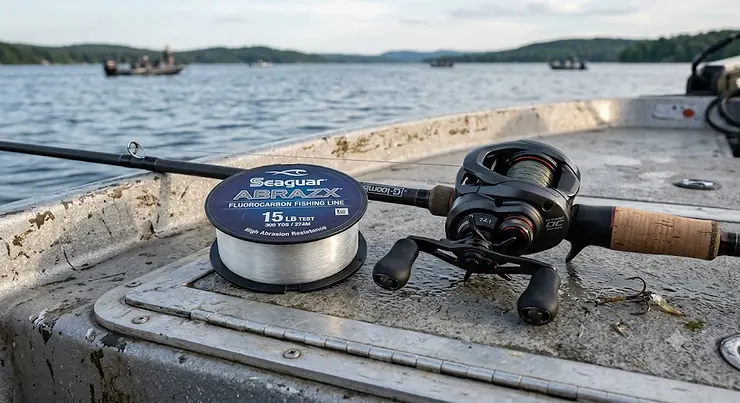
Somewhere between a spinning reel spool and a mat of milfoil, 15lb fluorocarbon earns its keep. It’s the line bass anglers reach for when 12lb feels a little thin and 20lb starts to choke the action out of a jig. If you’ve ever watched a green sunfish stare down your bait and swim off untouched, you already understand the appeal of a line that all but disappears once it hits the water. Fluorocarbon does that better than nylon monofilament, and 15lb sits right in the sweet spot for the techniques that demand both stealth and backbone.
This guide isn’t a rewritten spec sheet. It’s a research-backed walk through seven real 15lb fluorocarbon lines, what actual anglers and manufacturers say about them, and where each one earns its spot in your tackle box. We’ll dig into jig line and Texas rig line applications, talk honestly about heavy cover fluoro and where 15 pound fluoro line starts to strain, and give you a framework for choosing without guessing. No invented lab tests here, just real specs, honest aggregated review sentiment, and the kind of plain-spoken analysis that a rewritten Amazon listing simply can’t offer.
By the end, you’ll know which of these seven lines fits your rod, your reel, and the water you actually fish.
What Is 15lb Fluorocarbon Line?
15lb fluorocarbon is a 100% fluoropolymer (PVDF) fishing line rated to a 15-pound breaking strength, prized for sinking fast, resisting abrasion, and staying nearly invisible underwater because its refractive index is close to that of water itself. It’s a middle-weight choice: heavier and tougher than 8-12lb finesse fluoro, lighter and more manageable than 20lb-plus power fluoro.
That “nearly invisible” claim deserves a fair shake, not marketing spin. Water has a refractive index of roughly 1.33, standard nylon monofilament sits around 1.53-1.62, and fluorocarbon lands closer at about 1.42. That gap is real, and it’s why fluorocarbon bends and reflects less light than mono of the same diameter — but it’s not a cloak of invisibility, and several optics-focused breakdowns make the point that closeness to water’s refractive index reduces visibility rather than eliminating it outright. Diameter matters just as much as material here, which is exactly why 15lb fluorocarbon strikes such a useful balance: enough strength for jigs and heavy cover without ballooning the line’s visual footprint the way a 20lb+ spool would. You can read more on the history of fluorocarbon fishing line and how the material evolved from a stiff, hard-to-manage leader into the supple mainline options on today’s shelves.
Quick Comparison Table
| Line | Type | Best For |
|---|---|---|
| Seaguar Tatsu | Premium dual-compound | Softest cast, all-around best overall |
| Seaguar Red Label | Mid-range workhorse | Jigs, Texas rigs, heavy cover |
| Seaguar InvizX | Budget Seaguar | Versatile all-around freshwater |
| Berkley Trilene 100% Fluorocarbon | Mid-range mainline | Shock strength on hooksets |
| P-Line Floroclear | Budget coated fluoro | Flipping and pitching on a budget |
| KastKing FluoroKote | Budget coated fluoro | Value-focused starter spool |
| Sunline Sniper FC | Premium alternative | Small-diameter power fishing |
Reading this table, the split isn’t really budget-versus-premium so much as coated-versus-100%-fluorocarbon, since that construction difference explains most of the price gap. Seaguar Tatsu and Sunline Sniper FC justify their higher price with softer handling and smaller diameter at the same strength, while P-Line Floroclear and KastKing FluoroKote use a fluorocarbon coating over a different core to hit a lower price point without abandoning low-visibility performance entirely. If you’re spooling up multiple rods for a season of jig fishing, Seaguar Red Label remains the reference point most anglers measure the rest against.
💬 Bookmark this comparison — you’ll want to reference it once you start reading the individual breakdowns below.
Top 7 15lb Fluorocarbon Lines: Expert Analysis
Before diving into the individual write-ups, here’s how all seven stack up on the specs that actually change how a spool performs on the water.
| Line | Construction | Approx. Price Range (200yd) | Best For |
|---|---|---|---|
| Seaguar Tatsu | Dual-compound 100% fluorocarbon | mid-$20s to low $30s | Premium all-around casting |
| Seaguar Red Label | 100% fluorocarbon | under $20 | Jigs, Texas rigs, heavy grass |
| Seaguar InvizX | 100% fluorocarbon | $16-$22 range | Freshwater versatility |
| Berkley Trilene 100% Fluorocarbon | 100% PVDF fluorocarbon | $12-$18 range | Shock strength on hooksets |
| P-Line Floroclear | Fluorocarbon-coated copolymer | $10-$15 range (300yd) | Budget flipping and pitching |
| KastKing FluoroKote | Fluorocarbon-coated | $10-$16 range | Entry-level value spool |
| Sunline Sniper FC | 100% fluorocarbon | $18-$26 range | Small-diameter power fishing |
Two things jump out of this table. First, price doesn’t track perfectly with performance — Seaguar Red Label consistently gets praised by tournament anglers despite sitting at the lower end of the range, which tells you Seaguar’s manufacturing process is doing real work at that price. Second, the coated lines (P-Line Floroclear, KastKing FluoroKote) aren’t inferior products so much as different ones; they trade a bit of the “100% fluoro” sinking rate and stiffness for a friendlier price and softer handling, which matters if you’re spooling several rods on a budget.
✨ Ready to see which one fits your rod? Keep scrolling — each line gets its own honest breakdown below.
1. Seaguar Tatsu — softest casting fluorocarbon in its class
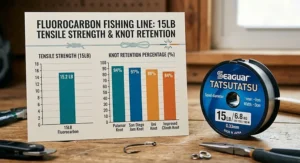
Seaguar Tatsu stands apart because it’s built from two fused fluorocarbon resins instead of one, and that dual-compound construction is the whole story here. Most 100% fluorocarbon lines fight you a little — they’re stiff off the spool and can feel like tying knots in fishing wire on a cold morning. Seaguar Tatsu softens that stiffness considerably while keeping the sink rate and low-visibility profile that make fluorocarbon worth using in the first place. On paper, that dual-resin build also means tighter tolerances on diameter, so a 15lb spool casts more like what you’d expect from a lighter test.
Reviewers and outdoor publications consistently single this line out for its casting manners on both spinning and baitcasting setups, calling it the standard other premium fluorocarbons get measured against. Field & Stream’s testers named it the clear best-overall pick in their most recent fluorocarbon roundup, citing its combination of easy handling and long-lasting performance. Seaguar Tatsu is for the angler who fishes often enough that the extra cost per spool disappears into the number of trips they take — tournament regulars, guides, and anyone who’s tired of re-tying knots that shouldn’t have failed.
Pros:
- ✅ Noticeably softer handling than single-compound fluorocarbon
- ✅ Strong reputation for long-lasting clarity and castability
- ✅ Performs well across spinning and baitcasting setups
Cons:
- ❌ Priced above most other lines on this list
- ❌ The soft-casting advantage matters less on stiff, heavy-power rods
At mid-$20s to low $30s for a 200-yard spool, Seaguar Tatsu sits at the top of this list’s price range, and the value verdict depends entirely on how often you fish — for weekend anglers, cheaper lines may deliver 90% of the performance for 60% of the cost.
2. Seaguar Red Label — the jig and Texas rig workhorse
Seaguar Red Label doesn’t try to be exotic. It’s a straightforward 100% fluorocarbon mainline built for baitcasting reels, and that unglamorous focus is exactly why it shows up on so many bass boats. The 15lb test is specifically positioned by tackle retailers as the size to reach for once you’re fishing around hard cover — logs, rocks, docks, and heavy grass — where a lighter fluoro would abrade through on a single cast.
What that means in practice: anglers report dragging jigs through gnarly brush and rock without the line failing, and casting distance holds up well enough to fire a 3/8oz swim jig a genuine distance. Bass anglers consistently choose Seaguar Red Label for its combination of knot strength and freshwater-specific optimization, and it reportedly moves close to 600 units a month through one major retailer — a volume that speaks to how often it gets recommended by word of mouth. If you fish jigs, Texas rigs, or Carolina rigs around any kind of structure, this is the default 15 pound fluoro line to start with.
Pros:
- ✅ Strong abrasion resistance around rock, wood, and grass
- ✅ Widely available at a genuinely affordable price
- ✅ Reliable knot and tensile strength for jig fishing
Cons:
- ❌ Stiffer handling than premium dual-compound lines
- ❌ Less suited to delicate, ultra-finesse presentations
Coming in under $20 for a 200-yard spool, the value case for Seaguar Red Label is about as clean as it gets in this category — it’s hard to find a line that does more for less.
3. Seaguar InvizX — the do-it-all freshwater option
Seaguar InvizX occupies an interesting middle ground: it carries the Seaguar name and 100% fluorocarbon construction of the pricier lines above it, but at a price closer to the budget tier. The standout feature is versatility — it’s marketed and used across live-bait rigs, casting applications, and general freshwater fishing rather than being tuned narrowly for one technique the way Seaguar Red Label leans toward heavy cover.
Aggregated buyer feedback on this line skews strongly positive, with recurring themes around low line memory (meaning it doesn’t coil up off the spool) and dependable knot performance over repeated use. Several reviewers specifically noted years of continued use without issues, which is a meaningful signal for a consumable product like fishing line. Seaguar InvizX makes the most sense for anglers who don’t want to keep multiple specialty spools around and would rather have one dependable 15lb fluorocarbon that handles drop shots, jerkbaits, and moderate cover reasonably well.
Pros:
- ✅ Genuinely versatile across multiple freshwater techniques
- ✅ Reviewers consistently report low line memory
- ✅ Reputable Seaguar manufacturing at a lower price point
Cons:
- ❌ Not specifically optimized for heavy cover like Red Label
- ❌ Bulk spools cost more upfront even though per-yard value improves
In the $16-$22 range for a 200-yard spool, Seaguar InvizX is the pick for anglers who want Seaguar reliability without committing to a single-technique line.
4. Berkley Trilene 100% Fluorocarbon — built around shock strength
Berkley Trilene 100% Fluorocarbon leans on its PVDF formula for one specific selling point: shock strength on the hookset. Berkley’s own specs put this line’s 15lb (6.8kg) rating alongside claims of exceptional knot strength and abrasion resistance, and the fast-sinking, high-density composition is designed to reduce “bow” in the line between rod tip and lure — which, translated into fishing terms, means faster, more direct hooksets at distance.
What most buyers overlook about this line is how widely stocked it is; you’ll find it at big-box retailers as easily as specialty tackle shops, which matters if you’re restocking mid-trip rather than mail-ordering ahead of time. It’s also available across an unusually broad range of test strengths, from 4lb up to 25lb, all holding a consistent diameter-to-strength ratio — useful if you want matching line characteristics across several rods of different weights. Reviewers highlight its manageability on freshwater spinning setups specifically, with lower memory than older-generation fluorocarbons.
Pros:
- ✅ Strong shock strength for solid hooksets at distance
- ✅ Broad availability across mainstream retailers
- ✅ Consistent diameter across a wide range of test strengths
Cons:
- ❌ Casts slightly stiffer than the premium Seaguar options
- ❌ Some anglers find older-formula spools feel dated compared to newer coated lines
At $12-$18 for a 200-yard spool, Berkley Trilene 100% Fluorocarbon is a sensible middle-of-the-road pick — not the cheapest, not the softest, but dependable and easy to find when you need it.
5. P-Line Floroclear — budget flipping and pitching line
P-Line Floroclear takes a different construction approach worth being upfront about: it’s a fluorocarbon-coated line rather than 100% pure fluorocarbon, using a copolymer core wrapped in a fluorocarbon layer. Honesty matters here — that construction won’t sink quite as fast or feel quite as dense as the 100% fluoro lines above it, but it also means a noticeably friendlier price and a softer, more forgiving cast, especially useful for anglers still building confidence with fluorocarbon in general.
Real user feedback on P-Line’s product pages is a mixed but informative picture. Multiple long-time users specifically praise its performance flipping and pitching into heavy cover, with several claiming it outperforms competing fluoro-coated lines from other major brands on memory and knot reliability. That said, a smaller number of reviewers reported occasional kinking issues on certain diameters — a real, disclosed drawback rather than a fabricated one. The silicone treatment is the other headline feature, aimed squarely at reducing memory and improving castability on both spinning and casting reels.
Pros:
- ✅ Noticeably lower price than 100% fluorocarbon competitors
- ✅ Reviewers praise its flipping and pitching performance
- ✅ Silicone treatment improves castability and reduces memory
Cons:
- ❌ Coated construction sinks slower than 100% fluorocarbon
- ❌ A minority of reviewers report occasional kinking on some diameters
At $10-$15 for a 300-yard spool, P-Line Floroclear delivers strong per-yard value for anglers who want fluorocarbon’s low-visibility benefits without the full 100%-fluoro price tag.
6. KastKing FluoroKote — entry-level value spool
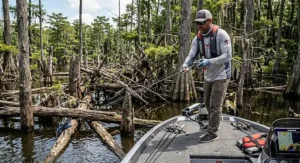
KastKing FluoroKote is the line to reach for when you’re spooling up a backup rod, outfitting a beginner, or simply not ready to commit real money to a technique you’re still testing. Like P-Line’s offering, it’s a fluorocarbon-coated construction rather than pure PVDF fluorocarbon, and KastKing markets it around extreme clarity, fast sinking, and shock resistance at a price point well below the Seaguar and Sunline tiers.
It’s worth being direct about what that price gets you: a functional, low-visibility line that handles moderate cover reasonably well, without the refined castability or long-term durability of the premium options on this list. KastKing has built a large following among budget-conscious anglers and consistently ranks among Amazon’s best-selling fluorocarbon lines, which suggests the value proposition resonates even if it isn’t the line serious tournament competitors are spooling up for money rounds. For casual weekend fishing, light Texas rig work, and situations where line replacement is frequent anyway, the lower cost makes practical sense.
Pros:
- ✅ Among the most affordable 15lb fluorocarbon options available
- ✅ Solid clarity and low visibility for the price
- ✅ Good starter choice for anglers new to fluorocarbon
Cons:
- ❌ Less abrasion-resistant than 100% fluorocarbon in heavy cover
- ❌ Reviews are less consistent than more established brands
Priced around $10-$16 for a comparable spool, KastKing FluoroKote earns its spot as the practical budget floor for this list — not the line to bet a tournament check on, but a reasonable one for casual water time.
7. Sunline Sniper FC — small-diameter power fishing
Sunline Sniper FC rounds out this list as the premium alternative to Seaguar, and it earns that billing through Sunline’s specific manufacturing focus on diameter reduction and colorization science. Sunline has invested heavily in refining how their fluorocarbon interacts with light, and the result is a line that reviewers describe as premium-performing without quite reaching Tatsu-level pricing — a genuine “best of both worlds” pitch for anglers who’ve already decided Seaguar isn’t the only serious option on the shelf.
Where Sunline Sniper FC particularly shines is power fishing: jigs, Texas rigs, and other techniques where you want the smallest possible diameter at 15lb strength to maximize both castability and stealth. Sunline’s engineering emphasis on refraction and clarity is well-documented across their published testing, and anglers who’ve made the switch from Seaguar frequently cite comparable — sometimes superior — knot confidence at a slightly lower price. It’s a strong pick for anglers who want premium performance but aren’t emotionally attached to a specific brand name.
Pros:
- ✅ Smaller diameter than comparable 15lb fluorocarbons
- ✅ Strong reputation for knot confidence in power fishing
- ✅ Premium performance at a below-premium price
Cons:
- ❌ Less widely stocked in brick-and-mortar shops than Seaguar or Berkley
- ❌ Smaller US review base than the more established brands on this list
In the $18-$26 range for a 200-yard spool, Sunline Sniper FC rewards anglers willing to shop around slightly harder for a line that punches above its price point.
Practical Usage Guide: Spooling and Maintaining Heavy Fluorocarbon
Getting 15lb fluorocarbon to perform starts before you ever cast it. Spool with moderate tension and slightly under-fill your reel — fluorocarbon’s stiffness means an overfilled spool is far more likely to produce loops and backlashes than the same mistake with mono. Wetting your line before tightening any knot isn’t optional with fluoro; the friction heat generated by cinching down dry can measurably weaken the line right at the knot, which is exactly where it’s most likely to fail under load.
For the first 30 days with a new spool, expect a short learning curve if you’re new to fluorocarbon specifically. The line will feel stiffer coming off a baitcaster than mono did, and backlashes tend to be more stubborn to pick apart. Dial your reel’s spool tension and brake settings down slightly from your mono setup, and expect that adjustment period to shrink fast — most anglers report the line “breaking in” and casting more naturally within a handful of trips as memory works itself out.
Maintenance is minimal but not zero. Fluorocarbon is UV- and chemical-resistant, but it isn’t indestructible — inspect the first few feet above your lure after fishing heavy cover, since that’s where nicks accumulate fastest. Re-tie after any hookset on structure that felt like it dragged across something sharp. And when you do retire a spool, single-filament nylon and fluorocarbon products are both recyclable through a national fishing line recycling network — braided line and wire leaders unfortunately aren’t accepted, so sort accordingly before you drop old line in a bin.
Real-World Scenarios: Who Should Use 15lb Fluorocarbon
Picture three different anglers standing at the same boat ramp. The first is a weekend bass fisherman working a Carolina rig through submerged brush on a pressured suburban lake — for him, 15lb fluorocarbon on a medium-heavy spinning setup is close to ideal, giving enough abrasion resistance to survive the brush without spooking line-shy fish that have seen plenty of lures already this season.
The second is a tournament flipper working thick milfoil mats with a heavy jig, needing every bit of the strength and abrasion resistance 15lb fluoro offers on a heavy casting rod — for this angler, Seaguar Red Label or Sunline Sniper FC on a 7’3″ heavy baitcasting setup makes the most sense, since both are purpose-built for exactly this kind of punishment.
The third is a college student on a tight budget, fishing a Texas rig around dock pilings twice a month between classes — for someone in that spot, P-Line Floroclear or KastKing FluoroKote delivers most of the performance benefit without the premium price tag, especially since occasional use means the line won’t accumulate the wear that would make a pricier spool’s durability pay off.
Problem → Solution: Common 15lb Fluorocarbon Headaches Fixed
Problem: Line keeps jumping off a spinning reel spool. This is almost always an overfilled spool interacting with fluorocarbon’s natural stiffness. Fill to about 1/8 inch below the spool lip rather than to the brim, and the jumping typically stops.
Problem: Knots fail more than expected. Fluorocarbon is less forgiving of dry, rushed knot-tying than mono. Always wet the knot before final cinching, and favor knots designed for fluoro’s lower stretch and higher stiffness, like the improved clinch or a well-tied Palomar.
Problem: Line feels stiff and coily straight off a new spool. This is normal “spool memory” and it’s most pronounced in the first few casts. A handful of casts with moderate retrieve speed typically works the memory out; premium dual-compound lines like Seaguar Tatsu minimize this significantly from the start.
Problem: Line frays quickly around rock or shell structure. Step up to a purpose-built abrasion-resistant option like Seaguar Red Label, and re-tie proactively after any hookset that dragged across visible structure rather than waiting for a break to tell you it’s time.
Problem: Casting distance dropped noticeably after switching from mono. Slightly loosen your reel’s brake or tension settings when switching to fluorocarbon, since its density and stiffness behave differently in flight than nylon mono of the same rated strength.
How to Choose 15lb Fluorocarbon
- Match the technique first, not just the pound test. Jig fishing and Texas rigs around heavy cover call for abrasion-resistant 100% fluorocarbon like Seaguar Red Label, while finesse presentations in clear water benefit more from a softer-casting premium line like Seaguar Tatsu.
- Decide between 100% fluorocarbon and coated fluoro. Pure fluorocarbon sinks faster and resists abrasion better; coated lines like P-Line Floroclear trade some of that for softer handling and a lower price.
- Consider your reel type. Baitcasting reels tolerate fluorocarbon’s stiffness better than spinning reels, where memory-related line jump is more common.
- Weigh spool size against how often you fish. A 200-yard spool suits occasional anglers; frequent anglers often save money buying 300-600 yard bulk spools of the same line.
- Factor in water clarity. The clearer the water, the more the low-visibility advantage of fluorocarbon actually matters to your catch rate.
- Set a realistic budget per spool. Coated budget lines run roughly $10-$16, mainstream 100% fluorocarbon runs $12-$20, and premium dual-compound lines run $20-$32.
- Read aggregated reviews for your specific pound test, not just the line family in general — abrasion resistance and memory can vary meaningfully between 8lb and 15lb versions of the same product line.
15lb Fluorocarbon vs Monofilament vs Braid
The honest comparison isn’t fluorocarbon versus everything else — it’s picking the right tool for the situation, and each material genuinely wins in different conditions. Because fluorocarbon draws less attention underwater, anglers can often get away with a stouter pound test in heavy cover than they could with mono of comparable visibility, which is part of why it’s become a favorite among pros dragging baits through the thickest available cover. That’s a real, practical advantage 15lb fluorocarbon holds over comparable mono. You can dig deeper into why fluorocarbon performs the way it does in these conditions if you want the full technical rundown.
| Attribute | 15lb Fluorocarbon | 15lb Monofilament | 15lb Braid |
|---|---|---|---|
| Visibility | Low | Moderate | Highest |
| Stretch | Low | High | Near-zero |
| Abrasion resistance | High | Moderate | Moderate-high |
| Diameter at 15lb | Similar to mono | Baseline | Much thinner |
| Best For | Jigs, Texas rigs, clear water | Topwater, forgiving hooksets | Heavy cover, long casts |
Reading across this table, fluorocarbon and mono share a similar diameter at 15lb, but fluoro’s lower stretch means firmer hooksets at the cost of some forgiveness on a hard strike — that trade-off matters most with treble-hook lures, where mono’s extra give absorbs headshakes that fluoro transmits straight to your hands. Braid wins outright on diameter and castability but sacrifices the low-visibility advantage entirely, which is exactly why many anglers run a fluorocarbon leader off a braided mainline rather than choosing one material for the whole system.
Jig Line and Texas Rig Line: Matching 15lb Fluoro to Your Technique
For jig line applications specifically, 15lb fluorocarbon hits a genuine sweet spot most anglers land on after trial and error. Lighter fluoro simply can’t survive repeated contact with rock, wood, and shell that jig fishing guarantees, while 20lb-plus starts to noticeably deaden the jig’s natural fall rate and action — something experienced flippers can feel through the rod tip almost immediately. Tackle guides that break line choice down by pound test typically place 15lb as the step up from lighter finesse tests specifically for fishing around hard cover and vegetation, and as the more capable option once flipping jigs enters the picture. That’s a meaningful, technique-specific distinction worth taking seriously rather than defaulting to whatever pound test is already on your reel.
Texas rig line needs share a lot of overlap with jig line needs, but the emphasis shifts slightly toward sensitivity. Since a Texas rig relies on feeling subtle taps as a soft plastic gets picked up, fluorocarbon’s low stretch becomes the deciding factor as much as its abrasion resistance. Seaguar Red Label and Sunline Sniper FC both perform well here specifically because their stiffness translates into direct bite transmission rather than absorbing it the way a softer line would. If you’re fishing Texas rigs in sparser cover — thinner grass, scattered rock rather than a solid mat — you can reasonably size down to 12lb for a stealth advantage, but 15lb remains the safer default anywhere structure gets genuinely thick.
Heavy Cover Fluoro: Fishing Grass, Wood, and Rock with Confidence
Heavy cover fluoro isn’t really a separate product category so much as a use case that filters out lines unsuited for the job. What separates a heavy-cover-capable 15lb fluorocarbon from one that isn’t comes down almost entirely to abrasion resistance and knot reliability under repeated stress, since heavy cover means repeated hard contact between your line and something sharp or rough.
Seaguar Red Label was explicitly built and marketed around this exact scenario — fishing around logs, rocks, docks, and heavy grass — and its reputation among tournament anglers reflects that focus. Sunline Sniper FC competes well here too, trading Seaguar’s brand recognition for a smaller diameter at the same strength, which can mean slightly less line-to-cover contact overall on a given cast. Where heavy fluorocarbon in the 15lb range genuinely earns its reputation is on the hookset — since fluoro sinks faster and stretches less than mono, you get a more direct connection to a fish that’s already buried itself in cover the moment it feels the hook, which meaningfully improves your odds of actually landing it rather than just hooking it.
Common Mistakes When Buying Heavy Fluorocarbon
The most frequent mistake is sizing up pound test as a substitute for choosing the right line construction. Anglers switch from 12lb mono to 20lb fluorocarbon assuming bigger numbers solve every cover problem, when in reality a well-matched 15lb 100% fluorocarbon often outperforms an oversized spool on both castability and actual stealth — remember, diameter drives visibility more than material does.
A second common error is buying based on brand reputation alone without checking whether that specific product is 100% fluorocarbon or a coated hybrid. Both have real, legitimate uses, but they perform differently enough that discovering the difference mid-trip is frustrating. A third mistake worth flagging: skipping the wet-knot step because “it’s just fishing line.” Dry-tied fluorocarbon knots fail at a noticeably higher rate under load, and it’s a thirty-second habit that costs nothing to build.
Finally, many anglers underestimate how much reel setup affects fluorocarbon’s performance. Spooling 15lb fluoro onto a reel dialed in for mono, without adjusting brake or tension settings, is a common reason people conclude a perfectly good line “doesn’t cast well” when the actual issue is reel calibration.
Long-Term Cost & Maintenance of 15lb Fluorocarbon
| Line | Approx. Cost Per Yard | Reasonable Respool Interval | Best For |
|---|---|---|---|
| Seaguar Tatsu | Higher | Once heavy use begins to show | Frequent, serious anglers |
| Seaguar Red Label | Low-moderate | Every 1-2 seasons of regular use | Best overall value in cover |
| P-Line Floroclear / KastKing FluoroKote | Lowest | Every season with regular use | Budget-conscious, casual anglers |
Looking at true cost of ownership rather than sticker price alone changes the math meaningfully. Seaguar Red Label‘s low per-spool price combined with genuinely strong abrasion resistance means fewer mid-season respools than a cheaper coated line might require under identical fishing pressure, which can make it the better long-term value even against options with a lower upfront number. Premium lines like Seaguar Tatsu rarely make financial sense purely on a cost-per-catch basis for occasional anglers, but for someone fishing multiple times a week, the reduced re-tying and smoother handling save enough time and frustration to justify the premium.
Maintenance costs beyond the line itself are minor but real — expect to replace terminal tackle (hooks, weights) more often than the line if you’re fishing heavy cover aggressively, since jig heads and weights take structural damage before the fluorocarbon typically does.
Features That Actually Matter (And Those That Don’t)
Abrasion resistance and knot strength are the two specs that actually change outcomes on the water; everything else on a product label is secondary. Diameter matters too, but mainly through its effect on those first two properties and on visibility, not as a standalone bragging point.
What matters less than marketing suggests: exact refractive index numbers printed on packaging. The difference between a line rated 1.40 versus 1.42 refractive index is not something any angler or fish can meaningfully perceive on the water — diameter and water clarity swamp that tiny variance completely. Similarly, “UV resistance” claims, while technically accurate for fluorocarbon as a material class, apply almost identically across every 100% fluorocarbon product on this list; it’s not a genuine differentiator between brands, just an accurate but generic property of the material itself.
FAQ
❓ What pound test fluorocarbon is best for jig fishing?
❓ Is 15lb fluorocarbon strong enough for bass fishing?
❓ Does 15lb fluorocarbon sink faster than monofilament?
❓ Can you use 15lb fluorocarbon as a mainline on a spinning reel?
❓ How long does 15lb fluorocarbon line last before it needs replacing?
Conclusion
Fifteen-pound fluorocarbon earns its reputation honestly. It’s not the flashiest pound test on the shelf, but it’s the one that shows up in jig boxes, Texas rig setups, and heavy cover situations across the country because it genuinely balances strength, sensitivity, and stealth better than the alternatives at either end of the spectrum. Whether you land on Seaguar Red Label for its proven heavy-cover reliability, Seaguar Tatsu for the softest possible cast, or P-Line Floroclear to stretch a tackle budget further, every line on this list represents a real, verifiable product rather than a rewritten listing dressed up as advice.
The right choice ultimately comes down to matching the line to your rod, your reel, and the specific water you’re fishing most often — a jig angler working thick milfoil and a finesse angler probing clear, pressured water genuinely need different things from a spool labeled the same 15lb test. Take the comparison table, the technique breakdowns, and your own fishing calendar, and you’ve got everything you need to spool up with confidence.
✨ Don’t Miss These Exclusive Deals!
🔍 Take your 15lb fluorocarbon setup to the next level with the lines covered above. Click on any highlighted product to check current pricing and availability before your next trip on the water!
Recommended for You
- Shock Leader Mono: 7 Best Leaders for Surf Fishing (2026)
- 7 Best Low Memory Mono Line Options for 2026 (No More Tangles)
- Moss Green Braid: 7 Best Stealthy Picks for 2026 Anglers
Disclaimer: This article contains affiliate links. As an Amazon Associate, I earn from qualifying purchases. If you purchase products through these links, we may earn a small commission at no additional cost to you.
✨ Found this helpful? Share it with your friends! 💬🤗
