
In This Article
Somewhere between “this line is way too thin to hold a hog out of the grass” and “why does my spool look like it survived a bar fight,” most anglers eventually land on 30lb braided line. It’s the workhorse test — heavy enough to bully bass out of matted vegetation, light enough that it doesn’t cast like a garden hose. 30lb braided line is a woven polyethylene fishing line rated to roughly 30 pounds of breaking strength, prized for its thin diameter, near-zero stretch, and the kind of raw pulling power monofilament simply can’t match at the same size. If you’ve ever watched a spinning reel bury itself in 20lb mono while a largemouth bass drags your jig into a stump field, you already understand the appeal.
This guide skips the marketing fluff and gets into what actually separates one spool of braid from another. We researched real, currently available products, dug into aggregated review sentiment (not invented quotes), and broke down where each line earns its keep — bass boats, surf rigs, inshore skiffs, or the garage tackle box of someone who just wants line that doesn’t snap on the first good hookset. Braid itself is built from ultra-high-molecular-weight polyethylene fibers, a material family originally developed for industrial and marine rope applications before fishing line manufacturers figured out how to weave it into something you could spool on a Shimano.
Whether you’re chasing largemouth in flooded timber, redfish around oyster bars, or just tired of respooling every season, the right 30lb braid changes how your whole rig performs — casting distance, hookset speed, and how confidently you can horse a fish away from cover before it wraps you around a dock piling.
Quick Comparison Table
| Line | Best For | Strand Count | Price Range (150yd) |
|---|---|---|---|
| Sufix 832 Advanced Superline | All-around abrasion resistance | 8-strand | $15-$25 |
| PowerPro Spectra Braided Line | Proven all-purpose value | 4-strand (round) | $10-$20 |
| Daiwa J-Braid X8 Grand | Flipping and punching heavy cover | 8-strand | $20-$30 |
| Seaguar Smackdown | Grass fishing with a leader | 8-strand | $15-$25 |
| KastKing SuperPower Silky8 | Budget-friendly beginners | 8-strand | $9-$15 |
| Reaction Tackle Braided Line | Bulk spools, saltwater trolling | 4/8-strand options | $9-$16 |
| Berkley X9 | Smooth casting and knot strength | 9-strand | $16-$26 |
A quick scan tells the real story: strand count and price climb together, but not in a straight line. Sufix 832 Advanced Superline and Daiwa J-Braid X8 Grand justify their higher price with genuinely different abrasion-resistant construction, while KastKing SuperPower Silky8 and Reaction Tackle Braided Line prove you don’t need to spend $25 to get a serviceable 30lb braid for weekend fishing. Notice that price ranges vary by retailer, yardage, and color — always check current pricing before buying, since Amazon listings fluctuate more than a bass boat’s fuel gauge.
💬 Found a favorite in this list already? Save this guide before you keep scrolling — you’ll want it when you’re standing in the tackle aisle later.
op 7 30lb Braided Lines: Expert Analy
1. Sufix 832 Advanced Superline — best all-around abrasion resistance
The name isn’t marketing filler — it’s literally the construction: 8 fibers, 32 weaves per inch. That density matters more than it sounds like it should, because tighter weaves mean a rounder line profile, and a rounder profile means less friction ripping through your rod guides on every cast. The build combines seven HMPE fibers with one GORE performance fiber, a combination Sufix uses specifically to boost abrasion resistance without ballooning the diameter. In practice, that means this line shrugs off contact with rocks, dock pilings, and boat hulls better than most 4-strand braids in the same test weight.
Based on the spec comparison, this is the braid built for anglers who fish structure aggressively rather than open water. Reviewers consistently report that 832 holds up over months of saltwater use without thinning or going fuzzy — a common failure mode with cheaper 8-strand braids — though a recurring, minor complaint is that the color fades faster than the line itself degrades. One practical note worth repeating: this braid is tough enough that fingernail clippers won’t cut it cleanly, so keep actual line scissors in the boat.
Pros:
- ✅ Exceptional long-term abrasion resistance in saltwater
- ✅ Round, quiet profile casts smoothly through guides
- ✅ Knot strength holds up well once properly wetted
Cons:
- ❌ Color fades noticeably faster than the line wears out
- ❌ Requires sharp line scissors, not household clippers
At around $15-$25 for a 150-yard spool, it sits mid-to-premium — a reasonable price for anglers who fish rocky or grassy structure weekly and don’t want to respool every month.
2. PowerPro Spectra Braided Line — most proven all-purpose value
PowerPro has been a household name in braided line since the technology went mainstream, and the 30lb Spectra version explains why. It uses Enhanced Body Technology (EBT) to keep the line round and manageable, which solves the classic early-braid complaint of lines that dig into the spool and cause wind knots on a hard hookset. What most buyers overlook about this model is that its round profile isn’t just a casting perk — it also distributes tension more evenly across the spool, reducing the chance of line burying itself under pressure.
Aggregated customer sentiment on this line is overwhelmingly positive, with ratings frequently sitting between 4.5 and 5 stars across hundreds of reviews on major retail sites. That said, a smaller number of anglers have reported occasional bad batches — line that felt weaker than rated or started fraying unusually fast — a quality-control inconsistency worth knowing about even if it isn’t the norm. For most buyers, this remains one of the most dependable “just spool it and fish” options on the market.
Pros:
- ✅ Round profile resists digging into the spool
- ✅ Long track record with a huge review base
- ✅ Wide range of colors and yardage options
Cons:
- ❌ Occasional reports of inconsistent batches
- ❌ Less abrasion-resistant than premium 8-strand builds
Price runs roughly $10-$20 for 150 yards depending on color and retailer, making it one of the better value-per-yard options in this roundup.
3. Daiwa J-Braid X8 Grand — best for flipping and punching heavy cover
This is the line anglers reach for when the plan is “put the bait directly into the nastiest cover on the lake.” Daiwa builds the X8 Grand from Izanas fiber, a proprietary polyethylene material the company claims delivers meaningfully better abrasion resistance than standard 4-carrier braid. Here’s what the spec sheet won’t tell you outright, but reviewers consistently note: the 8-carrier construction makes this line noticeably rounder and quieter through the guides than older Daiwa braids, which translates to smoother pitches and flips when you’re working a jig into brush at close range.
Reviewers who fish it for frog fishing and flipping heavy mats report punching tungsten weights through vegetation without break-offs — exactly the scenario this line is engineered for. It’s not the cheapest option here, but based on the spec comparison, the Izanas fiber and 8-carrier weave genuinely differentiate it from budget braids rather than just repackaging the same PE fiber under a fancier name.
Pros:
- ✅ Excellent abrasion resistance for punching cover
- ✅ Smooth, round profile with minimal line noise
- ✅ Color holds up well over repeated use
Cons:
- ❌ One of the pricier options in this roundup
- ❌ Overkill for light finesse or open-water applications
Expect to pay in the $20-$30 range for 150 yards — a premium price, but one that fits its role as a dedicated flipping line for serious cover fishing.
4. Seaguar Smackdown — best for grass fishing with a fluorocarbon leader
Smackdown built its reputation on being thin for its rated strength, which matters a lot when you’re threading line through matted grass or trying to squeeze a few extra yards of casting distance out of a spinning reel. Anglers who fish with a fluorocarbon leader consistently praise how cleanly this line ties leader-to-braid knots, and its high-visibility yellow colorway is noted for fading far more slowly than competing brands — a genuinely useful trait for anyone tracking subtle bites on bottom-contact baits.
Honest analysis requires flagging the trade-off, though: while tensile strength and thinness are strong points, some anglers report noticeably lower abrasion resistance around rocks and hard structure compared to 8-strand competitors like Sufix or Daiwa. That’s not a dealbreaker for grass and open-water applications, but it’s a real consideration if you fish rip-rap or rocky riprap banks regularly. This is a line that rewards fishing it the way it’s designed to be fished — over vegetation, with a leader, rather than dragged across abrasive structure.
Pros:
- ✅ Thin diameter for excellent casting distance
- ✅ Ties clean, reliable leader-to-braid knots
- ✅ Slow-fading high-visibility color option
Cons:
- ❌ Lower abrasion resistance around rock and hard cover
- ❌ Best paired with a leader, adding setup complexity
Pricing typically falls between $15-$25 for a 150-yard spool, positioning it as a solid mid-range choice for grass-heavy fisheries.
5. KastKing SuperPower Silky8 — best budget pick for new braid users
Not every angler needs — or wants to pay for — tournament-grade line, and that’s exactly the gap SuperPower Silky8 fills. Its 8-strand construction gives it a supple, manageable feel that’s genuinely friendly for anglers making the jump from monofilament for the first time, and industry write-ups consistently point to it as delivering solid casting distance for the price. Based on the spec comparison against premium 8-strand braids, the trade-off here is unsurprising: it sacrifices some long-term abrasion resistance to hit its lower price point.
For weekend anglers, tackle-box backups, or anyone spooling multiple rods without wanting to spend premium-line money on each one, that trade-off is easy to justify. What most buyers overlook is that “budget” doesn’t mean “bad” here — this line performs respectably in open water and light cover, it just isn’t the pick for punching through matted vegetation session after session.
Pros:
- ✅ Genuinely low price for 8-strand construction
- ✅ Supple, beginner-friendly handling
- ✅ Reliable casting distance for the cost
Cons:
- ❌ Abrasion resistance lags behind premium 8-strand lines
- ❌ Less ideal for heavy, repeated cover contact
At roughly $9-$15 for 150 yards, it’s one of the most accessible entry points into braided line in this entire roundup.

6. Reaction Tackle Braided Line — best value for bulk spooling
If you fish multiple rods, troll offshore, or just hate the math of paying premium-per-yard prices, Reaction Tackle’s braid solves a real problem: it’s sold in genuinely long spools — up to 1,000 yards in some listings — at a price per yard that undercuts most name-brand competitors. It’s marketed as pro-grade PE with strong abrasion resistance and zero stretch, and aggregated review scores on major retail platforms sit consistently in the 4.6-4.7 star range across hundreds of buyers, which is a notably strong signal for a budget-tier line.
What the marketing copy won’t tell you, but the review pattern suggests, is that this line performs closer to mid-tier braids than typical bargain-bin options — a reasonable surprise given the price. It’s a smart pick for anglers who need to respool several reels a season, run heavier tackle for trolling, or simply want a reliable backup spool in the tackle box without a big financial commitment.
Pros:
- ✅ Excellent price-per-yard on long bulk spools
- ✅ Strong aggregated review scores for a budget line
- ✅ Available in both 4-strand and 8-strand builds
Cons:
- ❌ Color and coating consistency vary by batch
- ❌ Less brand recognition than legacy manufacturers
Expect roughly $9-$16 depending on spool length, with the per-yard value improving significantly on the longer options.
7. Berkley X9 — best for smooth casting and knot strength
Berkley’s 9-strand construction is the standout feature here, adding one more carrier than most competitors’ 8-strand braids for an even rounder, smoother finished line. Anglers who’ve fished it alongside 8-strand competitors describe it as exceptionally smooth off the spool with noticeably strong knot performance — a detail that matters more than it sounds, since a weak knot is still the most common point of failure in braided line setups, not the line itself.
Here’s what the extra strand actually buys you in practice: reduced line noise through the guides, a rounder cross-section that resists flattening under drag pressure, and a supple hand-feel that makes it comfortable to fish all day on spinning gear. It’s priced as a mid-to-premium option, sitting just below the true flagship braids like Sufix 832 and Daiwa’s X8 Grand, but reviewers consistently rank it competitively against both for general-purpose bass and inshore fishing.
Pros:
- ✅ Extremely smooth casting from 9-strand construction
- ✅ Strong, reliable knot strength across common knots
- ✅ Comfortable, low-fatigue feel on spinning reels
Cons:
- ❌ Costs more than most 8-strand competitors
- ❌ Less proven track record in punching heavy mats
Pricing generally runs $16-$26 for 150 yards, landing it firmly in the mid-to-premium tier alongside its closest competitors.
Practical Usage Guide: Spooling, Knots, and Your First 30 Days
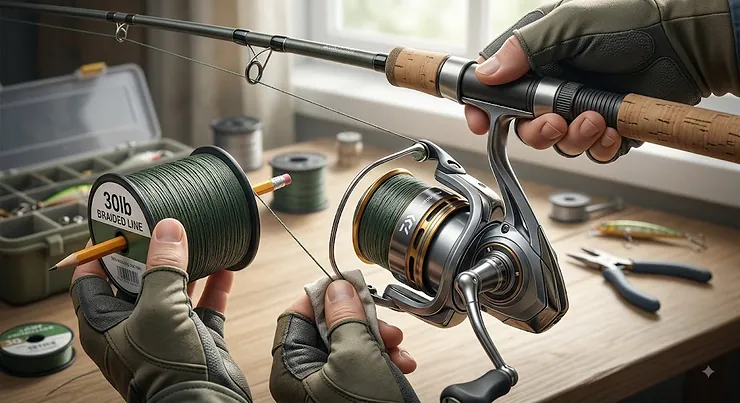
Getting 30lb braided line onto a reel correctly matters more than most first-timers expect, because braid behaves nothing like monofilament once it’s under tension. Start by running the line through a rag with light tension while spooling — this compresses the wraps evenly and prevents the loose, gap-filled spool that causes wind knots down the road. Fill spinning reels to about 1/8 inch from the lip; overfilling is the single most common cause of braid tangling off a spinning spool in the first few outings.
Knot choice matters just as much as spooling technique. A Palomar knot is the standard for tying braid directly to hooks or lures, and wetting the line before cinching down — a step reviewers across nearly every product in this guide mention — meaningfully improves knot strength by reducing friction damage during the cinch. If you’re running a leader, an FG knot or Alberto knot creates a smoother transition through guides than a bulky uni-to-uni connection, especially on spinning setups where guide contact is constant.
In the first month, expect a learning curve if you’re new to braid: it doesn’t stretch, so hooksets feel different and can be more violent than mono users expect, occasionally pulling hooks on soft-mouthed fish if you set too hard out of habit. Watch for backlash on baitcasters too — braid’s lack of stretch means overruns tangle faster and tighter than mono birds’ nests, so easing your thumb pressure and dialing in reel brakes before your first real cast will save you a frustrating afternoon.
Real-World Scenarios: Who Actually Needs 30 Pound Braid
Not every angler needs 30 pound braid, and matching the line to your actual fishing situation saves both money and headaches. Consider three common profiles.
The weekend bass angler fishing local ponds and lakes with moderate vegetation is a strong fit for 30lb braid paired with something like PowerPro Spectra Braided Line or Berkley X9 — enough strength to horse fish away from cover without the overkill diameter of 50lb+ test. The dedicated cover angler who spends entire trips flipping mats, docks, and laydowns should lean toward Daiwa J-Braid X8 Grand or Sufix 832 Advanced Superline, where the extra abrasion resistance directly translates into fewer break-offs on expensive tungsten weights and jigs.
The budget-conscious angler outfitting three or four rods for a family fishing trip is better served by KastKing SuperPower Silky8 or Reaction Tackle Braided Line — spreading a modest tackle budget across multiple reels matters more here than squeezing out the last percentage point of abrasion resistance. In each case, the “best” 30lb braid isn’t a universal answer; it’s the one that matches how often, and where, the line will actually take a beating.
Flipping Line Setups: Leaders, Rods, and Reel Pairings
Flipping is one of the oldest and most effective techniques for working heavy cover, and 30lb braid is a natural fit precisely because its thin diameter and zero stretch let you feel subtle bites even when your bait is buried three feet deep in a brush pile. As bass pros describe the technique, flipping and pitching let anglers place a bait with pinpoint accuracy close to the boat, which is exactly the scenario where braid’s sensitivity advantage over monofilament becomes obvious rather than theoretical.
For a dedicated flipping line setup, most anglers pair 30lb braid with a 7-foot to 7-foot-6 heavy-action rod and a baitcasting reel with a moderate-to-fast gear ratio for quickly taking up slack on the hookset. Whether to add a fluorocarbon leader depends on water clarity: stained or heavily vegetated water rarely requires one, since fish aren’t line-shy in low visibility, but clear-water flipping around isolated cover benefits from a short fluorocarbon section for stealth. Daiwa J-Braid X8 Grand and Sufix 832 Advanced Superline are the strongest picks here specifically because their abrasion-resistant construction holds up to the repeated cover contact flipping demands, session after session.
How to Choose Heavy Braid Fishing Line
Picking the right heavy braid fishing line comes down to matching a handful of specs to your actual fishing conditions rather than chasing the highest strand count on the shelf. Here’s the reasoning, step by step:
- Match test strength to cover density. Light grass and open water rarely need 30lb; thick mats and heavy timber justify it and beyond.
- Prioritize strand count for abrasion-heavy fishing. 8-strand and 9-strand builds like Sufix 832 Advanced Superline and Berkley X9 resist rock and dock contact better than older 4-strand designs.
- Consider diameter, not just pound test. Two 30lb braids can differ meaningfully in diameter, which affects both casting distance and how much line fits on your spool.
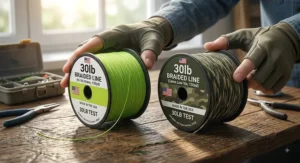
- Factor in color visibility needs. High-vis colors like those on Seaguar Smackdown help detect subtle bites; low-vis green or camo suits clear water and wary fish.
- Weigh price against fishing frequency. Weekend anglers rarely need premium-tier braid; anglers fishing weekly notice the difference in abrasion resistance fast.
- Check your reel’s line capacity. Braid’s thin diameter means you’ll often fit far more yardage than the spool size suggests — verify before buying a shorter, cheaper spool.
- Read aggregated review sentiment, not just star averages. A 4.5-star line with recurring abrasion complaints may still underperform a 4.3-star line with none.
Common Mistakes When Buying 30lb Braided Line
The single most common mistake is buying based on pound test alone and ignoring diameter — two 30lb braids from different manufacturers can vary enough in actual diameter that one casts noticeably farther and fits significantly more yardage on the same spool. A close second is skipping leader material entirely in clear water, then wondering why bites dry up; braid’s visibility underwater is a real factor that spec sheets rarely address directly.
Anglers also frequently underestimate how differently braid behaves compared to monofilament on a baitcaster, buying premium line before dialing in reel brakes and spool tension, which leads to backlashes that have nothing to do with the line’s actual quality. Finally, chasing the lowest price per yard without checking aggregated review sentiment for abrasion-resistance complaints is a common regret — the cheapest bulk spool isn’t a bargain if it needs replacing twice as often as a mid-tier option.
Heavy Cover Braid vs Monofilament and Fluorocarbon
Heavy cover braid earns its reputation specifically because of what happens when a fish runs directly into structure. Monofilament’s stretch — roughly 15-30% at the breaking point — absorbs shock on the hookset but also lets fish gain slack and momentum while burrowing into cover, exactly the moment you need maximum control. Braid’s near-zero stretch transfers hookset force almost instantly, which means you’re winning the tug-of-war the second a bass commits to a brush pile rather than a half-second later.
Fluorocarbon splits the difference in some ways — it’s more abrasion-resistant than mono and sinks faster, which matters for certain presentations — but it still can’t match braid’s diameter-to-strength ratio. A 30lb braid typically runs close to the diameter of 8-10lb monofilament, letting anglers fish heavier effective strength without the bulky spool or reduced casting distance a comparable mono test would require. The trade-off is visibility and abrasion behavior: braid doesn’t abrade gracefully the way mono can stretch and give slightly before failing, which is exactly why strand count and fiber quality matter so much once you’re fishing genuinely nasty cover.
What to Expect: Real-World Performance in Heavy Cover
Specs on a package only tell part of the story — what actually happens when 30lb braid meets a bass buried in matted hydrilla is where the differences show up. Expect the initial hookset to feel noticeably more direct and jarring than mono, since there’s no stretch cushioning the strike; many anglers new to braid over-set the hook out of habit before adjusting. Once the fish is hooked, dragging it through vegetation feels less like fighting the fish and more like fighting the plant matter itself — the line rarely gives, so success comes down to keeping steady pressure and using the rod, not the reel drag, to move fish out of the thickest sections.
Casting performance in real conditions also depends heavily on strand count and construction quality. Rounder, higher-strand-count lines like Daiwa J-Braid X8 Grand and Berkley X9 cast noticeably quieter and farther through guides than flatter 4-strand designs, particularly on windy days when line noise and friction both increase. Over a season of hard use, expect some color fade regardless of brand — it’s near-universal across braided lines — but structural degradation (fraying, thinning) should be minimal on quality 8-strand builds if you’re rinsing reels after saltwater exposure.
Power Fishing Braid for Different Anglers
Power fishing braid serves different purposes depending on who’s holding the rod. Tournament and highly frequent anglers benefit most from premium options like Sufix 832 Advanced Superline or Daiwa J-Braid X8 Grand, where marginal gains in abrasion resistance and castability compound across dozens of fishing days per season into fewer break-offs and less re-spooling. Casual weekend anglers get diminishing returns from premium tiers and are generally better served by mid-range options like PowerPro Spectra Braided Line, which balances proven reliability against a lower price point.
Beginners transitioning from monofilament specifically benefit from softer, more supple 8-strand budget lines like KastKing SuperPower Silky8 — the learning curve around backlash and knot-tying is gentler with a line that doesn’t fight the spool. Anglers outfitting multiple rods on a budget, whether for a family trip or a guide service running several client rods, are best matched with bulk-value options like Reaction Tackle Braided Line, where cost-per-rod matters more than incremental performance gains.
Long-Term Cost & Maintenance of Braided Line
Braided line’s biggest long-term cost advantage over monofilament is simple: it doesn’t degrade from UV exposure and water absorption nearly as fast, so a quality 30lb braid can realistically last multiple seasons of moderate use before requiring replacement, compared to mono’s typical single-season lifespan. That said, “doesn’t degrade” isn’t the same as “never needs attention” — rinsing reels after saltwater trips, avoiding prolonged direct sunlight storage, and periodically checking the first few feet of line for fraying (the section that takes the most abrasion) all extend usable life meaningfully.
Cost-per-use math favors premium lines more than the sticker price suggests. A $25 spool of Sufix 832 Advanced Superline that lasts two full seasons of weekly fishing works out cheaper per outing than a $10 budget spool that needs replacing every few months due to abrasion damage. For anglers who fish occasionally, though, that math reverses — a budget line replaced once a year still costs less overall than a premium spool sitting mostly unused. Total cost of ownership, in other words, depends entirely on fishing frequency and cover intensity, not just the price tag at checkout.
Features That Actually Matter (And Those That Don’t)
Strand count and fiber quality are the features that genuinely separate performance tiers — an 8-strand or 9-strand build from a reputable brand consistently outperforms 4-strand construction in abrasion resistance and casting smoothness, and that difference shows up in real fishing conditions, not just on paper. Diameter-to-strength ratio matters too, since a thinner line at the same pound test means more yardage per spool and less wind resistance on the cast.
Color, on the other hand, is mostly a personal preference dressed up as a performance feature — high-visibility colors help you see subtle line movement, low-visibility colors help avoid spooking fish in clear water, but neither changes the line’s actual strength or durability. Marketing claims about “unbreakable” or dramatically exaggerated pound-test multipliers are worth reading skeptically too; real-world abrasion resistance depends far more on fiber quality and weave density than on aggressive label copy. When comparing two similarly priced braids, spend your attention on strand count, diameter, and aggregated review sentiment around durability — not color options or bold marketing claims.
Safety, Regulations & Responsible Line Disposal
Braided line doesn’t biodegrade any faster than monofilament, and improperly discarded line remains a genuine hazard to wildlife — birds, turtles, and marine mammals can become entangled in line left on docks, beaches, or in the water. The good news is that recycling infrastructure has expanded significantly; organizations like the BoatUS Foundation, working with NOAA’s Marine Debris Program, have helped establish thousands of dedicated fishing line recycling bins at boat ramps, piers, and tackle shops across the country specifically to keep old line out of waterways.
Before disposing of old braid, cut it into shorter sections to prevent tangling hazards even in trash disposal, and check for a nearby recycling bin before defaulting to the garbage can — many tackle shops participate even without visible signage, so it’s worth asking. There’s no specific regulatory pound-test restriction on braided line for most recreational freshwater and inshore fishing in the U.S., but always check state-specific fishing regulations, since some tournament formats and specific fisheries do impose line-type or leader restrictions worth confirming before you hit the water.
FAQ
❓ Is 30lb braid too strong for bass fishing?
❓ What pound test mono is 30lb braid equivalent to?
❓ Do I need a leader with 30lb braided line?
❓ How long does 30lb braided line last?
❓ Can I use 30lb braid on a spinning reel?
Conclusion
Thirty-pound braided line earns its popularity honestly: it’s the sweet spot between manageable diameter and genuine cover-busting strength, which is exactly why it shows up on so many bass boats, inshore skiffs, and weekend tackle boxes. The right pick for you depends less on chasing the single “best” line on paper and more on matching construction quality, price, and abrasion resistance to how — and where — you actually fish.
If you’re punching mats and flipping heavy brush every weekend, Sufix 832 Advanced Superline and Daiwa J-Braid X8 Grand are worth the premium price for the abrasion resistance alone. If you’re outfitting several rods on a budget or just getting started with braid, KastKing SuperPower Silky8 and Reaction Tackle Braided Line deliver solid performance without the premium price tag. And for anglers who want a dependable, well-reviewed all-rounder, PowerPro Spectra Braided Line and Berkley X9 remain hard to beat.
Whichever spool ends up on your reel, remember that a great braid still needs a properly tied, wetted knot and a reel that’s been dialed in — the line is only half the equation. Get both right, and 30lb braided line will genuinely change how confidently you fish heavy cover.
✨ Ready to Upgrade Your Spool?
🎣 Take your next fishing trip to the next level with a braid built for the cover you actually fish. Click on any highlighted pick above to check current pricing and availability, and land the fish that used to get away!
Recommended for You
- 8 Strand Braided Line: 7 Best Picks Anglers Trust in 2026
- 4 Strand Braid: 7 Best Picks for 2026
- Spey Rod Salmon: 7 Best Picks for 2026, Ranked and Reviewed
Disclaimer: This article contains affiliate links. As an Amazon Associate, I earn from qualifying purchases. If you purchase products through these links, we may earn a small commission at no additional cost to you.
✨ Found this helpful? Share it with your friends! 💬🎣
