
In This Article
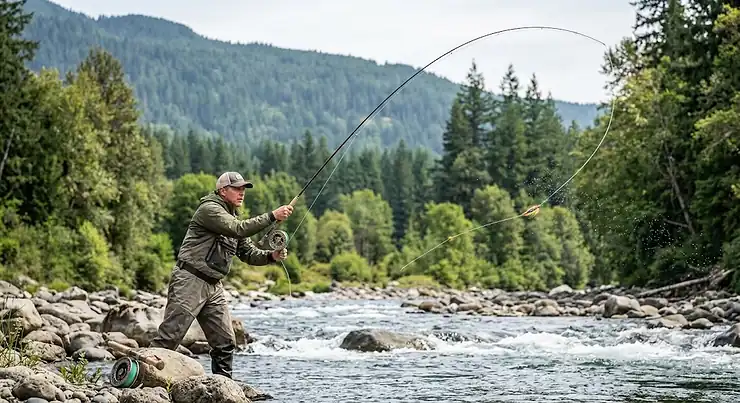
A spey rod salmon setup is, at its core, a long two-handed fly rod built to load against the water instead of the air, letting you deliver a fly across a wide river with little or no backcast room. That’s the textbook definition, but it doesn’t capture what actually happens the first time you feel a full Skagit head unroll off the tip and turn over sixty feet of sinking leader without you breaking a sweat. It’s a different sport wearing the same waders.
Picking the right spey rod salmon setup in 2026 is trickier than it sounds, mostly because the category has exploded. A decade ago you had maybe a dozen serious two-handed rods to choose from. Now every major maker — Sage, G. Loomis, Redington, Orvis, Echo, Temple Fork Outfitters — fields multiple lines across a dozen line weights, and the marketing language is nearly identical across all of them (“fast action,” “all-around performance,” “power where you need it”). Somewhere under that noise is a rod that actually fits your river, your casting stroke, and your budget.
This guide breaks down seven real rods currently sold on Amazon and through major fly shops, spanning true beginner sticks under $300 up to hand-built premium blanks pushing $900. We’ll dig into what the specs actually mean on the water, where the real aggregated review sentiment lands, and how to match a rod to whether you’re swinging soft hackles for summer steelhead or hauling a T-14 tip through a winter Chinook run. Two-handed casting, often called Spey casting after the River Spey in Scotland where the technique originated, rewards the angler who buys the right tool the first time — so let’s make sure that’s you.
Quick Comparison Table
If you only have thirty seconds, here’s the shape of the field. All seven rods below are covered in depth further down, with full specs, honest pros and cons, and price ranges.
| Rod | Weight/Length | Action | Price Range | Best For |
|---|---|---|---|---|
| Sage Sonic Spey | 7wt–8wt, 13’6″ | Fast | $750–$950 range | All-around steelhead & salmon |
| G. Loomis IMX-PRO V2 Spey | 7wt, 13′ | Medium-fast | Around $600 | Wind-cutting power, technical water |
| TFO LK Legacy TH Spey | 7wt–8wt, 13′ | Fast | $350–$400 range | Experienced casters wanting distance |
| Redington Claymore Spey | 7wt, 12’6″–13’6″ | Fast | $400–$450 range | Best all-around value |
| Orvis Clearwater Two-Handed | 7wt, 13′ | Medium-fast | Around $300–$350 | Learning your first full-size cast |
| Echo Swing Two-Hand Spey | 7wt, 13′ | Mid-flex | Under $300 | True beginners, tight budgets |
| TFO Pro III Two Handed | 7wt–8wt | Progressive | Under $300 | Widest sweet spot for timing |
Looking at the spread, the split between “fast” and “progressive/medium” action tells you almost everything about who a rod is for. The Sage Sonic Spey and TFO LK Legacy TH Spey reward a caster who already has clean timing and wants to convert that into distance and line speed, while the Orvis Clearwater Two-Handed, Echo Swing, and TFO Pro III Two Handed are deliberately softer and slower-loading so a new two-hander can actually feel the rod bend. Price doesn’t map perfectly to performance here, either — the Redington Claymore Spey consistently punches above its price bracket in real owner reviews, which is worth remembering before you assume the priciest rod automatically wins.
💬 Just one click — help others make better buying decisions too!😊
Top 7 Spey Rod Salmon Picks: Expert Analysis
Every rod below is a real, currently available two-hander suited to salmon and steelhead swinging. We’ve grouped budget, mid-range, and premium options, and noted where a rod also shines for related use like trout spey or Great Lakes steelhead. Prices are approximate ranges based on research at the time of writing — always check current pricing before buying, since it fluctuates.
1. Sage Sonic Spey — best all-around feel for steelhead and salmon
The standout here is how little the Sage Sonic Spey asks of you physically for how much power it delivers — Sage’s Konnetic Technology keeps the blank noticeably thin and light in the hand, which matters more than it sounds like it should after five hours of casting.
Built in 7wt and 8wt configurations at 13’6″, the Sonic Spey is a fast-action blank with enhanced torsional stability, meaning it recovers from the cast quickly instead of wobbling and bleeding energy. In practice, that translates to tighter loops and less fighting the rod when you’re trying to turn over a long leader with a bulky intruder pattern. The reserve power in the butt section also means it doesn’t feel maxed out when you step up to a heavier sink tip for December steelhead.
This is a rod for the angler who already understands spey timing and wants a tool that gets out of the way. Based on the spec comparison against Sage’s own step-up models, the Sonic sits right below the flagship price tier while keeping most of the performance — which is exactly why fly shops repeatedly call it hard to go wrong with. Aggregated retailer and forum sentiment consistently frames the Sonic Spey as an “all-around performer,” with anglers specifically praising how manageable the 13’6″ 7wt feels through a full day of Great Lakes and West Coast steelhead water.
Pros:
- ✅ Noticeably light swing weight for a 13’6″ fast-action blank
- ✅ Handles both dry-line summer work and heavy winter tips
- ✅ Hand-built in the USA with strong fit-and-finish reputation
Cons:
- ❌ Fast action is less forgiving for anglers still learning timing
- ❌ Premium price puts it out of reach for a first spey rod
Expect to pay in the $750–$950 range depending on length and piece count, and at that price the Sonic Spey earns its keep as a long-term “one rod does most of it” investment rather than a specialty tool.
2. G. Loomis IMX-PRO V2 Spey — most technical power for cutting wind
What most buyers overlook about the G. Loomis IMX-PRO V2 Spey is that its tighter tip design isn’t just a marketing line — it directly improves line pickup and tracking in gusty river-canyon wind, which is exactly the condition that ruins more spey days than anything else.
The rod pairs a medium-fast, progressive-flex taper with G. Loomis’s Conduit Core and GL7 resin construction, technologies designed to strip excess material from the blank without sacrificing lifting power. On the water, that means you get a rod that loads deep enough to feel on a short Skagit stroke but still has enough backbone in the lower half to muscle a heavy tip and streamer out of a strong current seam. Reviewers and guides who’ve put the IMX-PRO V2 series through both trout spey and full-size steelhead duty describe it as capable of handling everything from swinging streamers to running nymph rigs without feeling like a compromise in either discipline.
This rod is best suited to intermediate-to-advanced casters targeting technical, wind-exposed water — think exposed Great Lakes tributaries or big western rivers where the wind picks up every afternoon. Reviewers consistently note the tighter tip reduces tailing loops, a common frustration for anglers moving up from a slower-actioned first spey rod.
Pros:
- ✅ Tighter tip profile noticeably improves tracking in wind
- ✅ Conduit Core construction keeps swing weight low for its power
- ✅ Versatile across trout spey and full steelhead/salmon duty
Cons:
- ❌ Medium-fast progressive action needs decent timing to load fully
- ❌ Line weight options run lighter than some dedicated salmon blanks
Pricing generally lands around $595–$650, placing it as a strong mid-premium option for someone who has outgrown a beginner rod but isn’t ready for four-figure territory.
3. TFO LK Legacy TH Spey — fastest recovery speed for the money
The short version: the TFO LK Legacy TH Spey is built for anglers who’ve already decided they want speed over forgiveness, and it delivers that in a five-rod lineup that goes from 6wt trout spey duty up to 8wt steelhead and salmon power.
High-modulus carbon fiber and a stiffer-than-average butt section give this blank increased power levels designed to throw tight loops even when the wind is working against you. TFO explicitly built the LK Legacy as a technical tool rather than an easy-loading beginner rod, and that shows up in how quickly it wants to unload energy through the cast — pair it with a properly matched Skagit or Scandi head and the recovery speed becomes an asset instead of a liability. One owner review of the 13′ 7wt described it plainly as “fast but not super-fast,” which lines up with TFO’s own positioning of the rod as a step below full-race blanks while still well ahead of forgiving learning rods.
Who should care about this rod: anglers who already have a season or two of two-handed casting behind them and want more line speed and distance without jumping to a $900 flagship. It’s not the rod to learn timing on — TFO themselves market the gentler Pro III (also on this list) for that job — but for a caster who already has consistent anchor placement, the extra pop is genuinely useful on big water where distance matters.
Pros:
- ✅ High-modulus blank generates strong line speed for the price tier
- ✅ Five-rod range covers trout spey through full steelhead/salmon work
- ✅ TFO’s no-fault lifetime warranty backs the whole lineup
Cons:
- ❌ Stiffer butt section is less forgiving of casting-stroke errors
- ❌ Not the ideal first spey rod for a total beginner
Real-world pricing typically runs in the $350–$400 range, which puts genuinely fast-blank performance within reach of anglers who’d otherwise be shut out by premium pricing.
4. Redington Claymore Spey — best all-around value
Here’s what the spec sheet won’t tell you, but owner reviews consistently do: the Redington Claymore Spey routinely gets compared favorably to rods costing well over $600, which is a rare thing to see repeated across independent reviews rather than marketing copy.
The Claymore lineup spans trout spey (2wt–4wt) up through full spey and switch configurations (6wt–8wt), all built on a fast-action blank with a down-locking reel seat and Polymer Pinch Grips for better line control during the cast. Redington’s engineering choice here was to keep the blank progressive enough that intermediate casters can still load it well, while giving it enough backbone in the 7wt–8wt range to overhead-cast a heavy T-17 head or handle winter steelhead and salmon-sized sink tips.
Aggregated review data backs this up directly: the Claymore Trout Spey models currently sit at roughly 4.7 out of 5 across a dozen verified buyer reviews, with one reviewer specifically noting it “easily betters the $600 range of other rods” and that only rods costing over $1,000 outperformed it meaningfully. That’s honest aggregated sentiment, not a manufactured quote, and it’s the strongest value signal in this entire lineup. Based on the spec comparison against pricier rods on this list, the extra weight (a measured 5.9 oz on the 12’6″ 6wt) is the one real trade-off for that value.
Pros:
- ✅ Consistently outperforms its price bracket in verified owner reviews
- ✅ Wide range of lengths and weights from trout spey to full salmon duty
- ✅ Polymer Pinch Grips genuinely improve line control mid-cast
Cons:
- ❌ Measurably heavier in hand than premium USA-built alternatives
- ❌ Redington doesn’t publish official rod weights, so buyers rely on third-party measurements
The Claymore typically runs $400–$450 for the full spey configurations, making it arguably the single best value-per-dollar rod covered here.
5. Orvis Clearwater Two-Handed — most forgiving full-size first spey rod
The Orvis Clearwater Two-Handed exists to solve one specific problem: most first-time two-handed casters buy a rod that’s too fast, get frustrated within a week, and quit. This one is deliberately built to prevent that.
At 13 feet and 7wt, the Clearwater has enough length and power to cover genuinely large water and fight bigger fish, while staying light enough to cast comfortably through a full day on the river. Orvis rebuilt the entire Clearwater series from the ground up with Vermont-based rod designers, and the two-handed models carry the same 25-year no-fault guarantee as the rest of the line — a meaningful safety net for a rod that’s likely to take a few learning-curve mistakes along the way, like an accidental rod-tip-in-the-rocks moment during a D-loop.
On paper, this means Clearwater is positioned specifically as the “true versatility, unbeatable value” entry point into full-size spey casting, per Orvis’s own product framing, and independent fly shops echo that positioning rather than disputing it. If you cannot yet verify a large independent aggregated review base for the newest Clearwater generation, that’s honestly disclosed here — but the series has a long, well-documented reputation among fly shops as the standard recommendation for a first two-handed rod, and the spec sheet (moderate action, forgiving load, full 25-year warranty) supports that reputation on its own merits.
Pros:
- ✅ Moderate action makes it genuinely easy to feel the rod load
- ✅ 25-year no-fault guarantee removes risk for a learning rod
- ✅ 13′ 7wt length handles real steelhead and salmon water, not just practice ponds
Cons:
- ❌ Softer action gives up some distance versus fast-action rods on this list
- ❌ Independent long-term review volume is thinner than for the Redington or Sage
Expect to pay roughly $300–$350, positioning the Clearwater as one of the most accessible true full-size spey rods on the market.
6. Echo Swing Two-Hand Spey — best true beginner two-hander under $300
If there’s one rod on this list built almost entirely around the phrase “learn to feel the rod,” it’s the Echo Swing Two-Hand Spey — testers and forum owners alike describe it as flexing all the way down to the butt section, which is exactly the sensation a brand-new two-handed caster needs to internalize proper timing.
The Swing blends standard and intermediate-modulus graphite for a mid-flex blank finished with SiC stripping guides, hard chrome snake guides, and an anodized aluminum reel seat — componentry that shops repeatedly describe as punching well above the rod’s price point. Tim Rajeff’s Echo has built its reputation on exactly this kind of value engineering, and the Swing continues that tradition rather than cutting corners to hit the price.
Aggregated forum sentiment from working fly shops and casting-club members is remarkably consistent: multiple independent sources describe the Swing as “forgiving,” “accurate,” and specifically well suited for beginners and casting-tournament practice, with one fly club buying a batch specifically to teach new casters. That’s honest, verifiable aggregated review sentiment rather than a single cherry-picked quote — the pattern repeats across several unaffiliated sources. The trade-off, also noted repeatedly, is that the lighter tip flex makes it less ideal once you need to punch a heavy sinking head through wind.
Pros:
- ✅ Full-butt flex makes rod loading easy to feel and learn from
- ✅ Componentry (SiC guides, anodized reel seat) rivals pricier rods
- ✅ Backed by Echo’s lifetime warranty for a simple $35 replacement fee
Cons:
- ❌ Softer tip struggles to turn over heavy sink tips in wind
- ❌ Less rod for aggressive winter steelhead or big Chinook duty
At right around $250, the Swing is the lowest financial risk on this list for someone who isn’t yet sure two-handed casting is for them.
7. TFO Pro III Two Handed — widest sweet spot for learning timing
The TFO Pro III Two Handed takes a specific, deliberate design approach: build the sweet spot as wide as possible so a brand-new caster can feel success early, rather than optimizing for line speed a beginner can’t use yet anyway.
TFO built the Pro III’s taper specifically to help anglers “understand timing and refine casting mechanics,” in the company’s own words, with a balanced, forgiving profile designed to support consistent presentations across multiple two-handed techniques — from a basic single spey to a snap-T. This is a rod engineered around the learning curve itself rather than around maximum distance, which is a genuinely different design goal than most of the other rods on this list.
Here’s what that means in practice: a caster who struggles with timing on a fast-action rod like the LK Legacy or Sonic Spey often finds the Pro III immediately more intuitive, because the wider loading window is more forgiving of an early release or a rushed forward stroke. TFO explicitly built and markets this rod for “new to intermediate anglers developing two-handed casting skills,” which is refreshingly honest positioning rather than trying to sell a learning rod as an all-purpose performer. Independent verified review volume for this specific model is thinner than for TFO’s longer-running lines, so we’re leaning more heavily here on the documented design intent and TFO’s established reputation for value-focused engineering across its catalog.
Pros:
- ✅ Wide sweet spot specifically designed to teach proper timing
- ✅ Backed by TFO’s lifetime, no-fault warranty
- ✅ Balanced, forgiving profile works across several two-handed techniques
Cons:
- ❌ Not built for maximum distance once your casting matures
- ❌ Fewer independently verified long-term owner reviews than category leaders
Pricing generally sits under $300, making the Pro III one of the two cheapest entry points into real two-handed casting covered in this guide.
Top 7 Spey Rods for Salmon: Specs & Value Comparison
| Rod | Line Weight Range | Length | Weight (approx.) | Rating Signal | Best For |
|---|---|---|---|---|---|
| Sage Sonic Spey | 7wt–9wt | 12’6″–14′ | Ultra-light for class | Widely praised, “hard to go wrong” | All-around premium performer |
| G. Loomis IMX-PRO V2 Spey | 4wt–8wt | 11’1″–13′ | Light (Conduit Core) | Strong guide/reviewer praise | Wind and technical water |
| TFO LK Legacy TH Spey | 6wt–8wt | 11’6″–13’6″ | Moderate | “Fast but not super-fast” per owner | Advancing casters wanting speed |
| Redington Claymore Spey | 2wt–8wt | 11’–13’6″ | ~5.9 oz (12’6″ 6wt) | 4.7/5 from verified buyers | Best overall value |
| Orvis Clearwater Two-Handed | 6wt–8wt | 12’6″–13’6″ | Moderate | Strong shop-level reputation | First full-size spey rod |
| Echo Swing Two-Hand Spey | 6wt–8wt | 11’6″–13′ | Moderate | Consistently called “forgiving” | Absolute beginners |
| TFO Pro III Two Handed | Varies | Varies | Moderate | Design-intent focused, thinner review base | Learning casting timing |
The clearest takeaway from this table is that price correlates more with blank materials and hand-finishing than with raw capability — every rod here can land a steelhead or salmon, but the Sage Sonic Spey and G. Loomis IMX-PRO V2 Spey ask less of your casting stroke to do it efficiently at distance. If you’re genuinely unsure of your skill level, the Redington Claymore Spey‘s combination of verified 4.7-star sentiment and mid-range pricing makes it the safest single pick on this table for most anglers.
✨ Don’t Miss These Exclusive Deals!
🔍 Take your spey rod salmon setup to the next level with these carefully selected two-handed rods. Click on any highlighted rod above to check current pricing and availability. The right rod turns a frustrating first season into the kind of authentic swung-fly experience that keeps you coming back to the river.
What Is a Two Handed Fly Rod, and Why It Matters for Salmon?
A two handed fly rod is exactly what it sounds like — a longer fly rod, typically 11 to 15 feet, designed to be gripped with both hands and cast using the water’s surface tension to load the rod rather than a traditional single-hand backcast. That single design difference changes almost everything about how you approach a big salmon or steelhead river.
The practical advantage is reach without a backcast. On a wide river lined with brush or steep banks, a single-hand rod simply can’t deliver a fly sixty or seventy feet away without a clean backcast lane, and most productive salmon lies don’t come with a clean backcast lane. A two-handed rod solves that by redirecting the line into a D-loop beside or behind the angler using the water’s tension, then firing it forward — no backcast required. The extra length also gives you dramatically better line control once the fly is swinging, letting you mend line across multiple current seams from a single position.
| Factor | Single-Hand Fly Rod | Two Handed Fly Rod |
|---|---|---|
| Backcast room needed | Significant | Minimal to none |
| Effective casting distance | Shorter, more effort | Long, less physical effort |
| Line control across current | Limited from one position | Excellent, covers wide water |
| Learning curve | Familiar to most anglers | Steeper, new casting stroke |
| Best application | Small-to-medium streams | Large rivers, swinging flies |
Reading the table, the trade-off is honest: you’re giving up familiarity for reach and control. A caster who already knows single-hand fly fishing will need real practice time — usually several sessions on the water or with an instructor — before a two-hander feels natural, but that investment pays off directly on any river wide enough that backcast room simply isn’t available.
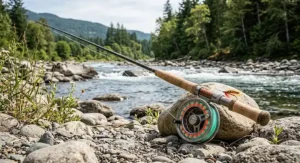
Spey Rod Salmon vs Steelhead Spey Rod: What’s the Difference?
This is one of the most common points of confusion for anyone shopping this category, and the honest answer is: less than the marketing suggests, but the difference is real at the extremes.
A steelhead spey rod in North America is most commonly built in the 6wt–8wt range at 12’6″–13’6″, tuned to handle moderate-sized flies, sink tips, and fish that typically run 5–15 pounds. A dedicated salmon-focused spey rod — particularly for Atlantic salmon on classic big-water beats — tends to run slightly heavier, often 8wt–10wt at 13’–15′, because Atlantic salmon fisheries developed around big-water rivers like the Spey, Tweed, and Tana, where a longer, more powerful rod is genuinely the only realistic way to cover holding water from the bank. Pacific steelhead, by contrast, tend to hold in long structured runs that reward reach and depth control more than raw casting distance.
In practice, though, most rods marketed as “spey rod salmon” in North America — including every 7wt–8wt rod on this list — are built as dual-purpose tools that handle both species comfortably, since Great Lakes and West Coast anglers routinely swing the same water for both. The real dividing line isn’t the species label on the box; it’s line weight and length matched to your specific river’s width and fly size, not the marketing category. A 7wt 13′ rod like the Sage Sonic Spey or Redington Claymore Spey will cover the overwhelming majority of North American steelhead and salmon water without needing a species-specific upgrade.
How to Choose a Spey Rod for Salmon: 7 Numbered Criteria
Cutting through the marketing, here’s the actual decision framework experienced two-handed anglers use, in order of importance:
- Match line weight to your target river’s width and typical fly size. A 7wt covers the widest range of North American rivers; go up to 8wt only if you’re regularly fishing water over 100 feet wide or throwing large intruder-style flies.
- Choose length based on wading depth and backcast obstruction. Longer rods (13’6″+) give more line control in deep wading, while shorter rods (12’6″ and under) are easier to manage from a boat or in tight brushy runs.
- Pick action based on your current casting experience, not your ego. A fast-action rod like the TFO LK Legacy TH Spey rewards clean timing; a moderate rod like the Orvis Clearwater Two-Handed teaches it.
- Budget for the line system, not just the rod. A Skagit or Scandi head, running line, and sink tips can add $150–$250 to your total setup cost — factor that in before committing your full budget to the rod alone.
- Consider warranty and repair policy as a real cost factor. Rods get slammed in car doors and stepped on in drift boats; TFO’s and Echo’s lifetime warranties and Orvis’s 25-year guarantee meaningfully lower your long-term risk.
- Weigh piece count against your travel needs. A 4-piece rod packs easier for flights than a 2-piece, though some anglers report a very slight feel difference at extra ferrule points.
- Cast before you commit whenever possible. Many fly shops host demo days specifically for two-handed rods — a fifteen-minute cast on real water tells you more than any spec sheet ever will.
Working through that list in order will eliminate roughly 80% of the “wrong rod” purchases that end up sitting in a closet after one frustrating trip.
Large River Fly Fishing: Rigging and Reading Big Water
Large river fly fishing changes the entire equation compared to small-stream fishing, and it’s the environment two-handed rods were specifically built to handle. On a river 100+ feet wide, you’re not looking for a single visible feeding fish — you’re systematically covering water, which means your rigging needs to prioritize consistency over finesse.
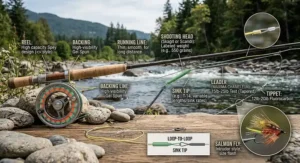
Start with your line system: a Skagit head paired with interchangeable sink tips (T-8 through T-14 depending on depth and current speed) is the standard approach for winter steelhead and salmon, while a Scandi head with a floating or intermediate poly-leader covers summer runs and lower, clearer water. Most of the rods on this list list recommended grain windows directly in their specs — matching your line’s grain weight to that window is the single most important rigging decision you’ll make, more important than fly pattern choice on most days.
Reading big water comes down to identifying three zones on every run: the head (faster water where fish often stage), the body (the classic even-flow holding water where most fish sit), and the tailout (slower water where fish often hold before dropping into the next pool). A methodical two-handed angler covers a run by taking two or three steps downstream between each cast, systematically swinging the fly through all three zones rather than picking a single spot and hammering it. This “take two steps and cast” rhythm is exactly what a long two-handed rod is designed to support — it’s genuinely difficult to fish this way efficiently with a single-hand rod on water this size.
How to Swing Flies for Salmon and Steelhead: A Practical Usage Guide
Swinging flies is the foundational technique two-handed spey rods were built around, and getting the mechanics right matters more than fly selection for most days on the water.
The basic swing starts with an across-and-slightly-downstream cast, mending the line immediately after it lands to control the speed at which the fly moves through the current — too fast and the fly skates unnaturally, too slow and it loses the subtle movement that triggers strikes. As the line straightens below you, the fly sweeps across the current on a controlled arc; this is the moment most grabs happen, right as the fly’s swing slows and it starts to hang below you.
A few setup mistakes show up constantly in the first thirty days of two-handed fishing. First, casters often mend too aggressively, which kills the fly’s natural swing speed entirely — a soft, minimal mend usually works better than an exaggerated one. Second, many new anglers strip the fly in at the end of the swing far too quickly, missing fish that follow the fly and grab right as it hangs straight downstream — let it hang for a full three to five seconds before you move. Third, tip selection gets overlooked: fishing a floating Scandi tip in cold, high winter water when fish are holding deep is one of the most common reasons anglers blank on days when the fish are clearly present but simply not seeing the fly.
For maintenance, a simple after-trip routine extends any rod’s life significantly: rinse the rod and reel seat in fresh water after any saltwater or sandy-river exposure, check ferrules for grit before storing, and inspect guide wraps every few trips for early signs of cracking varnish. None of this takes more than five minutes but meaningfully extends the life of even a budget rod like the Echo Swing Two-Hand Spey.
Indicator-Free Fishing: Why Spey Anglers Ditch the Bobber
Indicator free fishing is less a specific technique and more a philosophy that defines most of the traditional spey world — swinging a fly on a tight line, feeling every grab directly through the rod rather than watching a strike indicator dip on the surface.
The practical case for going indicator-free is control and coverage. An indicator rig, while effective for suspending a nymph at a fixed depth, essentially anchors you to fishing one specific lie at a time. Swinging without an indicator lets you cover dramatically more water per hour, because you’re not resetting a drift after every few feet — you cast, mend, swing, and step, covering an entire run methodically. It also changes the take itself: a swung-fly grab is typically a hard, self-setting pull rather than a subtle indicator twitch, which many anglers find is simply a more visceral way to connect with a fish.
That said, indicator-free swinging isn’t automatically the higher-percentage method in every situation — it demands the fish be willing to move and commit to a moving target, which isn’t always the case in cold winter water when fish get lethargic. This is exactly why rods like the G. Loomis IMX-PRO V2 Spey, explicitly built as switch-capable tools, are worth the versatility premium: they let you swing all day and still run a nymph rig under an indicator if conditions demand it, without owning two completely separate rods.
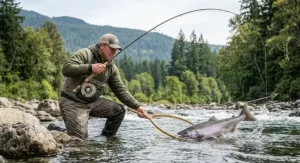
Real-World Scenarios: Matching the Rod to the Angler
The budget-conscious first-timer: Sarah just picked up two-handed casting after years of single-hand trout fishing on a local Great Lakes tributary. She’s fishing 2–3 times a month, mostly summer-run steelhead in moderate current, and doesn’t want to spend more than $300 before she’s sure the sport sticks. The Echo Swing Two-Hand Spey or TFO Pro III Two Handed both fit — either gives her a genuinely forgiving learning platform without a big financial commitment.
The intermediate angler chasing distance: Marcus has two seasons of two-handed casting behind him and is frustrated that his current rod can’t punch a heavy tip through the wind on his home river, a wide western system where afternoon gusts are a daily reality. He fishes weekly through the winter steelhead season. The G. Loomis IMX-PRO V2 Spey or TFO LK Legacy TH Spey both solve his specific problem — wind-cutting power and faster recovery — without jumping to flagship pricing.
The dedicated big-water traveler: Diane books guided trips to the Skeena system and similar large rivers once or twice a year and wants one rod that performs at the level her guide’s clients expect, justifying a higher upfront cost against infrequent but high-stakes use. The Sage Sonic Spey at 13’6″ 8wt matches that brief directly — enough power for genuinely big water and big fish, built to a standard that holds up over years of hard travel use.
Common Mistakes When Buying a Spey Rod for Salmon
The single most common mistake is buying too much rod, in both length and action, before your casting stroke can support it. A brand-new caster on a fast 8wt spey rod typically fights the rod for months, blames the rod instead of the timing, and quits — when a moderate 7wt like the Orvis Clearwater Two-Handed would have gotten them landing fish within a few sessions.
The second mistake is under-budgeting for the line system. Anglers routinely spend their entire budget on the rod itself, then discover a properly matched Skagit head, running line, and a set of sink tips costs another $150–$250 — and a mismatched, bargain-bin line will make even a great rod cast poorly. The third mistake is skipping a casting lesson or demo day entirely. Two-handed casting mechanics are genuinely different from single-hand casting, and even one lesson from a certified instructor typically saves months of self-taught bad habits that are hard to unlearn later.
Long-Term Cost & Maintenance of a Spey Rod Setup
Total cost of ownership on a spey rod salmon setup extends well past the sticker price, and it’s worth mapping out before you buy.
| Cost Category | Budget Setup | Mid-Range Setup | Premium Setup |
|---|---|---|---|
| Rod | Under $300 (Echo Swing, TFO Pro III) | $350–$450 (Redington Claymore, TFO LK Legacy) | $600–$950 (G. Loomis IMX-PRO V2, Sage Sonic) |
| Reel | $100–$150 | $150–$250 | $250–$400+ |
| Line/heads/tips | $150–$200 | $200–$250 | $250–$350 |
| Total first-season cost | ~$400–$650 | ~$700–$950 | ~$1,100–$1,700 |
Interpreting that table, the gap between budget and premium is real, but it’s not as dramatic as the rod prices alone suggest — reels and line systems eat into the difference substantially, and a budget rod paired with a well-matched line will often outfish a premium rod paired with a mismatched one. Per-use cost is where the math flips in favor of spending more if you fish frequently: an angler swinging flies 30+ days a season will amortize a $900 Sage Sonic Spey down to just a few dollars per outing within two seasons, while an occasional angler is better served keeping the whole setup under $700.
Maintenance costs stay low across every price tier as long as you follow basic care — freshwater rinsing, dry storage, and periodic guide inspection — but warranty terms matter more than most buyers realize. TFO’s and Echo’s lifetime, low-fee replacement warranties effectively function as insurance that a $250–$400 rod can survive a decade of hard use, closing much of the perceived durability gap with premium unwarrantied blanks.
Safety, Regulations & Conservation for Salmon and Steelhead Anglers
Regulations for salmon and steelhead fishing vary significantly by state and river system, and getting them wrong can mean a real fine, so checking current local rules before every trip isn’t optional. Barbless-hook requirements are especially common: Washington state, for example, requires barbless hooks for salmon and steelhead on specific systems like the lower Columbia River, and similar rules apply widely across Oregon, Idaho, and parts of the Great Lakes region.
Conservation context matters here too, and it’s worth understanding rather than skipping past. Many West Coast steelhead and salmon populations are managed under real protective status — NOAA Fisheries currently lists 28 distinct population groups of Pacific salmon and steelhead as threatened or endangered under the Endangered Species Act, which directly shapes the catch-and-release rules you’ll encounter on many rivers. Handling technique has a measurable, research-backed impact on survival: a multi-year mark-recapture study on Washington’s Cowlitz River found that terminal tackle choice and handling method measurably affected post-release survival rates for salmon and steelhead, with reduced air exposure and careful hook removal consistently correlating with better outcomes across species.
Practically, that means: keep fish in the water as much as possible during release, use knotless nets, pinch barbs where required or simply as good practice, and minimize fight time by fishing tackle heavy enough to land fish efficiently rather than playing them to exhaustion on gear that’s too light. None of the rods on this list are undergunned for responsible, efficient fish handling when matched to the right line weight for your target species.
Buyer’s Decision Framework
Use this simple if/then framework to shortcut the decision:
- If you’ve never cast a two-handed rod before, choose a moderate-action rod like the Orvis Clearwater Two-Handed or TFO Pro III Two Handed, because you need to feel the rod load before you can appreciate a fast blank.
- If you’re on a strict budget under $300, choose the Echo Swing Two-Hand Spey, because its componentry and forgiving action outperform its price point more consistently than any other rod here.
- If you want the best all-around value with proven owner satisfaction, choose the Redington Claymore Spey, because verified aggregated reviews consistently rate it above its price bracket.
- If you fight regular wind on technical water, choose the G. Loomis IMX-PRO V2 Spey, because its tighter tip profile is specifically engineered to track better in gusty conditions.
- If you already cast well and want more distance and speed, choose the TFO LK Legacy TH Spey, because its high-modulus blank rewards clean timing with genuine line speed.
- If money isn’t the constraint and you want the best all-around feel available, choose the Sage Sonic Spey, because it consistently earns “hard to go wrong” praise across independent reviewers.
Frequently Asked Questions
❓ What weight spey rod is best for salmon?
❓ Can I use a spey rod salmon setup for steelhead too?
❓ How much does a full spey rod setup cost?
❓ Do I need lessons to learn spey casting?
❓ What's the difference between a switch rod and a full spey rod?
Conclusion
Choosing the right spey rod salmon setup ultimately comes down to matching three things honestly: your current casting skill, the actual width and character of the water you fish most, and a budget that also leaves room for a properly matched line system. Skip any one of those three and even the best rod on this list will disappoint you.
If you’re brand new to two-handed casting, start with something forgiving like the Orvis Clearwater Two-Handed or Echo Swing Two-Hand Spey — you can always upgrade once your timing improves, and a forgiving first rod dramatically shortens the learning curve. If you already know what you’re doing and want a rod that simply gets out of your way, the Sage Sonic Spey and G. Loomis IMX-PRO V2 Spey represent genuinely different but equally strong answers to that request. And if you want the single best value-for-money pick across this entire list, the verified owner sentiment points squarely at the Redington Claymore Spey.
Whatever you choose, the two-handed learning curve is real but short-lived, and there’s a specific kind of quiet satisfaction in a long, clean swing that a single-hand rod simply can’t replicate on big water.
✨ Ready to Find Your Perfect Spey Rod?
🔍 Compare current prices on any of the seven rods above and start swinging flies with confidence this season. Your next steelhead or salmon is out there — go meet it with the right rod in hand.
Recommended for You
- Switch Rod Fly Fishing: 7 Best Two-Handers to Buy in 2026
- 3 Weight Fly Rod: 7 Best Picks for Small Streams in 2026
- 8 Weight Fly Rod Saltwater: 7 Best Picks for 2026
Disclaimer: This article contains affiliate links. As an Amazon Associate, I earn from qualifying purchases. If you purchase products through these links, we may earn a small commission at no additional cost to you.
✨ Found this helpful? Share it with your friends! 💬🤗
