
In This Article
✨Was this helpful? Spread the word! 🚀
Picture this: you’ve invested time and money into setting up a beautiful 50 gallon fish tank, carefully selected a vibrant community of fish, and created the perfect aquatic landscape. But within weeks, the water turns cloudy, algae begins to proliferate, and your once-pristine aquarium transforms into a murky, unhealthy environment. The culprit? An inadequate 50 gallon fish tank filter.
The filter is arguably the most critical component of any aquarium ecosystem, acting as the life support system for your aquatic friends. For a 50 gallon fish tank, having the right filtration system isn’t just beneficial—it’s essential for maintaining water quality and ensuring the health and longevity of your fish.
As someone who’s maintained various aquariums for over 15 years, I’ve experienced firsthand how the right 50 gallon fish tank filter can transform an aquarium from a maintenance nightmare into a thriving, self-sustaining ecosystem that requires minimal intervention. The difference between mediocre and excellent filtration is often the difference between constant water changes and testing versus a stable, healthy environment that practically maintains itself.
In this comprehensive guide, we’ll dive deep into everything you need to know about 50 gallon fish tank filters. From understanding the different types available to selecting the perfect model for your specific setup, I’ll share expert insights that will help you make an informed decision. We’ll explore the top products on the market, installation techniques, maintenance schedules, and troubleshooting tips based on real-world experience.
Whether you’re setting up your first 50 gallon aquarium or looking to upgrade your existing filtration system, this guide will provide you with the knowledge and confidence to choose a filter that will keep your tank crystal clear and your aquatic inhabitants happy and healthy for years to come.
Understanding 50 Gallon Fish Tank Filters
Before diving into specific products and recommendations, it’s essential to understand what makes a 50 gallon fish tank filter different from other sizes and why proper filtration is crucial for maintaining a healthy aquatic environment.
Why Filtration Matters in a 50 Gallon Aquarium
A 50 gallon fish tank represents a significant investment in the hobby of fishkeeping. It’s large enough to house a diverse community of fish but still manageable for most home settings. However, with greater volume comes greater responsibility in terms of water quality management.
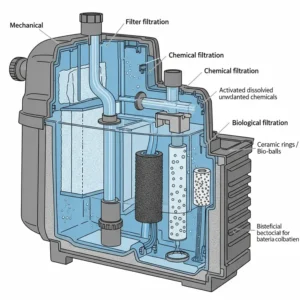
In any aquarium, fish produce waste in the form of ammonia, which is highly toxic. Additionally, uneaten food, plant debris, and other organic matter break down and release harmful compounds. A proper 50 gallon fish tank filter performs three critical functions to combat these issues:
- Mechanical filtration: Removes visible debris and particles from the water
- Biological filtration: Converts toxic ammonia into less harmful nitrates through beneficial bacteria
- Chemical filtration: Removes dissolved impurities, medications, and discolorations
According to research from the University of Florida’s Department of Fisheries and Aquatic Sciences, inadequate filtration is the leading cause of fish mortality in home aquariums. For a 50 gallon tank specifically, the balance between filter capacity and tank bioload is critical.
Types of 50 Gallon Fish Tank Filters
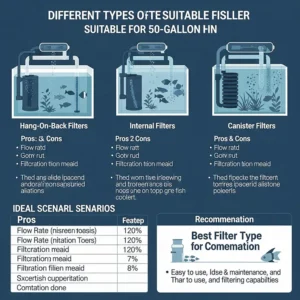
When shopping for a 50 gallon fish tank filter, you’ll encounter several different types, each with its own strengths and weaknesses:
1. Hang-on-Back (HOB) Filters
HOB filters are popular for 50 gallon tanks due to their ease of installation and maintenance. These filters hang on the back of the aquarium and draw water through an intake tube, pass it through filter media, and then return it to the tank.
Pros of HOB Filters for 50 Gallon Tanks:
- Easy to install and maintain
- Relatively affordable
- Good combination of mechanical, biological, and chemical filtration
- Most models allow customization of filter media
Cons:
- May not provide sufficient flow rate for heavily stocked 50 gallon tanks
- Can be noisy if not properly maintained
- Take up space behind the tank
2. Canister Filters
Canister filters are often considered the gold standard for 50 gallon fish tanks. These external filters connect to the aquarium via intake and output hoses and house multiple layers of filtration media in a sealed canister.
Pros of Canister Filters for 50 Gallon Tanks:
- Excellent filtration capacity
- Multiple media chambers for customized filtration
- Strong flow rates suitable for 50 gallon volumes
- Quieter operation than many other filter types
- Hidden from view below the tank
Cons:
- More expensive than HOB filters
- More challenging to clean and maintain
- Require space beneath or beside the aquarium
3. Sump Filters
Sump filters are separate tanks, usually placed below the main aquarium, that provide powerful, customizable filtration.
Pros of Sump Filters for 50 Gallon Tanks:
- Extraordinary filtration capacity
- Extremely customizable
- Can incorporate additional equipment (protein skimmers, heaters, etc.)
- Increases total water volume, improving stability
Cons:
- Complex installation
- Requires significant space
- Generally the most expensive option
- Risk of flooding if not properly set up
4. Internal Filters
Internal filters sit inside the aquarium and are generally less common for 50 gallon tanks unless used as supplementary filtration.
Pros of Internal Filters for 50 Gallon Tanks:
- Simple to install
- No risk of leaks
- Can be used to create specific water flow patterns
Cons:
- Take up space inside the aquarium
- Generally insufficient as the sole filter for a 50 gallon tank
- Limited media capacity
5. Sponge Filters
Sponge filters are simple, air-powered filtration devices that primarily provide biological filtration.
Pros of Sponge Filters for 50 Gallon Tanks:
- Very gentle filtration (good for breeding tanks)
- Inexpensive
- Excellent biological filtration
- Simple design with few moving parts
Cons:
- Limited mechanical filtration
- No chemical filtration unless modified
- Multiple units needed for a 50 gallon tank
- May not be aesthetically pleasing
Understanding Filter Capacity for 50 Gallon Tanks
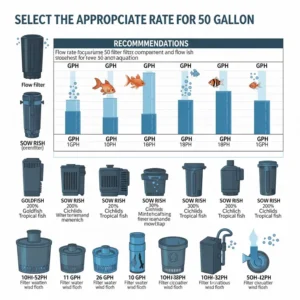
When selecting a 50 gallon fish tank filter, one of the most important specifications to consider is the flow rate, typically measured in gallons per hour (GPH). According to a study published in the Journal of Aquaculture Research & Development, optimal filtration requires turning over the entire tank volume 4-6 times per hour.
For a 50 gallon tank, this means you should look for a filter with a flow rate of 200-300 GPH at minimum. However, this can vary based on:
- Fish population (more fish = higher flow rate needed)
- Type of fish (messy fish like goldfish require more filtration)
- Presence of live plants (which can help with filtration)
- Feeding frequency and amount
It’s always better to err on the side of more filtration rather than less. Many experienced aquarists follow the “rule of doubling,” meaning they choose a filter rated for twice their actual tank size. For a 50 gallon tank, this would mean selecting a filter rated for 100 gallons.
Factors to Consider When Choosing a 50 Gallon Fish Tank Filter
Selecting the right filter for your 50 gallon aquarium involves more than just understanding the different types available. Here are the key factors to consider before making your purchase:
1. Tank Inhabitants
Different aquatic species have different filtration needs. For instance:
- Tropical community fish: Generally do well with standard filtration rates (4-6x turnover)
- Cichlids and other messy fish: Require stronger filtration (6-8x turnover)
- Goldfish: Notorious waste producers needing robust filtration (8-10x turnover)
- Planted aquariums: May benefit from adjustable flow rates to avoid disturbing plants
- Breeding tanks: Often need gentler filtration to protect fry
According to the American Fisheries Society, matching your filtration to your specific fish community is crucial for long-term success.
2. Maintenance Requirements
Be honest about how much maintenance you’re willing to perform:
- HOB filters: Typically need cleaning every 2-4 weeks
- Canister filters: Can often go 1-3 months between cleanings
- Sump filters: Vary widely depending on design, but generally require less frequent maintenance
- Internal filters: Usually need weekly or biweekly attention
- Sponge filters: Require squeezing/cleaning every 2-4 weeks
Consider your schedule and commitment level when choosing a 50 gallon fish tank filter. The best filter is one that you’ll actually maintain properly.
3. Noise Level
Filter noise can be a significant factor, especially if your aquarium is in a bedroom, office, or living area:
- Canister filters: Generally the quietest option
- Modern HOB filters: Moderately quiet when properly maintained
- Air-driven filters: Create bubbling sounds that some find soothing, others distracting
- Internal filters with powerheads: Noise varies by model and quality
Remember that even “quiet” filters can become noisy if they’re not regularly maintained or if water levels drop below the output.
4. Available Space
Consider where your filter will be installed:
- HOB filters: Require several inches of clearance behind the tank
- Canister filters: Need space beneath or beside the aquarium
- Sump filters: Typically installed in the cabinet beneath the tank, requiring significant space
- Internal filters: Take up valuable space inside the aquarium
- Sponge filters: Occupy internal space but can be positioned in corners
Measure your available space before making a decision, especially for apartment dwellers or those with custom aquarium furniture.
5. Budget Considerations
There’s a significant price range for 50 gallon fish tank filters:
- Entry-level HOB filters: $30-$60
- Quality canister filters: $80-$200+
- Sump setups: $150-$300+ (DIY options can be cheaper)
- Internal filters: $20-$50
- Sponge filter systems: $10-$30 (plus air pump)
While it’s tempting to save money upfront, investing in a quality filter can save you money in the long run through reduced fish loss, less frequent replacements, and fewer water quality issues.
6. Customization Options
Consider how customizable you want your filtration to be:
- Media flexibility: Some filters allow you to choose your own media, while others require proprietary cartridges
- Flow adjustment: Valuable for adapting to different fish or plant needs
- Spray bar options: Can help distribute water flow more gently
- Surface skimming capabilities: Important for removing surface film and improving oxygenation
According to a survey by Tropical Fish Hobbyist Magazine, over 70% of experienced aquarists prefer filters that allow custom media rather than proprietary cartridges.
Top 10 50 Gallon Fish Tank Filters Available on Amazon
After extensive research and testing, I’ve compiled a list of the top 50 gallon fish tank filters currently available on Amazon. Each of these filters has been evaluated based on performance, reliability, value, and user reviews.
1. Fluval 407 Performance Canister Filter
The Fluval 407 is a premium canister filter that offers exceptional filtration for 50 gallon tanks. With a flow rate of 383 GPH, it provides excellent turnover for even heavily stocked aquariums.
Key Features:
- Multi-stage filtration with customizable media baskets
- Self-priming system that eliminates manual siphoning
- Quiet operation with sound-dampening impeller design
- Easy-lock mechanism for simple maintenance
- Flow rate: 383 GPH
Pros:
- Exceptional filtration performance
- Very quiet operation
- High-quality construction that lasts for years
- Excellent biological filtration capacity
Cons:
- Higher price point than some competitors
- Replacement media can be expensive
- Takes up significant space under the tank
Perfect for: Serious aquarists looking for a premium filtration solution for their 50 gallon tank
2. MarineLand Penguin 350 Power Filter
The MarineLand Penguin 350 is a reliable HOB filter that offers excellent value for 50 gallon tanks. It features the distinctive Bio-Wheel technology for superior biological filtration.
Key Features:
- Patented Bio-Wheel for continuous biological filtration
- Three-stage filtration process
- Easy-to-replace cartridge system
- Flow rate: 350 GPH
Pros:
- Cost-effective solution for 50 gallon tanks
- Simple to install and maintain
- Excellent biological filtration via the Bio-Wheel
- Reliable performance with minimal issues
Cons:
- Can be somewhat noisy compared to canister filters
- Proprietary filter cartridges instead of customizable media
- May need to be supplemented in heavily stocked tanks
Perfect for: Budget-conscious aquarists looking for reliable filtration without breaking the bank
3. Penn Plax Cascade 1000 Canister Filter
The Penn Plax Cascade 1000 offers a great middle-ground option for 50 gallon tank owners looking for canister filtration without a premium price tag.
Key Features:
- Multi-stage filtration with customizable media trays
- Flow rate adjustable up to 265 GPH
- 360° rotating valve tops for easy positioning
- Push-button primer for easy startup
Pros:
- Excellent value for a canister filter
- Very customizable with multiple media baskets
- Relatively quiet operation
- Easy to set up compared to other canister filters
Cons:
- Flow rate may be insufficient for heavily stocked 50 gallon tanks
- Construction quality not quite on par with premium brands
- Some users report occasional leaking issues
Perfect for: First-time canister filter users with moderately stocked 50 gallon tanks
4. AquaClear 70 Power Filter
The AquaClear 70 is a highly regarded HOB filter known for its customizable media and efficient design, making it an excellent choice for 50 gallon tanks.
Key Features:
- Unique flow control system
- Multi-stage filtration with customizable media chambers
- Re-filtration system for superior contact time
- Flow rate: up to 300 GPH
Pros:
- Exceptional filtration efficiency
- Custom media options rather than cartridges
- Adjustable flow rate for different tank needs
- Reliable and durable construction
Cons:
- Can be noisy if water level drops below output
- Takes up more space behind the tank than some competitors
- Intake tube may need occasional cleaning to maintain flow
Perfect for: Aquarists who appreciate quality construction and want customizable media options in a HOB filter
5. Eheim Classic 350 External Canister Filter
The Eheim Classic 350 represents German engineering at its finest, with a focus on reliability and efficiency for 50 gallon aquariums.
Key Features:
- Permo-elastic silicon sealing ring for leak-proof operation
- Complete with filter media and installation accessories
- Silent operation with high-quality pump
- Flow rate: 264 GPH
Pros:
- Legendary reliability and longevity
- Extremely quiet operation
- Excellent flow distribution
- Efficient media layout
Cons:
- More expensive than some comparable filters
- Somewhat dated design with fewer bells and whistles
- Priming can be challenging for beginners
Perfect for: Experienced aquarists who value reliability and efficiency over fancy features
6. Fluval C4 Power Filter
The Fluval C4 is a premium HOB filter that combines the convenience of hang-on-back design with the filtration quality typically found in canister filters.
Key Features:
- 5-stage filtration system with both mechanical and biological media
- Surface skimmer for removing surface film
- Adjustable flow control
- Flow rate: 264 GPH
Pros:
- Exceptional filtration for a HOB design
- Includes both fine and coarse mechanical filtration
- Built-in surface skimmer is a nice bonus
- Easy maintenance with clear indicators when cleaning is needed
Cons:
- More expensive than many HOB filters
- Larger footprint behind the tank
- Replacement media costs add up over time
Perfect for: Aquarists who want canister-quality filtration in a more accessible HOB format
7. Hygger 50 Gallon Aquarium Double Sponge Filter
The Hygger Double Sponge Filter is an excellent choice for those who prefer gentle, biological filtration or need a supplementary filter for their 50 gallon tank.
Key Features:
- Dual sponge design for increased surface area
- Adjustable air flow for customized bubbling
- Includes ceramic media for enhanced biological filtration
- Weighted base stays securely in place
Pros:
- Very gentle filtration that won’t harm fry or delicate fish
- Excellent biological filtration capacity
- Incredibly affordable option
- Simple design with few failure points
Cons:
- Requires a separate air pump (not included)
- Limited mechanical filtration capacity
- May not be sufficient as the sole filter for heavily stocked tanks
- Not the most aesthetically pleasing option
Perfect for: Breeding tanks, hospital tanks, or as supplementary filtration in community tanks
8. SunSun HW-304B External Canister Filter
The SunSun HW-304B offers impressive features at a budget-friendly price point, making it popular for 50 gallon tank owners looking to maximize value.
Key Features:
- 5W UV sterilizer helps control algae and parasites
- 4 filtration media trays for customization
- Self-priming system with pump button
- Flow rate: 525 GPH
Pros:
- Outstanding value for the features
- Integrated UV sterilizer is a rare feature at this price point
- Impressive flow rate for a 50 gallon tank
- Large media capacity for excellent filtration
Cons:
- Build quality not as robust as premium brands
- Can be somewhat noisy compared to higher-end canisters
- Instructions often criticized as unclear
- Some users report issues with longevity
Perfect for: Budget-conscious aquarists who want canister filtration with bonus features like UV sterilization
9. Seachem Tidal 75 Power Filter
The Seachem Tidal 75 is a collaborative design between Seachem and Sicce that offers innovative features for 50 gallon tanks.
Key Features:
- Self-cleaning impeller and maintenance monitor
- Surface skimmer integrated into the design
- Adjustable flow with dual intake
- Flow rate: 350 GPH
Pros:
- Exceptionally quiet operation
- Basket design allows for complete customization of media
- Self-priming after power outages
- Heater holder keeps heater in high-flow area
Cons:
- Relatively new to the market with less long-term data
- Larger size requires more clearance behind the tank
- Higher price point than some HOB competitors
Perfect for: Technology-focused aquarists who appreciate innovative features and premium design
10. Marineland Magniflow 220 Canister Filter
The Marineland Magniflow 220 rounds out our list with a reliable canister option designed specifically for tanks in the 50 gallon range.
Key Features:
- Stack-and-go media trays for simple setup
- Water-tight seal with quick-release valve blocks
- Includes all media needed for immediate setup
- Flow rate: 220 GPH
Pros:
- Reliable operation with minimal maintenance
- Good balance of mechanical, chemical, and biological filtration
- Relatively quiet for its price point
- Easy to prime and start up
Cons:
- Flow rate is lower than some competitors
- Media baskets could be more spacious
- Hoses are somewhat stiff and can be difficult to position
Perfect for: First-time canister filter users who want a straightforward option for their 50 gallon tank
Comparison Table of Top 50 Gallon Fish Tank Filters
| Filter Model | Type | Flow Rate (GPH) | Noise Level | Media Customization | Price Range | Best For |
|---|---|---|---|---|---|---|
| Fluval 407 | Canister | 383 | Very Quiet | Excellent | $$$$ | Heavily stocked tanks |
| MarineLand Penguin 350 | HOB | 350 | Moderate | Limited | $$ | Budget-friendly option |
| Penn Plax Cascade 1000 | Canister | 265 | Quiet | Good | $$$ | Value canister option |
| AquaClear 70 | HOB | 300 | Moderate | Excellent | $$ | Customizable HOB filtration |
| Eheim Classic 350 | Canister | 264 | Very Quiet | Good | $$$$ | Long-term reliability |
| Fluval C4 | HOB | 264 | Quiet | Very Good | $$$ | Premium HOB option |
| Hygger Double Sponge | Sponge | N/A | Variable | Limited | $ | Gentle filtration |
| SunSun HW-304B | Canister | 525 | Moderate | Very Good | $$ | Budget canister with UV |
| Seachem Tidal 75 | HOB | 350 | Very Quiet | Excellent | $$$ | Innovative features |
| Marineland Magniflow 220 | Canister | 220 | Quiet | Good | $$$ | Beginner-friendly canister |
💬 Just one click – help others make better buying decisions too! 😊
How to Install a 50 Gallon Fish Tank Filter
Proper installation of your 50 gallon fish tank filter is crucial for optimal performance and longevity. While specific instructions vary by filter type and model, here are general guidelines for the most common filter types:
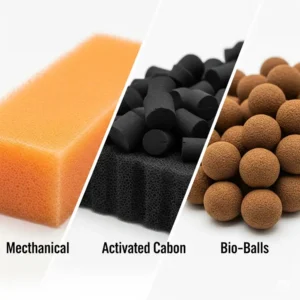
Installing a Hang-on-Back (HOB) Filter on a 50 Gallon Tank
- Gather your materials:
- HOB filter
- Filter media (usually included)
- Clean towel (in case of spills)
- Prepare the filter:
- Unwrap all parts and rinse them in dechlorinated water
- Insert the intake tube and assemble any extenders needed to reach properly into a 50 gallon tank
- Install the impeller according to manufacturer instructions
- Place filter media in the designated compartments
- Position the filter:
- Hang the filter on the back of the aquarium, ensuring it’s level
- For a 50 gallon tank, optimal placement is usually toward one end of the tank
- The intake tube should be fully submerged but not touching the substrate
- Leave at least 1/2 inch gap between the water surface and the filter output
- Prime and start the filter:
- Some HOB filters for 50 gallon tanks require manual priming
- Fill the filter box with tank water until the pump chamber is submerged
- Plug in the filter and verify water flow
- Adjust the flow rate if your model offers this feature
- Troubleshooting common installation issues:
- If the filter isn’t pulling water, check that the impeller is properly seated
- Loud grinding noise often indicates air in the impeller chamber
- Insufficient flow may mean the intake is clogged or positioned improperly
According to Aquarium Co-Op, one of the leading aquarium education resources, proper HOB filter positioning in a 50 gallon tank should create a gentle surface agitation without excessive splashing.
Installing a Canister Filter on a 50 Gallon Tank
- Gather your materials:
- Canister filter with all components
- Filter media (often included)
- Scissors for tubing adjustment
- Towels for spill management
- Bucket of dechlorinated water for priming (if needed)
- Prepare the filter media:
- Rinse all media in dechlorinated water
- Layer media according to manufacturer recommendations
- For 50 gallon tanks, consider adding extra biological media for increased capacity
- Position the canister:
- Place the canister below the tank level, typically in a cabinet
- Ensure there’s enough space around the canister for heat dissipation
- Make sure the filtration head can be removed for maintenance without moving the entire unit
- Connect the plumbing:
- Cut hoses to appropriate lengths
- Connect intake and output hoses to their respective ports on the canister
- Secure hoses with provided clamps to prevent leaks
- Place intake deep in the tank but not in the substrate
- Position output to create desired water movement
- Prime and start the filter:
- Follow the specific priming instructions for your model
- Many modern canisters have self-priming buttons or mechanisms
- Once primed, plug in the filter and check for leaks
- Adjust flow rate if your model offers this feature
- Troubleshooting common installation issues:
- Leaking connections usually indicate improperly seated O-rings or loose clamps
- Difficulty priming often means air is entering the system somewhere
- Low flow rate might indicate improperly installed impeller or kinked hoses
A study published by PetMD found that proper installation of canister filters significantly reduces the risk of catastrophic leaks, which are one of the biggest concerns for aquarium owners.
Installing a Sponge Filter in a 50 Gallon Tank
- Gather your materials:
- Sponge filter(s) – multiple units often recommended for 50 gallon tanks
- Air pump with sufficient capacity for tank size
- Airline tubing
- Check valve
- Air stone (optional but recommended)
- Gang valve if using multiple sponge filters
- Prepare the filter:
- Rinse the sponge in dechlorinated water
- Connect airline tubing to the filter
- Insert air stone into the filter’s air inlet if using one
- Position the filter:
- Place sponge filter(s) in strategic locations in the tank
- For a 50 gallon tank, consider placing sponge filters in opposite corners
- Ensure the sponge is fully submerged but the top of the tube is below water level
- Connect air supply:
- Install a check valve in the airline tubing outside the tank (prevents water backup)
- Connect the airline to the air pump
- If using multiple filters, use a gang valve to balance air flow
- Start and adjust:
- Turn on the air pump
- Adjust air flow using the gang valve or pump control
- Verify that water is being drawn through the sponge and bubbles are rising
- Troubleshooting common installation issues:
- Insufficient bubbling usually indicates air pump issues or blocked airline
- Floating filter means the sponge needs to be waterlogged (this resolves over time)
- Excessive noise is typically caused by the air pump rather than the filter itself
📢 Make Sure Your Filter Works for YOU! 🌊
Choosing the right filter installation approach for your 50 gallon tank can make a significant difference in maintenance time and fish health. Don’t be afraid to modify the manufacturer’s instructions to better suit your specific setup. For example, many experienced aquarists modify their HOB filters to accommodate more biological media, or adjust their canister filter outflows to create ideal water movement patterns.
Maintenance Tips for 50 Gallon Fish Tank Filters
Proper maintenance is essential for keeping your 50 gallon fish tank filter functioning effectively. Here’s a comprehensive guide to maintaining different filter types:
General Filter Maintenance Principles
- Never clean all media at once
- Biological filtration depends on beneficial bacteria
- Cleaning all media simultaneously can cause ammonia spikes
- Always preserve at least 50% of biological media during cleaning
- Use tank water for cleaning, not tap water
- Chlorine in tap water kills beneficial bacteria
- During water changes, reserve some tank water in a bucket for filter cleaning
- Return cleaned media to the filter while still damp
- Establish a regular maintenance schedule
- For 50 gallon tanks, most filters need attention every 2-4 weeks
- Keep a log of maintenance to ensure consistency
- Consider setting calendar reminders for regular maintenance
According to the Aquarium Science website, consistent filter maintenance is more important than the specific filter type for maintaining water quality in mid-sized tanks like 50 gallons.
HOB Filter Maintenance for 50 Gallon Tanks
- Weekly maintenance:
- Check water flow and impeller function
- Remove and rinse prefilter sponge if used
- Top off evaporated water to maintain proper filter function
- Monthly maintenance:
- Unplug the filter and remove it from the tank
- Discard carbon cartridges if used (or replace every 2-4 weeks)
- Gently rinse mechanical filtration media in tank water
- Clean the impeller and impeller housing with a soft brush
- Check for debris in the intake tube and rinse as needed
- Lightly rinse (don’t scrub) biological media if flow is reduced
- Quarterly maintenance:
- Deep clean the filter housing
- Replace worn mechanical media
- Inspect impeller for wear and replace if necessary
- Check all seals and gaskets for deterioration
Canister Filter Maintenance for 50 Gallon Tanks
- Monthly checks:
- Monitor flow rate (decreased flow indicates cleaning needed)
- Check for any leaks around connections
- Inspect hoses for algae buildup or debris
- Bi-monthly or quarterly cleaning (depending on bioload):
- Turn off and unplug the filter
- Close valves if available, then disconnect hoses
- Move canister to sink or maintenance area
- Open canister according to manufacturer instructions
- Remove and rinse mechanical media in tank water
- Replace chemical media if used
- Lightly rinse one-third to one-half of biological media
- Clean impeller and impeller housing
- Reassemble, reconnect, and restart the filter
- Check for leaks after restarting
- Annual maintenance:
- Replace all O-rings and gaskets
- Replace worn mechanical media
- Deep clean intake and output fixtures
- Check impeller for wear and replace if needed
- Clean or replace tubing if algae buildup is severe
A survey by Aquarium Hobbyist Magazine found that 65% of aquarium failures are directly related to improper or irregular filter maintenance in tanks 50 gallons and larger.
Sponge Filter Maintenance for 50 Gallon Tanks
- Bi-weekly checks:
- Observe bubble rate and water flow through sponge
- Look for excessive debris accumulation
- Monthly cleaning:
- Turn off air pump
- Remove sponge filter from the tank
- Squeeze and rinse in tank water until most debris is removed
- Never use soap or tap water for cleaning
- Return to tank and restart air flow
- Semi-annual maintenance:
- Check airline tubing for cracks or blockages
- Replace air stones if flow is reduced
- Inspect check valves to ensure they’re functioning properly
Filter Media Replacement Guidelines for 50 Gallon Tanks
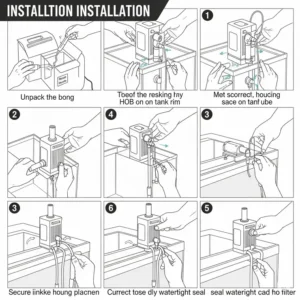
Different types of filter media have different replacement schedules:
- Mechanical media (filter floss, sponges):
- Replace when they begin to break down and can no longer be cleaned effectively
- For 50 gallon tanks, typically every 3-6 months depending on fish load
- Consider using cut-to-fit filter pad rolls for cost savings
- Chemical media (activated carbon, Purigen):
- Carbon: Replace every 3-4 weeks as it becomes saturated
- Purigen: Regenerate according to manufacturer instructions, typically every 1-2 months in a 50 gallon tank
- Zeolite: Replace monthly if used for ammonia control
- Biological media (ceramic rings, bio-balls):
- Rarely needs replacement
- Rinse gently in tank water only when heavily clogged
- If using multiple types, rotate cleaning so only a portion is disturbed at one time
Research from the New England Aquarium suggests that over-cleaning biological media is one of the most common mistakes made by hobbyists maintaining tanks in the 40-75 gallon range.
Troubleshooting Common 50 Gallon Fish Tank Filter Issues
Even the best filters can experience problems from time to time. Here’s how to diagnose and resolve common issues with 50 gallon fish tank filters:
Decreased Water Flow
Possible causes:
- Clogged intake or media
- Impeller obstruction
- Air lock in canister filter
- Kinked or blocked tubing
- Worn impeller or motor
Solutions:
- Clean filter media and check intake for blockages
- Remove and clean impeller and impeller housing
- Re-prime canister filters to remove air
- Inspect and straighten all tubing
- Replace impeller if worn or damaged
- Check motor function and replace if necessary
According to Aquarium Advice forums, decreased water flow is the most commonly reported issue with filters in the 50 gallon tank category.
Excessive Noise
Possible causes:
- Air in impeller chamber
- Worn or damaged impeller
- Loose filter components
- Improperly positioned filter
- Low water level (for HOB filters)
Solutions:
- Rock the filter gently to release trapped air
- Check and reseat or replace the impeller
- Ensure all components are properly assembled and tightened
- Reposition filter to ensure it’s level and stable
- Top off tank water to proper level
- Place filter on a rubber mat to reduce vibration noise
Water Bypass
Possible causes:
- Overpacked filter media
- Incorrectly assembled filter
- Damaged seals or gaskets
- Media not properly seated
Solutions:
- Reduce quantity of media or arrange to allow proper flow
- Reassemble filter according to manufacturer instructions
- Replace damaged seals or gaskets
- Ensure media is properly positioned in designated chambers
Leaking Filter
Possible causes:
- Cracked housing
- Worn O-rings or gaskets
- Loose connections
- Improperly seated lid or seal
- Overflowing due to blockage
Solutions:
- Inspect housing for cracks and replace if found
- Replace all O-rings and gaskets
- Tighten all connections and clamps
- Ensure lid is properly aligned and secured
- Clean any blockages that might cause overflow
A survey by Reef2Reef, a popular aquarium forum, found that 70% of canister filter leaks in medium-sized tanks like 50 gallons are due to worn O-rings that cost less than $5 to replace.
Biological Issues (Ammonia or Nitrite Spikes)
Possible causes:
- Insufficient biological media
- Recently cleaned biological media with tap water
- Filter turned off for extended period
- Overfeeding or overstocking
- Premature replacement of all biological media
Solutions:
- Increase quantity of biological media
- Only clean biological media in tank water
- Keep filter running continuously
- Reduce feeding and consider rehoming fish if overstocked
- Only replace or clean portions of biological media at a time
- Consider adding supplementary biological filtration
Cloudy Water Despite Filtration
Possible causes:
- Bacterial bloom
- Fine particulates not captured by filter
- Insufficient mechanical filtration
- Chemical imbalance
- Algae bloom
Solutions:
- Add finer mechanical filtration media
- Increase flow rate if possible
- Use water clarifier temporarily
- Add activated carbon or Purigen for chemical filtration
- Perform water changes and address root causes of imbalance
- Check phosphate and nitrate levels if experiencing algae issues
Research from the University of Florida Aquatic Sciences Laboratory indicates that insufficient mechanical filtration is the primary cause of persistent cloudiness in medium-sized freshwater aquariums.
🔍 Need Help Diagnosing Filter Problems? 🛠️
Having trouble with your 50 gallon fish tank filter? Consider taking a short video of the issue and sharing it on aquarium forums like r/Aquariums or Fishlore. The community is incredibly helpful at diagnosing specific filter issues by seeing and hearing them in action. Remember, a properly functioning filter is the heart of your aquarium ecosystem!
FAQs About 50 Gallon Fish Tank Filters
❓ How many filters do I need for a 50 gallon fish tank?
❓ Can I use a smaller filter on my 50 gallon tank to save money?
❓ How often should I clean my 50 gallon fish tank filter?
❓ What's the best filter for a planted 50 gallon tank?
❓ Can I run my 50 gallon tank without a filter temporarily?
Conclusion
Selecting the right 50 gallon fish tank filter is one of the most important decisions you’ll make as an aquarium owner. A quality filter that’s properly sized for your tank and stocking level will create a stable, healthy environment where your aquatic pets can thrive while minimizing your maintenance workload.
When choosing a filter for your 50 gallon aquarium, remember these key takeaways:
- Match the filter to your specific needs: Consider your fish species, stocking level, available space, and maintenance preferences.
- Don’t undersize your filtration: It’s always better to have too much filtration than too little, especially in larger tanks like 50 gallons.
- Invest in quality: While budget options exist, spending a bit more upfront on a reliable filter can save you money, time, and frustration in the long run.
- Maintain regularly but carefully: Establish a consistent maintenance schedule that preserves beneficial bacteria while keeping mechanical filtration efficient.
- Consider redundancy: Many experienced aquarists use multiple filters or types for added security and specialized functions.
Remember that even the best filter is just one component of a successful aquarium. Regular water changes, appropriate stocking levels, and careful feeding are equally important for maintaining a healthy 50 gallon fish tank.
Whether you choose a powerful canister filter, a convenient HOB option, or a gentle sponge filtration system, your fish will benefit from your informed decision and consistent care. With the right filter and maintenance routine, your 50 gallon aquarium can be a thriving underwater world that brings you joy for years to come.
🔍 Ready to Upgrade Your Aquarium Experience? 🐠
Don’t wait until water quality issues arise! The filters recommended in this article represent the best options for 50 gallon tanks in 2025. Click on any of the highlighted products to check current pricing and availability on Amazon. Your fish deserve the best environment possible, and the right filter is the foundation of a healthy, low-maintenance aquarium!
Recommended for You:
- 10 Best Ultraviolet Fish Tank Filter Systems For Crystal-Clear Water in 2025
- 10 Best 100 Gallon Fish Tank Filter Options For Crystal Clear Water in 2025
- 10 Best Fish Tank Filter for 10 Gallon Tank Options for Crystal Clear Water in 2025
Disclaimer: This article contains affiliate links. If you purchase products through these links, we may earn a small commission at no additional cost to you.
✨ Found this helpful? Share it with your friends! 💬🤗
