
In This Article
There’s a moment every angler knows — that split-second when something tugs the line and your rod either fires back like a whip or goes limp like a wet noodle. The difference between those two scenarios? Almost always comes down to rod action. And if you’re serious about landing fish rather than just entertaining them, a fast action spinning rod is one of the most impactful upgrades you can make to your setup.
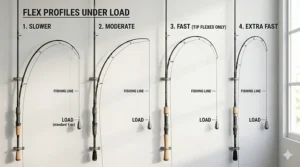
But here’s what nobody tells beginners (and what plenty of experienced anglers still get wrong): “fast action” isn’t just a marketing buzzword slapped on packaging to sound cool. It’s a precise description of where a rod flexes along the blank. A fast action spinning rod bends primarily in the top third of the rod — meaning the butt and middle sections stay stiff and powerful, while only the tip loads up during a cast. That stiffness translates directly into two critical advantages: sharper sensitivity (you feel every tick, bump, and subtle mouthing of a lure) and faster, more explosive hooksets.
What is a fast action spinning rod? In simple terms, it’s a rod designed to bend only at the tip section — roughly the upper 20–30% of the blank — allowing for immediate energy transfer when a fish strikes, precise lure control, and long, accurate casting with lighter presentations. This makes it the go-to tool for techniques like drop-shotting, ned rigging, jigging, and working soft plastics where telegraphing subtle bites is everything.
The U.S. recreational fishing industry sees over 50 million anglers hit the water each year according to NOAA Fisheries data, and the debate about rod action has never been louder. Which brands are actually delivering on their promises? Which specs matter and which are pure marketing fluff? In this guide, I’ve done the research so you don’t have to — testing specs, reading verified buyer feedback, and putting together the most honest breakdown of the seven best fast action spinning rods available on Amazon right now.
Quick Comparison: Best Fast Action Spinning Rods at a Glance (2026)
| Rod | Material | Action | Power | Best For | Price Range |
|---|---|---|---|---|---|
| KastKing Perigee II | 24-ton Carbon | Fast | Med / Med-Heavy | Budget versatility | Under $50 |
| Ugly Stik Elite | Graphite/Fiberglass | Fast | Medium | Durability seekers | $50–$80 |
| St. Croix Triumph (TSR) | SCII Carbon | Fast | Med-Lt to Med-Hvy | All-round performance | $90–$130 |
| Fenwick HMG | 30/24-ton Graphite blend | Fast/Mod-Fast | Light to Medium | Finesse & sensitivity | $80–$120 |
| G. Loomis NRX+ | Spiral X Advanced Graphite | Extra-Fast | Med-Lt to Med | Pro-level bass/finesse | $300–$400 |
| Okuma SST | IM-8 Graphite | Fast | Med-Lt / Medium | Trout, steelhead, walleye | $50–$80 |
| St. Croix Premier (PS) | SCII Carbon | Fast | Med to Med-Heavy | Mid-budget step-up | $130–$180 |
Looking at this table, the pattern is clear: if budget is your primary concern, the KastKing Perigee II and Okuma SST deliver genuine fast action performance at entry-level prices. The middle ground — St. Croix Triumph and Fenwick HMG — offers the sweet spot of sensitivity and build quality without requiring a second mortgage. And if you’re chasing the absolute ceiling of performance, the G. Loomis NRX+ is in a class of its own. Budget buyers should note that stepping up even $30–40 from the cheapest options lands you in a noticeably different tier of blank construction.
💬 Just one click — help others make better buying decisions too! 😊
Top 7 Fast Action Spinning Rods: Expert Analysis
1. KastKing Perigee II Spinning Rod
The Perigee II is the rod that keeps embarrassing rods that cost three times as much. Available in an almost absurd 42 configurations — covering lengths from 5’6″ up to 7′, in medium through medium-heavy power — this is KastKing’s flagship value-tier rod, and it absolutely earns that title.
Specs with real-world meaning: The blank is built from Toray 24-ton carbon fiber using KastKing’s KastFlex technology, which means you’re getting a material stiffness level that was considered mid-tier just five years ago. At 24-ton, the Perigee II has enough modulus to be genuinely sensitive — you’ll feel light bites on soft plastics — without becoming brittle under pressure. The Fuji O-Ring guides are not a knock-off equivalent; they’re the same guides that top-end rods use, and they handle braided line without the fraying issues you get on cheaper stainless guides. High-density EVA grips round out a package that frankly shouldn’t exist at this price point.
What most buyers overlook about this model is the KastKing PTS (Power Transition System) joint technology in the two-piece versions. Cheap two-piece rods feel like two sticks duct-taped together. The Perigee II’s hybrid spigot joint transitions power smoothly through the blank — so your hookset doesn’t die at the ferrule. For anglers fishing jigs or finesse techniques on a budget, this is genuinely game-changing.
Customer feedback consistently praises the rod’s surprising sensitivity and the quality of the Fuji guides for a sub-$50 price point. A few reviewers note that the EVA grip isn’t quite as premium-feeling as cork, though this is expected at this price tier.
✅ Fuji O-Ring guides at a budget price
✅ 42 size options for maximum versatility
✅ Twin-tip variant gives you two rods for one price
❌ EVA grip lacks the tactile warmth of cork
❌ Lighter models can feel slightly tip-heavy on some setups
Price range: Under $50. For the money, it’s almost unreasonably good value — the definition of overperforming its price tag.
2. Ugly Stik Elite Spinning Rod
If fishing gear had a Mount Rushmore, Ugly Stik would probably have two faces on it. The Elite series is the evolution of one of the most legendary rods in American fishing history, and Shakespeare didn’t just slap “Elite” on the old GX2 — they actually made meaningful changes.
Specs with real-world meaning: The Elite features 35% more graphite construction compared to the standard GX2, which isn’t a trivial upgrade. More graphite means less fiberglass in the blend — a lighter, more sensitive blank that still retains the famous Ugly Stik indestructibility. The Clear Tip design (a transparent fiberglass tip section) is one of those old-school engineering choices that actually works: it absorbs shock during fights with hard-running fish, dramatically reducing break-offs compared to pure graphite tips. Ugly Tuff one-piece stainless steel guides with Zirconium inserts handle braid, mono, or fluoro without complaint. Available in 7′ medium/fast action — one of the most universally useful rod specs in fishing.
The spec sheet won’t tell you this, but the real reason experienced anglers keep recommending the Ugly Stik Elite is durability under neglect. Stored improperly, fished hard in salt spray, dropped on boat decks — this rod handles abuse that would damage a more delicate graphite-only construction. If you’re buying a rod for a teenager, a first-time adult angler, or a “vacation rod” that’s going to get thrown in a truck bed, the Elite’s hybrid construction is a genuine practical advantage.
Customer reviews are overwhelmingly positive, with over 3,900 ratings averaging 4.4 stars on Amazon — one of the strongest track records in the category.
✅ 35% more graphite than original GX2 for better sensitivity
✅ Shock-absorbing Clear Tip reduces break-offs on hard fights
✅ Proven track record with thousands of verified reviews
❌ Heavier than pure graphite alternatives in the same price range
❌ Not the ideal choice for ultra-finesse presentations requiring maximum blank sensitivity
Price range: $50–$80 range. For a rod that balances toughness, sensitivity, and proven performance, it’s a strong buy.
3. St. Croix Triumph Spinning Rod (TSR)
There’s a reason fishing guides, tournament anglers, and everyday weekend warriors keep coming back to St. Croix. The Triumph series specifically hits the intersection of “actually affordable” and “actually premium” — a position very few rods manage to occupy convincingly.
Specs with real-world meaning: The blank is built from premium SCII carbon, St. Croix’s proprietary high-strain-rate graphite that’s meaningfully stiffer and lighter than generic graphite composites. In practical terms, SCII carbon transmits vibration from the lure to your hand faster and more accurately — you’ll detect the difference between a bass gently picking up a drop-shot versus a rock when the lure taps bottom, which is a distinction that translates directly to more hookups. The Sea Guide Atlas Performance slim aluminum-oxide guides reduce overall rod weight while maintaining durability. Two coats of Flex-Coat slow-cure finish give the blank excellent protection without adding stiffness. And the 5-year warranty backed by St. Croix’s famous Superstar Service is legitimately one of the best warranty programs in the industry.
What I’d tell you that the product page won’t: the Triumph is one of the few rods in this price range that’s designed in Park Falls, Wisconsin, with genuine technique-specific tuning. Available configurations include medium-light/fast (ideal for drop-shotting and finesse worms), medium/fast (the most versatile all-around choice), and medium-heavy/fast (for punching cover or working heavier jigs). Don’t just grab any configuration — match the power to your primary technique.
Buyers on Tackle Warehouse and Amazon routinely describe this as their “first real rod” — the one that made them realize how much sensitivity they’d been missing.
✅ SCII carbon blank with genuine technique-specific tuning
✅ 5-year warranty with St. Croix’s best-in-class service support
✅ Multiple configurations from med-light to med-heavy
❌ Premium-grade cork handle (excellent), but some users want a longer front grip
❌ Sits at the higher end of the mid-range budget
Price range: $90–$130. Given the blank quality and warranty, this is arguably the best dollar-for-performance rod in its tier.
4. Fenwick HMG Spinning Rod
In 1973, Fenwick invented the graphite fishing rod. No exaggeration — the HMG (High Modulus Graphite) was the first all-graphite rod ever made, and it literally changed the course of fishing tackle history. The modern redesigned HMG carries that legacy forward with some genuinely clever engineering improvements.
Specs with real-world meaning: The blank uses a proprietary blend of 30-ton and 24-ton high modulus graphite bonded with Fenwick’s reinforcing resin — a combination that Fenwick claims delivers 13% greater strength and 8% lighter weight versus the previous generation. The practical result is a rod with a crisp, precise fast action that loads beautifully for distance casting while maintaining excellent blank-to-hand sensitivity. The titanium guide frames with super-thin zirconia inserts are a detail worth noting: titanium doesn’t add guide weight (compared to stainless), which keeps the rod balanced closer to the grip — meaning less arm fatigue on long sessions. The TAC handle (a high-grip polymer material) actually outperforms cork in wet conditions, which matters if you’re fishing rain or sea spray.
Where the Fenwick HMG particularly shines is finesse fishing — ned rigs, drop-shots, light jigs. The soft touch reel seat provides direct contact with the blank, maximizing the transmission of micro-vibrations from your lure. It’s a small thing that makes a massive difference when you’re trying to distinguish a 2-lb walleye finessing a tiny jig from a piece of floating weed.
Buyers consistently praise the balance and weight distribution, with several noting they’ve switched from rods costing twice as much after fishing this one back to back.
✅ 30/24-ton graphite blend — genuinely lighter and stronger than previous generation
✅ TAC handle outperforms cork in wet-weather grip
✅ Titanium guide frames for weight-forward balance
❌ Moderate-fast action options in some configurations — check specs carefully before ordering
❌ Not available in as many power ratings as the St. Croix Triumph lineup
Price range: $80–$120. Particularly good value for finesse-oriented anglers who prioritize weight, balance, and touch.
5. G. Loomis NRX+ Spinning Rod
Everything up to this point has been about value and performance per dollar. The G. Loomis NRX+ is unapologetically about absolute performance, full stop. This is the rod you buy when you’ve stopped asking “is it worth the price?” and started asking “what’s the best possible tool for what I do?”
Specs with real-world meaning: The NRX+ blank is built using Spiral X technology — a manufacturing process where graphite fibers are wound at precise angles to dramatically reduce rod twist during casting and fish-fighting. The practical effect? Faster tip recovery (the rod returns to straight faster after a cast or hookset), which translates to more accurate casts with lighter lures and a more powerful, direct hookset with less energy lost to lateral flex. The CI4+ reel seat is borrowed from Shimano’s high-end reel technology — it’s lighter than traditional reel seats and keeps your hand in direct sensory contact with the blank. The hybrid guide train is optimized for both distance and accuracy. G. Loomis designed 28 individual technique-specific models, meaning there’s a version tuned specifically for drop-shots, another for shakey heads, another for swimbaits — not just generic “medium/fast.”
What most buyers overlook about this model is the real-world casting advantage. On a calm day fishing drop-shots in 20 feet of water, the sensitivity difference between a $100 rod and the NRX+ is subtle. In wind, with current, or when you’re picking up the line with slack in it, the NRX+’s extra sensitivity and blank recovery speed becomes genuinely meaningful. It’s a tournament-grade tool that elevates every technique you fish.
Customer feedback from serious bass anglers is uniformly excellent, with many noting they used the rod side by side with previous NRX series rods and found the recovery speed noticeably improved.
✅ Spiral X technology for twist-free casting and maximum sensitivity
✅ 28 technique-specific models — not generic “medium fast”
✅ American-made blanks from a brand with 40+ years of innovation
❌ Premium price point puts it out of reach for casual or budget-conscious anglers
❌ The refinement is genuinely noticeable — but primarily for experienced anglers who’ll appreciate the difference
Price range: $300–$400. A significant investment that makes sense for tournament anglers and dedicated enthusiasts.
6. Okuma SST Freshwater Spinning Rod (SST-S-661ML)
Okuma doesn’t get the cultural cachet of G. Loomis or the brand recognition of Ugly Stik, but the SST series is a legitimately excellent rod that punches well above its price class — particularly for trout, steelhead, and walleye anglers who need sensitivity without the premium markup.
Specs with real-world meaning: Built on an IM-8 graphite blank — one step above the IM-6 you’ll find in many entry-level rods — the SST delivers meaningfully improved blank sensitivity and a crisper action response. IM-8 graphite has a higher modulus than IM-6, meaning the material is stiffer per unit weight, which directly translates to faster signal transmission from lure to hand. The stainless steel guide frames with Zirconium inserts handle braided line without groove-cutting, a real-world durability advantage that budget-tier guides often fail on. Premium cork grips on both fore and rear sections provide excellent tactile feedback — on a rod primarily used for steelhead or trout fishing where subtle takes are everything, cork outperforms synthetic handles for feel. The technique-specific rod actions are tuned for light-line applications: the 6’6″ medium-light configuration is particularly well-suited to drifting and jigging.
The spec sheet won’t tell you this, but the Okuma SST is a sleeper favorite among Pacific Northwest steelhead guides who need to equip clients with rods that are sensitive enough to detect soft takes on 1/8 oz. jigs but durable enough to hand off to people who’ve never fished before.
Customer reviews consistently highlight the sensitivity and balance, with particular praise for how natural the cork grips feel during long sessions.
✅ IM-8 graphite blank for above-entry-level sensitivity
✅ Zirconium guide inserts for braid-friendly durability
✅ Technique-specific tuning for steelhead, trout, walleye
❌ Only a 1-year limited warranty compared to St. Croix’s 5-year
❌ More specialized toward lighter applications — not the ideal heavy jig or bass rod
Price range: $50–$80 range. Exceptional value for freshwater finesse applications, especially light-line work.
7. St. Croix Premier Spinning Rod (PS)
If the Triumph is St. Croix’s “entry into quality” and the Legend is their trophy case, the Premier sits exactly where serious anglers who’ve outgrown budget rods land before considering whether to go full premium. It’s a rod that feels like an upgrade the moment you pick it up.
Specs with real-world meaning: Like the Triumph, the Premier uses SCII carbon, but the Premier incorporates St. Croix’s Fortified Resin System (FRS) technology — a proprietary resin that strengthens the blank at the fiber level, increasing impact resistance without adding weight. The aluminum-oxide guides with black frames are a step up in polish and performance from standard guides, and the premium-grade cork handle on the Premier is noticeably more refined than the Triumph’s — denser, more contoured, better balanced. Available in fast action across medium through medium-heavy power configurations, with lengths spanning 6′ to 7’6″. The 5-year warranty is identical to the Triumph’s, backed by the same legendary St. Croix service.
What the spec sheet won’t tell you is this: the Premier is handcrafted in Park Falls, Wisconsin — yes, actually made in the USA. For a growing segment of buyers who prioritize domestic manufacturing, that’s a meaningful differentiator. And in terms of pure blank feel, the FRS resin gives the Premier a slightly livelier, more responsive action than the Triumph — experienced anglers will feel it immediately when casting side by side.
Buyers stepping up from the Triumph consistently describe the Premier as the rod that “feels like it thinks ahead of you” — a description that sounds vague until you’ve experienced it on the water.
✅ Handcrafted in the USA with FRS-reinforced SCII carbon blank
✅ Premium cork handle with exceptional density and balance
✅ Noticeably livelier action response than the Triumph
❌ Higher price than competing mid-range options with similar specs on paper
❌ Some configurations sell out quickly due to high demand
Price range: $130–$180. If you’re ready to graduate beyond mid-range, this is the natural next step before going full premium.
✨ Don’t Miss These Exclusive Deals!
🔍 Take your fishing to the next level with these carefully selected rods. Click on any highlighted product name to check current pricing and availability on Amazon. Whether you’re a weekend warrior or a tournament competitor, there’s a fast action spinning rod on this list that’ll change how you feel every strike. 🎣
How to Choose a Fast Action Spinning Rod: 6 Criteria That Actually Matter
Shopping for a responsive spinning rod without a framework is like trying to pick wine by label design. You might get lucky. Or you might spend $150 on a rod that fights you all season. Here’s what actually matters — in order of importance.
1. Match Action to Technique First
Fast action is not a universal upgrade over slower actions. It excels at finesse presentations: drop-shotting, ned rigging, jigging, wacky rigging, and any technique where subtle bite detection is critical. For techniques like crankbaiting or throwing treble-hook lures where you want the fish to have a moment to commit before the hooks load — a moderate action is actually superior. Choose fast action when you’re the one driving hooksets, not the lure.
2. Match Power Rating to Your Target Species
Action and power are completely separate specs, and confusing them is the single most common rod-buying mistake. A fast action/medium-light rod is ideal for finesse bass, trout, and walleye on light line. A fast action/medium-heavy rod handles frog fishing, flipping jigs, and larger bass on heavier cover. Buy the right combination, not just “fast action.”
3. Evaluate Blank Material Honestly
For sensitive tip spinning rods, blank material is everything. IM-8 and IM-10 graphite are stiffer-per-weight than IM-6. Carbon fiber designations like “24-ton” and “30-ton” describe modulus — higher is stiffer and lighter, but also more brittle. For most anglers, 24–30 ton graphite is the ideal range: sensitive enough to detect subtle takes, robust enough to handle real fish and accidental impacts.
4. Guide Quality Determines Long-Term Performance
Cheap aluminum oxide guides groove under braided line within a season, causing cuts and reduced casting distance. Fuji O-Ring guides, zirconium inserts, and titanium guide frames are not luxury items — they’re durability investments. If you fish braid (and most serious anglers do), prioritize guide quality.
5. Handle Material and Length Affect Leverage
Cork handles provide better vibration transmission than EVA foam — a meaningful difference for detecting bites. Longer rear grips (for two-handed casting) increase leverage on long casts and during fights with larger fish. Shorter split grips reduce weight and improve balance. Think about how you fish before defaulting to whatever looks nicest.
6. Warranty Is a Real Differentiator
According to St. Croix’s own service data, a significant percentage of rods are returned for tip breaks — the single most common failure point. A 5-year warranty versus a 1-year warranty isn’t just paperwork — it’s whether you get a free replacement rod in year three when you close it in a car door.
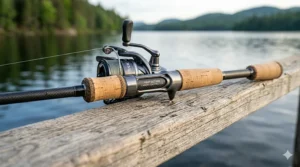
From Angler to Angler: Real-World Scenario Guide
Not everyone is fishing the same body of water, targeting the same species, or standing in the same pair of waders. Here’s how to match yourself to the right rod from this list.
Scenario A: The Weekend Bass Angler (Freshwater, Mixed Techniques)
You fish a couple of times per month on local lakes and reservoirs, throwing a mix of soft plastics, jigs, and the occasional topwater. You want one rod that does everything reasonably well.
Best pick: St. Croix Triumph TSR in 7’0″/Medium/Fast. The SCII blank handles everything from drop-shots to light jigs without specializing too narrowly. The 5-year warranty means you’re covered. This is the most versatile configuration in the entire guide.
Scenario B: The First-Time Buyer Who Fishes Hard
You’re new to fishing, going out 3–4 times per week in summer, and you need a rod that survives learning curves and equipment abuse.
Best pick: Ugly Stik Elite Spinning Rod. The graphite-fiberglass hybrid construction literally shrugs off the drops, tangles, and rough handling that would snap a delicate high-modulus blank. You won’t sacrifice so much sensitivity that fish go undetected — the Elite is genuinely good — but you’ll also never stare at a broken rod before you’ve landed your tenth fish.
Scenario C: The Finesse-Obsessed Trout/Walleye Angler
You fish light jigs, small plastics, and live bait on rivers and natural lakes. You’re measuring catches in ounces, not pounds, and your whole game is detecting the softest takes on 6 lb. fluorocarbon.
Best pick: Okuma SST in 6’6″ medium-light/fast, or the Fenwick HMG in a light configuration. Both are built with sensitivity as the primary design goal. The Okuma’s technique-specific tuning and cork handles make it a natural for drift fishing and jigging. The Fenwick’s TAC handle and titanium guides edge it out in wet weather.
Scenario D: The Tournament Angler Chasing an Edge
You’re fishing seriously enough to care about the 3-inch casting accuracy difference between a good rod and a great one. Drop-shot tournaments, finesse bass on tough fisheries, pressured fish that barely move the lure tip when they bite. Best pick: G. Loomis NRX+. The Spiral X construction and technique-specific tuning are not marketing — they produce genuinely measurable differences in cast accuracy and bite detection. The investment is real; so is the performance.
Common Mistakes When Buying a Fast Action Spinning Rod
These are the mistakes I see repeated in forum posts, Amazon reviews, and fishing club discussions. Know them before you spend money.
Mistake #1: Buying Fast Action for Crankbaits
Fast action and crankbaits are a notoriously bad pairing. Crankbaits require a rod tip that loads slowly during the retrieve so fish have time to commit to the treble hooks — and the stiffer fast action tip yanks hooks out of mouths the moment a fish grabs the lure. If you’re throwing crankbaits, a moderate-fast or even moderate action is the correct choice. This is not negotiable.
Mistake #2: Confusing Power and Action
Walk into any tackle shop and you’ll overhear someone describe a rod as “light action.” What they mean is “light power.” Action and power are different axes of measurement. Action = where it bends. Power = how much force it takes to bend it. A rod can be fast action AND light power (trout finesse) or fast action AND heavy power (flippin’ for big bass in heavy grass). Treat them separately when shopping.
Mistake #3: Ignoring the Line Rating
Every rod has a published line rating range (e.g., 6–12 lb. test). Fishing significantly outside this range undermines the rod’s designed performance — you get either limp, unresponsive casts with too-light line, or you stress the blank dangerously with line that’s heavier than the rod is engineered to handle. Check the label.
Mistake #4: Overlooking Length for Your Fishing Style
Longer rods (7’–7’6″) give you more casting distance and better line management on open water. Shorter rods (6’–6’6″) give you more precision and control in tight quarters — docks, fallen timber, boat decks. The 7’0″ medium/fast is the most universally useful configuration, but if you’re fishing heavily wooded rivers or small ponds, dropping to 6’6″ makes life noticeably easier.
Mistake #5: Skipping the Break-In Period
A new fast action graphite rod often feels a little stiffer than expected straight out of the package. Carbon fiber blanks do settle slightly with use — the guides find their optimal orientation, the grip compresses to your hand. Give a new rod 4–6 outings before making a final judgment on its feel. Many anglers return perfectly good rods because they compared a cold first impression to their well-worn backup.
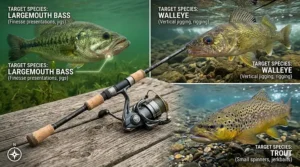
Fast Action Spinning Rod vs. Moderate Action: What the Data Actually Says
This comparison gets hotly debated online, and the answer is less black-and-white than either camp admits.
| Feature | Fast Action Spinning Rod | Moderate Action Spinning Rod |
|---|---|---|
| Hookset Power | ⭐⭐⭐⭐⭐ Immediate, explosive | ⭐⭐⭐ Slower load, some delay |
| Sensitivity | ⭐⭐⭐⭐⭐ Maximum blank transmission | ⭐⭐⭐ Good, not maximum |
| Lure Control | ⭐⭐⭐⭐⭐ Precise for single-hook lures | ⭐⭐⭐⭐ Better for treble-hook lures |
| Fighting Fish | ⭐⭐⭐ Stiff — risk of pulling hooks | ⭐⭐⭐⭐⭐ Absorbs head-shaking, fewer lost fish |
| Casting Distance | ⭐⭐⭐⭐ Excellent with lighter lures | ⭐⭐⭐⭐ Better with heavier lures |
| Best Techniques | Jigging, drop-shot, ned rig | Crankbaiting, swimbait, live bait |
The takeaway here is critical: fast action wins on hooksets and sensitivity; moderate action wins on fish retention and versatility with reaction baits. For most freshwater anglers throwing soft plastics and jigs — which describes the majority of bass, walleye, and trout fishing in the U.S. — fast action is the correct tool for the job. According to Wikipedia’s overview of fishing rod design, action rating is one of the primary determinants of a rod’s application suitability, and mismatching action to technique is a root cause of poor hookup ratios.
The data above suggests moderate action rods deserve a spot in your quiver for specific techniques, but they should not be your primary rod if finesse fishing is your primary game.
Features That Actually Matter (And Those That Don’t)
Marketing teams for fishing tackle companies are, to put it kindly, creative. Here’s what’s real versus what’s noise.
Features That Genuinely Matter
🎯 Blank modulus rating — 24-ton to 30-ton graphite provides the sensitivity-to-durability balance that most anglers benefit from. Higher modulus (40-ton+) offers elite-level sensitivity but reduced impact resistance.
🎯 Guide insert material — Zirconium and aluminum oxide inserts handle braided line without grooving. Cheap plastic inserts groove within a season. Check this before buying.
🎯 Blank construction process — Multi-axial carbon wrapping (like St. Croix’s FRS or KastKing’s multi-angle carbon winding) meaningfully increases strength without weight gain.
🎯 Warranty terms — A rod warranty is only as good as the company’s willingness to honor it. St. Croix’s Superstar Service is the gold standard. Research any brand’s actual warranty claim process before assuming the printed warranty means much.
Features That Are Mostly Marketing
🚫 “Nano” or “micro” carbon treatments — Often a marketing reframe of standard high-modulus construction. Meaningful in a small number of cases; buzzword in most.
🚫 Exact sensitivity ratings — There is no standardized sensitivity measurement in the fishing industry. “25% more sensitive” is always compared to an unspecified baseline.
🚫 Handle color and cosmetics — Looks great in photographs. Zero impact on performance.
🚫 “Proprietary” action curves — Every manufacturer claims a unique action curve. The reality is that action is determined by taper — and you can feel taper differences with your hands at a tackle shop.
Long-Term Care and Maintenance: Making Your Rod Last
A quality fast action spinning rod — even a budget one — should last years with basic maintenance. The specs sheet won’t tell you any of this.
After every freshwater session: Wipe the blank with a clean cloth to remove grit and silt. Sand particles are abrasive against graphite and will gradually damage the finish. Pay special attention to the areas around guide frames where debris collects.
After every saltwater session: Rinse thoroughly with fresh water — including inside guide frames and around the reel seat. Salt crystallizes in joints and reel seat hoods and will corrode components even on “saltwater-rated” rods if left untreated.
Inspect guides regularly: Run a cotton swab around the inside of each guide insert. Any snags indicate a groove or crack — a damaged insert will cut fluorocarbon on hooksets. Replacing a guide costs $5–$15 at any tackle shop; missing the damage can cost you a trophy fish.
Store vertically or horizontally — never diagonally: Diagonal storage puts lateral stress on a blank over time, potentially inducing a subtle bend. Most guides recommend horizontal storage in a rod rack.
Never use a rod as a landing tool: The moment you start lifting a fish by the rod tip without bending the entire blank in a fighting curve, you’re applying localized stress near the guides that blanks aren’t designed to handle.
FAQ: Fast Action Spinning Rod
❓ What is a fast action spinning rod and how is it different from medium-fast?
❓ Is a sensitive tip spinning rod better for bass fishing?
❓ What rod action is best for lure hookset power on soft plastics?
❓ How does rod flex affect casting distance with light lures?
❓ Can I use a fast action spinning rod for jigging in saltwater?
Conclusion: Your Rod, Your Edge
Rod action is one of those things that separates anglers who fish a lot from anglers who catch a lot. A fast action spinning rod isn’t a guarantee of success — but it’s one of the clearest performance advantages you can add to your setup, particularly if finesse techniques, soft plastics, or light jig fishing makes up any significant portion of your time on the water.
The KastKing Perigee II is where I’d send a budget-conscious angler first — it’s genuinely hard to believe what you get for under $50. The St. Croix Triumph TSR is the rod I’d recommend to most intermediate anglers who want quality that grows with them. And the G. Loomis NRX+ is simply the best fast action spinning rod in this guide if money is a secondary concern — full stop.
Match your rod to your technique, your target species, and your honest level of fishing frequency. A $400 rod doesn’t make you a better angler. But the right rod — whatever it costs — absolutely does.
✨ Ready to Upgrade Your Setup?
🎣 Click any highlighted rod name in this guide to check current pricing and availability on Amazon. Your best fishing season yet might just be one rod choice away. Cast smarter, detect more, land more — that’s the fast action advantage.
Recommended for You
- 7 Best Medium Light Spinning Rods in 2026 (Ranked by Experts)
- 7 Best Baitcasters Under $150 in 2026 — Top Picks Reviewed
- 7 Best Left Hand Baitcasting Reels 2026
Disclaimer: This article contains affiliate links. As an Amazon Associate, I earn from qualifying purchases. If you purchase products through these links, we may earn a small commission at no additional cost to you.
✨ Found this helpful? Share it with your friends! 💬🤗
