
In This Article
There’s a moment every coastal angler knows. You’ve got a redfish pinned to the grass flat, the tide is dropping, and you’re levering with everything you’ve got — and then your rod does something horrible. It either folds like a wet noodle or telegraphs absolutely nothing, leaving you guessing whether that tug was a fish or a clump of spartina. A quality inshore spinning rod is the one piece of gear that separates an educated guess from genuine feel.
An inshore spinning rod is a specialized fishing rod designed for saltwater environments close to shore — bays, flats, estuaries, mangrove edges, and grass beds. At its core, it balances sensitivity (so you feel the bite) with backbone (so you can muscle a bull red away from structure) and corrosion resistance (because saltwater destroys everything it touches, eventually). Most quality inshore spinning rods run 7 to 7’6″ in medium or medium-heavy power with fast or extra-fast actions, though the right spec depends heavily on your target species and technique.
I’ve spent time fishing Florida’s Nature Coast, the Carolinas, and the Texas Laguna Madre targeting snook, speckled trout, redfish, flounder, and the occasional cobia that has no business being that close to a dock. Along the way, I’ve cycled through more sticks than I care to admit. What you’ll find below isn’t a list of everything that’s out there — it’s a shortlist of what actually works, why it works, and which type of angler each rod is built for. Let’s get into it.
Quick Comparison: Top 7 Inshore Spinning Rods at a Glance
| Rod | Length | Power/Action | Line Weight | Best For | Price Range |
|---|---|---|---|---|---|
| St. Croix Mojo Inshore | 7’0″ | M / Fast | 8–17 lb | All-around inshore | ~$150–$200 |
| PENN Battalion II Inshore | 7’0″ | ML / X-Fast | 8–15 lb | Light finesse & flounder | ~$80–$130 |
| Shimano Teramar SE | 7’0″ | M / Mod-Fast | 8–17 lb | Redfish & live bait | ~$130–$180 |
| Ugly Stik Carbon Inshore | 7’0″ | M / Fast | 10–20 lb | Durability + value | ~$50–$80 |
| St. Croix Legend Tournament Inshore | 7’0″ | M / Fast | 8–17 lb | Tournament precision | ~$300–$400 |
| St. Croix Triumph Inshore | 7’0″ | M / Fast | 8–17 lb | Step-up intermediate | ~$80–$120 |
| Ugly Stik Inshore Select | 7’0″ | M / Mod | 6–20 lb | Beginners & rough use | Under $50 |
What this table tells you: The budget gap between the Ugly Stik Inshore Select and the St. Croix Legend Tournament Inshore is real — but so is the gap in feel and performance under pressure. If you’re fishing once a month for fun, don’t spend $300+ on a rod. If you’re wading grass flats four days a week, the mid-range Mojo or Teramar SE will pay for themselves in both fish landed and frustration avoided. The PENN Battalion II earns the value crown in the $80–$130 tier — more on that below.
💬 Just one click — help others make better buying decisions too! 😊
Top 7 Inshore Spinning Rods: Expert Analysis
1. St. Croix Mojo Inshore Spinning Rod — Best All-Around Coastal Spinning Rod
The St. Croix Mojo Inshore (model MIS70MF, 7’0″ Medium Fast) is probably the most talked-about stick in the inshore category for good reason — it punches well above its price bracket. Built on premium SCIII carbon fiber (St. Croix’s mid-modulus blank material), this rod hits the sensitivity/strength balance that most anglers spend years chasing. The fast action means the tip loads crisply on lighter artificials like 1/4-oz jig heads and DOA shrimp, but the blank has enough reserve power through the mid-section to turn a large redfish away from oyster bars. That’s a harder trick than it sounds — many rods in this range either feel like noodles under load or transmit zero vibration on the retrieve.
The Fuji DPS reel seat with black hoods keeps saltwater corrosion at bay. Hard aluminum-oxide guides with corrosion-resistant black frames mean you’re not replacing guides after two seasons of brine exposure. The split-grip premium cork handle is a genuine pleasure on long days — lighter than full-grip designs, and cork gives you tactile feedback that EVA foam simply can’t match. St. Croix backs every rod with a 5-year transferable warranty through their Superstar Service program, which actually matters when you’re spending this kind of money.
This is the rod I’d hand to an intermediate angler who has outgrown their starter setup and is ready to feel what they’ve been missing. It’s also the go-to recommendation for any angler targeting the classic inshore slam — snook, redfish, and speckled trout — in the same outing.
Customers consistently praise the casting distance and blank sensitivity; a few note that the fast tip requires care around rod holders and boat gunwales.
✅ SCIII carbon blank with exceptional sensitivity-to-power ratio
✅ Fuji DPS reel seat, corrosion-resistant guides
✅ 5-year transferable warranty
❌ Tip section is delicate — not ideal for rough boat storage
❌ Premium price vs. true budget options
Price range: ~$150–$200 |
2. PENN Battalion II Inshore Spinning Rod — Best Value Performer Under $130
PENN’s second-generation Battalion II (model BATINII1220S70, 7’0″ Medium Light / Extra Fast) is built around a genuinely innovative blank construction called SLC2 — an inner layer of spiral carbon wraps combined with outer longitudinal carbon fibers. The result is a blank that resists twisting under load better than traditional single-direction layups. In practice, this means when you’re fighting a fish at an angle — which happens constantly in inshore fishing — the rod doesn’t torque in your hand. That’s a real difference you feel, not just a marketing claim.
Fuji Alconite guides and Fuji reel seats give it a premium component feel that’s unexpected at this price point. Alconite is Fuji’s lower-friction ring material — it handles braid especially well, which matters if you’re running 10–15 lb PowerPro as a main line (and you should be in saltwater). The extra-fast action is worth noting: this is a finesse rod that shines on lighter presentations, soft plastics under a popping cork, or sight-casting shrimp imitations to speckled trout. It’s not the rod for heaving 3/4-oz swimbaits at tarpon in a pass.
This is the rod for anglers who fish regularly and want legitimate quality without the premium St. Croix price. It’s especially compelling for new saltwater converts coming from freshwater, where PENN’s reliability reputation is already well-established.
Customer reviews highlight the surprising lightness and sensitivity; some users note they wished PENN offered more power options in the same price tier.
✅ SLC2 anti-twist blank construction
✅ Fuji Alconite guides — excellent with braid
✅ Lightweight and well-balanced
❌ Extra-fast action limits versatility for heavier lure weights
❌ Fewer power/length options than competitors
Price range: ~$80–$130 |
3. Shimano Teramar SE Spinning Rod — Best for Redfish & Live Bait Presentations
Shimano’s Teramar Southeast (TERSESX70MB, 7’0″ Medium) was redesigned with TC4 blank construction, Shimano’s proprietary blend of carbon layers that produces an unusually strong, flexible blank without adding weight. The “B” suffix in newer models means it also features a rubber gimbal butt on heavy-power models — useful when fighting larger coastal game fish. What makes the Teramar SE different from the Mojo Inshore is its moderate-fast action: it loads deeper into the blank, which makes it forgiving on longer fights and more powerful during the full sweep of a hookset on a live bait rig. If you’re free-lining live pinfish or pilchards under a dock for snook, this action profile is hard to beat.
The SeaGuide guide train is optimized for overall rod balance rather than pure sensitivity — meaning the Teramar SE feels balanced in the hand on long casts in a way that faster-tipped rods sometimes don’t. Traditional cork grips and corrosion-resistant hardware round out a thoughtful overall package. Shimano has been refining the Teramar line for years, and the latest iteration reflects genuine field testing in the Southeast’s varied coastal environments.
This rod is ideal for the angler who does a lot of live bait work, popping corks, or free-lining in structure-heavy environments where a moderate-loading blank helps keep fish buttoned during a head shake.
Buyers praise its balance and durability in saltwater; some note it lacks the tip-end sensitivity of faster-actioned rods when throwing light soft plastics.
✅ TC4 blank for superior strength-to-weight performance
✅ Moderate-fast action perfect for live bait and cork rigs
✅ Well-balanced SeaGuide guide system
❌ Less sensitive at the tip than extra-fast alternatives
❌ Limited heavy-power models for larger coastal species in some sizes
Price range: ~$130–$180
4. Ugly Stik Carbon Inshore Spinning Rod — Best Budget Inshore Rod That Doesn’t Feel Budget
Let’s be honest: the Ugly Stik name used to mean “indestructible but you’ll feel nothing.” The Ugly Stik Carbon Inshore (B0D8SRVMT9) changes that narrative. Built on a 24-ton graphite blank with a solid graphite tip, this rod is reportedly 50% stronger and 30% lighter than the iconic GX2 — and that’s not marketing hyperbole, it’s lab-tested data from Shakespeare’s own controlled testing. In the hand, it feels genuinely crisp. The fast action loads well for soft plastic presentations, and the graphite tip transmits strikes clearly enough that you won’t be second-guessing every tap on the retrieve.
Ugly Tuff one-piece stainless steel guides eliminate the insert pop-out problem that plagues cheaper rods in saltwater (there’s nothing worse than losing an insert on a guide at the start of a fishing trip). The Fuji reel seat is a premium addition at this price point. The 7-year warranty is longer than most — and Ugly Stik’s customer service actually honors it, which is worth something.
What this rod lacks is the fine-tuned action calibration of the Mojo or Teramar. It’s a fantastic workhorse for anglers who fish in rough conditions, loan rods to friends, or want a backup stick for the boat without spending $150+. Don’t underestimate it, though — plenty of anglers fish it as their primary rod with excellent results.
Customer feedback emphasizes durability and surprised satisfaction with sensitivity; a minority note occasional guide noise with braided line.
✅ 24-ton graphite blank — genuinely sensitive for the price
✅ Ugly Tuff one-piece stainless guides (no insert loss)
✅ 7-year warranty — best in class at this price
❌ Not as refined as higher-tier options in action calibration
❌ Guide noise reported by some braid users
Price range: ~$50–$80 |
5. St. Croix Legend Tournament Inshore Spinning Rod — Best Premium Rod for Serious Anglers
The St. Croix Legend Tournament Inshore is the rod you buy when you’ve stopped making excuses. Built on premium SCVI carbon fiber (St. Croix’s highest-modulus blank material), it is measurably lighter, more sensitive, and more precisely calibrated than anything in the mid-range category. The practical difference is real: at this sensitivity level, you feel the difference between a 1/4-oz jig ticking across a sand bottom versus crawling over a grass edge — information that changes where you slow down and let the bait breathe. That’s the kind of rod intelligence that catches more fish.
Sea Guide Hero Hi-Grade guides with slim aluminum oxide rings and SS316 stainless gun smoke frames represent the top tier of corrosion-resistant hardware. The blend of EVA and cork on the handle is thoughtfully contoured — long sessions on the water in 90°F Florida heat become noticeably more comfortable. At $300–$400, this isn’t a casual purchase. But if you’re fishing the flats 80+ days a year, tournament fishing, or guide-level angling, the refinement at this level is justified by real performance gains under actual fishing conditions.
The spec sheet won’t tell you this, but what you actually pay for at the SCVI level is blank consistency — every rod off the line performs identically, unlike cheaper graphite blanks where quality control variation is a real issue.
Tournament anglers and serious guides who need the best available tool consistently rave about this rod; beginners sometimes find the sensitivity overwhelming (which is less a criticism than a reminder to match your rod to your experience level).
✅ SCVI carbon fiber — the most sensitive and lightweight blank in St. Croix’s lineup
✅ Sea Guide Hero Hi-Grade corrosion-resistant guides
✅ 15-year transferable warranty backed by Superstar Service
❌ Significant price premium over mid-range options
❌ High-modulus blank is more brittle — requires careful handling
Price range: ~$300–$400 |
6. St. Croix Triumph Inshore Spinning Rod — Best Step-Up Rod for Serious Beginners
The Triumph Inshore (TRIS series) is often overlooked because it sits between the Ugly Stik tier and the Mojo Inshore — but for a specific buyer profile, it’s the ideal choice. Built on SCII carbon fiber with aluminum-oxide guides and a Fuji ECS reel seat, it delivers noticeably better blank quality than the Ugly Stik Carbon without jumping to the Mojo’s price point. The action is well-tuned for medium-power inshore applications: throwing ¼- to ¾-oz lures, popping corks, and light live bait presentations for speckled trout and smaller reds.
What makes this rod valuable as a step-up tool is the feedback clarity. Coming from a fiberglass or entry-level graphite rod, the SCII blank feels like someone turned the volume up — ticks, taps, and bottom composition differences suddenly register in a way they didn’t before. That accelerates your development as an angler more than any technique video ever will. Paired with a quality 2500-series spinning reel and 10 lb fluorocarbon leader, this setup can cover 80% of inshore scenarios effectively.
The Triumph Inshore is the rod for anglers who have committed to coastal fishing as a regular hobby and want to invest one step up from starter gear without breaking the bank.
Buyers frequently cite the value-to-performance ratio and the feel improvement over cheaper rods; some note it lacks the refinement of the Mojo for demanding technique work.
✅ SCII carbon — clear upgrade over fiberglass or entry graphite
✅ Fuji ECS reel seat, aluminum oxide guides
✅ 5-year warranty
❌ Not as refined as the Mojo Inshore under high-stress scenarios
❌ Limited technique-specific models versus premium lines
Price range: ~$80–$120 |
7. Ugly Stik Inshore Select Spinning Rod — Best Entry-Level Rod for New Coastal Anglers
The Ugly Stik Inshore Select (7’0″ Medium, 1-piece) is where most American coastal anglers start — and for good reason. Under $50, it delivers enough performance to learn on, enough toughness to survive abuse, and enough sensitivity to teach you what a bite feels like. The graphite and fiberglass composite construction (the classic Ugly Stik recipe) is what gives it that legendary near-indestructibility: these rods survive scenarios that would splinter an all-graphite design.
The Ugly Tuff guides handle braid cleanly, the Clear Tip® design transmits bite information better than the blank itself, and the comfortable EVA grip stays manageable when wet. It won’t win casting distance competitions and the sensitivity isn’t surgical — but honestly, neither of those things matters when you’re learning the basics of reading structure, working a jig, or timing a hookset. Get the fundamentals down on this rod, then upgrade.
This rod is for first-year saltwater anglers, anglers on tight budgets, or anyone who needs a dedicated “pier rod” or “kids’ rod” that won’t hurt when it gets knocked overboard.
Buyers praise its resilience and accessibility; experienced anglers note they feel the limitation in sensitivity compared to graphite-only blanks.
✅ Near-indestructible graphite/fiberglass composite blank
✅ Clear Tip® for improved sensitivity at the entry level
✅ Excellent price — genuinely usable right out of the box
❌ Less sensitive than all-graphite alternatives
❌ Heavier than modern graphite blanks of similar length
Price range: Under $50 |
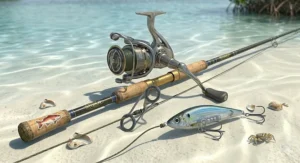
How to Set Up Your Inshore Spinning Rod for First-Season Success
Getting a good rod is half the equation. Here’s what most tackle shops won’t walk you through.
Step 1: Match Your Reel to Your Rod
For a 7’0″ medium inshore spinning rod, a 2500–3000 series spinning reel is the standard pairing. A 2500 keeps the setup light for finesse work; a 3000 adds line capacity for longer fish runs. Don’t put a 5000-series reel on a medium-power stick — it throws the balance off and tires your wrist.
Step 2: Choose the Right Main Line
Braid is the standard for inshore work. 10–20 lb PowerPro or Sufix 832 gives you thin diameter, excellent sensitivity, and zero stretch for fast hooksets. The key is adding a fluorocarbon leader — 20–30 lb in clear water, lighter in stained water. Connect them with an Alberto knot or FG knot for the slimmest connection through guides.
Step 3: Set Your Drag Properly
Set drag to roughly 25–30% of your line’s breaking strength before heading out. For 15 lb braid, that’s 3.75–4.5 lbs of drag tension. Too tight and you’ll pop the line on a hard-running redfish; too loose and you’ll never drive a hook home. A simple hand-pull test works fine.
Step 4: Rinse After Every Use
This is non-negotiable for saltwater rods. Fresh water rinse from tip to butt, paying attention to guide frames and the reel seat. Salt crystal buildup inside guide frames eventually oxidizes the metal and weakens monofilament mid-cast. Two minutes of rinsing extends your rod’s life by years. According to NOAA’s saltwater fishing resources, proper gear maintenance also contributes to responsible resource stewardship — a well-cared-for outfit keeps you fishing longer with less waste.
Step 5: Store It Horizontally or Tip-Up
Never store a rod leaning at an angle against a wall for extended periods. The blank develops a permanent set from gravity. Horizontal rod racks or vertical tip-up storage keep blanks straight and guides aligned.
The Right Rod for Your Angler Profile: A Real-World Match Guide
Not every angler needs the same stick. Here’s how to match the rod to the person.
🎣 The Weekend Warrior (1–2 trips per month, mixed inshore species)
Best pick: St. Croix Mojo Inshore or PENN Battalion II
You need versatility above all else. A 7’0″ medium fast like the Mojo Inshore handles soft plastics, live bait under a cork, and light topwaters without demanding technique changes. The Mojo’s SCIII blank gives you feedback that actually improves your fishing, trip over trip, without requiring tournament-level skill to interpret. Budget closer to $150–$200 and don’t look back.
🏆 The Tournament or Guide-Level Angler (3–5+ trips per week)
Best pick: St. Croix Legend Tournament Inshore
At this level of commitment, the sensitivity gap between SCIII and SCVI carbon is felt in actual fishing outcomes — not just in hand-feel. You’ll detect subtle structure changes and tentative bites that cost you fish on lesser equipment. The $300–$400 price is an investment that pays back over dozens of guided trips or tournament days. According to the International Game Fish Association (IGFA), technique refinement and equipment sensitivity are among the most cited factors in consistent inshore catch rates among competitive anglers.
👶 The First-Timer (just starting saltwater fishing)
Best pick: Ugly Stik Inshore Select or Ugly Stik Carbon Inshore
Don’t spend $200 on a first saltwater rod. You’ll likely bang it against a boat gunwale, set it down on a pier railing, and possibly snap it in a truck door. Learn the basics on a sub-$80 stick, then upgrade once you know what you’re looking for in feel and action. The Ugly Stik Carbon Inshore is an especially strong pick here — the 24-ton graphite blank gives you genuine feedback at a price that doesn’t sting if something goes wrong.
🦐 The Finesse Specialist (speckled trout, ladyfish, snook on light jigs)
Best pick: PENN Battalion II Inshore (ML/XF) or St. Croix Triumph Inshore
Light-power, extra-fast action is your world. The Battalion II’s SLC2 construction and extra-fast taper loads beautifully with 1/8-oz jig heads and small paddle tails. You’ll feel every bump of a trout following the lure, which is exactly the information you need to slow down the retrieve at the right moment and trigger a strike. The Coastal Conservation Association notes that speckled trout populations specifically respond to finesse presentations in clear, shallow water — giving a sensitive, lighter-action rod a genuine biological advantage in this fishery.
How to Choose an Inshore Spinning Rod: 6 Criteria That Actually Matter
1. Blank Material: Graphite Grade Determines Everything
Higher-modulus graphite (think SCVI vs. SCII) is stiffer and lighter for the same diameter — meaning more sensitivity, less fatigue. The trade-off is brittleness. For a boat angler who’s careful with gear, high-modulus pays dividends. For someone who fishes rough docks and rocky inlets, a mid-modulus blank with more give is the smarter call.
2. Rod Length: 7 Feet Is the Sweet Spot
The range runs 6’6″ to 7’6″ for most inshore applications. Shorter rods (6’6″) cast more accurately and work better in tight mangrove tunnels. Longer rods (7’6″) cast farther and improve leverage on big fish. A 7’0″ one-piece rod threads the needle for the widest range of inshore scenarios — open grass flats, dock fishing, and pass fishing included.
3. Power vs. Action: Know the Difference
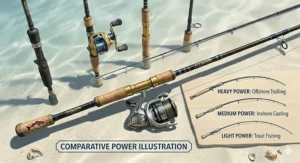
Power is how much pressure it takes to bend the rod (light, medium, heavy). Action is where the rod bends (fast = bends near the tip; moderate = bends toward the middle). For inshore spinning, medium power with fast action is the most versatile combination. Medium-heavy fast adds backbone for larger redfish, cobia, and nearshore species.
4. Guide Quality: The Overlooked Variable
Cheap guides wear grooves into your line under regular casting. Aluminum oxide (Alconite, SiC) rings resist this. More importantly, one-piece guides (like Ugly Tuff) eliminate the insert pop-out problem entirely. For braided line — which you should be using in saltwater — guide ring quality directly affects casting distance and line longevity.
5. Reel Seat Corrosion Resistance
Fuji DPS and Fuji ECS reel seats are the gold standard for inshore work. They seal out saltwater penetration and hold your reel firmly even after years of use. Cheaper reel seats loosen over time in brine exposure, creating an annoying rattle and, eventually, a reel that shifts mid-fight.
6. Warranty and Customer Service
This matters more than most buyers realize. St. Croix’s 5–15 year transferable warranty (backed by Superstar Service) and Ugly Stik’s 7-year warranty both cover manufacturing defects and, in many cases, reasonable breakage scenarios. A rod with good warranty support has a genuinely lower long-term cost of ownership than a no-warranty alternative at the same price.
Common Mistakes When Buying a Coastal Spinning Rod
🚫 Buying Too Much Rod for Your Species
A 7’6″ heavy-power rod for speckled trout is like using a freight truck to deliver a pizza. The sensitivity is gone, the action is all wrong for 1/4-oz jigs, and you’ll exhaust yourself on a fish that should be fun. Match power to species: medium-light for trout and flounder, medium for reds and snook, medium-heavy for larger slot and oversized reds or nearshore cobia.
🚫 Ignoring Rod Action in Favor of Power
“I need something strong” is the most common statement that leads to a wrong purchase. Power tells you the maximum stress the rod handles; action tells you how it feels and performs during normal fishing. A heavy-power fast-action rod and a heavy-power moderate-action rod feel completely different on the water. Always ask specifically about the action, not just the power.
🚫 Using Freshwater Reel Seats and Guides in Saltwater
This is less about rods sold specifically for inshore fishing (those are built for it) and more about converting a freshwater setup. Non-marine-rated hardware corrodes within a single season, destroying guide integrity and loosening reel seats. If you’re fishing saltwater regularly, use gear specifically rated for it — and rinse it every single time.
🚫 Skipping the Leader
Even in an article about rods, this is worth saying: running braid directly to your lure in inshore saltwater, especially in clear water, dramatically reduces bites. A 20–30 lb fluorocarbon leader is nearly invisible underwater and absorbs the shock of aggressive hooksets better than braid alone. Your rod performance only matters if fish are actually biting.
🚫 Overlooking One-Piece vs. Multi-Piece Design
Multi-piece rods are convenient for travel but introduce a potential weak point at each ferrule. For your primary inshore rod, go one-piece whenever possible. One-piece blanks transfer energy from tip to butt uninterrupted — which is exactly what you want during a hookset or a long fight.
Inshore Spinning Rod vs. Offshore or Surfcasting Rod: Why They’re Different Tools
This comparison matters more than most beginners expect. Offshore spinning rods (used for bottom fishing or trolling in deeper water) are built for raw strength and line capacity — heavier blanks, larger guides, longer butts. Surfcasting rods sacrifice sensitivity for casting distance, running 10–14 feet with heavy, wide-diameter guides designed to shoot line during a two-handed cast. Neither is remotely appropriate for inshore work.
An inshore spinning rod is engineered for precision, sensitivity, and the specific leverage angles of fighting a fish in shallow water — where the angle of battle is low and horizontal rather than the steep vertical angle of offshore deep-drop fishing. Wikipedia’s overview of spin fishing explains the core mechanics well: the spinning rod’s design centers on casting lures and detecting subtle bites, which requires tip sensitivity that offshore or surf rods simply can’t provide.
| Feature | Inshore Spinning | Offshore Spinning | Surfcasting |
|---|---|---|---|
| Length | 6’6″–7’6″ | 6’–7′ | 10’–14′ |
| Blank Sensitivity | High | Low–Medium | Very Low |
| Lure Weight Range | 1/8–1 oz | 2–10 oz | 1–6 oz |
| Best Environment | Bays, flats, estuaries | Deep water | Open beach |
| Action | Fast to Mod-Fast | Moderate | Moderate–Slow |
The above comparison makes one thing obvious: using an offshore heavy-action rod in an estuary would feel like trying to thread a needle while wearing oven mitts. The tools are simply built for different jobs.
Features That Actually Matter (And Those That Don’t)
Actually matters: Blank modulus (directly impacts sensitivity and weight), guide ring material (impacts line wear and casting friction), reel seat sealing (impacts longevity in saltwater), action calibration (impacts fishing performance). These are the specs that determine how the rod performs on fish.
Marketing noise: Color schemes and cosmetic finishes. Handle aesthetics. Rod model naming conventions (a “Pro Series” label means nothing without the specs to back it up). One brand’s “ultra-sensitive” claim is another brand’s standard. Ignore the adjectives and look at the material grades: SCVI vs. SCII, SiC vs. aluminum oxide, Fuji vs. generic hardware. These are the real performance differentiators.
Nuanced but real: Line rating windows. Most inshore anglers run 10–17 lb braid with fluorocarbon leaders — look for rods with line ratings that comfortably include that range. A rod rated 6–12 lb will feel under-gunned on the hookset against a heavy red; a rod rated 20–40 lb will never load properly on a 1/4-oz jig.
Long-Term Rod Care: How to Make Your Inshore Spinning Rod Last a Decade
After every trip: Rinse with fresh water. Run a damp cloth over the guides. Loosen your drag before storage (this preserves reel internals, which your rod deserves a compatible partner for).
Monthly: Inspect guides for nicks or grooves by running a cotton ball through each one — snags mean guide damage that cuts braid. Check ferrules (if applicable) for looseness. Inspect the reel seat for corrosion buildup. Wipe down cork grips with a slightly damp sponge.
Annually: Apply a thin coat of cork sealant to natural cork grips if they’re drying out. Inspect tip-top guide for any sharp edges from impact damage. If you’ve broken a tip, St. Croix, Shimano, and PENN all offer repair services — use them rather than DIY gluing, which rarely preserves blank performance.
Storage: Horizontal rod racks are ideal. If you’re using a rod tube for travel, ensure the rod isn’t touching the tube walls at pressure points. Never leave a rod strapped to a roof rack during highway travel without a protective sock — guide tip abrasion from wind and debris is surprisingly common.
Frequently Asked Questions About Inshore Spinning Rods
❓ What length inshore spinning rod is best for beginners?
❓ What's the best inshore spinning rod for snook fishing specifically?
❓ Is a saltwater spinning setup different from a freshwater setup?
❓ How much should I spend on my first inshore spinning rod?
❓ Can I use an inshore spinning rod for nearshore fishing?
✨ Don’t Miss These Exclusive Deals!
🔍 Ready to upgrade your saltwater arsenal?
Click any highlighted product name above to check current pricing and availability on Amazon. Whether you’re rigging up for speckled trout on a Carolina flat or hunting redfish in a Texas marsh, the right inshore spinning rod is waiting. These are the exact rods I’d recommend to any angler asking me face-to-face — no filler, no fluff.
Final Verdict: Which Inshore Spinning Rod Should You Buy in 2026?
Here’s the honest summary after putting these seven rods through real inshore conditions.
The St. Croix Mojo Inshore is the pick for the widest audience — versatile enough for mixed inshore species, sensitive enough to reward skill development, and backed by a warranty that makes the price defensible. If you fish saltwater seriously and need one rod to cover most of what the coast throws at you, this is it.
For anglers on a tighter budget who still want legitimate performance, the Ugly Stik Carbon Inshore overdelivers at its price. The 24-ton graphite blank and Ugly Tuff guides represent a genuine upgrade over the GX2 era — this isn’t your grandfather’s indestructible fishing stick anymore. It bites now.
The PENN Battalion II earns its reputation in the mid-range tier, especially for finesse anglers who prioritize anti-twist blank performance and Fuji components. And for those ready to invest in the best available tool on the market, the St. Croix Legend Tournament Inshore represents the pinnacle of what this category offers.
Whatever you fish with, get out there. The flats are calling.
💬 Loved this guide? Share it with your fishing crew! 🎣🤗
Recommended for You
- Best Fast Action Spinning Rod: 7 Expert Picks for 2026
- 7 Best Medium Light Spinning Rods in 2026 (Ranked by Experts)
- 7 Best Baitcasters Under $150 in 2026 — Top Picks Reviewed
Disclaimer: This article contains affiliate links. As an Amazon Associate, I earn from qualifying purchases. If you purchase products through these links, we may earn a small commission at no additional cost to you.
✨ Found this helpful? Share it with your friends! 💬🤗
