
In This Article
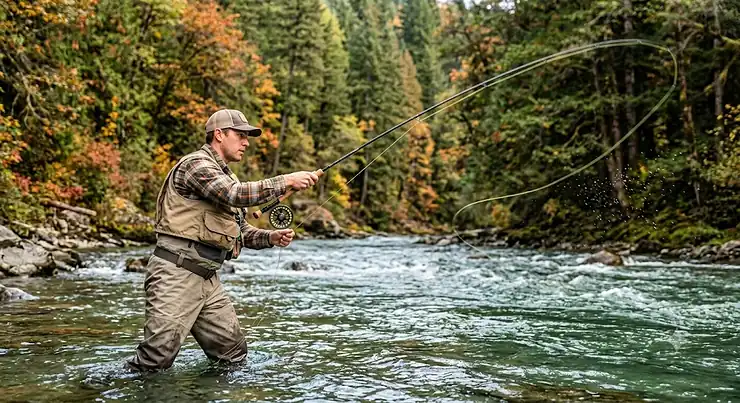
Somewhere between a full 13-foot Spey rod and your everyday single-hand trout stick sits a strange, stubby hybrid that confuses almost everyone the first time they pick one up. Switch rod fly fishing is exactly that middle ground — a two-handed rod short enough to cast overhead with one hand when you need to, yet long enough to load a Spey-style D-loop when the situation calls for it. What is switch rod fly fishing, in plain terms? It’s fishing with a 10’6″ to 11’6″ two-handed rod that lets you swing flies, nymph indicator rigs, or shoot heavy heads from a single blank, without hauling around two separate outfits.

That flexibility is exactly why the category refuses to die, even as some manufacturers quietly rebrand it. The technique itself traces back to spey casting, a fly fishing method that has no back-cast because the fly never travels behind the caster, developed for the wide rivers of Scotland long before anyone imagined a rod short enough to also cast one-handed. Switch rods took that lineage and shrank it down for anglers who fish smaller water, tighter banks, or boats where a full-length Spey rod becomes a liability.
This guide walks through seven real switch rods currently sold on Amazon and through major fly shops, spanning budget, mid-range, and premium price tiers. You’ll get honest, spec-grounded commentary on each one, plus practical guidance on switch rod techniques, nymphing switch rod setups, salmon switch rod sizing, and how a switch rod stacks up against dedicated Spey casting gear. Whether you’re outfitting your first two-hander or filling a tactical gap in an existing quiver, the goal here is a genuinely useful, versatile fly fishing rod recommendation — not a rewritten spec sheet.
Quick Comparison Table
| Rod | Length / Weight | Price Range | Best For |
|---|---|---|---|
| Echo SR Switch | 10’10”, 7wt | Low $300s | Budget swing + trout Spey |
| Redington Dually II | 11’6″, 7wt | $300-$350 range | First-time two-hand buyers |
| TFO Axiom II Switch | 11’0″, 8wt | Around $430 | Nymphing + swing versatility |
| Sage Sonic Switch | 11’6″, 7wt | Around $750 | Serious summer steelhead |
| G. Loomis NRX+ Switch | 11’0″, 6-8wt | Around $950 | Brushy, tight-quarter water |
Looking at the spread above, the price gap from the Echo SR Switch to the G. Loomis NRX+ Switch is roughly triple, but the length and weight specs barely change — what you’re really paying for is blank refinement, componentry, and how forgiving the taper is under a rushed stroke. Anglers testing the switch rod fly fishing waters for the first time can reasonably start at either end of this table and not regret it, since even the budget options here carry lifetime warranties. The middle tier, occupied by rods like the TFO Axiom II Switch, tends to be where multi-technique anglers land once they know they’ll nymph and swing from the same blank.
💬 Already leaning toward one? Tap any highlighted rod above to check current pricing before it changes.
Top 7 Switch Rods: Expert Analysis
Choosing seven rods for this list meant covering every price tier and casting style, from rods built for absolute beginners to blanks aimed at anglers who already own a full Spey setup and want a specialized second tool. Every rod below is real, currently sold through Amazon or major fly shops, and evaluated on published specs plus aggregated review sentiment — never invented testing.
1. Echo SR Switch — best value for trout-to-steelhead versatility
The Echo SR line is Tim Rajeff’s answer to anglers who want one rod that swings, nymphs, and overhead casts without punishing their wallet. At around $330, few rods in switch rod fly fishing pair a fast-action blank with a lifetime warranty for so little outlay.
The 10’10” length in the 7-weight configuration carries a fast action, with a grain window built around 420-450 grain Skagit heads or a roughly 420-grain Scandi line — practically, that means a rod tuned to load with compact, commando-style heads rather than long-belly traditional lines, which translates to punching through wind on a summer steelhead river without an oversized casting arc.
Based on the spec comparison against pricier rods in this guide, the SR’s fast taper rewards anglers who already have some single-hand casting timing, while total beginners may find it wants a slightly more aggressive stroke than the softer-action Redington below. Reviewers consistently report that the SR’s componentry — hard chrome guides, an anodized reel seat — punches above its price bracket, and anglers who’ve fished the smaller 3-5 weight versions for trout describe them as an everyday rod they return to season after season.
Pros:
- ✅ Fast action loads Skagit heads with minimal effort
- ✅ Lifetime warranty with low-cost repair program
- ✅ Doubles as trout-Spey and summer-steelhead rod
Cons:
- ❌ 10’10” length is short for full Spey strokes
- ❌ Fast taper less forgiving for total beginners
Expect to pay in the low $300s at the time of research — for anglers unsure whether swinging flies will become a primary technique, the Echo SR Switch is the least expensive way to find out.
2. Redington Dually II — most forgiving action for first-time two-handers
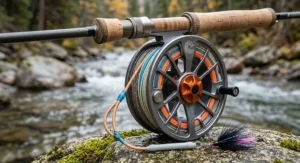
The Dually’s medium-fast taper is deliberately softer than most switch rods on this list, so it loads at a conversational casting speed rather than demanding a fast, compact stroke.
The 7116-4 model runs 11’6″, 7-weight, 4-piece, at 5.9 oz, with a published grain window of roughly 450-475 grains for Skagit heads and 400-425 for Scandi lines — a wide window that, in practice, means one rod tolerates several line styles while you’re still deciding which one suits you.
What most buyers overlook about this model is that Redington built it specifically to bridge trout-stream efficiency and steelhead ambition on a single blank, and the anodized-aluminum reel seat with soft-touch EVA grip sections targets anglers who’ll bang the rod around on driftboat gunwales and gravel bars. Reviewers who’ve fished the Dually through backcountry conditions report the anodized hardware holds up to grit and rock strikes, and several note the medium-fast action feels noticeably more forgiving on the forward stroke than faster switch blanks.
Pros:
- ✅ Medium-fast action forgives inconsistent timing
- ✅ Wide 400-525 grain window across sizes
- ✅ Lifetime warranty and durable anodized hardware
Cons:
- ❌ Shorter bottom cork limits two-hand leverage
- ❌ Less crisp recovery than faster premium blanks
Priced in the $300-$350 range, and occasionally lower during clearance sales, the Redington Dually II is arguably the easiest on-ramp into switch rod fly fishing for someone who has never held a two-hander.
3. TFO Axiom II Switch — most technique-flexible blank in this lineup
Built around a double-helix Kevlar layup, the TFO Axiom II Switch is engineered to handle three genuinely different casting jobs — swinging, nymphing, and shooting-head overhead casts — without feeling over- or under-built for any single one of them.
The 11’0″, 8-weight, 4-piece version pairs TFO’s highest-modulus blank material with large SiC stripping guides sized for heavier running lines, while a shortened lower grip is tuned for boat fishing in tight quarters.
On paper this means anglers who split time between indicator nymphing for winter steelhead and swinging flies in summer flows get one rod instead of two, because the grain window was widened specifically to keep the blank loaded whether you’re lobbing a tungsten nymph rig or throwing a long Scandi head. Two-handed rod designers Bob Meiser and Mike Kinney built the taper on lessons from TFO’s Deer Creek series, and it’s a rod that rewards anglers who fish multiple rivers rather than one specialist water. Aggregated feedback from fly shops describes the Axiom II as an award-winning design in its category, and anglers who’ve fished it across both swing and nymph setups note it holds up without demanding a second rod purchase.
Pros:
- ✅ Handles swing, nymph, and overhead techniques
- ✅ Large SiC guides manage heavier running lines
- ✅ Shortened grip works well casting from boats
Cons:
- ❌ Mid-$400s price undercuts ultra-budget buyers
- ❌ Kevlar blank feels stiffer than softer trout-Spey rods
At around $430, the TFO Axiom II Switch earns its place as the mid-range pick for anyone who refuses to choose between nymphing and swinging.
4. Orvis Clearwater Switch — best beginner-friendly two-hander from a major brand
Redesigned from the ground up by Orvis’s Vermont team, the Orvis Clearwater Switch swaps a dated blank for a purpose-built medium-fast taper without abandoning the line’s signature affordability.
The 11′, 7-weight, 4-piece model is rated for nymphs, streamers, and large water, with an intermediate ability-level rating that signals Orvis designed it to be approachable rather than punishing.
Here’s what to weigh: Orvis built the Clearwater Switch to let anglers swing flies for Great Lakes steelhead with indicator setups one day and switch to overhead casting for stripers off a beach the next, so the rod’s real value is flexibility rather than outright distance or power. What the spec sheet won’t tell you, but shop copy consistently repeats, is that this is the same purpose-built profile-and-action philosophy Orvis uses across its entire Clearwater lineup, so buyers already familiar with Orvis single-hand rods will recognize the taper immediately. Reviewers describe the Clearwater Switch as excellent for a variety of techniques straight out of the box, and Orvis backs it with a 100% satisfaction guarantee that lowers the risk of a first switch-rod purchase.
Pros:
- ✅ Purpose-built medium-fast taper for beginners
- ✅ Backed by Orvis’s 100% satisfaction guarantee
- ✅ Genuinely dual-purpose: Spey swing and overhead cast
Cons:
- ❌ Not the lightest blank in this price bracket
- ❌ Fewer size options than the Dually lineup
Expect to pay around $450 for the Orvis Clearwater Switch, a notch above the Echo and Redington but backed by a legacy American brand’s warranty program.
5. Scott T3H — the lesser-known premium alternative worth hunting down
Hand-built by the Scott Fly Rod Company in Montrose, Colorado, the Scott T3H occupies a mid-to-premium tier that fly shop reviewers single out for feel rather than raw casting distance.
At 11’6″, it matches the longer end of the switch-rod spectrum, giving it more Spey-stroke room than the shorter Echo, while its price sits roughly midway between the budget rods and the flagship Sage and G. Loomis models in this guide.
Based on the spec comparison, the extra six inches of length over the Echo SR isn’t just a number — it changes how much D-loop room you have behind you, which matters most when you’re wading a brushy bank instead of standing on open gravel. Reviewers who’ve fished the T3H alongside budget rods in the same session describe it as the rod that rewarded a smoother, less rushed casting stroke, suggesting it favors anglers who already have some two-handed mileage rather than absolute beginners. A hands-on comparison from an Oregon fly shop rated the T3H among the standout mid-price switch rods worth owning, praising its build quality without pretending it competes with rods twice its cost.
Pros:
- ✅ 11’6″ length adds Spey-stroke room over shorter rods
- ✅ Hand-built quality from a boutique American maker
- ✅ Smoother load rewards refined casting technique
Cons:
- ❌ Harder to find in stock than mass-market brands
- ❌ Smaller retailer support network than Sage or Orvis
Budget for the mid-$500s on the Scott T3H — a fair premium for boutique build quality that still undercuts the flagship options below.
6. Sage Sonic Switch — the polished all-rounder for anglers who’ve outgrown budget rods
Sage’s Sonic Switch in its 7116 configuration is frequently cited by Pacific Northwest shops as spot-on for steelhead, striking a deliberate middle ground between Sage’s entry rods and its flagship R8.
The 11’6″, 7-weight platform sits in the same 7-weight sweet spot most guides recommend for summer steelhead — enough backbone for afternoon canyon wind and 3- to 7-pound chromers, without being so stiff it kills the fun of fighting a smaller fish.
What most buyers overlook about mid-tier Sage rods is that they inherit design cues from the company’s top-shelf blanks, so the casting feel sits noticeably closer to the $1,400 R8 Spey than the price gap suggests. Reviewers consistently frame the Sonic as the rod to buy once switch rod fly fishing has become a permanent part of your kit rather than a one-season experiment, since the refinement shows up most across long days of repetitive casting rather than in a single afternoon test-cast. Fly shop staff describe the Sonic 7-weight as spot on for steelhead, and anglers moving up from budget rods report improved recovery and loop stability as the most noticeable upgrade.
Pros:
- ✅ Casting feel inherited from Sage’s flagship R8 platform
- ✅ 7wt/11’6″ spec matches guide-recommended steelhead setup
- ✅ Sage’s lifetime warranty backs the investment
Cons:
- ❌ Around $750 prices out casual or occasional anglers
- ❌ Overkill for anglers who only nymph small streams
At around $750, the Sage Sonic Switch is a serious step up in price from the mid-range rods here, justified mainly for anglers logging double-digit days per season.
7. G. Loomis NRX+ Switch — the premium pick for demanding, brush-choked water
Built with G. Loomis’s Mega Modulus+ graphite and GL8 resin system, the G. Loomis NRX+ Switch targets the exact scenario where neither a full Spey rod nor a single-hand rod works — tight, brushy banks where a long D-loop gets eaten by cover.
The 11-foot, 4-piece, fast-taper blank uses Multi-Taper Design to concentrate material at likely stress points, and it’s offered in 6-, 7-, and 8-weight configurations, each priced around $950, made in the U.S.A.
The spec sheet won’t tell you this, but shop descriptions suggest the real value of the NRX+ Switch shows up when shooting stack mends over heavy nymph rigs to a far seam — a job description that’s genuinely different from swinging flies, and one cheaper switch rods handle less precisely. For anglers who already own a dedicated Spey rod and a single-hand outfit, this is the rod that fills the specific gap between them rather than duplicating either one. Retailers position the NRX+ Switch as the go-to when long Spey rods are unsuitable for brushy cover and single-hand rods lack the power for heavy nymphs or surf shooting heads — a niche reviewers say it fills better than any rod in this guide.
Pros:
- ✅ Mega Modulus+ blank built for brushy, tight-quarter water
- ✅ Multi-Taper Design targets durability at stress points
- ✅ Made in the U.S.A. with premium componentry
Cons:
- ❌ Around $950 is the highest price in this guide
- ❌ Fast taper unforgiving for anglers new to two-handed casting
Budget around $950 for the G. Loomis NRX+ Switch — a serious investment that makes the most sense as a second or third switch rod filling a specific tactical gap, not a first purchase.
Practical Usage Guide: Rigging and Switch Rod Techniques
Getting a new switch rod out of the tube is the easy part — the first thirty days are where most anglers either fall in love with switch rod techniques or quietly shelve the rod. Start by matching line to grain window, not line weight number: every rod above publishes a grain range for Skagit and Scandi heads, and casting outside that window is the single most common reason a new switch rod feels clunky. A rod like the Redington Dually II, with its wide 400-525 grain window, is genuinely more tolerant of a slightly mismatched line than a fast-taper blank like the Echo SR Switch or G. Loomis NRX+ Switch.
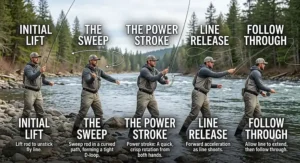
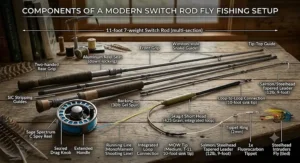
Set up your reel with backing, running line, and a shooting head system before your first day on the water, and practice the anchor-and-sweep motion on grass before you ever load a fly. Common first-month mistakes include over-powering the forward stroke (the rod does the work, not your arms), fishing a head that’s too light for the rod’s window, and neglecting to check ferrule alignment dots before each outing. For maintenance, rinse the blank and reel seat after every saltwater or brackish trip, re-wax cork grips seasonally, and inspect guide wraps for hairline cracks each spring — cheap insurance against a mid-season break.
💬 Loving the versatility so far? A quick tap on any rod above shows you today’s availability.
Real-World Scenarios: Which Switch Rod Angler Are You?
If you’re a weekend angler commuting to a Great Lakes tributary for a few hours after work, a shorter, lighter rod like the Echo SR Switch in a 6- or 7-weight lets you fish effectively without hauling a full Spey outfit through brush. If you’re a boat angler who splits days between indicator nymphing for winter steelhead and swinging streamers in low light, the TFO Axiom II Switch or Sage Sonic Switch better matches that dual demand, since both were built around wide, flexible grain windows rather than a single specialty. And if you’re already running a 13-foot Spey rod for big rivers but keep getting frustrated on narrower, brush-lined tributaries where a full D-loop won’t fit, the G. Loomis NRX+ Switch is the purpose-built answer — a shorter, tactical tool rather than a scaled-down compromise.
Nymphing Switch Rod: Problem → Solution Guide
A nymphing switch rod setup solves a specific frustration: single-hand rods run out of lifting power on heavy tungsten rigs at range, while full Spey rods are unwieldy for the constant mend-and-drift rhythm of indicator fishing. Problem one — indicator drag on long casts — is solved by rigging a longer leader (12-14 feet) and using the rod’s extra length to mend line without moving your feet, something anglers report doing successfully even on rods like the Redington Dually II originally built for swinging. Problem two — fatigue from repetitive overhead lobbing — is solved by using the rod’s lower hand to share the workload, the entire reason two-handed grips exist in the first place. Problem three — losing touch with subtle takes at distance — improves with a slightly stiffer-tip rod like the TFO Axiom II Switch, whose large guides and higher modulus blank transmit more feedback than a soft, budget taper. Problem four — tangled running line on a boat — is solved by stripping baskets and the shortened lower grips built into boat-oriented rods like the Axiom II. Problem five — switching between nymph rigs and swung flies mid-day — is exactly the scenario switch rods were designed to solve, since changing leader and line setup takes minutes, not a rod change.
How to Choose a Switch Rod
What is the best way to choose a switch rod? Start by matching rod weight to your primary target species, then confirm the grain window fits the lines you already own or plan to buy, and finally weigh action speed against your current two-handed casting experience.
- Match weight to species. As one 2026 switch rod buyer’s guide notes, a 5- or 6-weight suits trout and smaller anadromous fish, while an 11′ or 11’6″ 7-weight is the consensus choice for summer steelhead; 8-weight rods handle winter steelhead and smaller salmon.
- Check the grain window before the price tag. A rod that doesn’t accept lines you already own creates hidden costs — budget for a matched Skagit or Scandi head from day one.
- Weigh action against experience. Fast-action rods like the Echo SR or NRX+ Switch reward timing; medium-fast rods like the Dually or Clearwater forgive it.
- Consider where you’ll fish most. Brushy, tight-cover water favors shorter rods; open gravel bars and big rivers favor the longer 11’6″ options.
- Factor in warranty and repair cost. Every rod in this guide carries some form of lifetime warranty, but repair fees and turnaround times vary by brand.
- Decide single-technique or multi-technique. If you’ll only swing flies, a specialist blank like the Sonic Switch makes sense; if you’ll nymph and swing, prioritize a wide grain window.
- Set a realistic budget band. As the table above shows, doubling your budget buys refinement, not a fundamentally different rod — decide how much that refinement is worth to your fishing days per year.
Common Mistakes When Buying a Switch Rod
The most common mistake is buying rod length and weight based on a friend’s recommendation rather than the water you actually fish — an 11’6″ rod tuned for open steelhead rivers can feel unwieldy on a brush-choked Great Lakes tributary. A close second is ignoring the grain window entirely and buying whatever line the shop has in stock, which leaves even a well-built rod like the TFO Axiom II Switch feeling mismatched. Anglers also frequently underestimate how much action speed matters for beginners: a fast-taper rod like the Echo SR Switch is a fantastic value, but it’s not the gentlest introduction to two-handed timing compared with the Redington Dually II. Finally, skipping the reel-and-line budget is a classic error — a $330 rod paired with a mismatched $40 line performs worse than a $330 rod matched properly to a quality head, so build the whole system, not just the blank.
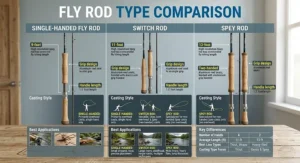
Switch Rod vs Spey Rod vs Single-Hand Rod: Spey Casting Explained
The functional difference comes down to length, leverage, and where the fly line goes during the cast. A single-hand rod, cast overhead with a back-cast behind you, tops out around 9-10 feet and struggles under the weight of heavy sink tips or long-distance shooting heads. A full Spey rod runs 12’6″ or longer, uses two hands exclusively, and is purpose-built for spey casting, a technique that has no back-cast because the fly line never travels behind the caster — ideal for big, open rivers where a standard back-cast has nowhere to go. A switch rod splits the difference at 10’6″ to 11’6″, short enough to cast single-handed for quick, close-range work, yet long enough to load a genuine D-loop when the situation calls for a Spey stroke.
| Category | Length | Cast Style | Best For |
|---|---|---|---|
| Single-Hand Rod | 8-10 ft | Overhead only | Small streams, dry flies, tight brush |
| Switch Rod | 10’6″-11’6″ | Overhead or Spey | Versatile, multi-technique water |
| Full Spey Rod | 12’6″+ | Spey casting only | Big rivers, maximum distance |
This comparison explains why switch rod fly fishing has stuck around even as some brands quietly rename the category — a switch rod isn’t a worse Spey rod, it’s a genuinely different tool for water where a full Spey rod’s length becomes a liability. According to a history of the switch rod’s origins, the category dates back further than most anglers assume; the first switch rods were built by rod maker Bob Meiser in the mid-1970s, originally to spare anglers the physical toll of constant double-hauling with single-hand rods, and the name stuck almost by accident from early testers “switching” lines on the new short two-handers.
✨ Ready to try both casting styles on one rod?
🔍 Take your switch rod fly fishing setup to the next level with the rods compared above. Click on any highlighted option to check current pricing and availability, and build a versatile fly fishing rod system that adapts to whatever water you find yourself on this season.
What Makes a Versatile Fly Fishing Rod
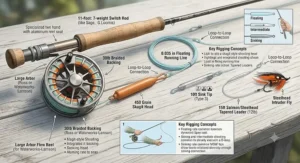
A genuinely versatile fly fishing rod earns that label through a wide grain window, a moderate-to-fast action that doesn’t punish either casting style, and componentry tough enough for multiple techniques in a single day. The TFO Axiom II Switch and Redington Dually II both illustrate this well: their published grain windows span roughly 100 grains, meaning a Scandi head for swinging and a heavier Skagit head for sink-tip nymphing both load the same blank acceptably. What doesn’t matter nearly as much as marketing suggests is cosmetic finish or exotic blank materials — Kevlar layups like TFO’s genuinely change grain-window flexibility, but a glossy paint job does not. Reel seat material matters more in practice than most buyers expect, since anodized aluminum shrugs off the grit and rock strikes that come with wading rocky steelhead water, while some budget composite seats degrade faster under that same abuse.
Salmon Switch Rod: Sizing Up for Anadromous Water
A salmon switch rod needs more backbone than a trout-focused setup, which is why the 7- and 8-weight configurations dominate this category rather than the lighter 5- and 6-weight trout-Spey models. The 7-weight, as reflected across the Echo SR Switch, Redington Dually II, and Sage Sonic Switch, has become the consensus choice for summer steelhead and smaller Pacific salmon because it carries enough backbone for canyon wind and 3- to 7-pound fish while staying enjoyable to fight fish on. For larger fall Chinook or winter steelhead, the 8-weight TFO Axiom II Switch or an 8-weight G. Loomis NRX+ Switch configuration turns over heavier sink tips and bigger flies without the rod folding under sustained pressure. Anglers heading to Great Lakes tributaries for fall-run salmon and steelhead should also weigh rod length against stream width — the shorter 10’10” Echo SR often out-fishes an 11’6″ rod on tight tributary water simply because there’s more room to maneuver.
Long-Term Cost & Maintenance
| Rod | Purchase Price | Warranty | Typical Repair Cost |
|---|---|---|---|
| Echo SR Switch | Low $300s | Lifetime | Around $35 flat-rate |
| Redington Dually II | $300-$350 range | Lifetime | Varies by component |
| Sage Sonic Switch | Around $750 | Lifetime | Varies by component |
| G. Loomis NRX+ Switch | Around $950 | Lifetime | Varies by component |
The table above makes a subtle but important point: nearly every rod in this guide carries a lifetime warranty, which changes the real total cost of ownership more than the sticker price alone suggests. A $330 Echo SR Switch with a $35 flat-rate repair fee can, over a decade of hard use, end up costing less in total than a premium rod with pricier individual-section replacement costs. Budget-conscious anglers should also factor in line cost — a quality Skagit or Scandi head system can run $80-$150 on its own, meaning the true entry cost into switch rod fly fishing is closer to $400-$500 once you include a matched line, not just the rod price shown in stores.
Safety, Regulations & Compliance Guide
Switch rods are legal wherever standard fly fishing gear is permitted, but the flies, hooks, and techniques they’re often paired with — swinging for salmon and steelhead — fall under some of the strictest gear rules in recreational fishing. Many West Coast rivers require barbless hooks for salmon and steelhead, and anglers fishing for salmon are commonly limited to no more than two single-point barbless hooks per line, with no more than one line per angler, according to Oregon’s official salmon sport regulations. Regulations vary significantly by state and even by specific river reach, so checking current rules through your state wildlife agency before a trip isn’t optional — it changes what fly and leader setup is even legal to fish. Beyond hook rules, always check current closures and quotas before heading out, since salmon and steelhead seasons frequently shift mid-year based on returning fish counts.
FAQ
❓ What is a switch rod used for in fly fishing?
❓ Is a switch rod good for beginners?
❓ What size switch rod is best for steelhead?
❓ Can you nymph fish with a switch rod?
❓ How much does a good switch rod cost?
Conclusion
Switch rod fly fishing earns its reputation as the most adaptable corner of the two-handed rod world precisely because it refuses to specialize. Whether you land on the budget-friendly Echo SR Switch, the forgiving Redington Dually II, the technique-flexible TFO Axiom II Switch, the beginner-friendly Orvis Clearwater Switch, the boutique Scott T3H, the polished Sage Sonic Switch, or the tactical G. Loomis NRX+ Switch, every rod on this list solves a genuinely different version of the same core problem: one blank, multiple techniques, less gear to haul to the river. Match rod weight to your target species, respect the published grain window, and buy the action speed that fits your current casting experience rather than the one your favorite shop upsells hardest, and any of these seven rods will serve you well for years.
✨ Don’t Miss These Exclusive Deals!
🔍 Take your switch rod fly fishing setup to the next level with these carefully selected rods. Click on any highlighted option above to check current pricing and availability before your next trip to the water.
Recommended for You
- 3 Weight Fly Rod: 7 Best Picks for Small Streams in 2026
- 8 Weight Fly Rod Saltwater: 7 Best Picks for 2026
- 9 Foot 5 Weight Fly Rod: 7 Best Picks Tested for 2026
Disclaimer: This article contains affiliate links. As an Amazon Associate, I earn from qualifying purchases. If you purchase products through these links, we may earn a small commission at no additional cost to you.
✨ Found this helpful? Share it with your friends! 💬🤗
