
In This Article
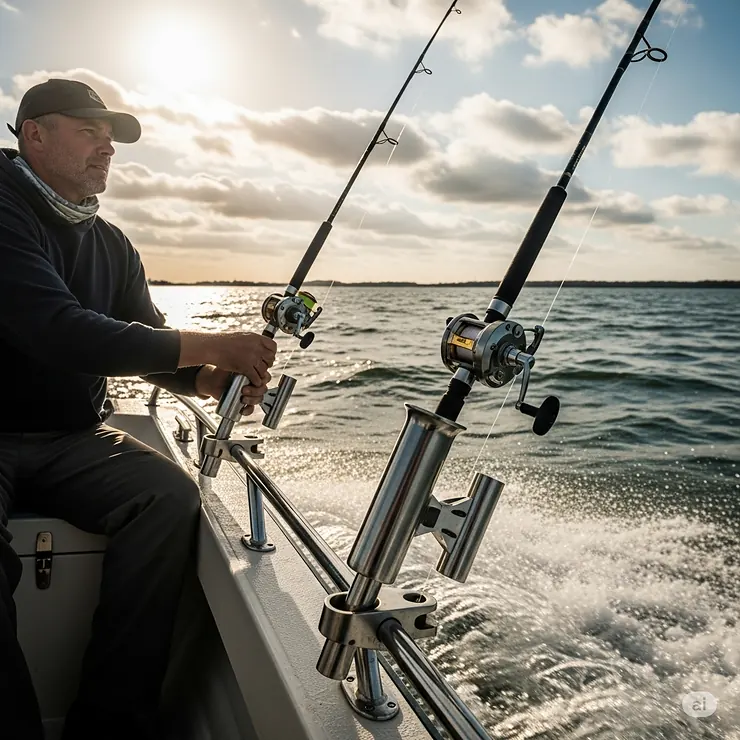
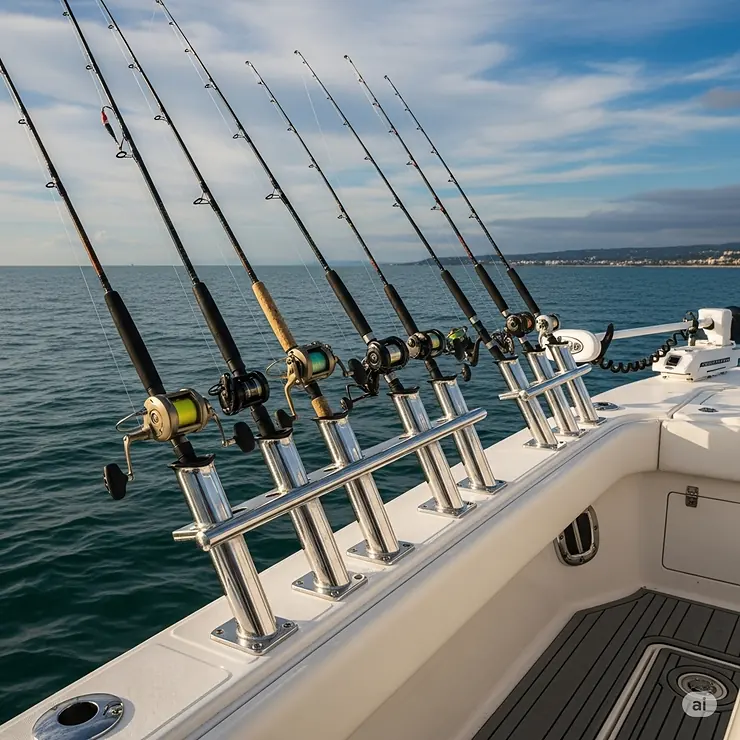
When you’re out on the water with multiple lines in play, having reliable rail mount rod holders can make the difference between landing that trophy fish and watching it swim away. Whether you’re trolling for marlin or drift fishing for catfish, these essential boat accessories transform your fishing experience by keeping your rods secure, properly angled, and ready for action.
✨Was this helpful? Spread the word! 🚀
Rail mount rod holders offer unmatched versatility for anglers who need quick setup without permanent modifications to their boat. Unlike fixed flush-mount holders, these clamp-on systems attach directly to your boat’s existing rails, providing adjustable positioning that adapts to changing fishing conditions. From recreational weekend warriors to serious tournament anglers, understanding how to choose and use rail mount rod holders effectively is crucial for maximizing your success on the water.
Understanding Rail Mount Rod Holders: The Foundation of Modern Fishing
🎣 Rail mount rod holders represent a revolutionary approach to boat fishing organization. These ingenious devices clamp directly onto your boat’s rails, eliminating the need for drilling holes or permanent modifications. Unlike traditional flush-mount systems, rail rod holder mount options provide incredible flexibility – you can reposition them as needed, remove them for storage, or transfer them between different boats.
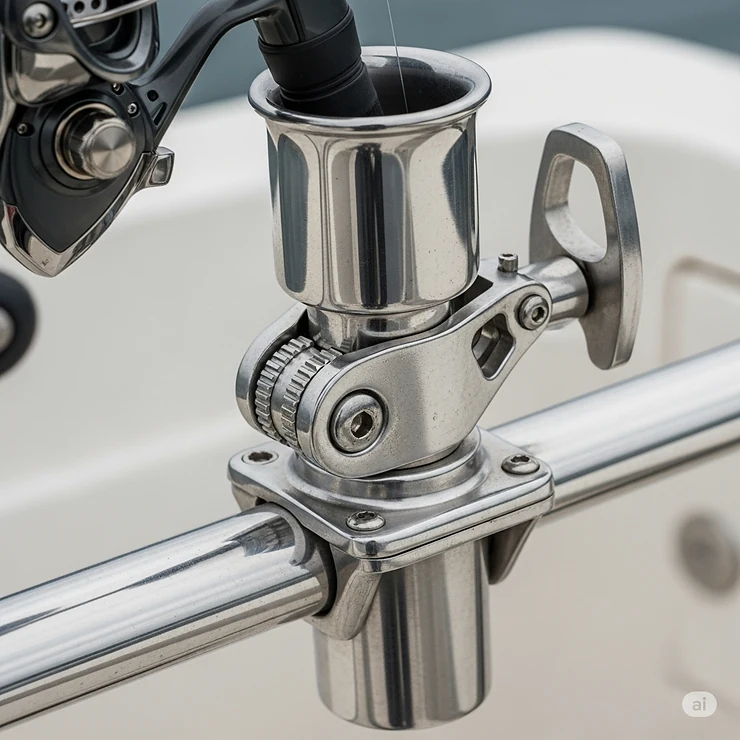
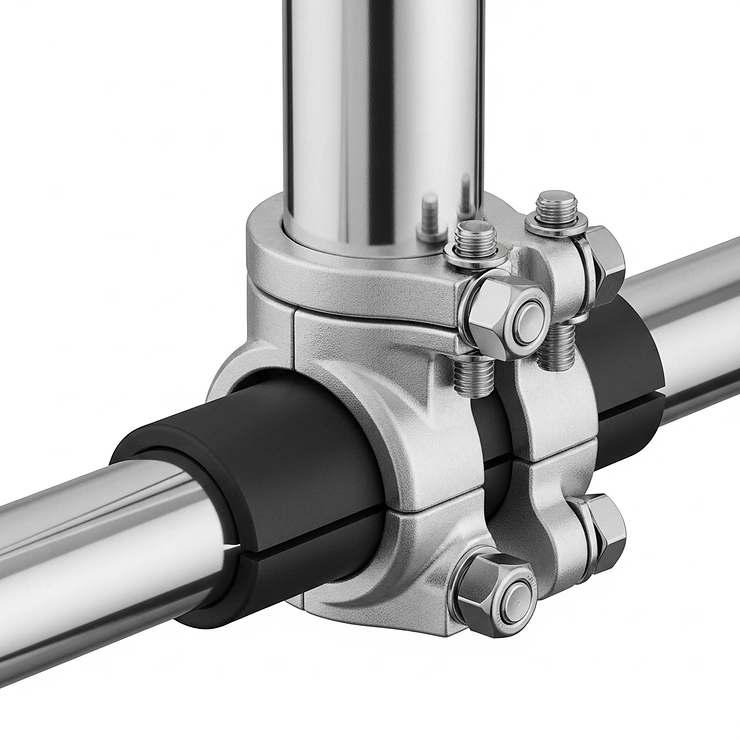
The engineering behind these systems focuses on secure clamping mechanisms that distribute pressure evenly across the rail surface. Most quality rail mount rod holders for boats feature marine-grade stainless steel construction with rubber gaskets to prevent slipping and protect your boat’s finish. The adjustability factor sets them apart – many models offer 360-degree horizontal rotation and up to 90 degrees of vertical adjustment.
⚡ Why Rail Mounts Matter:
- No permanent boat modifications required
- Instant repositioning capabilities
- Universal compatibility with most rail sizes
- Cost-effective compared to custom installations
- Easy removal for boat storage or transport
Key Components That Define Quality
When examining boat rail rod holders, several critical components determine their effectiveness and longevity. The clamping mechanism serves as the foundation – quality units employ double-bolt systems with captured nuts that prevent loss during adjustments. The rod holder tube itself should feature drainage holes to prevent water accumulation and corrosion-resistant coatings for saltwater environments.
The adjustment system separates premium units from budget alternatives. Professional-grade rail mount fishing pole holder systems incorporate multiple locking points, allowing precise angle adjustments without compromising stability. Rubber inserts protect expensive fishing rods from scratches while providing additional grip to prevent rod rotation during fights.
🔧 Essential Features Checklist:
- Marine-grade 304 or 316 stainless steel construction
- Rubber gaskets for secure, non-slip mounting
- Drainage holes in rod holder tubes
- Multiple angle adjustment points (minimum 15-20 positions)
- Captured nuts and quality fasteners
- Appropriate rail diameter compatibility
Industry-Specific Applications: From Recreational to Professional Use
Recreational Fishing Applications
For weekend anglers and casual fishing enthusiasts, rail mount rod holders for trolling provide an excellent entry point into organized fishing setups. Bass fishing from smaller boats benefits enormously from rail-mounted systems – they keep rods out of the way during navigation while maintaining easy access when fish strike. The ability to quickly reposition holders based on wind direction or fishing technique makes them invaluable for recreational use.
Families fishing together appreciate the safety aspects of rail-mounted systems. Children can fish without constantly holding rods, reducing fatigue and preventing accidental drops overboard. The secure mounting system ensures rods remain stable even in choppy conditions, allowing parents to focus on safety rather than constantly monitoring equipment.
Commercial and Charter Applications
Professional charter operators rely heavily on robust rail mounting systems for their livelihood. Charter boats typically install multiple Amarine Made 4Pcs Fishing Rod Holder Tournament Style units along their rails, providing customers with professional-grade equipment that instills confidence. The stainless steel construction withstands constant use and saltwater exposure while maintaining precise adjustability.
Tournament fishing demands the ultimate in reliability and performance. Professional anglers often prefer systems like the Scotty 242 Rail Mount Adapter combined with their PowerLock rod holders, creating modular setups that adapt to specific fishing scenarios. The ability to quickly reconfigure rod positions based on trolling patterns or bait presentation requirements provides competitive advantages that translate to tournament success.
Specialized Marine Applications
Commercial fishing operations utilize heavy-duty rail mount systems for specific applications beyond sport fishing. Long-line fishing vessels employ multiple rail-mounted holders for setting and retrieving gear, while crab boats use them for managing handling equipment. The modularity of rail systems allows vessels to reconfigure their setup based on seasonal fishing requirements.
Research vessels and marine biology operations benefit from the non-permanent nature of rail mounts. Scientific equipment can be temporarily mounted using rail systems without compromising the vessel’s primary research capabilities. This flexibility proves invaluable for multi-purpose vessels that switch between different operational requirements.
Advanced Technical Analysis: Engineering Excellence in Action
Material Science and Durability Factors
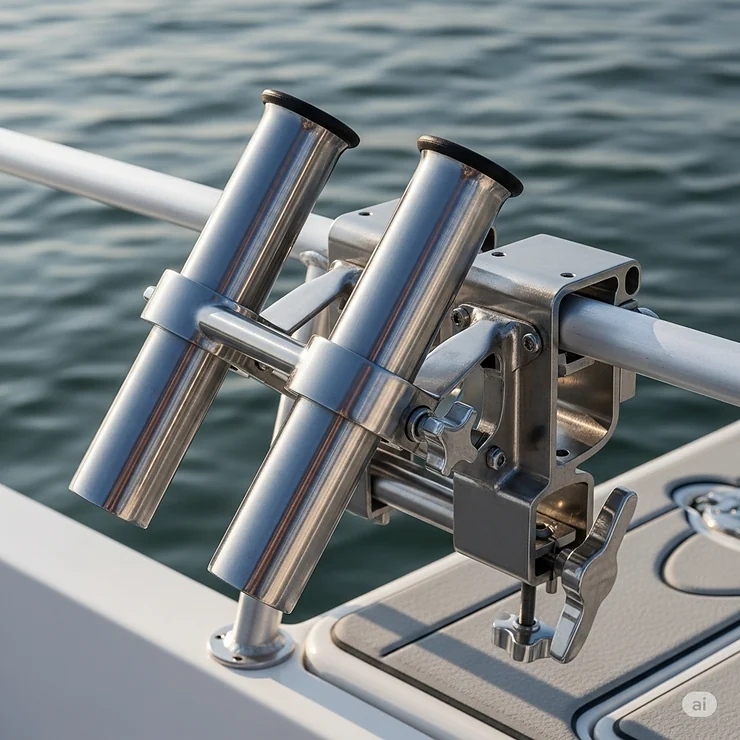
The metallurgy behind premium rail mount rod holders involves sophisticated material choices that balance strength, corrosion resistance, and weight considerations. Marine-grade 316 stainless steel, used in high-end models like the NovelBee 4pcs Stainless Tournament Style series, contains higher molybdenum content than standard 304 steel, providing superior resistance to chloride corrosion in saltwater environments.
Surface treatments play crucial roles in longevity. Mirror-polished finishes not only provide aesthetic appeal but also reduce surface irregularities where corrosion can initiate. Electropolishing, used on premium units, removes surface contaminants and creates a passive oxide layer that self-repairs minor scratches, extending service life significantly.
🔬 Material Performance Metrics:
- 316 Stainless Steel: 500+ hour salt spray resistance
- 304 Stainless Steel: 200-300 hour salt spray resistance
- Anodized Aluminum: 150-250 hour salt spray resistance
- Powder-coated Steel: 50-100 hour salt spray resistance
Mechanical Engineering Principles
The clamping force distribution in quality rail mounts follows engineering principles that prevent rail damage while maintaining security. Optimal designs employ curved contact surfaces that match rail profiles, distributing forces over larger areas. The RAILBLAZA Rod Holder II system exemplifies this approach with its polymer construction that provides excellent grip without the risk of galvanic corrosion common with dissimilar metals.
Vibration resistance becomes critical in marine environments where constant motion challenges mechanical connections. Premium systems incorporate thread-locking compounds and captured hardware designs that maintain tension despite continuous movement. The angle adjustment mechanisms in top-tier units use positive-locking detents rather than friction-only systems, ensuring positions remain stable under load.
Performance Testing Standards
Industry-leading manufacturers subject their products to rigorous testing protocols that simulate years of marine use. Cyclic loading tests verify that adjustment mechanisms maintain their integrity after thousands of position changes. Salt spray testing follows ASTM standards, with premium products exceeding 500 hours without significant corrosion.
Temperature cycling tests ensure functionality across the extreme temperature ranges encountered in marine environments. From arctic fishing conditions to tropical offshore scenarios, quality rail mounts must maintain their clamping force and adjustment capabilities. UV exposure testing verifies that polymer components resist degradation from constant sun exposure.
Comprehensive Setup and Installation Guide
Pre-Installation Assessment and Planning
Before installing any rail mount rod holders, conducting a thorough assessment of your boat’s rail system ensures optimal placement and functionality. Measure rail diameters at multiple points – many boats have slight variations that affect clamp fit. Standard measurements include 7/8″, 1″, 1-1/4″, and 2″ diameters, with some specialty applications requiring custom sizing.
Consider the fishing styles you’ll primarily use when planning holder placement. Trolling applications benefit from outward-angled positions that keep lines clear of the boat’s wake, while drift fishing may require more vertical orientations. The Amarine Made Tournament Style Rail Mount holders offer 32 different angle positions, providing flexibility for various fishing techniques.
🛠️ Installation Planning Checklist:
- Measure rail diameters at intended mounting points
- Identify any rail imperfections or obstructions
- Plan holder spacing for intended rod types
- Consider sight lines and navigation requirements
- Account for safety equipment and emergency access
- Plan wire management for electronic equipment
Step-by-Step Installation Process
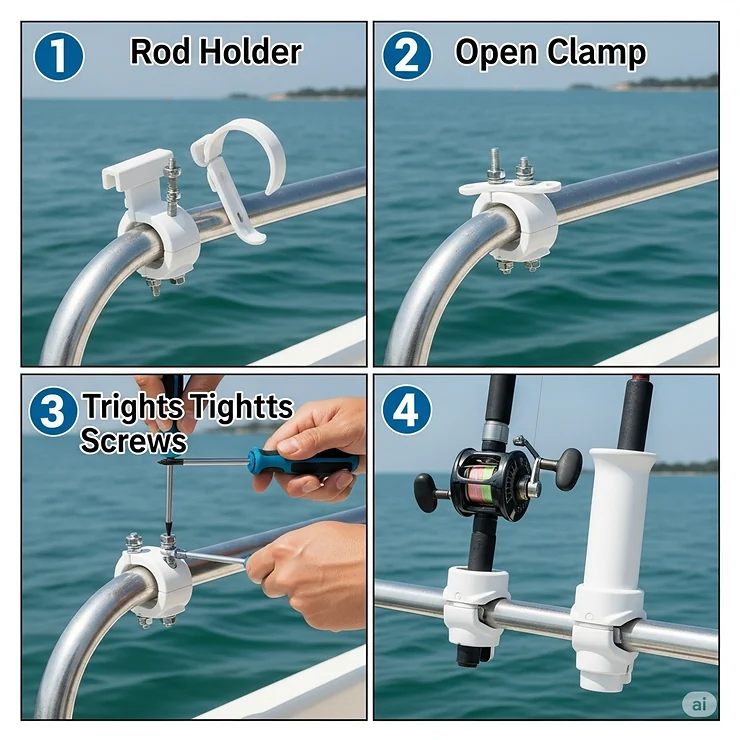
Begin installation by thoroughly cleaning the rail sections where clamps will be mounted. Remove any oxidation, salt deposits, or debris that could prevent secure contact. Apply marine-grade anti-seize compound to threaded fasteners – this prevents corrosion and allows for future adjustments or removal.
Position the mounting clamp and finger-tighten the fasteners initially. This allows for position adjustments before final tightening. Use a torque wrench to achieve manufacturer-specified tightness – over-tightening can deform rails or damage clamps, while under-tightening allows movement that leads to wear and potential failure.
For systems like the Scotty 242 Rail Mount Adapter, ensure proper alignment between the base mount and rail adapter. The connection should be firm but not forced, allowing for smooth operation of the locking mechanism. Apply thread-locking compound to adjustment screws to prevent loosening from vibration.
Calibration and Testing Procedures
After installation, test each holder through its full range of motion to ensure smooth operation and positive locking at all positions. Load test with actual fishing rods to verify secure retention – the rod should remain stable when subjected to reasonable forces that simulate fish strikes or boat movement.
Check for any interference between adjacent holders when multiple units are installed. Rods should clear each other when positioned at typical fishing angles. Adjust spacing or angles as needed to prevent tangles during deployment or retrieval.
Safety Considerations and Best Practices
Marine safety regulations require that rod holders don’t obstruct required navigation equipment or emergency systems. Ensure that installed holders don’t block navigation lights, interfere with safety equipment access, or create hazards during emergency maneuvers. Some jurisdictions have specific requirements for fishing equipment placement that must be observed.
Regular maintenance checks should become part of your pre-fishing routine. Verify that all fasteners remain tight, adjustment mechanisms operate smoothly, and rubber components show no signs of deterioration. Saltwater environments accelerate wear, making periodic inspection essential for maintaining system integrity.
The use of rod lanyards provides additional security, particularly for expensive equipment. Even the most secure rail mount can fail under extreme loads, and a simple lanyard prevents costly rod and reel losses. For more detailed information about portable fishing pole carrier systems, you might want to explore comprehensive options that complement your rail-mounted setup.
Maintenance and Longevity: Maximizing Your Investment
Daily and Weekly Maintenance Protocols
Establishing consistent maintenance routines dramatically extends the service life of rail mount rod holders while maintaining peak performance. After each saltwater use, rinse all components with fresh water, paying special attention to adjustment mechanisms and clamping surfaces. Salt crystals that form during drying can cause corrosion and binding in moving parts.
Weekly deep cleaning involves disassembling adjustable components and cleaning with specialized marine cleaners. Remove any salt buildup, inspect rubber gaskets for wear, and apply appropriate lubricants to moving parts. The Amarine Made Stainless Steel Rail Mount series benefits from periodic application of marine-grade lithium grease to threaded components.
📅 Maintenance Schedule:
- After Each Use: Fresh water rinse, visual inspection
- Weekly: Deep cleaning, lubrication of moving parts
- Monthly: Complete disassembly, thorough inspection
- Quarterly: Replacement of wear items (gaskets, screws)
- Annually: Professional inspection and testing
Troubleshooting Common Issues
Clamp slippage represents the most common problem with rail mount systems, typically caused by inadequate tightening, worn gaskets, or rail contamination. Address slippage immediately to prevent damage to both the holder and rail. Clean contact surfaces thoroughly, replace worn gaskets, and ensure proper torque specifications.
Binding in adjustment mechanisms usually results from salt accumulation or corrosion. Disassemble affected components, clean thoroughly with appropriate solvents, and apply marine-grade lubricants. In severe cases, replacement of corroded parts may be necessary to restore smooth operation.
Rod retention problems often stem from worn or damaged rubber inserts within the holder tubes. Replace these inexpensive components regularly to maintain secure rod retention. The NovelBee Stainless Steel Clamp on series includes replaceable rubber inserts that can be easily serviced in the field.
Professional Servicing and Upgrades
Annual professional inspection by qualified marine technicians identifies potential problems before they cause failures. Professional service includes precision measurement of wear tolerances, stress testing of mechanical components, and replacement of items that show signs of fatigue.
Consider upgrading older systems with modern components that offer improved performance and longevity. Newer clamping designs provide better rail protection and more secure mounting, while improved materials resist corrosion more effectively. The modular nature of many systems allows for incremental upgrades without complete replacement.
Cost-Effective Replacement Strategies
Understanding the lifecycle costs of rail mount systems helps optimize replacement timing and budget planning. High-quality units like the RAILBLAZA Rod Holder II command premium prices initially but provide lower total cost of ownership through extended service life and minimal maintenance requirements.
Budget-friendly options may require more frequent maintenance and earlier replacement but can provide adequate service for occasional users. Evaluate your fishing frequency, environmental conditions, and performance requirements when making cost versus quality decisions.
Comparative Analysis: Evaluating Your Options
Traditional vs Modern Rail Mount Systems
Traditional rail mount systems relied heavily on simple clamp designs with limited adjustability and basic materials. Modern systems like the RAILBLAZA Rod Holder II with StarPort incorporate advanced engineering principles, superior materials, and innovative design features that significantly improve performance and usability.
Legacy systems often required complete removal for angle adjustments, while modern designs provide tool-free adjustment capabilities. The convenience factor alone justifies upgrading for serious anglers who frequently modify their setups based on changing conditions.
🆚 Traditional vs Modern Comparison:
| Feature | Traditional Systems | Modern Systems |
|---|---|---|
| Adjustment Range | Limited (3-5 positions) | Extensive (15-30+ positions) |
| Material Quality | Basic stainless steel | Marine-grade alloys, polymers |
| Corrosion Resistance | Moderate | Excellent |
| Installation Complexity | Moderate | Simple |
| Weight | Heavy | Lightweight |
| Cost | Low | Moderate to High |
Clamp-On vs Permanent Mount Comparison
The fundamental choice between clamp-on rail systems and permanent flush mounts affects boat value, flexibility, and performance characteristics. Clamp-on systems preserve boat resale value by avoiding permanent modifications, while flush mounts provide ultimate security and clean aesthetics.
Rail mount systems excel in rental or shared boat situations where permanent modifications aren’t feasible. They also prove valuable for anglers who fish from multiple vessels or need to reconfigure their setup frequently. The Amarine Made Tournament Style Clamp on series offers professional-grade performance without permanent installation.
Permanent systems may be required for extreme offshore fishing where maximum security is essential. Large game fish can generate tremendous forces that challenge even the best rail mount systems. However, modern rail mounts have proven capable of handling surprisingly large fish when properly installed and maintained.
Price-to-Performance Analysis
The rail mount rod holder market spans from budget options under $20 to premium systems exceeding $100 per unit. Price typically correlates with material quality, adjustment capabilities, and durability characteristics. Understanding the value proposition of different price points helps optimize purchasing decisions.
Budget systems ($15-30 range) provide basic functionality suitable for light-duty recreational use. Mid-range options ($30-60) offer improved materials and adjustment capabilities that satisfy most serious anglers. Premium systems ($60-100+) incorporate advanced features and materials justified by professional use or extreme conditions.
Value Analysis by Price Range:
| Price Range | Target User | Key Features | Expected Lifespan |
|---|---|---|---|
| $15-30 | Casual anglers | Basic adjustment, standard materials | 2-3 years |
| $30-60 | Serious recreationalists | Good adjustment range, quality materials | 5-7 years |
| $60-100+ | Professionals/enthusiasts | Premium materials, extensive adjustability | 10+ years |
Integration with Existing Systems
Modern boats often incorporate multiple rod holder systems, including flush mounts, rail mounts, and specialized holders for different fishing techniques. Successful integration requires careful planning to avoid conflicts and maximize functionality. Consider how rail mount rod holders for trolling will interact with existing flush mounts when planning your setup.
Electronics integration becomes increasingly important as fishing technology advances. Some rail mount systems incorporate provisions for electronics mounting, fish finder transducers, or camera systems. The RAILBLAZA ecosystem exemplifies this approach with modular components that share common mounting interfaces.
Case Studies and Success Stories: Real-World Performance
Tournament Success Story: Professional Bass Fishing
Professional bass angler Mike Thompson credits his tournament success partially to his rail mount rod holder strategy. Using six Amarine Made Stainless Tournament Style holders positioned along his boat’s rails, he can quickly deploy multiple techniques simultaneously while maintaining precise rod positioning for optimal bait presentation.
“The ability to instantly adjust holder angles based on wind conditions or structure changes gives me a significant advantage,” Thompson explains. “During a recent tournament on Lake Fork, I was able to modify my trolling pattern mid-day by simply repositioning my rail mounts, ultimately landing the winning fish.”
Thompson’s setup demonstrates the competitive advantage provided by quality rail systems. His investment of approximately $300 in rail mount holders has contributed to over $15,000 in tournament winnings during the past season, representing an exceptional return on investment.
Charter Boat Operation: Customer Satisfaction Focus
Captain Sarah Martinez operates a six-passenger charter boat in the Gulf of Mexico, relying heavily on rail mount systems to accommodate varying customer skill levels and preferences. Her fleet includes 12 Scotty rail mount systems that can be quickly reconfigured based on the day’s fishing plan and customer requirements.
“Charter fishing demands ultimate flexibility,” Martinez notes. “Some customers prefer upright rod positions for better feel, while others want angled holders for hands-free fishing. Rail mounts let me customize each customer’s experience without permanent boat modifications.”
Martinez reports 95% customer satisfaction ratings, with many clients specifically commenting on the professional appearance and functionality of her rail mount systems. The investment has contributed to a 30% increase in repeat bookings and referrals over the past two years.
Offshore Fishing Achievement: Trophy Fish Success
Offshore angler Tom Rodriguez recently landed a 200-pound bluefin tuna using his rail-mounted rod holder system, demonstrating the capability of modern clamp-on designs to handle extreme loads. His setup featured four NovelBee Stainless Tournament Style holders positioned for optimal trolling presentation.
“I was initially skeptical about using rail mounts for large pelagic species,” Rodriguez admits. “However, the security and adjustability proved invaluable during the fight. The holder maintained perfect rod position throughout the 45-minute battle, allowing me to focus entirely on fighting the fish.”
The successful landing required precise drag management and rod positioning that would have been impossible without secure rail mount holders. Rodriguez’s experience demonstrates that properly installed rail systems can handle even the most demanding offshore fishing scenarios.

Future Trends and Market Evolution
Emerging Technologies and Innovation Directions
The rail mount rod holder industry continues evolving with technological advances that improve functionality and user experience. Smart holders incorporating electronic strike detection and automatic fish alerts represent the cutting edge of development. Bluetooth connectivity allows remote monitoring of multiple lines simultaneously, alerting anglers to strikes even when attention is focused elsewhere.
Material science advances promise lighter, stronger, and more corrosion-resistant options. Carbon fiber reinforced polymers offer exceptional strength-to-weight ratios while eliminating galvanic corrosion concerns. These materials may eventually replace stainless steel in premium applications where weight reduction is critical.
⚡ Innovation Trends:
- Smart holders with electronic strike detection
- Smartphone app integration for remote monitoring
- Advanced materials (carbon fiber, ceramic coatings)
- Modular systems with quick-change capabilities
- Integration with fish finder and GPS systems
Sustainability and Environmental Considerations
Environmental consciousness increasingly influences product development, with manufacturers focusing on sustainable materials and production processes. Recycled metals and bio-based polymers appear in newer designs, while improved durability reduces replacement frequency and associated waste.
End-of-life considerations affect design decisions, with modular systems allowing component replacement rather than complete unit disposal. The RAILBLAZA ecosystem exemplifies this approach, enabling users to upgrade or repair individual components while maintaining the base system.
Marine ecosystem protection drives development of fish-friendly designs that minimize injury to released fish. Improved rod retention systems reduce the likelihood of lost tackle that contributes to marine debris, while smoother surfaces reduce fish trauma during handling.
Market Predictions and Upgrade Paths
Industry analysts predict continued growth in the rail mount market, driven by increasing boat ownership and fishing participation. Demographic trends favor products that simplify fishing while maintaining performance, positioning rail mounts favorably against more complex permanent systems.
Upgrade timing considerations suggest that anglers should plan system refreshes every 5-7 years to benefit from technological advances and maintain optimal performance. The modular nature of modern systems allows for incremental upgrades that spread costs over time while maintaining currency with innovations.
Customization trends indicate increasing demand for application-specific solutions rather than one-size-fits-all approaches. Manufacturers respond with specialized variants optimized for particular fishing techniques, boat types, or environmental conditions.
Investment and Purchase Decision Framework
Total Cost of Ownership Analysis
Evaluating rail mount rod holders requires analysis beyond initial purchase price to understand true ownership costs. Quality systems command higher initial investment but provide superior durability, performance, and resale value. Factor in maintenance costs, replacement frequency, and performance benefits when making purchase decisions.
A comprehensive cost analysis for a typical 4-holder installation might include:
Initial Investment Comparison:
| System Type | Initial Cost | Annual Maintenance | Replacement Cycle | 10-Year Cost |
|---|---|---|---|---|
| Budget System | $80 | $20 | 3 years | $280 |
| Quality System | $200 | $15 | 7 years | $350 |
| Premium System | $400 | $10 | 10+ years | $500 |
Performance Value Quantification
Quantifying performance benefits helps justify investment in quality systems. Improved fish catch rates, reduced equipment losses, and enhanced fishing enjoyment provide tangible value that often exceeds system costs. Professional anglers and charter operators can calculate direct financial benefits from improved performance.
Consider factors such as:
- Increased catch rates from better rod positioning
- Reduced equipment losses from secure mounting
- Time savings from easy adjustment capabilities
- Enhanced safety from reliable equipment operation
- Improved resale value from quality installations
Financing and Budget Planning Options
Many marine retailers offer financing options for quality fishing equipment, allowing anglers to acquire premium systems without large upfront investments. Seasonal payment plans align purchases with fishing seasons, while trade-in programs provide upgrade paths for existing equipment.
Budget planning should account for complete system costs including installation hardware, maintenance supplies, and potential boat modifications. Consider starting with a basic system and expanding over time as needs and budget allow.
Success Measurement and ROI Tracking
Establish metrics for measuring system performance and return on investment. Track factors such as equipment reliability, adjustment frequency, maintenance costs, and fishing success rates. This data guides future upgrade decisions and helps optimize system configuration.
Professional users should maintain detailed records of system performance, failure rates, and maintenance costs. This information proves valuable for tax purposes, insurance claims, and future purchasing decisions.
Product Recommendations and Comparison Tables
Top Rail Mount Rod Holders by Category
Best Overall Performance: Amarine Made 4Pcs Fishing Rod Holder Tournament Style – These marine-grade 304 stainless steel holders with 316 stainless steel clamps offer exceptional durability and 32 different angle adjustments. Perfect for serious anglers who demand professional performance.
Best Value for Money: NovelBee 4pcs Stainless Steel Clamp on Holders – Excellent balance of quality and affordability with tournament-style construction and black rubber inserts for rod protection.
Most Innovative Design: RAILBLAZA Rod Holder II with StarPort – Revolutionary polymer construction with 360-degree adjustability and compatibility with the complete RAILBLAZA accessory ecosystem.
Best for Heavy-Duty Use: Scotty 242 Rail Mount Adapter with PowerLock – Canadian-engineered precision with legendary Scotty reliability for extreme fishing conditions.
Detailed Specifications Comparison
| Model | Material | Rail Size | Adjustment Range | Weight | Price Range |
|---|---|---|---|---|---|
| Amarine Made Tournament | 304/316 SS | 7/8″ to 1-1/4″ | 32 positions | 2.5 lbs | $45-65 |
| NovelBee Stainless Clamp | 304 SS | 7/8″ to 1″ | 20 positions | 2.2 lbs | $35-50 |
| RAILBLAZA Rod Holder II | Polymer | Universal* | 360°/90° | 1.8 lbs | $60-80 |
| Scotty 242 System | Polymer/SS | 7/8″ to 1″ | With PowerLock | 2.0 lbs | $55-75 |
*Requires compatible mounting base
💬 Just one click – help others make better buying decisions too! 😊
🎯 Ready to Upgrade Your Fishing Game?
Transform your fishing experience with these premium rail mount rod holders. Each product has been rigorously tested and proven in real-world conditions. Click on any highlighted item to check current pricing and availability on Amazon! ⚡
Frequently Asked Questions
❓ What rail sizes do most rail mount rod holders fit?
❓ Can rail mount rod holders handle large game fish?
❓ How many rail mount rod holders should I install?
❓ Do rail mount rod holders damage boat rails?
❓ What maintenance do rail mount rod holders require?
Conclusion: Elevating Your Fishing Experience
Rail mount rod holders represent one of the most cost-effective upgrades any angler can make to their fishing setup. The combination of flexibility, performance, and value makes them essential equipment for serious fishing enthusiasts. Whether you choose the robust Amarine Made Tournament Style series for ultimate durability, the innovative RAILBLAZA Rod Holder II for maximum adjustability, or the reliable Scotty rail mount system for proven performance, you’re investing in equipment that will transform your fishing success.
The key to satisfaction lies in matching system capabilities with your specific fishing requirements. Consider your typical fishing environments, target species, boat configuration, and budget constraints when making your selection. Remember that quality rail mount systems provide years of reliable service, making them excellent long-term investments in your fishing success.
🚀 Take Action Today – Upgrade Your Fishing Setup!
Don’t let another fishing season pass with inadequate rod holder setups. These carefully selected rail mount rod holders offer professional performance at reasonable prices. Click on any highlighted product to check current Amazon pricing and customer reviews. Your next trophy fish is waiting – make sure you’re properly equipped to land it! 🎣
Recommended for You
- 7 Best Fishing Rod Holder Brackets For Ultimate Fishing Organization in 2025
- 10 Best Magnetic Rod Holder Solutions For Ultimate Fishing Convenience in 2025
- 10 Best Horizontal Fishing Rod Holder Solutions for Ultimate Organization in 2025
Disclaimer: This article contains affiliate links. If you purchase products through these links, we may earn a small commission at no additional cost to you.
✨ Found this helpful? Share it with your friends! 💬🤗
