
In This Article
A frog fishing rod is a heavy-power, fast-to-extra-fast-action baitcasting rod, usually 7 to 7’6″ long, built to walk hollow body frogs across slop and pads, then horse a bass out of the mess it just blew up in. That’s the whole job description in one sentence, but anyone who’s tried to do it with the wrong stick knows the gap between “technically a rod” and “a rod that actually works” is enormous.
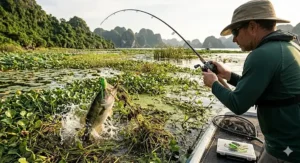
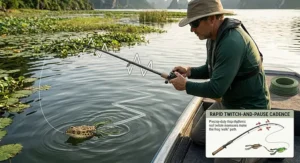
Here’s the thing nobody tells you at the tackle counter: frog fishing isn’t really about finesse. It’s about violence with good timing. You’re skipping a bait across a mat of vegetation thick enough to walk on, twitching it so it looks like a panicked amphibian having the worst day of its life, and then — when a five-pound bass detonates underneath it — you need a rod with enough backbone to drive a hook through a weed mat and a fish’s jaw at the same time, in roughly half a second, without the rod folding up like a wet noodle.
That’s a tall order for a frog fishing rod, and it’s why so many anglers end up frustrated with gear that looked great on a store rack but turns gummy the moment a frog goes off in heavy cover. The right rod feels almost boring during the cast — soft tip, easy lob, no drama — and then transforms into a crowbar the instant a fish commits.
We dug through real listings, owner reviews, and tournament angler write-ups to put together seven frog fishing rods you can actually buy right now, spanning true budget builds up through tournament-grade tackle. Whether you’re chasing your first frog blow-up or replacing a rod that finally gave up the ghost, there’s a fit on this list.
Quick Comparison Table
| Rod | Length / Power | Best For | Price Range |
|---|---|---|---|
| KastKing Royale Select 7’3″ H | 7’3″, Heavy, Extra-Fast | Tightest budget | Under $80 |
| Dobyns Fury FR735C | 7’3″, Heavy, Fast | Best value overall | $120–$150 range |
| Abu Garcia Veritas (PLX) Frog | 7’6″, Medium-Heavy, Fast | Long casts, soft tip | $130–$160 range |
| St. Croix Bass X | 7’4″, Heavy, Mod-Fast | Durability on a budget | $150–$180 range |
| Lew’s Custom Pro Speed Stick | 7’4″, Heavy, Fast | Lightweight all-day use | $160–$190 range |
| 13 Fishing Envy Black III | 7’3″–7’6″, Heavy | Sensitivity-focused anglers | $190–$230 range |
| St. Croix Legend Tournament Bass | 7’4″–7’5″, Heavy/MH, Fast | Tournament-grade everything | $300–$350 range |
A quick read on the numbers above: the price gap between the cheapest and most expensive rod on this list is roughly four-to-one, but the performance gap is nowhere near that dramatic — most of what you’re paying for at the top end is shaved-off ounces, better warranty coverage, and components that survive a thousand boat flips instead of three hundred. If you fish frogs three times a season, the Dobyns or the KastKing will treat you fine. If you’re flipping a frog forty days a year and your back already hates you, the lighter premium builds start paying for themselves in fatigue you don’t feel at 6 p.m.
💬 Just one click — help others make better buying decisions too!😊
Top 7 Frog Fishing Rods: Expert Analysis
1. KastKing Royale Select 7’3″ Heavy
The KastKing Royale Select is the rod we’d hand a buddy who just discovered frog fishing exists and isn’t ready to commit real money to the habit yet. It’s built on a graphite blank with a 7’3″ heavy power, extra-fast action — the textbook frog spec — paired with stainless guides that won’t immediately rust if you leave it in the truck bed during a thunderstorm.
What most buyers overlook about a budget rod like this: the blank-to-handle transition is where cheap rods usually fall apart first, and KastKing reinforced exactly that zone, which is why this one survives hooksets that snap rods twice its price. Owners consistently mention it casts farther than they expected for the cost, with a few noting the cork handle wears faster than premium options after a full season of use.
This is the right call for weekend anglers, college-budget tournament grinders, or anyone who wants a dedicated frog rod in the rod locker without raiding the grocery budget.
✅ Pros: Genuinely affordable; correct frog taper out of the box; surprisingly stout backbone
❌ Cons: Handle materials feel basic; not built for daily hardcore use
Price-wise, you’re looking at well under $80, which makes it the easiest “just try it” purchase on this list.
2. Dobyns Fury FR735C
The Dobyns Fury FR735C earns its reputation as the internet’s favorite “why spend more” frog rod, and after digging through years of owner feedback, it’s not hard to see why. It runs a high-modulus graphite blank with a Fuji reel seat and Kevlar-wrapped guides — components you’d expect on a rod costing twice as much.
The 7’3″ heavy power with fast action gives it a soft enough tip to walk a frog naturally through slop, but the backbone shows up the second a fish commits, which is exactly the split personality a frog rod needs. Several longtime users specifically compare it favorably against Dobyns’ own pricier Champion series, saying the performance gap is smaller than the price gap suggests. The AA-grade cork handle holds up well, though a handful of reviewers report guide wraps loosening after extended heavy use.
This is the rod for the angler who wants tournament-rod feel without a tournament-rod invoice — ideal for someone building out a frog-specific setup as a second or third rod on the deck.
✅ Pros: Premium-feeling components at a mid-tier price; balanced in hand; proven frog-specific taper
❌ Cons: Some reports of guide wrap durability issues; cosmetic finish is basic
Expect a price in the $120–$150 range — arguably the best dollar-for-dollar pick on this entire list.
3. Abu Garcia Veritas (PLX) Frog Casting Rod
Abu Garcia built the Abu Garcia Veritas PLX Frog Casting Rod specifically for this technique, which shows in the details most general-purpose rods skip. The 7’6″ length and Powerlux 100 graphite construction trade a little punching power for noticeably longer casts — useful when bass are holding in the middle of a grass flat instead of tight against the bank.
The titanium-alloy guides with zirconium inserts aren’t just a marketing line; they shave real weight off the tip section, which matters over a full day of repetitive frog twitches. In my experience, that soft tip is the standout feature here — it lets a frog walk side to side with minimal wrist effort, which means less fatigue by hour four. Owners frequently praise the casting distance and comfort, with the most common complaint being that the medium-heavy power feels a touch light for the thickest matted slop compared to true heavy-power competitors.
Best suited for anglers working open pads and scattered cover rather than gnarled, matted-down vegetation where raw lifting power matters more than reach.
✅ Pros: Excellent casting distance; lightweight all-day comfort; purpose-built frog taper
❌ Cons: Less backbone than heavy-power rivals; pricier than its raw power rating might suggest
Plan on a price in the $130–$160 range depending on retailer and configuration.
4. St. Croix Bass X Casting Rod
The St. Croix Bass X in the 7’4″ heavy configuration is the rod that keeps showing up in “best budget frog rod” conversations among anglers who’ve owned far more expensive sticks. It’s built on St. Croix’s SCII carbon fiber blank with stainless guides and aluminum-oxide inserts — componentry usually reserved for rods costing considerably more.
The spec sheet won’t tell you this, but the moderate-fast taper gives this rod a forgiving, parabolic bend under load that’s genuinely confidence-inspiring when a big bass is thrashing in slop ten feet from the boat — it loads progressively instead of feeling like a stiff pool cue. One especially telling owner comment described it as outperforming rods from three more expensive brands for frogging and flipping specifically. The trade-off, per other reviews, is that some buyers have experienced breakage under stress that comparable rods shrugged off, so treat it like a quality tool rather than an indestructible one.
A strong match for anglers who want St. Croix’s five-year warranty and build quality without paying St. Croix’s flagship prices.
✅ Pros: Excellent feel-to-price ratio; backed by a 5-year warranty; proven for frogging and flipping
❌ Cons: A small number of reports of rod breakage; handle grip placement can feel awkward with certain reel sizes
Typical pricing lands in the $150–$180 range.
5. Lew’s Team Lew’s Custom Pro Speed Stick (Magnum Pitching Stick)
The Lew’s Custom Pro Speed Stick, in its 7’4″ heavy “Magnum Pitching Stick” configuration, is built around Lew’s LFS-X5 multilayered graphite — a construction method aimed squarely at shaving weight without sacrificing the lifting power a frog rod needs when a fish wraps you in stalks.
What stands out here is the SoftTouch graphite reel seat, which transmits more vibration to your hand than a standard seat — genuinely useful since frog strikes are often visual, but feeling the take still helps you time the hookset on a fish that bites short. The tangle-free SS316 guides with zirconium inserts also mean less line slap noise on the cast, which matters more than people think when you’re skipping a bait under a dock at 6 a.m. Owners frequently highlight how light the rod feels for its power rating; the more common gripe is that the cork handle’s palm swell isn’t ideal for anglers with smaller hands.
This rod fits anglers who fish frogs for hours at a stretch and feel every extra ounce in their forearm by the end of the day.
✅ Pros: Excellent weight-to-power ratio; sensitive reel seat design; quiet guide train
❌ Cons: Handle shape won’t suit every hand size; available models can vary by retailer
Expect to pay in the $160–$190 range for this configuration.
6. 13 Fishing Envy Black III Casting Rod
The 13 Fishing Envy Black III leans hard into a Japanese 46-ton Toray graphite blank, which is the kind of spec that sounds like marketing fluff until you actually feel how light and crisp the blank is compared to lower-modulus competitors. Paired with Fuji Stainless K guides and SiC inserts, it’s engineered for anglers who treat sensitivity as a non-negotiable even on a technique most people consider a “feel-it-with-your-eyes” presentation.
Here’s what that modulus rating actually means in practice: higher-modulus graphite transmits more vibration through the blank but is generally more brittle, so 13 Fishing compensates with a reinforced butt section to keep the heavy-power frog models from snapping under hookset pressure. The Evolve Carbon Divide reel seat adds genuine blank contact you can feel through the cork. Reviewers occasionally flag inconsistent quality control on guide wraps out of the box — worth a quick inspection on arrival — but the rods that pass inspection get rave reviews for feel.
Ideal for anglers upgrading from a budget rod who want to feel the difference a premium blank makes, without jumping straight to the $300+ tier.
✅ Pros: Exceptional sensitivity for the price tier; premium cork handle; lightweight in hand
❌ Cons: Occasional QC inconsistencies reported; pricier than mid-tier alternatives like the Bass X
Pricing typically runs in the $190–$230 range.
7. St. Croix Legend Tournament Bass (Slop-N-Frog / Swim Frog)
If you fish frogs for a living — or just want the rod that tournament pros reach for — the St. Croix Legend Tournament Bass in its Swim Frog or Slop-N-Frog configuration is the top of this list for a reason. It’s built on St. Croix’s SCIV+ carbon fiber with Advanced Reinforcing Technology, a layup designed to add real strength without thickening the blank — which is how a rod this powerful still feels feather-light in your hand after a full day.
The detail that actually matters here: the Integrated Poly Curve tooling removes transitional stress points along the blank, so instead of bending at one weak spot under a hookset, the whole rod loads evenly — which is the difference between a rod that survives ten years of mat-busting hooksets and one that develops a soft spot after one bad season. Fuji’s PTS blank-touch reel seat adds sensitivity most frog anglers don’t expect to need until they’ve felt it. The 15-year transferable warranty backs all of that up, which matters given the price tag.
This is the pick for tournament anglers, guides, or serious hobbyists who fish frogs often enough that rod failure isn’t an inconvenience — it’s a lost paycheck.
✅ Pros: Best-in-class blank technology; exceptional balance for its power; 15-year warranty
❌ Cons: Significant price jump over the rest of this list; arguably overkill for casual anglers
Budget for the $300–$350 range, making it a clear premium investment rather than an impulse buy.
How to Choose a Frog Fishing Rod
If you want the short version before reading the deeper sections below, here’s the decision tree:
- Pick heavy power and fast-to-extra-fast action first — this is non-negotiable for pulling fish out of mats.
- Choose 7′ to 7’6″ length based on how far you need to skip baits versus how tight your casting lanes are.
- Match guide material to your line — braid eats cheap guide inserts, so prioritize titanium or aluminum oxide if you fish braid exclusively.
- Decide your budget tier honestly — a $130 rod with the right taper outperforms a $300 rod with the wrong one.
- Check the reel seat type — exposed-blank seats add sensitivity that matters more than people expect on visual strikes.
- Consider your hand size and grip preference — palm swell handles fit some anglers far better than others.
- Factor in warranty length — frog rods take abuse, and a strong warranty is real insurance, not just a sales line.
Practical Usage Guide
Getting the most out of a frog fishing rod isn’t complicated, but a few habits separate anglers who land fish from anglers who just get bit a lot.
First, match your reel’s gear ratio to the rod’s power — a high-speed reel (7.3:1 or faster) paired with a heavy frog rod lets you take up slack instantly after a blow-up, which matters because a bass that feels resistance in heavy cover will bury itself deeper before you can react. Second, re-check your guide wraps every few months if you fish braided line heavily; braid is abrasive enough to wear cheaper inserts faster than most anglers expect. Third, store the rod horizontally or in a rod sock rather than standing it tip-down in a corner, since that’s the single most common cause of warped tips on graphite blanks.
One mistake almost everyone makes in their first season: setting the hook the instant a frog disappears. Wait a half-second for the fish to fully eat and turn — frog rods are built with enough backbone to forgive a slightly delayed hookset, which is exactly why patience pays off more here than on most other techniques.
Real-World Scenarios: Matching the Rod to the Angler
Picture three different anglers standing on the same dock.
The weekend hobbyist fishes maybe fifteen days a season, mostly on a local pond with scattered lily pads. Budget matters more than shaved ounces here — the KastKing Royale Select or Dobyns Fury covers this angler completely, since the technique-specific taper does the heavy lifting regardless of price tier.
The serious tournament grinder fishes forty-plus days a year, often in thick, matted vegetation where a delayed hookset or a soft tip costs fish. This angler benefits most from the St. Croix Bass X or Lew’s Custom Pro Speed Stick — enough backbone to punch through mats, light enough to fish all day without arm fatigue setting in by noon.
The guide or full-time competitor needs gear that simply cannot fail mid-tournament, and that’s where the St. Croix Legend Tournament Bass earns its price tag — the warranty alone is worth factoring into the math when a broken rod means a blown derby day.
Problem → Solution Guide
Problem: My frog rod keeps breaking on the hookset. This usually means the power rating is too light for the cover you’re fishing — bump up to a true heavy-power blank like the Dobyns Fury or St. Croix Legend Tournament rather than a medium-heavy.
Problem: I can’t cast a lightweight hollow body frog rod very far. Length helps more than power here — a 7’6″ rod like the Abu Garcia Veritas generates more leverage and line speed on the cast than a shorter stick.
Problem: My arm is exhausted after a few hours of frogging. Look at total rod weight and blank modulus — higher-modulus graphite (like on the 13 Fishing Envy Black III) sheds ounces that add up across hundreds of casts.
Problem: I keep losing fish that blow up but don’t get hooked. This is often a hookset timing issue rather than a gear issue, though a softer-tip rod can also help frogs walk more naturally and trigger fuller commitment strikes.
Problem: My guides are wearing out fast. Braided line plus budget guide inserts is the usual culprit — upgrading to titanium or aluminum-oxide guide trains solves this almost every time.
✨ Don’t Miss These Exclusive Deals!
🔍 Take your frog fishing rod setup to the next level with these carefully selected picks. Click on any highlighted rod to check current pricing and availability. The right rod turns a frustrating day of missed blow-ups into the kind of explosive topwater strikes that make this whole technique addictive!
Frog Fishing Rod vs. Standard Bass Rod
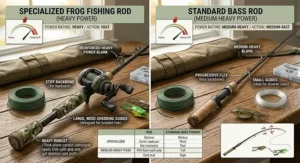
A frog fishing rod and a general-purpose bass rod might look similar on a rack, but the differences matter more than the eye test suggests. A standard medium-heavy bass rod is built as a do-everything tool — fine for crankbaits, jigs, and spinnerbaits — but it typically has a tip that’s too stiff for walking a hollow body frog naturally and not quite enough lifting power to horse a bass through thick matted vegetation. Frog rods, by contrast, are tuned with a softer tip section for natural bait action and a notably stiffer mid-to-butt section for the hookset-and-extraction phase.
This matters most in heavy cover. A general bass rod might handle a frog just fine in open water around scattered pads, but the moment a fish buries itself in a thick mat, the lack of backbone becomes obvious fast — you’ll feel the rod folding instead of pulling the fish toward you. If frogging is a regular part of your rotation, a dedicated frog rod isn’t a luxury; it’s the tool that actually closes the deal on strikes you’re already getting.
Common Mistakes When Buying a Frog Fishing Rod
The most common error is buying based on length alone without checking power and action — a 7’6″ medium rod is not a frog rod, no matter how long it is. The second mistake is assuming all “heavy power” ratings are equivalent across brands; one company’s heavy can flex closer to another company’s medium-heavy, which is why owner reviews mentioning specific techniques matter more than the spec sheet alone.
A third mistake is ignoring guide material when fishing braided line exclusively — cheap guide inserts wear down faster under braid’s abrasive surface, leading to grooved guides that fray line over time. Finally, plenty of anglers underestimate how much total rod weight affects fatigue over a full day; shaving two ounces off a blank doesn’t sound like much until you’ve made four hundred casts.
What to Expect: Real-World Performance
On paper, most frog rods on this list look similar: heavy power, fast action, roughly 7 to 7’6″ in length. In practice, the differences show up in three moments — the cast, the walk, and the hookset.
During the cast, lighter, higher-modulus blanks like the 13 Fishing Envy Black III or St. Croix Legend Tournament Bass load and release with noticeably less effort, which matters across a full day of repetitive skipping under docks and limbs. During the walk — the side-to-side twitching action that makes a hollow body frog look alive — softer-tipped rods like the Abu Garcia Veritas produce a more natural side-to-side glide with smaller wrist movements. And during the hookset, stiffer butt sections like those on the St. Croix Bass X or Dobyns Fury translate directly into more solid hooksets through thick vegetation, where a softer rod simply can’t transfer enough force to set the hook through several inches of matted grass.
Features That Actually Matter (And Those That Don’t)
What actually matters: power rating accuracy (not just the label, but real-world performance reports), guide material if you fish braid, blank weight for all-day comfort, and reel seat design for sensitivity on visual strikes. These directly affect how many fish you land, not just how the rod feels in a store.
What matters less than marketing suggests: cosmetic finish and color, exotic-sounding proprietary blank names without backing specs, and ultra-premium componentry on a rod you’ll fish three days a season. A flashy paint job has never set a hook. If you’re an occasional frogger, the difference between a $130 rod with the right taper and a $300 rod with the same taper is mostly bragging rights.
Long-Term Cost & Maintenance
Frog rods take a beating — boat flips, hooksets through vegetation, the occasional door slam — so total cost of ownership matters more here than with finesse gear you baby in a rod locker. A $130 rod that needs replacing every two seasons of heavy use ends up costing roughly the same as a $300 rod backed by a 15-year warranty, once you factor in the long run.
Maintenance is minimal but worth doing: rinse guides after saltwater or muddy-water trips, check wraps for looseness every few months, and replace worn guide inserts before they start fraying your line rather than after. Most of the rods on this list — particularly the St. Croix and Dobyns options — carry multi-year warranties that cover manufacturing defects, which is genuinely worth registering the moment you unbox a new rod.
FAQ
❓ What size frog fishing rod is best for beginners?
❓ Can I use a frog rod for other topwater bass rod techniques?
❓ How much should I spend on a hollow body frog rod?
❓ Is spinning or casting better for frog fishing?
❓ What line works best with a heavy cover topwater rod?
Conclusion
A frog fishing rod isn’t the kind of gear you need to overthink, but it is the kind of gear where the wrong choice quietly costs you fish all season without you realizing it’s the rod’s fault. The good news is that the spread on this list — from the budget-friendly KastKing Royale Select up through the tournament-grade St. Croix Legend Tournament Bass — covers nearly every angler and every budget without forcing a compromise on the one spec that actually matters: a true heavy-power, fast-action build with a soft enough tip to walk a frog naturally.
If you fish frogs occasionally, the Dobyns Fury remains the easiest recommendation on this entire list — it punches well above its price point. If frogging is a core part of your game and you’re tired of fighting your rod instead of the fish, stepping up to the St. Croix Bass X or Lew’s Custom Pro Speed Stick will feel like a genuine upgrade in both comfort and hooksets. And if you’ve already decided frogging is your technique for life, the Legend Tournament Bass is built to be the last frog rod you ever need to buy.
Whatever you choose, the goal is the same: feel that surface erupt, keep your composure for half a second longer than feels natural, and let the rod you picked do the rest.
For more on why frogs even work as a bass lure in the first place, largemouth bass are opportunistic ambush predators that key in heavily on amphibians and other prey hiding in dense vegetation cover, which is exactly the habitat a frog bait is designed to mimic. Fisheries researchers at Texas A&M’s pond management program also note how strongly bass behavior ties to structure and cover, reinforcing why heavy-cover technique-specific rods exist in the first place. For deeper technique breakdowns beyond gear selection, Outdoor Life’s frog rod testing is a solid additional resource.
Recommended for You
- Casting Rod for Bass: 7 Best Picks Anglers Trust in 2026
- 7 Best Medium Action Bass Rod Picks That Catch More Fish in 2026
- 7 Best Heavy Action Bass Rods in 2026
Disclaimer: This article contains affiliate links. As an Amazon Associate, I earn from qualifying purchases. If you purchase products through these links, we may earn a small commission at no additional cost to you.
✨ Found this helpful? Share it with your friends! 💬🤗
