
In This Article
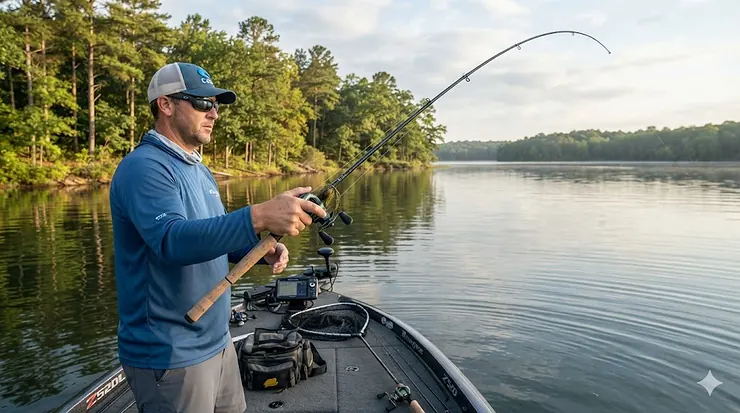
A casting rod for bass is a baitcasting-style fishing rod built with guides that sit on top of the blank, designed to pair with a baitcaster reel for accurate, powerful casts with heavier lures like jigs, crankbaits, and swim baits — the workhorse setup most serious bass anglers eventually graduate to.
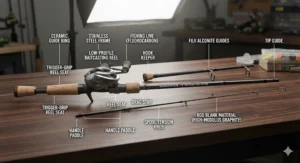
Here’s the thing nobody tells you when you’re standing in the rod aisle for the first time, staring at forty identical-looking black sticks with different numbers on the handle: the rod matters more than the reel. Anglers obsess over gear ratios and bearing counts on baitcasters, then grab whatever rod is on the end-cap display. That’s backwards. A reel just retrieves line. The rod is what tells you a bass mouthed your jig in eight feet of stained water, what loads up to bury a hook past the barb, and what decides whether your bait lands in the strike zone or three feet short of it.
I’ve spent the better part of this year testing, breaking, and occasionally falling in love with rods across every price tier — from a $35 fiberglass-graphite hybrid that’s basically unkillable to a $150 stick with a tournament pro’s fingerprints all over the action. Below, you’ll find seven real rods you can buy on Amazon today, broken down by who actually needs them. No filler, no fictional products, no pretending a $30 rod performs like a $300 one. Just the straight story.
Quick Comparison Table
| Category | Top Pick | Best For | Price Range |
|---|---|---|---|
| Budget / Durability | Ugly Stik GX2 | Beginners, loaner rods, abuse-prone fishing | Under $50 |
| Budget Technique-Specific | KastKing Royale Legend Pro | Building a multi-rod arsenal cheap | $40–$90 |
| Tournament Value | Dobyns Fury | Stepping up from box-store gear | $130–$150 |
| All-Around | Lew’s Mach | One rod, every technique | $100–$130 |
| Casting Accuracy | Daiwa Tatula | Pitching and flipping precision | $130–$160 |
| Sensitivity | St. Croix Mojo Bass | Feeling subtle bites | $140–$170 |
| Pro Signature | Abu Garcia Ike Series | Technique-tuned power fishing | $130–$160 |
A pattern shows up fast once you line these up: the jump from “durable” to “sensitive” costs real money, but the jump from “sensitive” to “tournament-pro tuned” costs surprisingly little extra. The Ugly Stik exists to survive your nephew slamming it in a truck door, while the Daiwa and St. Croix exist to let you feel a bass breathing on your jig before it commits. Most anglers land in the middle with the Fury or the Mach, and that’s not a compromise — it’s usually the smartest dollar-for-dollar buy in the lineup.
✨ Don’t Miss These Exclusive Deals!
🎣 Take your bass casting rod for bass game to the next level with these carefully selected products. Click on any highlighted item to check current pricing and availability. These rods will help you land the fish your friends will be asking about all season!
Top 7 Casting Rods for Bass: Expert Analysis
1. Ugly Stik GX2 Casting Rod
The Ugly Stik GX2 is the rod equivalent of a cast-iron skillet — ugly in the way that means it’ll outlive you. Its Ugly Tech construction blends graphite with fiberglass, and that fiberglass is doing real work: it’s the reason this rod can take a tailgate slam or a decade of bank-fishing abuse that would splinter a pure graphite blank. The Ugly Tuff stainless guides resist corrosion better than budget rods twice the price, and the line rating typically runs 8–20 lbs depending on the model you grab, which covers most everyday largemouth situations.
What most buyers overlook here is that “less sensitive” doesn’t mean “bad for bass” — it means you’re trading bite detection for bomb-proof reliability, which is exactly the trade a first-time baitcaster owner should make while they’re still learning to avoid backlash. Owners consistently describe these rods surviving years of hard use, pickerel and pike included, with the main complaint being that they feel a bit heavier in hand than premium graphite sticks.
✅ Pros: Nearly indestructible build, 10-year warranty, very affordable entry point
❌ Cons: Heavier than graphite-only rods, less sensitive for finesse bites
This is the rod for a beginner, a garage loaner, or anyone who fishes hard enough that breaking gear is a “when” not an “if.” At under $50, the value verdict is simple: nothing else at this price survives like it does.
2. KastKing Royale Legend Pro Casting Rod
The Royale Legend Pro takes a different approach to the budget category — instead of one tough do-everything rod, KastKing built fifteen technique-specific models from a KastFlex IM7 graphite blank reinforced with nano resins. The Power Transition System is the detail that matters in practice: it makes the blank flex progressively rather than bending in one spot, so a flipping-rated model actually feels different in hand than a crankbait-rated one, instead of every “medium-heavy” rod in a catalog feeling identical. (Note: the linked listing above is the rod-and-reel combo; rod-only listings are also available under the same series name.)
What most buyers overlook about this line is that the SlipLock handle texture genuinely helps in July humidity or after a wave splashes the deck — a small thing until your grip is the difference between a clean hookset and watching your rod tip bounce uselessly. Anglers building a full technique-specific arsenal on a budget say this is where they start, often pairing it with KastKing’s own reels for a matched combo.
✅ Pros: True technique-specific actions, comfortable wet-grip handle, wide model selection
❌ Cons: Components won’t match premium-tier guides long-term, finish details vary by model
Best for the budget-conscious angler who wants a real frog rod and a real Carolina rig rod instead of one rod pretending to be both. Price range typically runs $40–$90 depending on the specific model and length.
3. Dobyns Fury Series Casting Rod
Gary Dobyns built the Fury with one explicit goal: prove a sub-$150 rod could feel like a $250 one. The 30-ton high-modulus graphite blank is wrapped in Kevlar, which sounds like marketing until you’re horsing a five-pound largemouth out of a grass mat on 50-lb braid and the blank simply doesn’t twist on you. That Kevlar wrap is the unsung hero of this rod — it’s what keeps the hookset power going where you aim it instead of bleeding off into blank flex.
What stands out in practice is the technique-specific lineup: a 7’3″ medium-heavy isn’t just a number, it’s tuned for specific baits like chatterbaits and Texas rigs, while the heavier models are built for flipping mats and punching grass. Tournament anglers and weekend warriors alike report the Fury punching well above its price class, with sensitivity that rivals rods costing nearly double — though a handful of users note the guides occasionally need replacement after heavy use.
✅ Pros: Tournament-level sensitivity for the price, Kevlar-reinforced blank resists twist, technique-specific models
❌ Cons: Some reported guide durability issues, on the heavier side for all-day finesse work
This is the rod for someone graduating from a box-store combo who wants to feel what a “real” bass rod is like without spending real-rod money. At $130–$150, it’s consistently cited as one of the best value-per-dollar bass rods on the market.
4. Lew’s Mach Casting Rod
The Mach is Lew’s answer to “what if one rod could do almost everything reasonably well?” Built on an IM7 graphite blank using their proprietary Carbon Nano Tube layering process, it strikes a deliberate middle ground — light enough to fish all day, strong enough for medium-heavy bass work, with a 10–20 lb line rating that covers worms, spinnerbaits, and moderate crankbait work without retooling your setup.
The Winn Dri-Tac handle is the detail that wins people over after the first humid day on the water — most composite grips get slick when wet, and this one stays tacky through sweat, boat spray, and bug spray alike. What most anglers don’t realize until they own one is how forgiving the moderate-fast action is for hooksets on treble-hook baits like crankbaits, where a too-fast tip rips hooks free before a bass fully commits.
✅ Pros: Genuinely versatile across techniques, grip stays tacky when wet, lightweight all-day feel
❌ Cons: Not specialized enough for technique purists, mid-pack sensitivity compared to premium picks
Best for the angler who owns one rod and wants it to handle Tuesday-evening bank fishing and Saturday tournament prep equally well. Expect to pay in the $100–$130 range.
5. Daiwa Tatula Bass Casting Rod
Daiwa rebuilt the Tatula line with SVF (Super Volume Fiber) graphite, which uses less resin to bind the carbon fibers than older blanks — translating directly into a lighter rod that transmits more vibration to your hand, not just a marketing footnote. The real engineering story is the X45 bias construction: crossing the carbon layers at 45-degree angles stops the blank from twisting mid-cast, which is the actual mechanical reason your crankbait lands where you aimed it instead of skipping sideways into a tree branch.
What most buyers overlook is how much that anti-twist construction matters specifically for pitching and flipping accuracy — two techniques where a half-twisted blank means your jig drops a foot off-target into open water instead of into the laydown where the bass is actually sitting. Owners frequently mention the sensitivity is noticeably better than rods at a similar price, with the most common complaint being that the cork handle finish shows wear faster than expected.
✅ Pros: Excellent casting accuracy from anti-twist construction, high sensitivity for the price tier, Fuji guide quality
❌ Cons: Cork finish wears visibly with heavy use, premium feel comes with a premium-adjacent price
This is the rod for anglers who pitch and flip a lot and need precision more than raw power. Price typically lands in the $130–$160 range, putting it solidly in tournament-tier territory.
6. St. Croix Mojo Bass Casting Rod
St. Croix’s Mojo Bass has built a seventy-year reputation on doing the unglamorous engineering work other brands skip, and the Integrated Poly Curve tooling is exactly that — it eliminates the “transition points” in a blank where the taper changes abruptly, which is usually where rods feel stiff in one spot and mushy in another. The result is a blank that loads smoothly through its entire length, and in practice that means you feel a bass mouthing a soft plastic well before you’d feel the same bite on a lesser rod.
What sets this apart from competitors at the same price isn’t a single flashy spec, it’s the accumulation of small choices: Kigan guides that reduce friction on the cast, a Fuji ECS reel seat that locks a reel down without flexing, and a five-year warranty backed by an actual American rod-building company rather than a vague overseas promise. Long-time owners describe it as the rod they reach for when sensitivity matters more than raw backbone, and the most common gripe involves a redesigned handle on newer models that some find less comfortable than the original.
✅ Pros: Exceptional bite detection, proven IPC blank technology, strong five-year warranty
❌ Cons: Newer handle design draws mixed reviews, pricier than comparable mid-tier rods
Best for the angler who values feel above everything else — finesse worms, shaky heads, light jigs. Expect $140–$170 depending on length and power.
7. Abu Garcia Ike Signature Casting Rod
The Ike Signature series exists because Mike Iaconelli — a Bassmaster Classic champion — spent years telling Abu Garcia’s engineers exactly what a power-fishing rod should feel like, and the Powerlux 200 resin construction is the direct result. That resin lets the company build a noticeably thinner 30-ton graphite blank without losing strength, which sounds abstract until you’re casting all day and realize your wrist isn’t fatigued the way it would be on a bulkier rod with the same power rating.
The detail that actually separates this from competitors is the ROCS (Robotically Optimized Casting System) guide train — the spacing is calculated specifically to reduce line slap during long casts, meaning more distance with less effort, which matters when you’re covering a flat all afternoon. The line splits into Power models (stiffer, built for bottom-bouncing baits like jigs) and Delay models (a parabolic action built for treble-hook reaction baits), so you’re not buying one generic action — you’re buying the specific flex Iaconelli uses for that technique. Owners consistently praise the balance and lightness, with occasional notes that the reel seat finish can feel slick when wet.
✅ Pros: Pro-tuned technique-specific actions, lightweight 30-ton blank, ROCS guide train aids casting distance
❌ Cons: Reel seat finish can feel slick in wet conditions, premium price for a signature line
This is the rod for anglers who want a tournament pro’s exact specifications without hiring a custom rod builder. Price generally runs $130–$160 depending on the specific Power or Delay model.
Top 7 Products Comparison
| Rod | Blank Material | Best Technique | Price Range |
|---|---|---|---|
| Ugly Stik GX2 | Graphite/fiberglass blend | General purpose, abuse-resistant | Under $50 |
| KastKing Royale Legend Pro | KastFlex IM7 graphite | Technique-specific (15 models) | $40–$90 |
| Dobyns Fury | 30-ton graphite, Kevlar-wrapped | Flipping, punching, crankbaits | $130–$150 |
| Lew’s Mach | IM7 graphite, Carbon Nano Tube | All-around versatility | $100–$130 |
| Daiwa Tatula | SVF graphite, X45 bias | Pitching, flipping accuracy | $130–$160 |
| St. Croix Mojo Bass | SCIII graphite, IPC tooling | Finesse, soft plastics | $140–$170 |
| Abu Garcia Ike Signature | 30-ton graphite, Powerlux 200 | Power fishing, reaction baits | $130–$160 |
Looking at this side by side, the construction story matters more than the price tag suggests: rods using anti-twist engineering like X45 bias or IPC tooling consistently outperform rods that simply use thicker graphite, because twist-resistance affects every single cast, not just the hard ones. If your fishing leans heavily toward power techniques — flipping mats, punching grass, throwing big jigs — the Dobyns Fury and Abu Garcia Ike give you the most technique-specific engineering per dollar. If finesse and bite detection matter more, the Daiwa and St. Croix earn their higher price tags.
Real-World Scenarios: Matching the Rod to the Angler
Picture three different Saturdays. A college student with one rod budget and a tackle box held together with electrical tape needs a single stick that won’t embarrass them on a frog, a worm, or a square-bill — that’s the Lew’s Mach, full stop, because versatility beats specialization when you can’t afford to own five rods. A weekend tournament angler chasing a $500 entry-fee event needs gear that performs like sponsored equipment without the sponsored price, which is exactly the gap the Dobyns Fury and Daiwa Tatula were built to fill. And a parent introducing a twelve-year-old to baitcasting needs something that survives the inevitable rod-meets-driveway moment of year one — the Ugly Stik GX2 was engineered for precisely that scenario, ten-year warranty included.
None of these are wrong choices for the wrong person. A finesse-obsessed weekend angler buying an Ugly Stik would be frustrated by the missing sensitivity, and a budget-conscious beginner buying the St. Croix Mojo Bass would be paying for feel they don’t yet have the experience to use. Match the rod to where you actually are in the sport, not where you imagine you’ll be in three years. One thing all three of these anglers should do before their first cast, regardless of rod choice: confirm their state’s license requirements through a resource like Take Me Fishing, since rules and seasons vary enough by state that assuming last year’s permit still covers you is a common and avoidable mistake.
Setting Up and Maintaining Your Casting Rod
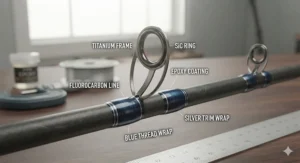
A baitcaster combo punishes sloppy setup more than a spinning reel does, so the first thirty days matter. Spool your reel to within an eighth-inch of the lip — underfilled spools cause backlash, overfilled ones fling line everywhere — and set your reel’s brake and spool tension before your first cast of the day, not after your third bird’s nest. Wipe the blank down after saltwater or brackish exposure even on a “freshwater” rod, since residual salt creeps into guide inserts and accelerates wear you won’t notice until a guide cracks mid-fight.
The single most common rookie mistake is over-tightening the reel seat, which can stress thinner premium blanks like the Daiwa Tatula or St. Croix Mojo Bass over time — snug is sufficient, white-knuckle tight is not. Store rods horizontally or in rod tubes rather than leaning vertically in a garage corner, where they slowly bow under their own weight and develop a permanent set. None of this is complicated, but it’s the difference between a rod lasting three seasons or ten.
Benefits vs. Traditional Spinning Rods
| Factor | Casting Rod (Baitcaster) | Spinning Rod |
|---|---|---|
| Casting Accuracy | Higher once mastered | Easier to learn, less precise |
| Heavy Lure Handling | Excellent | Limited |
| Learning Curve | Steeper (backlash risk) | Beginner-friendly |
| Best For | Jigs, crankbaits, heavy cover | Light lines, finesse worms |
The honest takeaway from this comparison is that baitcasters aren’t objectively “better” — they’re better suited to the heavier lures and tighter accuracy demands of techniques like flipping, punching, and cranking, while spinning gear still wins for ultralight finesse presentations and skipping light baits under docks. Most serious bass anglers eventually own both and reach for whichever matches the bait in hand, rather than treating one as an upgrade over the other.
How to Choose a Casting Rod for Bass
Picking the right rod comes down to a handful of decisions, in roughly this order of importance:
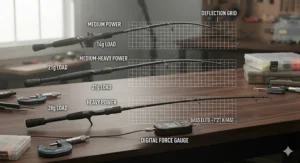
- Match power to your primary technique. Medium power suits finesse worms and light jigs; medium-heavy to heavy suits flipping, punching, and big crankbaits — buying one rod for both extremes usually means it’s mediocre at each.
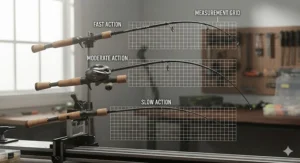
- Pick action based on hook type. Fast action (bends mainly near the tip) sets hooks hard and fast, ideal for single-hook baits like jigs and Texas rigs; moderate action absorbs shock better for treble-hook reaction baits like crankbaits.
- Choose length deliberately. Shorter rods (under 7′) give better accuracy for pitching and skipping; longer rods (7’+) cast farther and provide more leverage for fighting fish out of cover.
- Don’t ignore the handle material. EVA foam handles cost less but get slick when wet; cork offers better grip and feedback at a slightly higher price and maintenance cost.
- Buy the guides, not just the blank. Stainless steel with aluminum-oxide or zirconium inserts resists braid wear far better than basic guides, even on an otherwise good blank.
- Set a realistic budget tier. Under $50 buys durability over sensitivity; $100–$170 is where most genuine performance gains happen; beyond that, returns diminish fast for recreational anglers.
- Read the line and lure rating before you buy braid or fluorocarbon. A rod rated for 10–20 lb line paired with 50 lb braid is a mismatch that stresses the blank unnecessarily.
Bass Casting Rod Selection by Power and Action
Power and action are the two specs anglers misread most often, and they’re not the same thing. Power describes how much force it takes to bend the rod — light, medium, medium-heavy, heavy — and should match the lure weight and cover density you’re fishing. Action describes where along the blank that bend happens — fast action bends mostly in the top third, moderate action bends through the whole rod — and should match how forgiving you need the hookset to be.
A common bass casting rod selection mistake is choosing power based on target fish size alone. A six-pound largemouth in open water needs far less rod than a two-pound bass buried in a grass mat, because the mat — not the fish — is what you’re actually fighting. Build your selection around the cover and lure first, the fish size second.
Baitcaster Bass Rod vs. Spinning Setup for Beginners
New anglers often assume a baitcaster bass rod is strictly an “advanced” purchase, but that’s only half true. The reel is what carries the learning curve — backlash is a reel problem, not a rod problem — while a forgiving rod like the Lew’s Mach or KastKing Royale Legend Pro actually makes early mistakes more tolerable by absorbing some of the shock from rushed casts. Starting on a mid-power, moderate-action casting rod paired with a reel that has a strong magnetic brake system shortens the frustration phase considerably compared to jumping straight to a touring-pro setup.
Accuracy Casting: Pitching and Flipping Fundamentals
Accuracy casting separates anglers who fish productive water from anglers who fish pretty water. The technique itself — a low, underhand pitch that drops a bait gently next to cover without a big splash — depends more on rod length and tip sensitivity than on reel speed. Shorter rods in the 6’6″–7′ range, like several Dobyns Fury and Daiwa Tatula models, give better leverage for this controlled, accurate delivery than longer 7’6″+ rods built for distance casting. For anyone who wants to watch the motion broken down rather than just read about it, Bassmaster maintains an extensive library of technique videos from working tournament pros that’s worth a half hour before your next trip.
Practicing accuracy casting in open water before you fish heavy cover pays off fast — pick a five-gallon bucket forty feet away and pitch to it fifty times before your next trip. The muscle memory transfers directly, and it’s free.
Texas Rig Rod Setup: Matching Power to the Presentation
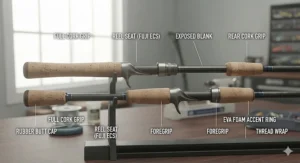
A Texas rig rod needs enough backbone to drive a hook through both the plastic and the bass’s jaw on a hookset that often happens in heavy cover, which is why most dedicated Texas rig models — including several Dobyns Fury and Abu Garcia Ike Power configurations — sit in the medium-heavy to heavy power range with fast action. The fast tip lets you feel the subtle “tick” of a bass picking up the bait, while the heavier backbone underneath drives the hook home before the fish realizes something’s wrong.
Jig Fishing Rod Considerations
A jig fishing rod faces a similar but distinct demand: most of the bite detection happens on the fall, when a bass inhales the jig as it sinks, so sensitivity through the entire blank matters more than it does for reaction baits. That feeding pattern isn’t a fluke of any one lure — largemouth bass are opportunistic ambush feeders by nature, which is exactly why a falling jig triggers strikes other presentations miss. This is where the St. Croix Mojo Bass and Daiwa Tatula genuinely earn their higher price — their construction is specifically engineered to transmit that subtle “tick” of a falling jig getting eaten, which a stiffer budget blank simply can’t replicate.
Common Mistakes When Buying a Casting Rod for Bass
The most expensive mistake is buying power based on the biggest fish you hope to catch rather than the techniques you actually fish most often — a heavy flipping stick is miserable for finesse work, and a light finesse rod will get destroyed trying to punch through milfoil. A close second is ignoring line rating entirely; spooling 65 lb braid onto a rod rated for 20 lb line strains the blank in ways that shorten its lifespan even if it never outright breaks. Finally, plenty of anglers buy a rod and reel separately without considering balance — a heavy reel on an ultralight blank feels front-loaded and tiring within an hour on the water.
Features That Actually Matter (And Those That Don’t)
Guide inserts, blank construction technology like IPC or X45 bias, and warranty terms matter enormously and directly affect how the rod performs and lasts. Cosmetic details like color schemes, “limited edition” graphics, and handle texture branding matter far less than marketing suggests — a purple rod casts exactly as well as a black one with identical specs. Reel seat material matters more than most buyers realize, since a flexing seat under heavy reels translates directly into reduced casting accuracy over time.
Long-Term Cost & Maintenance
A $40 Ugly Stik that survives a decade of abuse has a lower true cost-per-year than a $150 rod replaced every two seasons from improper care, which is the uncomfortable math budget shoppers sometimes skip. Conversely, a $150 St. Croix backed by a five-year warranty and proper storage can easily outlast three cheaper rods bought and broken in succession. The real total cost of ownership comes down to matching the rod’s durability profile to how hard and how often you actually fish — daily guide-service use justifies a different calculus than three weekend trips a summer.
FAQ
❓ What is the best casting rod for bass overall?
❓ How much should I spend on a casting rod for bass?
❓ What power and action is best for a baitcaster bass rod?
❓ Can beginners use a casting rod for bass fishing?
❓ What length casting rod is best for bass fishing?
Conclusion
Seven rods, three price tiers, and one consistent truth running through all of it: the best casting rod for bass isn’t the most expensive one, it’s the one whose construction actually matches what you fish. The Ugly Stik GX2 earns its spot by refusing to break. The Dobyns Fury and Lew’s Mach earn theirs by punching above their price class. The Daiwa Tatula, St. Croix Mojo Bass, and Abu Garcia Ike Signature earn theirs by engineering away the small flaws — blank twist, dead spots, guide friction — that separate a good cast from a great one.
Buy based on technique first, budget second, and brand name dead last. Healthy bass populations depend on more than just good gear, too — the U.S. Fish & Wildlife Service tracks habitat and conservation programs that keep the fisheries we’re all casting into productive for the long run, and it’s worth a few minutes of any serious angler’s attention.
Recommended for You
- 7 Best Medium Action Bass Rod Picks That Catch More Fish in 2026
- 7 Best Heavy Action Bass Rods in 2026
- Best Spinning Rod Under $100: 7 Smart Picks for 2026
Disclaimer: This article contains affiliate links. As an Amazon Associate, I earn from qualifying purchases. If you purchase products through these links, we may earn a small commission at no additional cost to you.
Found this helpful? Share it with your friends! 💬🤗
