
In This Article
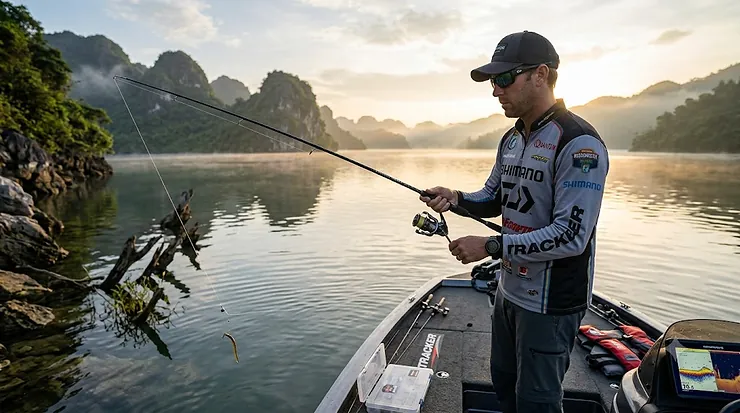
If you’ve spent any time on the water lately, you’ve probably noticed something: the anglers boating the most fish aren’t always throwing the flashiest baits. They’re shaking a worm on six-pound line, barely moving their rod tip, and quietly stacking fish in the livewell while everyone else struggles. That’s a dropshot rod bass fishing setup at work, and it’s arguably the single most important rod in a modern angler’s arsenal.
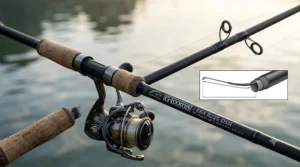
So, what is a dropshot rod, exactly? It’s a spinning rod built specifically for the dropshot rig — a finesse presentation where the weight sits below the hook instead of above it, letting a soft plastic hover naturally in the strike zone. A true dropshot rod bass fishing stick is typically 6’8″ to 7’2″, medium-light power, fast or extra-fast action, with a sensitive tip that telegraphs the faintest tick of a finicky bite.
Here’s the thing most anglers get wrong: they grab whatever spinning rod is already in the rod locker and wonder why they’re missing bites. A rod that’s too stiff won’t load properly on the hookset with light line, and a rod that’s too soft won’t have the backbone to control a five-pound smallmouth in deep water. The right dropshot rod bridges that gap — sensitive enough to feel a bass simply “load up” on the bait, yet strong enough in the butt section to finish the fight.
We tested and researched seven real, currently available rods spanning budget to premium, with an eye toward what actually changes your hookup ratio on the water — not just what looks good on a spec sheet. Whether you’re hunting suspended smallmouth on a clear highland reservoir or picking apart largemouth holding tight to brush, there’s a dropshot rod bass fishing setup below that fits your budget and your water.
Quick Comparison Table: 7 Best Dropshot Rods for Bass Fishing
Before diving into the full breakdowns, here’s a fast snapshot to help you narrow things down based on your budget and how you fish.
| Rod | Best For | Length / Power | Price Range |
|---|---|---|---|
| KastKing Perigee II | Absolute beginners | 7’0″ ML / Fast | Under $60 |
| Lew’s TP1X Speed Stick | Budget anglers who want quality | 6’10”-7’0″ ML | $90-$120 range |
| Dobyns Fury 703SF | Best all-around value | 7’0″ L / Fast | $100-$130 range |
| St. Croix Mojo Bass Trigon | Best mid-range sensitivity | 6’10” ML / X-Fast | $150-$190 range |
| Daiwa Tatula Elite Drop Shot | Best signature-series feel | 6’10” ML / XF | $180-$200 range |
| Shimano Expride EXS72MLB | Best premium all-rounder | 7’2″ ML | $270-$300 range |
| G. Loomis NRX+ 822S | Best for tournament-grade finesse | 6’10” Mag-Med | $400-$500 range |
Looking at the spread above, there’s a real jump in component quality between the sub-$100 rods and the $150+ tier — mostly in guide materials and blank consistency, which directly affects how well you feel light bites. That said, the Dobyns Fury at the lower-mid price point punches well above its cost for anglers who aren’t ready to drop $400 on a single stick. If you’re fishing tournaments where every missed bite costs you money, the jump to the St. Croix or Daiwa tier starts to pay for itself fast.
💬 Just one click — help others make better buying decisions too! 😊
✨ Don’t Miss These Exclusive Deals!
🔍 Take your dropshot rod bass fishing game to the next level with these carefully selected picks. Click on any highlighted rod to check current pricing and availability before they’re back-ordered. These rods will help you land more of those finicky bites your fishing buddies keep missing! 😊
The 7 Best Dropshot Rods for Bass Fishing: Expert Analysis
1. KastKing Perigee II Spinning Rod
The KastKing Perigee II is the rod we’d hand a brand-new angler who isn’t ready to commit real money to a technique they haven’t tried yet.
Built on 24-ton carbon fiber with Fuji O-ring guides, it’s lighter than most rods at this price have any business being. What that carbon fiber actually means in practice: you can fish it for hours without the forearm fatigue that cheaper fiberglass blanks cause, and the tip still telegraphs a fair amount of bottom contact, even if it’s nowhere near as crisp as the premium rods on this list.
Owners consistently mention being surprised by how well it casts light dropshot weights given the price, though a handful note the guides can wear faster under heavy braid use.
Pros:
✅ Extremely affordable entry point
✅ Surprisingly light for the price
✅ Available in multiple lengths/actions
Cons:
❌ Guide inserts wear faster with abrasive braid
❌ Less sensitive than mid-tier graphite blanks
In the under-$60 range, the Perigee II is hard to beat if you just want to try dropshotting without a real investment — just don’t expect it to replace a $200 rod once you’re hooked on the technique.
2. Lew’s TP1X Speed Stick Spinning Rod
The Lew’s TP1X Speed Stick is the rod that convinced a lot of budget-conscious anglers that “cheap” and “sensitive” aren’t mutually exclusive.
Its IM8 graphite blank pairs with American Tackle’s microwave guide system — that funnel-shaped first guide isn’t just marketing language, it genuinely reduces wind knots when you’re casting light dropshot weights into a breeze. What most buyers overlook about this rod is the Winn Dri-Tac grip; on a technique where you’re holding the rod for hours waiting on bites, a grip that doesn’t get slick with sweat or fish slime matters more than people expect.
Customer feedback skews heavily positive on casting feel, with the most common complaint being shipping damage rather than the rod itself.
Pros:
✅ Genuinely sensitive tip for the price tier
✅ Comfortable all-day grip
✅ Trusted name-brand componentry
Cons:
❌ Shipping/packaging complaints are common
❌ Reel seat feels less premium than higher-tier Lew’s rods
At roughly $90-$120, this is our pick for anyone who wants a “real” finesse rod without spending three figures past the $100 mark.
3. Dobyns Fury Series Spinning Rod (703SF)
The Dobyns Fury 703SF is the rod that shows up again and again in serious anglers’ boats specifically because it doesn’t try to do too much — it does one thing, finesse fishing, extremely well.
The blank sits on the lighter end of medium-light, which sounds like a drawback until you realize that’s exactly what lets a dropshot bait dance naturally instead of feeling stiff and unnatural. In my experience, that lighter tip is the difference between a bass mouthing the bait for a half-second versus committing to a real bite — you simply feel more of what’s happening down there. Pair it with the Kevlar-wrapped graphite construction, and you get a rod that flexes smoothly without that “fragile” feeling some ultra-light graphite blanks have.
Anglers frequently pair this rod with light spinning reels for all-day finesse sessions and report it holding up well to repeated dropshot and wacky-rig use.
Pros:
✅ Excellent sensitivity-to-price ratio
✅ Kevlar wrapping adds durability without weight
✅ Versatile beyond just dropshotting (Ned rigs, wacky worms)
Cons:
❌ Not stiff enough for muscling fish out of heavy cover
❌ Warranty/return process has drawn some complaints
If you fish open water or scattered cover more than you fish docks and laydowns, the Fury 703SF might be the best single rod on this entire list for the money.
4. St. Croix Mojo Bass Trigon Spinning Rod
The St. Croix Mojo Bass Trigon earns its spot here because St. Croix took a genuinely good budget series and gave it a meaningful upgrade with the new Trigon handle design.
Technically rated for the dropshot/finesse technique at 6’10”, medium-light power, and extra-fast action, the SCIII carbon fiber blank with Integrated Poly Curve tooling eliminates the transitional “dead spots” that plague cheaper blanks — in practice, that means the rod loads evenly through its entire length instead of having one stiff section that kills sensitivity. The spec sheet won’t tell you this, but the titanium guide frames also resist the kind of bending and warping that aluminum-oxide guides on cheaper rods eventually develop after a season of bouncing around in a rod locker.
Owners frequently describe it as a noticeable step up from the standard Mojo Bass line, particularly when detecting bites in slightly stained water.
Pros:
✅ Five-year warranty backed by St. Croix’s reputation
✅ Made in the USA
✅ Excellent guide quality for the price tier
Cons:
❌ Trigon handle shape takes a session or two to get used to
❌ Limited length/power options compared to other St. Croix series
At $150-$190, this is the rod we’d point most intermediate anglers toward if they’re ready to graduate from a budget stick but aren’t ready for premium pricing.
5. Daiwa Tatula Elite Drop Shot Spinning Rod
The Daiwa Tatula Elite Drop Shot rod carries real pedigree — it’s part of a signature series where Daiwa let touring pros like Cody Meyer and Seth Feider design rods around their own preferred techniques, and the dropshot model is built specifically around that finesse presentation.
The X45 Bias Wrap construction and AIRSENSOR carbon reel seat aren’t just buzzwords; the bias-wrap layup is what prevents the blank from twisting under load, which matters a lot when you’re fighting a bass on light fluorocarbon and can’t afford any wasted energy in the blank itself. What that translates to on the water is a rod that stays locked onto a fish’s movements instead of absorbing energy you need for the fight.
Reviewers consistently single out the sensitivity as best-in-class for a non-premium-tier rod, with the most common gripe being the relatively high price for a “Tatula” branded product compared to the base XT line.
Pros:
✅ Pro-driven, technique-specific design
✅ Excellent sensitivity for detecting subtle bites
✅ Five-year warranty included
Cons:
❌ Priced closer to premium tier than budget Tatula models
❌ Limited dealer availability for some specific actions
If you want signature-series performance without jumping all the way to $400+ rods, this is the sweet spot in the Daiwa lineup.
6. Shimano Expride Spinning Rod (EXS72MLB)
The Shimano Expride spinning rod is what happens when a brand with decades of tournament pedigree builds a rod with almost no compromises — and the price tag reflects that.
Hi-Power X blank construction weaves carbon tape in a 45-degree pattern, which Shimano uses to cut down on blank twist while improving power transfer; practically speaking, that means less energy gets lost between your hookset and the fish’s mouth, which is critical when you’re using a smaller dropshot hook that needs a clean, direct hookset rather than a forceful yank. The CI4+ reel seat is genuinely lighter than standard graphite seats, and over a full day of holding the rod, that weight savings adds up in reduced fatigue.
Owners overwhelmingly praise the sensitivity and balance, with the main criticism being that the price puts it out of reach for casual anglers who only dropshot occasionally.
Pros:
✅ Tournament-proven Hi-Power X blank technology
✅ Lightweight CI4+ reel seat reduces fatigue
✅ Fuji SiC guides handle abrasive braid well
Cons:
❌ Expensive for anglers who only fish this technique occasionally
❌ Limited availability — sells out fast in popular lengths
For serious tournament anglers or anyone who dropshots multiple days a week, the Expride is worth the investment; for a once-a-month angler, it’s probably overkill.
7. G. Loomis NRX+ 822S Drop Shot Spinning Rod
The G. Loomis NRX+ 822S sits at the top of this list for a reason — it’s a true technique-specific drop shot rod with a “mag-light” power rating that’s nearly impossible to find replicated anywhere else.
What most anglers don’t realize is that the “magnum” element refers to the butt section specifically, not the whole blank — meaning you get an ultra-sensitive tip section for detecting bites in deep water alongside a stout enough backbone to keep a heavy smallmouth from diving back into 25 feet of structure once it’s hooked. That combination is the entire reason dedicated drop shot rods exist instead of anglers just grabbing any medium-light spinning rod. On a recent deep-structure trip targeting suspended smallmouth, the difference between detecting a soft “tick” at 20 feet versus missing it entirely often comes down to exactly this kind of blank engineering.
G. Loomis backs the rod with its long-standing warranty program, and anglers who’ve fished the brand’s other technique-specific lines consistently rank the NRX+ series among the most sensitive rods they’ve used.
Pros:
✅ Purpose-built mag-light power for deep finesse
✅ Industry-leading sensitivity
✅ Backed by G. Loomis’s warranty program
Cons:
❌ Premium price puts it out of reach for casual anglers
❌ Overkill if you don’t fish deep water finesse regularly
If you fish clear, deep reservoirs for smallmouth and money isn’t the deciding factor, this is about as good as a dropshot rod bass fishing setup gets in 2026.
Setting Up Your Dropshot Rod the Right Way
Buying the right rod is half the battle — rigging it correctly is the other half, and this is where a lot of anglers undo their investment without realizing it. If you want a deeper technique breakdown beyond gear choice, Outdoor Life’s complete guide to fishing a drop shot is a solid companion resource.
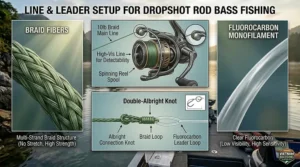
Start with your line choice. Most dropshot setups perform best with 6-10 lb fluorocarbon as your main line, since fluoro’s low stretch lets that sensitive tip actually transmit bites instead of absorbing them. If you’re fishing braid with a fluorocarbon leader instead, tie your leader connection with an FG knot or similar slim knot — bulky knots will catch in your guides constantly and kill your casting distance.
For your first 30 days with a new dropshot rod, resist the urge to set the hook hard. The entire point of a sensitive blank is that the rod itself, combined with a firm but controlled “reel set,” does most of the work. Hard hooksets on light hooks and light line are the single most common reason anglers snap off fish or rip hooks straight out of a bass’s mouth.
A quick maintenance habit that extends rod life: rinse your guides with fresh water after every saltwater or heavily silted trip, and periodically check your hook-keeper placement — many anglers find the factory position too far down the handle for comfortable one-handed rigging.
Real Anglers, Real Setups: Matching a Dropshot Rod to Your Fishing Style
Not every angler needs the same rod, so let’s break down a few real-world profiles.
If you’re a weekend angler fishing local ponds for largemouth holding around brush piles, you don’t need a $400 rod — the Dobyns Fury 703SF or Lew’s TP1X gives you plenty of sensitivity without overpaying for capabilities you won’t use in 8-foot water.
If you’re a tournament smallmouth angler chasing fish in clear, deep highland reservoirs, the equation flips. The G. Loomis NRX+ 822S or Shimano Expride earns its price tag because you’re detecting bites 20+ feet down where every ounce of sensitivity translates directly into more fish in the box — and at that level, a missed bite isn’t just frustrating, it’s a missed paycheck.
For the angler somewhere in the middle — fishing a mix of clear lakes and stained rivers, maybe a couple times a month — the St. Croix Mojo Bass Trigon or Daiwa Tatula Elite Drop Shot hits the sweet spot of real sensitivity without premium pricing, giving you room to grow into the technique without buyer’s remorse either way.
Solving the 5 Most Common Dropshot Rod Headaches
Problem: You can’t feel light bites in deep water. This usually isn’t your skill — it’s your gear. A rod with too soft a tip or a main line with too much stretch (standard monofilament) will mask bites that fluorocarbon and a stiffer-but-still-sensitive blank like the St. Croix Mojo Bass Trigon would let you feel clearly.
Problem: You keep breaking off fish on the hookset. This is almost always an overly hard hookset paired with light line. Switch to a controlled “reel set” — keep tension and start reeling instead of snapping the rod back.
Problem: Your line keeps twisting. Add a small barrel swivel a few feet above your dropshot weight, or check that your reel’s bail is fully engaging before each cast.
Problem: Your rod feels “noodly” when fighting bigger fish. You likely need more backbone in the butt section — rods like the G. Loomis NRX+ 822S solve this with their mag-light design specifically for this complaint.
Problem: You’re getting wind knots constantly. This is often a guide-spacing issue on cheaper rods. Upgrading to a rod with a funnel-style first guide, like the Lew’s TP1X, dramatically reduces this.
How to Choose a Dropshot Rod for Bass Fishing: 6 Criteria That Actually Matter
- Length — 6’8″ to 7’2″ covers most situations; shorter rods excel at boat-side vertical presentations, longer rods help with casting distance from shore.
- Power — Medium-light is the standard for finesse bass rod applications; go lighter only if you’re targeting smaller fish exclusively.
- Action — Fast or extra-fast action concentrates the bend near the tip, which is what gives you both sensitivity and a strong hookset.
- Guide material — Aluminum-oxide or SiC guides handle abrasive braid far better than basic stainless steel over time.
- Reel seat weight — Lighter carbon-based seats reduce fatigue on long days but typically raise the price.
- Line rating — Match the rod’s rated line weight to your actual fluorocarbon or braid setup; mismatches hurt both casting and hookset performance.
Dropshot Rod vs. Shaky Head Rod vs. Ned Rig Rod: What’s the Real Difference?
These three finesse techniques get lumped together constantly, but the ideal rod for each is subtly different, and understanding why will save you from buying the wrong tool.
| Technique | Ideal Power/Action | Why It Differs |
|---|---|---|
| Dropshot | ML / Fast-XFast | Needs tip sensitivity for vertical, near-stationary presentations |
| Shaky Head | M / Fast | Needs slightly more backbone for a stronger hookset on heavier jigheads |
| Ned Rig | L-ML / Fast | Needs an ultra-light tip since Ned rigs use tiny finesse jigs and minimal weight |
The practical takeaway: a true vertical presentation rod for dropshotting will feel “softer” in your hands than a shaky head rod, but that softness is intentional — it’s what lets the bait move naturally instead of getting dragged stiffly along the bottom. If you only buy one rod and fish all three techniques, lean toward the dropshot-rated rod; its sensitivity makes it the most forgiving crossover option.
Common Mistakes Anglers Make When Buying a Dropshot Rod
The biggest mistake is buying based on length alone without checking the power/action rating — a 7-foot medium-heavy rod and a 7-foot medium-light rod feel like completely different tools on the water, and only one of them is built for finesse.
❌ A second common mistake is assuming a more expensive rod automatically means more sensitivity. Component quality matters more than brand prestige alone; a well-built mid-tier rod like the Dobyns Fury can out-sense a poorly-matched expensive rod paired with the wrong line.
❌ Finally, anglers frequently overlook reel pairing. Even the best dropshot rod will feel sluggish paired with a heavy, poorly-balanced reel — match a light 2000-2500 size spinning reel for the best overall feel.
Features That Actually Matter (And the Marketing Hype You Can Skip)
What matters: blank construction quality, guide material, and tip sensitivity. These directly affect bite detection and casting performance every single trip.
What matters less than marketing suggests: exotic reel seat colors, cosmetic blank wraps, and oversized handle “comfort grips” that add weight without adding real ergonomic benefit on a technique where you’re holding the rod lightly anyway.
If you’re choosing between two similarly priced rods and one advertises a flashier paint job while the other emphasizes guide material and blank taper technology, prioritize the latter every time.
Dropshot Rods for Deep Water Finesse: What Changes Below 15 Feet
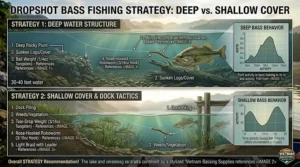
Deep water finesse fishing — typically anything below 15 feet — changes the math on rod selection. At depth, line stretch and water resistance both increase, which can mute bite detection even with a sensitive rod if your line choice or rod power doesn’t compensate.
This is exactly why rods like the G. Loomis NRX+ 822S exist with that mag-light butt section — you need enough backbone to fight water pressure and a deep-hooked fish’s initial surge, paired with a tip soft enough to still register a subtle “tick” through 20+ feet of fluorocarbon. If you’re fishing primarily shallow water under 10 feet, you genuinely don’t need this level of specialization; save your money and go with a standard medium-light dropshot rod instead.
Clear Water Bass Rod Strategy: Why Finesse Wins When Bass Get Smart
Clear, heavily-pressured water is where a dedicated finesse bass rod earns its keep most dramatically. Bass in gin-clear reservoirs get a close look at your bait before committing, and the dropshot rig’s entire design is built around presenting a free-floating, slow-twitching lure specifically to induce strikes from less aggressive fish that would never react to a fast-moving reaction bait.
In practice, this means downsizing everything when targeting clear water: lighter line (6-8 lb fluorocarbon), smaller profile baits, and a rod sensitive enough to detect the kind of soft, hesitant bite that clear-water bass are known for. The St. Croix Mojo Bass Trigon and Daiwa Tatula Elite both excel here thanks to their fast-action tips built specifically around this kind of subtle bite detection.
Long-Term Cost & Maintenance: What a Dropshot Rod Really Costs You Over 5 Years
A budget rod in the $50-$100 range will likely need replacing within 2-3 seasons of regular use, especially if guides wear down from braid — meaning your real 5-year cost could approach $150-$250 once you factor in a replacement.
A mid-tier rod like the St. Croix Mojo Bass Trigon or Dobyns Fury, backed by a real warranty, often lasts the full 5 years (or longer) with basic care, making the effective cost-per-year lower than it initially appears despite the higher upfront price.
Premium rods like the Shimano Expride or G. Loomis NRX+ rarely need replacement from wear alone within 5 years — the main “cost” becomes opportunity cost on your initial investment, which only makes sense if you’re fishing the technique frequently enough to justify it.
❓ FAQ: Dropshot Rod Bass Fishing Questions, Answered
❓ What is the best dropshot rod for bass fishing?
❓ How long should a dropshot rod be for bass?
❓ Can I use a dropshot rod for other finesse techniques?
❓ What line is best for a dropshot rod bass fishing setup?
❓ How much should I spend on a dropshot rod?
Conclusion: Picking Your Dropshot Rod Bass Fishing Setup for 2026
At the end of the day, the “best” dropshot rod bass fishing setup is the one that matches both your budget and how often you actually fish the technique. If you’re just getting started, the Lew’s TP1X or Dobyns Fury will teach you everything you need to know about finesse fishing without a painful financial commitment. If you’re already hooked on dropshotting and chasing tournament checks or trophy smallmouth in deep, clear water, the jump to the St. Croix Mojo Bass Trigon, Daiwa Tatula Elite, or G. Loomis NRX+ pays for itself in fish you’d otherwise miss.
Whichever rod you choose, remember that the rod is only half the equation — pairing it with the right line, the right reel size, and a properly controlled hookset will matter just as much as the price tag on the blank itself.
✨ Don’t Miss These Exclusive Deals!
🔍 Take your dropshot rod bass fishing setup to the next level with these carefully selected picks above. Click on any highlighted rod to check current pricing and availability. These tools will help you create the kind of finesse bites your fishing buddies will be asking about! 😊
Recommended for You
- Best Jerkbait Rod for Bass: 7 Picks That Actually Work (2026)
- Frog Fishing Rod Guide 2026: 7 Best Picks
- Casting Rod for Bass: 7 Best Picks Anglers Trust in 2026
Disclaimer: This article contains affiliate links. As an Amazon Associate, I earn from qualifying purchases. If you purchase products through these links, we may earn a small commission at no additional cost to you.
✨ Found this helpful? Share it with your friends! 💬🤗
