
In This Article
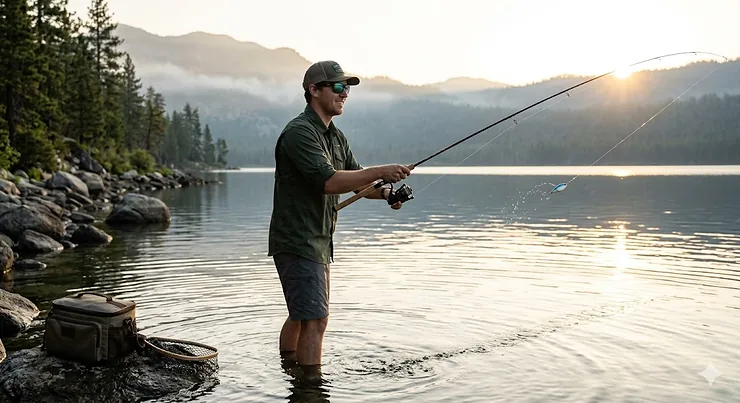
There’s a moment every bass angler knows. You flip a creature bait into a gnarly mat of hydrilla, something big inhales it, and you have roughly half a second to drive the hook home and keep that fish from wrapping you around a stump. In that half-second, your rod is everything. A heavy action bass rod isn’t just a preference — it’s a survival tool for the kind of fishing where hesitation costs you the fish of your life.
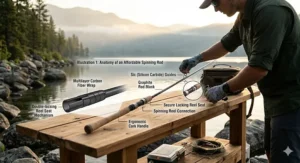
A heavy action bass rod is defined by its power rating (heavy or extra-heavy) and a fast or extra-fast action taper, meaning the blank bends in the top 20–30% of the rod while the butt section stays bone-stiff. That combination gives you two things that matter most in heavy cover: the backbone to punch through thick vegetation with a 1-oz weight, and the sensitivity to feel a 4-lb largemouth breathe on your bait before it even runs with it.
This guide covers seven real, currently available heavy action bass rods on Amazon — from budget-friendly workhorses under $80 to tournament-ready sticks north of $300. We’ll walk through who each rod is built for, what the specs actually mean on the water, and how to choose the right one for your style of fishing. Whether you’re throwing big baits in open water or punching heavy cover with braided line, there’s a rod on this list for you.
Quick Comparison: Top Heavy Action Bass Rods at a Glance
| Rod | Length | Power/Action | Line Weight | Best For | Price Range |
|---|---|---|---|---|---|
| Lew’s Speed Stick FSSC76HF | 7’6″ | Heavy/Fast | 15–65 lb | Flipping & pitching | Under $80 |
| Dobyns Fury FR 735C | 7’3″ | Mag-Heavy/Ex-Fast | 12–25 lb | Frogs, heavy cover | Around $80–$100 |
| KastKing Royale Legend Pro | 7’3″ | Heavy/Fast | 14–25 lb | Tournament versatility | $80–$130 |
| Ugly Stik Elite Casting Rod | 7′ | Heavy/Fast | 17–40 lb | Beginner to intermediate | Under $80 |
| Abu Garcia Veritas 2.0 Casting | 7’3″ | Heavy/Fast | 14–20 lb | Mid-range all-arounder | $100–$150 |
| Fitzgerald Titan HD 7’8″ | 7’8″ | Heavy/Mod-Fast | 17–65 lb | Punching & pitching mats | $150–$200 |
| St. Croix Legend Tournament Bass | 7’3″ | Heavy/X-Fast | 14–65 lb | Elite finesse-power fishing | $280–$330 |
The table tells a story worth unpacking: price doesn’t always equal performance for every angler. The Lew’s Speed Stick and Dobyns Fury both punch well above their price tags for anglers focused primarily on flipping and frogging. However, if tournament-level sensitivity and cutting-edge blank technology matter to you, the St. Croix Legend Tournament Bass is in a class of its own. Budget buyers get solid value anywhere under $100; upgrade the moment your fishing demands more.
💬 Just one click — help others make better buying decisions too! 😊
Top 7 Heavy Action Bass Rods: Expert Analysis
1. Lew’s Speed Stick Casting Rod FSSC76HF — Best Budget Flipping Stick
The Lew’s Speed Stick is the rod that quietly outperforms its price tag every single time. At 7’6″ with a heavy power/fast action rating, it’s purpose-built for flipping and pitching — and Lew’s didn’t cut corners to get it there.
The IM8 graphite blank with Carbon Nano Tube (CNT) construction is the headline feature, and here’s what that means for you: CNT technology strengthens the blank at a molecular level, so you get a rod that’s stiffer and more sensitive than standard IM8 without adding weight. The Fuji Concept O guides with deep-pressed aluminum oxide inserts reduce friction so dramatically that even thick braided line — 50 or 65 lb braid for punching — shoots through clean. Line weight ratings of 15–65 lb and lure weights from 3/8 to 2 oz mean you can fish a 3/4-oz jig or a 1.5-oz punching weight on the same rod without compromise. The full-length cork grip with Duracork inlays is a genuine comfort upgrade over cheap EVA foam, especially after four hours of flipping.
What most buyers overlook about this rod is that 7’6″ length. Longer than the average 7’3″ bass rod, it gives you added reach when pitching to spots under dock overhangs or back in thick reeds. You can put your bait somewhere a shorter rod simply can’t.
Anglers consistently mention how well-balanced the rod feels paired with a baitcaster — not tip-heavy, which is a real achievement at this length and price point.
✅ Excellent sensitivity for the price
✅ True 65-lb braid compatibility — rare under $100
✅ 7’6″ length adds reach for precise pitching
❌ Cork grip may show wear faster than premium options
❌Blank finish is functional, not flashy
Price range: under $80 — outstanding value for dedicated flipping rods.
2. Dobyns Fury FR 735C — Best Mag-Heavy Powerhouse Under $100
If you’ve spent any time in bass fishing communities online, you’ve seen the Dobyns Fury FR 735C mentioned in nearly every “best rod under $100″ conversation. The buzz is real. This 7’3” mag-heavy, extra-fast action rod punches so far above its price class that even experienced anglers do a double-take.
Mag-heavy is Dobyns’ proprietary power rating — it sits between heavy and extra-heavy, giving you more raw power than a standard heavy rod without crossing into the brutal stiffness of an XH blank. Combined with an extra-fast taper, the tip is ultra-sensitive to subtle bites while the mid and butt sections are built to bully fish out of matted grass. High-modulus graphite blank, Fuji reel seat, Kevlar guide wrapping, and AA-grade cork grip — those are components you’d expect on a $200 rod. Line rating of 12–25 lb mono/fluoro (or 40–65 lb braid equivalents), lure weights from 1/4 to 1.5 oz, covers everything from frog fishing to heavy jig pitching.
The FR 735C works particularly well for anglers who prefer a slightly shorter rod than the 7’6″ options. Easier to manage in a kayak or tight shoreline vegetation, still long enough to load up a cast. Buyers report using it confidently for frogging, flipping, pitching creature baits, and punching — four techniques that usually demand dedicated rods.
The one downside experienced buyers flag: the guides can loosen from their resin seats after extended hard use. A tiny drop of rod tip cement during your first week of fishing solves this permanently.
✅ Mag-heavy power is genuinely different — not just marketing
✅ Tournament-level components at budget prices
✅ Incredibly versatile across heavy-cover techniques
❌ Guide wrapping needs a quick check and reinforcement out of the box
❌ Limited model selection compared to larger series
Price range: around $80–$100 — one of the best dollar-per-performance rods on Amazon.
3. KastKing Royale Legend Pro Bass Fishing Rod — Best Tournament-Ready Mid-Range
KastKing has spent years building a reputation for premium features at prices that make high-end rod builders nervous. The Royale Legend Pro is their most refined attempt yet — and it lands squarely in the sweet spot between “budget” and “boutique.”
The blank is KastFlex IM7 graphite, which delivers sensitivity that rivals 30-ton blanks from more expensive competitors. The crucial spec here is the Fuji FazLite guide system — these aren’t cheap knockoffs. FazLite guides are 45% lighter than standard Fuji K guides, and every gram of weight reduction on the guides translates directly into better blank vibration transmission. In other words, you feel more. The SlipLock split-grip handle uses a patented locking system that eliminates the handle rattle that plagues many rods in this price bracket. The 7’3″ heavy/fast configuration is ideal for a broad range of power fishing techniques: flipping, pitching, punching, heavy swimbaits, and bulky topwater lures.
This rod is the right choice for the angler who’s serious but not yet ready to drop $300 on a St. Croix. It fishes confidently enough for weekend tournament use, and the PTS (Power Transition System) integrated into the blank construction gives it a progressive feel on big fish that prevents the rod from feeling like a broom handle.
Anglers love the sensitivity on light bites and the confidence it inspires when driving the hook home on a quality fish in heavy cover.
✅ Fuji FazLite guides — genuinely premium, not budget substitutes
✅ SlipLock handle eliminates annoying rattle
✅ Tournament-capable at a non-tournament price
❌ Tip feels slightly stiffer than advertised “fast” action suggests
❌ Color scheme isn’t for everyone (personal preference)
Price range: $80–$130 — a legitimate step up from entry-level without the sticker shock.
👉 Check current price and availability on Amazon
4. Ugly Stik Elite Casting Fishing Rod — Best for Beginners Fishing Heavy Cover
The Ugly Stik name has been synonymous with “nearly impossible to break” for forty years. The Elite Casting Rod takes that legendary toughness and upgrades it with 35% more graphite than the GX2 series, which used to be the toughness benchmark.
The result is a rod that’s genuinely lighter and more sensitive than traditional Ugly Stik designs without losing the indestructible reputation. The Ugly Tech construction — a blend of graphite and fiberglass — gives the blank an inherent shock absorption quality that pure graphite blanks lack. That matters for beginners who may occasionally drive a hook into a dock post or bounce the rod off the gunwale. The Clear Tip design (a small section of fiberglass at the tip) prevents tip breakage, which is how most bass rods die. Ugly Tuff PVD-coated stainless-steel one-piece guides are genuinely excellent — harder than aluminum oxide, frictionless with braid, and impervious to corrosion in saltwater or acidic tannic water.
Available in 7′ heavy/fast, this is the rod we’d hand to someone fishing heavy cover for the first time who doesn’t yet have muscle memory for hook-setting on braided line. The slightly forgiving tip compared to pure graphite rods means fewer pulled hooks on reaction strikes — a real advantage when you’re still developing feel.
Line weight rating of 17–40 lb keeps you honest — this is built for real heavy cover applications, not finesse work dressed up as power fishing.
✅ Durability is genuinely exceptional — bent guides can be straightened, tips rarely break
✅ Clear Tip design eliminates the #1 cause of rod death
✅ Accessible learning curve for new heavy-cover anglers
❌ Heavier blank than pure graphite competitors
❌ Sensitivity ceiling is lower than carbon-fiber options
Price range: under $80 — the most forgiving heavy action bass rod money can buy.
5. Abu Garcia Veritas 2.0 Casting Rod — Best Mid-Range All-Arounder
Abu Garcia has been building fishing equipment since 1921. The Veritas 2.0 represents over a century of refinement distilled into a mid-range rod that competes aggressively with rods $50–$100 more expensive.
The signature feature is Spiral Core Construction with 30-ton graphite blanks. Here’s the science in plain English: standard graphite blanks layer carbon fiber in one direction. Spiral Core weaves multiple layers at opposing angles, like braided rope. Abu Garcia claims this improves overall break strength by 22% and tip strength by over 30% compared to their previous Veritas generation. In heavy-cover fishing, that means you can horse a 5-lb bass through thick hydrilla without the white-knuckle feeling that cheaper blanks give you. The titanium alloy guides with SiC (silicon carbide) inserts handle every line type — mono, fluoro, braid — without heat buildup during long cast sessions. The ergonomic reel seat with micro-click hood provides a rock-solid reel connection that doesn’t creak or loosen over time.
The Veritas 2.0 heavy/fast in 7’3″ is the rod that experienced anglers recommend when a friend asks “what should I upgrade to from my entry-level rod?” It’s not just sensitivity — it’s balance. The rod feels right from the first cast, which is harder to achieve than most manufacturers admit.
✅ Spiral Core Construction — real structural improvement, not marketing spin
✅ Balance and weight feel premium at a mid-range price
✅ SiC guides compatible with all line types including heavy braid
❌ Less technique-specific than rods designed purely for heavy cover
❌ Handle feels slightly short for some larger-handed anglers
Price range: $100–$150 — the gold standard upgrade path from budget rods.
6. Fitzgerald Fishing Titan HD Series 7’8″ Flipping Rod — Best for Punching Mats
Fitzgerald Fishing is a proudly American-owned company, and the Titan HD Series is their tournament-proven answer to the demands of punching and pitching. Available in 7’6″, 7’8″, and 7’10” configurations with heavy and extra-heavy options, this series gives you more length choices than most competitors.
The 7’8″ heavy is the standout for punching heavy vegetation. Length matters more in punching than almost any other bass technique — extra inches translate directly into better pendulum momentum for punching weights through thick matted grass. The blank uses Fitzgerald’s proprietary high-modulus graphite formula, and the guide system features American Tackle Titanium frames with Nanolite HD rings. Titanium guides are 64% lighter than stainless steel, and that weight reduction high on the blank dramatically shifts the rod’s balance point toward your hand. After four hours of continuous flipping, your wrist notices. The extra-heavy models (7’6″ XH and 7’10” XH) accommodate punching weights up to 2 oz — necessary for punching through thick, layered mats that reject anything lighter.
This rod is built for the angler who has a dedicated heavy-cover setup on the front deck of a tournament boat. It’s not a “catch-everything” rod. It’s a weapon for one specific, demanding application, and it’s exceptional at it.
Buyer feedback consistently highlights the sensitivity — unusual for a rod this stiff — and the confidence it inspires when driving the hook through thick cover into the jaw of a fish.
✅ Titanium guides — the lightest, strongest guide material available
✅ Multiple length options (7’6″ to 7’10”) for precise technique matching
✅ XH models handle punching weights up to 2 oz
❌ Not versatile — purpose-built for heavy cover scenarios only
❌ Requires commitment to specific fishing style to justify the price
Price range: $150–$200 — exceptional value for a purpose-specific tournament punching rod.
7. St. Croix Legend Tournament Bass Casting Rod LBTC73HXF — Best Premium Choice
If any rod deserves the word “legendary,” it’s the St. Croix Legend Tournament Bass series. Designed and handcrafted in Park Falls, Wisconsin — yes, USA-made — the LBTC73HXF (7’3″ Heavy, Extra-Fast) represents the current pinnacle of what a production bass rod can be.
The blank material is SCIV+ Carbon Fiber — a strategic lay-up of St. Croix’s proprietary SCIV and SCVI carbon grades, creating a hybrid that delivers stiffness-to-weight ratios that pure single-grade blanks can’t match. Three technologies work together here: Advanced Reinforcing Technology (ART) adds exotic carbon fiber for dramatically greater strength with virtually no increase in blank diameter. Fortified Resin System (FRS) improves impact resistance. Integrated Poly Curve (IPC) tooling eliminates all transitional points in the blank, creating truly smooth, uninterrupted power transfer from tip to butt. The Fuji PTS reel seat with blank-touch design means your hand literally feels the blank vibration — nothing between your fingers and the graphite but a thin reel seat housing.
The 7’3″ heavy/extra-fast is rated for 14–65 lb line and lures from 3/8 to 1.5 oz, covering every heavy-cover technique imaginable. And the 15-year transferable warranty backed by St. Croix’s Superstar Service program is the best in the industry. Period.
This rod is for the angler who has fished long enough to know that the gap between “good” and “exceptional” is real, and who is willing to invest in a rod that will outlast six or seven budget replacements.
✅ SCIV+ blank technology — industry-leading sensitivity-to-weight ratio
✅ USA-made craftsmanship with 15-year transferable warranty
✅ Fuji PTS blank-touch reel seat for maximum feel transmission
❌ Price point is a genuine commitment — this is a long-term investment rod
❌ SCIV+ blanks are stiff enough that over-powering fish can feel harsh for beginners
Price range: $280–$330 — the rod you buy once and fish for a decade.
✨ Don’t Miss These Exclusive Deals!
🔍 Take your heavy cover bass fishing to the next level with these carefully selected rods. Click any highlighted product name to check current pricing and availability on Amazon — these tools will put more fish in the boat.
How to Set Up and Fish a Heavy Action Bass Rod: A Practical Guide
You bought the rod. Now what? Most anglers underestimate how different a true heavy action bass rod fishes compared to the medium-heavy all-arounders they’ve been using. Here’s how to get dialed in fast.
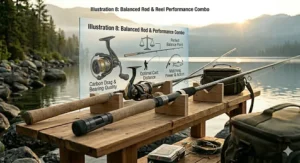
Pair it with the right reel and line. A heavy rod demands a reel with serious drag capacity and a gear ratio matched to your technique. Flipping and pitching calls for a 7.1:1–8.1:1 ratio for fast line pick-up on hook sets. Load it with 50–65 lb braided line for punching — mono stretches too much for the explosive hook sets that heavy cover demands. For frogging and topwater, 50 lb braid is the minimum; the abrasion from lily pad stems will destroy anything lighter within a single session.
Learn the pendulum flip. Flipping isn’t casting — it’s a controlled pendulum motion where you strip line from the reel, swing the bait forward, and use the rod’s weight to generate momentum. A heavy rod makes this easier, not harder. The stiff blank transfers energy efficiently; you’ll need far less effort than you expect to drop a bait accurately 15–20 feet away in tight quarters.
Set the hook like you mean it. The number one mistake new heavy-cover anglers make is a soft hook set. Braided line has near-zero stretch; the hookset energy goes directly to the fish with nothing absorbed. But you’re also punching through grass or pulling a fish’s mouth up through matted vegetation. Drive the rod straight up and to the side simultaneously — a two-motion hookset that both penetrates the hook and starts moving the fish laterally away from cover.
Maintain your guides. After fishing in saltwater, brackish, or acidic tannic water (common in Southern cypress swamps), rinse your rod with fresh water, paying special attention to the guide inserts. Even titanium frames and SiC rings benefit from a light wipe-down with rod and reel oil every few trips.
Common first-month mistakes to avoid: Don’t try to cast heavy-cover techniques like a crankbait — the stiff tip makes that miserable. Don’t use a gear ratio below 6.3:1 — you’ll miss fish by the time your reel catches up. And don’t skip the knot upgrade: on 65 lb braid with a heavy rod, a basic clinch knot is the weakest link in your system. Use a Palomar or Uni knot and cut it short.
Matching the Rod to the Angler: Real-World Scenarios
The best heavy action bass rod is always the one that matches your fishing situation — not the most expensive one on the shelf. Here’s a quick profile guide.
The weekend warrior fishing pressured lakes. You’re on the water 20–30 days a year, mostly targeting bass in submerged vegetation, dock pilings, and shallow laydowns. Budget is real. The Lew’s Speed Stick FSSC76HF or Dobyns Fury FR 735C are your rods. Both handle 50–65 lb braid, both have legitimate sensitivity for their price, and both will hold up for years of weekend use without babying.
The serious tournament angler. You’re pre-fishing twice a week, running a 20-foot tournament boat, and your front deck has four or five rods rigged up at any given time. The Fitzgerald Titan HD and St. Croix Legend Tournament Bass belong on that deck. The Fitzgerald earns its keep as a dedicated punching rod; the St. Croix is the “do everything heavy” stick when you need one rod to cover multiple presentations. For the angler in between — tournament-curious but not yet dropping four figures on gear — the KastKing Royale Legend Pro delivers tournament-credible performance at a fraction of the cost.
The beginner transitioning from medium-heavy rods. If you’ve been fishing a 7’3″ medium-heavy for everything and you’re ready to step into heavy cover for the first time, the Ugly Stik Elite Casting Rod is the ideal transition. Its graphite/fiberglass construction forgives mistakes (pulled hooks, missed hook sets, an occasional rod hit against the boat) while still providing enough backbone to teach you what heavy-cover fishing actually requires.
The big-bait specialist. Swimbaits and glide baits over 3 oz need a rod rated for the task — something like the Fitzgerald Titan HD in X-Heavy, or the St. Croix Legend Tournament in the specific swimbait model. The Abu Garcia Veritas 2.0 in heavy/fast handles swimbaits up to 2 oz beautifully if you’re not yet throwing true giant baits.
How to Choose a Heavy Action Bass Rod: 6 Key Criteria
Buying the wrong heavy action rod doesn’t just waste money — it actively hurts your fishing. Here are the six factors that actually matter, stripped of marketing language.
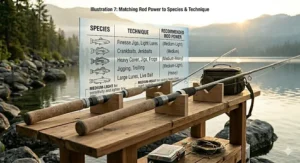
1. True power rating vs. advertised power rating. “Heavy” means different things to different manufacturers. Compare line weight ratings rather than trusting power labels alone. A rod rated for 15–65 lb is genuinely heavy; a rod rated for 10–20 lb that calls itself “heavy” is closer to medium-heavy in practice.
2. Blank material and modulus. Higher-modulus graphite (30-ton and above) is stiffer and lighter, but more brittle. IM7 and IM8 graphite balance sensitivity and durability at mid-range prices. Fiberglass blends add durability but weight. Match blank material to your fishing environment: if you’re grinding through rock piles and dock posts, a slightly tougher blank beats a fragile high-modulus option.
3. Guide quality and compatibility. Braided line is abrasive. Cheap aluminum guides with braid will groove and fray your line within a season. Look for SiC, Zirconium, or titanium inserts at minimum. Fuji and American Tackle titanium guides are the benchmarks.
4. Rod length and your technique. 7’3″ is the versatile workhorse for most heavy-cover techniques. 7’6″–7’10” adds reach for punching mats and pitching to specific spots with precise entry angles. Shorter than 7′ in heavy action sacrifices leverage that heavy-cover hook sets require.
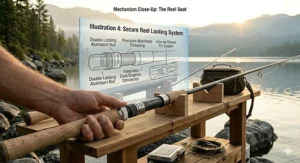
5. Reel seat design. Exposed-blank or blank-touch reel seats (like the St. Croix Fuji PTS) transmit dramatically more vibration than conventional graphite reel seats. If sensitivity in heavy cover is a priority, reel seat design matters as much as blank material.
6. Warranty and repairability. Bass rods get abused. A 15-year warranty like St. Croix’s is genuinely valuable. A one-year warranty on a budget rod means a broken rod might become a replacement rod sooner than you’d like. Factor that into total cost of ownership.
Heavy Action vs. Medium-Heavy: What Nobody Tells You
The most common question beginners ask is whether they actually need a heavy action rod or if their medium-heavy will do the job. The honest answer: it depends entirely on where you fish.
A medium-heavy rod (typically rated for 10–17 lb line, 3/16–5/8 oz lures) is a genuinely excellent all-around bass rod. For fishing crankbaits, jerkbaits, spinning Carolina rigs, and lighter jigs in open water or light cover, a medium-heavy is better than a heavy — the softer tip keeps treble hooks pinned on fish better than the stiff tip of a heavy rod.
But the moment you start fishing heavy cover seriously — punching grass mats, flipping in laydowns, throwing 3/4-oz or heavier jigs into vegetation — a medium-heavy becomes a liability. The stiffer butt section of a heavy rod is what drives a hook through 12 inches of matted grass and into a fish’s jaw. A medium-heavy rod simply compresses under that load instead of transferring energy.
According to fisheries research data from The American Fisheries Society, largemouth bass in heavily fished lakes increasingly retreat to dense aquatic vegetation as pressure intensifies. If you fish lakes receiving significant angling pressure, heavy-cover fishing isn’t just a technique — it’s an access strategy to fish that other anglers simply cannot reach with lighter gear.
| Scenario | Best Choice | Why |
|---|---|---|
| Crankbaits / jerkbaits | Medium-Heavy | Treble hook pinning, rod load |
| Flipping / pitching jigs | Heavy | Hookset power through cover |
| Punching grass mats | Heavy/X-Heavy | Weight and hook penetration |
| Frogging open mats | Heavy | Fast hookset, line management |
| Carolina rigs open water | Medium-Heavy | Sensitivity and subtle action |
The analysis here is clear: for anglers who spend meaningful time in heavy cover, a dedicated heavy action bass rod isn’t a luxury — it’s the tool that separates fish landed from fish lost.
Common Mistakes When Buying a Heavy Action Bass Rod
After years of watching anglers leave money on the table (and fish in the water), certain buying mistakes keep appearing.
Buying a heavy rod for techniques that don’t need it. A heavy rod with a crankbait feels like dragging the lure with a broomstick. If your lake is mostly open water and light structure, a heavy action rod will actively hurt your productivity. Match the tool to the environment.
Ignoring the line-to-rod match. A heavy rod rated for 15–65 lb braid is useless with 12 lb fluorocarbon — the mismatch creates an unbalanced system where the rod is too stiff for the line’s tensile strength. Match your line weight to the rod’s rated range.
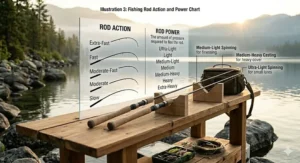
Confusing “heavy” action with “heavy” power. Action describes where the rod bends (fast, moderate, slow). Power describes how much force it takes to bend (light, medium, heavy). A heavy-power fast-action rod and a heavy-power moderate-action rod fish completely differently. For flipping and punching, you want heavy power and fast action. Don’t mix these terms up when reading specs.
Underestimating handle length for flipping. Full-length cork grips or extended rear grips matter for flipping. The extra rear grip gives your non-dominant hand a purchase point for two-handed hook sets — critical when a 4-lb bass is trying to bury itself in a laydown.
Buying premium without purpose. A $300 rod is worth the investment if you’re fishing 80+ days a year in competition or high-pressure conditions. It’s questionable value if you’re on the water six weekends a summer. Spend where your fishing frequency justifies it.
Long-Term Cost and Maintenance: What Heavy Cover Fishing Really Costs
Let’s talk money beyond the purchase price — because heavy-cover fishing is genuinely hard on equipment.
A $65 budget rod that lasts two seasons costs roughly the same per year as a $200 rod that lasts ten seasons. The math almost always favors buying better the first time, but “better” doesn’t always mean “most expensive.” Understanding where quality investment pays off versus where it’s wasted is how experienced anglers build their rod arsenal efficiently.
Guide replacement. Even quality SiC guides crack from hard use. Most rod builders charge $15–$30 per guide to replace them, and a full re-guide job on a 7-guide heavy rod runs $80–$120. This is why Fuji guide quality matters at purchase — cheap guides need replacement faster.
Cork grip maintenance. Cork grips deteriorate with fish slime, sunscreen, and bug spray exposure. Clean them monthly with mild soap and water. A light coat of linseed oil annually keeps cork supple. Neglected cork grips become brittle and crack within two seasons.
Blank inspection. After any hard hook-set on a snag or after the rod takes a hard knock, run your fingers slowly along the entire blank and hold it up to light looking for micro-fractures. A cracked blank under load can fail catastrophically. Catching it early is literally a matter of personal safety.
Storage. Vertical rod storage (tip up) in a rod locker or ceiling-mount rack prevents the permanent set that horizontal storage causes in graphite blanks over time. Rod socks prevent the micro-scratches that, over years, weaken blank integrity.
The St. Croix 15-year transferable warranty mentioned earlier makes their pricing look different when you run the numbers: at $300 amortized over 15 years, it’s $20 per year for a rod that will outperform anything in its price class for its entire useful life. That’s perspective worth having before dismissing the premium options.
For more information on bass habitat and conservation that affects where you’ll be using that heavy action rod, the U.S. Fish & Wildlife Service and Bass Anglers Sportsman Society (B.A.S.S.) offer excellent resources on responsible fishing practices.
✨ Don’t Miss These Exclusive Deals!
🔍 Ready to upgrade your heavy-cover arsenal? Click any highlighted rod above to check current Amazon pricing. Stock on these models moves fast — especially the Dobyns Fury and the Fitzgerald Titan HD series.
FAQ: Heavy Action Bass Rods
❓ What is a heavy action bass rod best used for?
❓ What pound test line should I use on a heavy action bass rod?
❓ Is a heavy action rod good for beginners?
❓ What's the difference between heavy and extra-heavy bass rods?
❓ Can I use a heavy action flipping stick for big bait fishing?
Conclusion: The Right Heavy Action Bass Rod Changes Everything
Every season, anglers leave tournaments and good fishing trips shaking their heads over fish they lost in heavy cover — fish that bent them off on thick grass, stripped line around stumps, or simply bulldogged deep in a mat while an inadequate rod buckled. The right heavy action bass rod doesn’t guarantee you land every fish. But it shifts the odds dramatically in your favor.
Start where your budget makes sense. The Lew’s Speed Stick and Dobyns Fury FR 735C are genuinely exceptional values that will outperform their price tags for years. When you’re ready to step up, the Abu Garcia Veritas 2.0 represents a meaningful upgrade in sensitivity and construction quality. And when you want the absolute best production bass rod available on Amazon, the St. Croix Legend Tournament Bass is where the conversation ends.
Match the rod to your fishing. Pair it with quality line, a quality reel, and a few seasons of deliberate practice in heavy cover. The fish are in there — they’ve always been in there. You just need the right tool to go get them.
✨ Found this guide helpful? Share it with your fishing crew and help them make smarter gear decisions! 💬🤗
Recommended for You
- Best Spinning Rod Under $100: 7 Smart Picks for 2026
- 7 Best Graphite Spinning Rods in 2026
- 7 Best Two Piece Spinning Rods in 2026
Disclaimer: This article contains affiliate links. As an Amazon Associate, I earn from qualifying purchases. If you purchase products through these links, we may earn a small commission at no additional cost to you.
✨ Found this helpful? Share it with your friends! 💬🤗
